Positive Psychology Coaching: Methods, Evidence, Questions
Positive psychology coaching is coaching that applies research on well-being, strengths and flourishing to help clients grow, rather than starting from what is wrong with them. A coach using it works with what the client does well, what gives them energy and meaning, and which small, tested exercises (gratitude, strengths use, savoring) might help. The evidence for those exercises is real but smaller than the popular books suggest, and an honest coach says so.
This guide covers where positive psychology coaching came from, the PERMA framework many coaches use, what the meta-analyses actually found, a session you can run with a sample dialogue and 12 questions, who it suits, where "positive" goes wrong, and the training routes. If you coach on Coachful, our team will build the check-ins, worksheets and program in this guide in your account for free.
Where positive psychology coaching came from
Positive psychology began as a deliberate correction. Martin Seligman made it the theme of his 1998 term as president of the American Psychological Association, and in 2000 he and Mihaly Csikszentmihalyi introduced a special issue of the American Psychologist arguing that the field's "exclusive focus on pathology" had left out "the positive features that make life worth living" (Seligman and Csikszentmihalyi, 2000).
Coaching picked the ideas up quickly, because coaches already worked with functioning people who wanted more from life. Robert Biswas-Diener and Ben Dean wrote Positive Psychology Coaching (2007), and Biswas-Diener followed with Practicing Positive Psychology Coaching (2010). Seligman's Flourish (2011) introduced PERMA, the five-part model of well-being that many coaches now use as a map. In parallel, Christopher Peterson and Seligman's classification of 24 character strengths (2004) gave coaches a shared vocabulary for strengths, which we cover in our guide to VIA character strengths coaching.
The core ideas: PERMA and strengths
PERMA names five building blocks of well-being. Coaches use it as a quick scan to find where a client's life feels thin, then pick one block to work on.
| PERMA element | What it means | A coaching question | A small exercise |
|---|---|---|---|
| Positive emotion | Joy, gratitude, interest, calm | "What gave you even a minute of real enjoyment this week?" | Write down three things that went well each evening |
| Engagement | Absorption, losing track of time | "When did you last forget to check the clock?" | Schedule one hour of the absorbing task, protected |
| Relationships | Connection and support | "Who do you leave feeling better after you see them?" | One deliberate conversation a week |
| Meaning | Belonging to something beyond yourself | "What part of your work would you defend to a skeptic?" | Connect one weekly task to the reason it matters |
| Accomplishment | Progress and mastery | "What did you finish recently that you're proud of?" | A visible tracker for one goal |
Three other ideas run through the approach: strengths (using what is already good about a person in new ways), savoring (stretching good moments rather than rushing past them), and broadening (the observation that positive emotions tend to widen the options a person can see). None of them asks the client to ignore problems. They change the starting point.

What the research supports, and what it doesn't
Here is the evidence, read in order of how much weight it can bear.
- The early experiments. In a six-group, placebo-controlled online study, Seligman and colleagues (2005) tested five happiness exercises against a control and found that three of them lastingly increased happiness and reduced depressive symptoms. This study made positive psychology interventions famous.
- The first big meta-analysis. Bolier and colleagues (2013) pooled 39 randomized studies with 6,139 participants. Effects were small: 0.34 for subjective well-being, 0.20 for psychological well-being and 0.23 for depression, with signs of publication bias and wide variation in study quality.
- The correction. White, Uttl and Holder (2019) reanalyzed the earlier meta-analyses, accounting for the many small studies. Effects on well-being stayed significant but shrank to about r = .10, and effects on depression were variable and generally not significant.
- Coaching studies. In a randomized trial, a 10-week cognitive-behavioral, solution-focused life coaching group raised goal striving, well-being and hope compared with a waitlist (Green, Oades and Grant, 2006, 56 adults). A 2021 meta-analysis by Wang, Lai, Xu and McDowall of 20 studies of cognitive-behavioral and positive psychology coaching found large effects on goal attainment (g = 1.29) and moderate effects on self-efficacy (g = 0.59), no significant difference between the popular approaches, and better outcomes for integrative coaching that combined them (g = 0.71).
What this means for your practice: positive psychology exercises help a little on average, some people a lot and some not at all. They are not a treatment for depression. Combining them with goal work and problem-solving, as most good coaches already do, looks better than using them alone.
How to run a positive psychology coaching session
- Agree the outcome. What does the client want from today, and from the engagement?
- Do a quick PERMA scan. Ask the client to rate each element from 0 to 10, or use a Wheel of Life with PERMA labels.
- Look at the high scores first. Ask what is working in the strongest area and why. This is evidence, not flattery.
- Choose one area to grow. Let the client pick, even if it isn't the lowest score.
- Find a strength to bring to it. "Which of the things that work over there could help here?"
- Design one small experiment. Specific, short, two weeks at most, with an observable result.
- Plan for the hard days. Ask what will get in the way and what the client will do then.
- Close with savoring. Ask what was most useful today and let them say it slowly.
A short sample dialogue
Ahmed is a hospital manager who says he is "fine, just flat". Illustrative, not a transcript.
Coach: If you rate each of those five areas from 0 to 10, where are you?
Ahmed: Relationships an eight. Accomplishment seven. Engagement three. Meaning maybe four.
Coach: Before we go to the threes, what makes relationships an eight?
Ahmed: My team, honestly. I like teaching new staff.
Coach: When you're teaching them, how is your engagement?
Ahmed: Oh, high. I lose an hour without noticing. But I've stopped doing it. No time.
Coach: What would one teaching hour a week look like, starting next week?
Ahmed: Thursday afternoons. A short session on rostering for the two new coordinators.
Coach: And what will you notice afterwards that tells you it worked?
Ahmed: I'll leave on time and not dread Friday.
The coach did not argue with "flat". The high score led to the low scores, and the experiment uses a strength Ahmed already has.
12 positive psychology coaching questions
- What's going well right now, even if it's small?
- When did you last lose track of time in a good way?
- What were you doing at your best this month?
- What would the people closest to you say you're good at?
- Which of your strengths are you using least at the moment?
- What gives your work meaning on a hard day?
- Who leaves you with more energy than you started with?
- What are you proud of finishing recently?
- What would "a little better" look like by next week?
- What's one moment from this week worth slowing down to enjoy?
- What gets in the way of the things that help you?
- What was most useful about today?
Our strengths-based coaching questions go deeper on the strengths part, and appreciative inquiry coaching applies the same starting point to whole teams.

Who it suits, and who it doesn't
It suits clients who are functioning but flat or stuck; leaders who are fluent in their failings and vague about their strengths; people rebuilding after a hard period who are now ready to look forward; and teams that need a better starting point than a list of problems.
It suits less well people in grief or crisis, for whom "what's going well?" can feel dismissive; clients with depression or anxiety who need a clinician; and anyone facing a real injustice that needs addressing rather than reframing.
Where "positive" goes wrong
- Toxic positivity. Telling a client to focus on the good when something is genuinely wrong teaches them to hide things from you. Acknowledge the difficulty first.
- Overselling the science. "Gratitude rewires your brain" is not what the meta-analyses found. "Small exercises like this help some people a bit, so let's test it for you" is.
- Prescribing instead of coaching. A gratitude journal assigned to everyone is a worksheet, not coaching. Let the client choose and design the experiment.
- Missing a clinical picture. Persistent low mood, sleep problems or hopelessness mean a referral. Our guide to trauma informed coaching covers how to raise it.
Positive psychology coaching training routes
We checked these on the programs' own sites in October 2026:
- University of Pennsylvania, Master of Applied Positive Psychology (MAPP). The program says it was the first degree of its kind. It runs full time for one year over three semesters (nine course units) in a hybrid, low-residency format, with Seligman among the faculty.
- VIA Institute on Character with MentorCoach, Character Strengths Interventions. An on-demand course of eight one-hour sessions for coaches, listed at $498, taught by VIA's education director Ryan Niemiec.
Neither is a coaching credential. For that, look at ICF-accredited coach training and the ICF credentials, and log your hours as you go; our guide to ICF coaching hours explains what counts.
How to run positive psychology coaching inside Coachful
Positive psychology works through small, repeated actions, which is exactly what is hard to track by email. This is how coaches set it up in Coachful, all included in your membership.
A PERMA check-in
Build a form with five slider questions, one per PERMA element, and attach it to your first session as prep, then repeat it monthly. You'll see change over time instead of relying on memory. The Wheel of Life tool on our site and the wheel template in Tools > Explore can be relabeled for PERMA.
Ready-made exercises
Tools > Explore includes editable templates such as Gratitude practice, Strengths in action, Strengths and energy match and Purpose exploration. Edit the wording, then assign them or add them to a program week.
Experiments as habits
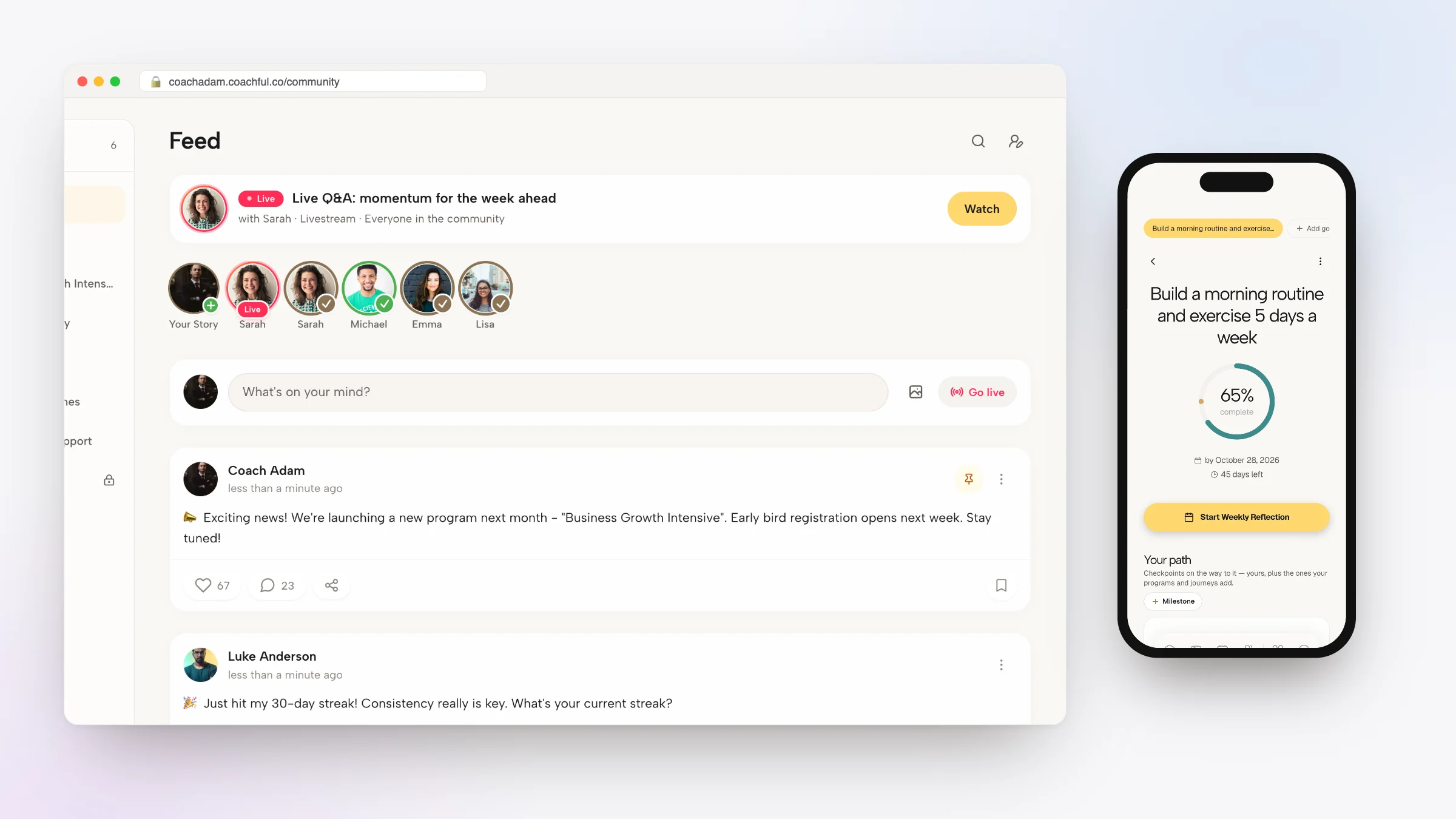
Turn the agreed experiment into a habit with a reminder (for example "Three good things" every evening at 9:00). The client ticks it off, sees a progress ring and can view their progress over the month.
Goals and the bigger picture
Save the experiment's purpose as a goal with milestones, and use a journey to lay out the arc of the engagement. A step such as "Create your 90-day vision" can open the client's vision board directly.

A wins channel for groups
In group programs, a community space for wins and milestones gives members somewhere to share what went well, which is the positive-emotion exercise done socially.

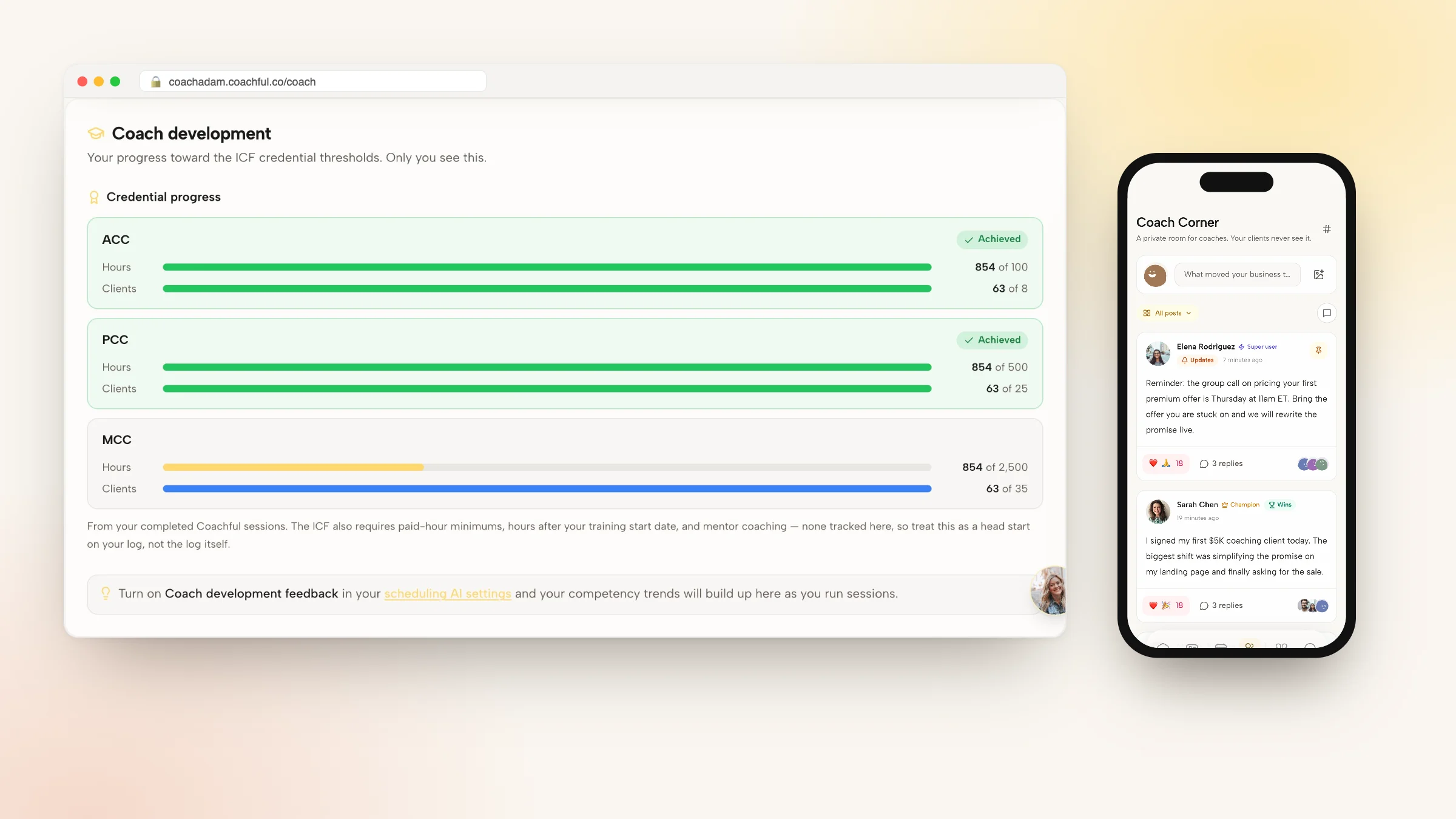
Watching for the clients who aren't flourishing
The Clients overview shows average mood, reflections and a Check in on list. When a client keeps reporting low or stuck, that's a signal to talk, and sometimes to refer.

Have our team build your positive psychology program
Coachful's white-glove service is free on every plan. From Create > We'll build it for you, ask the team for a PERMA check-in, a set of exercises, a six-week flourishing program or a website. Send your existing material and the team replies by email, usually within about 24 hours, then builds it in your account. They never invent research claims, testimonials or prices. Read what the free white-glove service includes, and see our pages for life coaches and mindset coaches.

Frequently asked questions
What is positive psychology coaching?
It is coaching that uses research from positive psychology, the study of well-being and strengths, to help clients flourish. Coaches work with strengths, positive emotion, engagement, relationships, meaning and accomplishment, and use small tested exercises alongside normal goal work.
What is the PERMA model in coaching?
PERMA comes from Martin Seligman's Flourish (2011) and stands for Positive emotion, Engagement, Relationships, Meaning and Accomplishment. Coaches use it as a scan: the client rates each area, then chooses one to build, often using a strength from a higher-scoring area.
Does positive psychology coaching actually work?
On average, modestly. Meta-analyses of positive psychology exercises find small effects on well-being, around r = .10 after correcting for small studies. Coaching trials that blend positive psychology with cognitive-behavioral methods show larger effects on goal attainment, and integrative approaches did best in a 2021 meta-analysis.
Is positive psychology coaching the same as positive thinking?
No. Positive thinking tells you to look on the bright side. Positive psychology coaching acknowledges problems, then uses research on strengths and well-being to choose what to build, and tests whether it works for this particular client.
How do I become a positive psychology coach?
Train as a coach first, ideally in an ICF-accredited program, then add positive psychology study. Options range from short courses, such as the VIA and MentorCoach Character Strengths Interventions course, to the University of Pennsylvania's one-year MAPP degree.
What is the difference between positive psychology coaching and therapy?
Coaching works with functioning people on growth and goals. Therapy treats mental health conditions. Positive psychology exercises are not a treatment for depression, and a coach who sees signs of it should refer the client to a licensed professional.
Can Coachful build a positive psychology program for me for free?
Yes. The white-glove service is free on every Coachful plan. Ask from Create > We'll build it for you and the team will build your PERMA check-in, exercise library or program in your account, usually within about 24 hours.