A Coach's Guide to the Wheel of Life Tool

Coachful
The Wheel of Life is a simple but incredibly powerful coaching tool. You’ve probably heard of it, but maybe you're thinking, "Is it really that effective, or just another 'feel-good' exercise?" As a coach, you want tools that create real breakthroughs, not just temporary inspiration.
Think of it as a quick "snapshot" of a client's life, giving you both a 30,000-foot view of what’s working and what isn’t. It acts as a compass, pointing directly to the areas that are thriving and, more importantly, those that need attention. It’s your secret weapon for turning vague dissatisfaction into a clear starting point.
What Is the Wheel of Life and Why Does It Work?
As a coach, you know the feeling. A client comes to you feeling "stuck," "off-balance," or just plain unfulfilled, but they can't quite put their finger on why. They're lost in a fog of dissatisfaction. Your mind is racing: "Where do I even begin? How can I get to the root of this without a 20-questions-style interrogation?" This is precisely where the Wheel of Life shines as one of the best conversation starters you have.
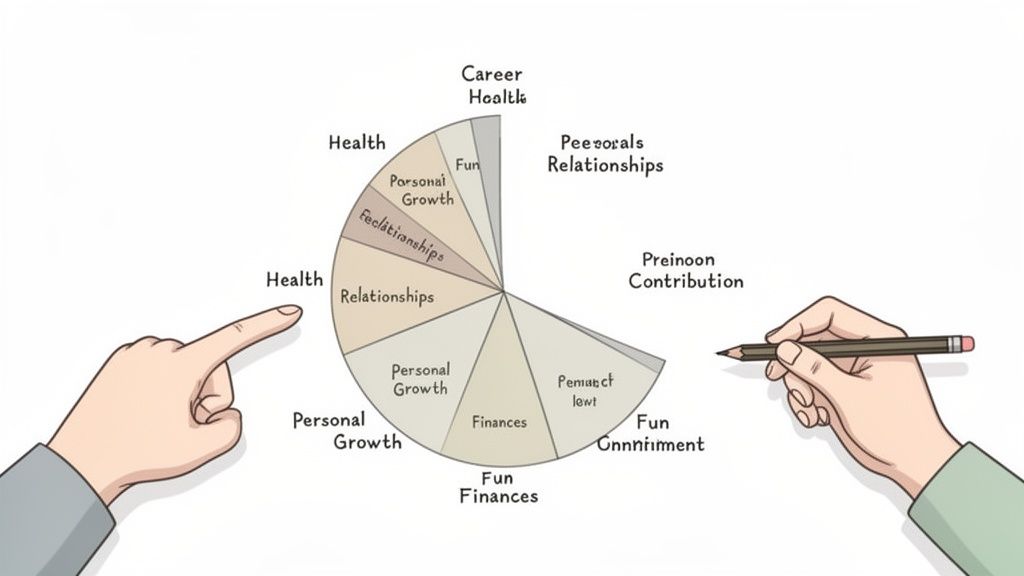
At its core, it's a circle divided into wedges, with each wedge representing a key life category—things like Career, Finances, Health, and Relationships. By having a client rate their satisfaction in each area, you’re doing more than just talking; you're helping them turn those vague, abstract feelings into a concrete picture they can actually see.
The Psychology Behind Its Impact
You might be wondering, "It's just a circle on paper. What makes it so effective?" Its power comes from making the intangible tangible. When a client scores each segment and connects the dots, they aren't just discussing their life anymore—they are seeing it.
Imagine your client scores their career a solid 8, but their health is a 3. When they connect the dots, they create a lopsided, spiky wheel. That visual is the "aha" moment. It’s no longer a fuzzy feeling; it’s a stark, data-driven image reflecting their reality. Seeing that imbalance is often far more motivating than you just telling them, "It sounds like you're neglecting your health."
The Wheel of Life doesn't measure perfection; it nurtures awareness. It acts less as a scorecard and more as a companion for meaningful dialogue, helping both coach and client uncover why certain areas feel neglected and how subtle shifts can create a greater sense of alignment.
Building Instant Rapport and a Coaching Agenda
Introducing this exercise at the start of a coaching relationship is a fantastic, non-intimidating way to begin. Instead of firing off a list of probing questions, you can frame it as a joint discovery: "Let's create a quick visual map of your life right now to see where your energy is flowing."
Your inner dialogue might be thinking, "Will this feel too basic for my high-achieving client?" But this simple activity builds immediate trust. It positions you as a helpful guide, not an interrogator. The results give you a clear, co-created foundation for your entire coaching engagement, allowing you to set meaningful goals from the very first session. In a booming industry, tools that provide this kind of clarity are invaluable. The life coaching market in the United States alone was valued at $2.06 billion in 2025 and is set to continue its rapid growth, highlighting the huge demand for personal development. You can discover more insights about the life coaching industry and its impressive expansion on Paperbell.com.
Selecting the Right Wheel of Life Model
So, you’ve seen what the Wheel of Life can do. The immediate next question in your head is, "Which wheel should I use? Is there a one-size-fits-all?" It’s a great question, and the answer is crucial. The right model can spark a genuine breakthrough for your client, while the wrong one can feel impersonal and completely miss the point.
Ultimately, the best choice always comes down to your client and their unique situation.
Think of it like this: the classic 8-segment wheel is your wide-angle lens. It gives you a fantastic, broad overview. But sometimes, you need a macro lens. For an entrepreneur client burning the midnight oil, a standard wheel’s “Career” segment is too broad. They aren't just thinking about a "career"—they're wrestling with cash flow, team morale, and product development. A specialized wheel is that macro lens.
Standard Versus Specialized Wheels
The traditional Wheel of Life is a brilliant all-rounder. It covers the big, universal pillars of life that resonate with almost everyone.
- Career: How fulfilled are they in their professional life?
- Finances: Do they feel secure and in control of their money?
- Health: This covers both physical energy and mental well-being.
- Family & Friends: The strength of their support system and relationships.
- Romance: Their satisfaction with their intimate partnership.
- Personal Growth: Are they learning, evolving, and challenging themselves?
- Fun & Recreation: Is there enough joy, play, and leisure in their life?
- Physical Environment: How do their home and work spaces make them feel?
But what about the client with a very particular goal? A standard wheel might feel too generic. An executive isn't just thinking about "Career"; they're wrestling with team dynamics, stakeholder management, and their own leadership presence. For them, a specialized wheel offers far more clarity.
The table below breaks down a few common models to help you see the difference.
Comparing Common Wheel of Life Models
| Model Type | Typical Categories | Best For (Client Type) |
|---|---|---|
| Standard | Career, Finances, Health, Family & Friends, Romance, Personal Growth, Fun & Recreation, Physical Environment. | Clients new to coaching, those seeking general life balance, or for an initial discovery session. |
| Business/Leadership | Team Vision, Stakeholder Management, Decision-Making, Delegation, Executive Presence, Resilience, Work-Life Integration. | Executives, managers, business leaders, and entrepreneurs looking to improve their professional impact. |
| Wellness | Physical Health, Emotional Well-being, Nutrition, Sleep, Movement, Mindfulness, Social Connection, Stress Management. | Clients focused on burnout recovery, health goals, stress reduction, or improving overall well-being. |
As you can see, pulling out a Leadership Wheel for an executive client immediately shows them you understand their world. This simple act of customization makes the exercise more relevant and powerful right from the start.
The Decisive Question: To Use a Template or Co-Create?
This leads you to a key decision point as a coach: do you pull out a pre-made template, or do you create a wheel from scratch with your client? There’s a time and a place for both. Your inner coach might be thinking, "Is co-creating too unstructured? Will it waste time?"
A pre-made template is fantastic for providing structure. If a client is feeling overwhelmed or is completely new to self-reflection, a template gives them a solid framework. It’s reliable, efficient, and avoids the "analysis paralysis" that can come from a totally blank slate.
On the other hand, co-creating a custom wheel is an incredibly engaging process. Imagine a client who is a freelance artist and new parent. Standard categories might not fit. Their key life areas might be "Creative Flow," "Client Pipeline," "Family Time," and "Personal Well-being."
By simply asking, "What are the 6-8 areas that matter most to you right now?" you shift the power to the client. This one question fosters a deep sense of ownership and guarantees that every single segment on their wheel is directly connected to their personal values and immediate priorities.
For example, asking this question might lead a client to identify "Spiritual Practice" or "Community Involvement" as a core segment, something a template would have missed. This collaborative approach turns a simple assessment into a profound conversation about what a fulfilling life actually looks like for them.
A Step-by-Step Guide to Facilitating the Exercise
Alright, you’ve picked the right Wheel of Life model. So, what now? It's one thing to have the tool, but it's another thing entirely to facilitate it in a way that sparks real insight instead of feeling like a homework assignment. Your mind might be asking, "How do I make sure this lands well and doesn't feel cheesy?"
This is where your skill as a coach truly shines. The real power of the Wheel of Life isn’t in the circle itself, but in the quality of the conversation you build around it. By breaking the process down into three simple phases, you can turn this exercise into a powerful catalyst for change.
Let's walk through how to make that happen.
Phase 1: The Introduction
The way you introduce this exercise sets the stage. Your goal is to make your client curious and comfortable. If it sounds like a formal evaluation, they'll get guarded.
Forget the dry, technical explanations. Try a more inviting approach.
Coach: "Before we jump into specific goals, I thought we could start by creating a quick visual map of your life as it is right now. Think of it as a simple snapshot to see where your energy is going and which areas might be calling for a little more attention. There are no right or wrong answers here—it's just a tool to help us see the bigger picture together."
This language immediately positions the wheel as a helpful starting point, not a judgment. It’s an invitation to be open and honest.
As you prepare the wheel, it’s useful to remember how different models relate to one another. The classic wheel is the foundation, but you can get more specific.
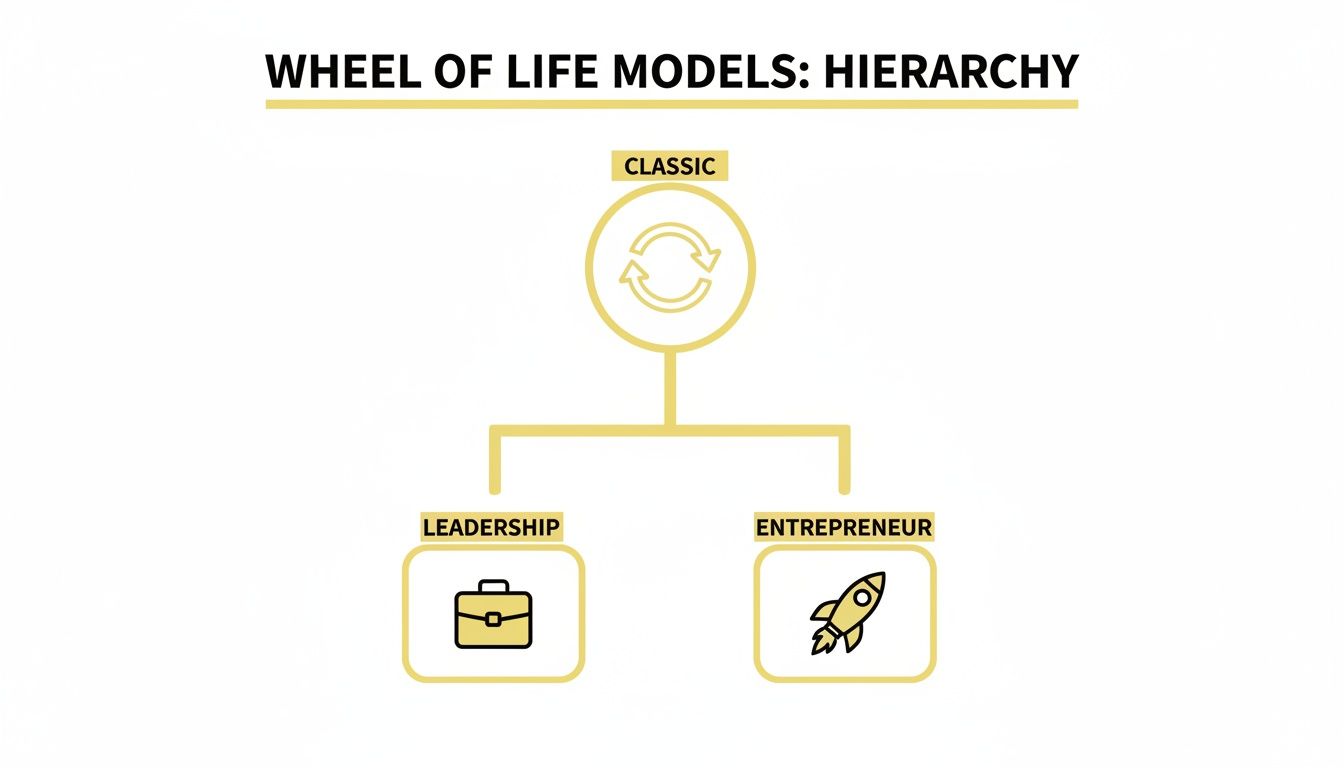
This just shows how specialized versions for Leadership or Entrepreneurs are built on the same fundamental principles, allowing for a more tailored and relevant conversation.
Phase 2: The Self-Assessment
This is the heart of the exercise. But the magic isn't in the score; it’s in the thinking behind it. Just asking, "Rate your career from 1 to 10" is a huge missed opportunity.
Your job is to guide their reflection with powerful questions. This anchors their score to real feelings, transforming a rating scale into a moment of self-discovery.
Here’s how you can deepen the process:
Instead of: "Rate your health."
Ask: "If you were to imagine your health and energy at a perfect '10,' what would that look and feel like every day? Maybe it’s waking up refreshed without an alarm. With that picture in mind, where would you say you are today on that scale from 1 to 10?"
Instead of: "How are your finances?"
Ask: "Let’s say a '10' represents total financial peace—feeling secure, in control, and free from money-related stress. For you, that might mean not checking your bank account before buying groceries. What number best captures where you are right now?"
This approach does two brilliant things. First, it forces the client to define what a "10" means to them. Second, it makes their score more meaningful because it's tied to their own vision. I always encourage clients to jot down a quick note on why they chose each score.
Phase 3: The Insight
Once the wheel is scored, your client is left with a spiky, lopsided shape. For many, this can be jarring. Your job is to reframe it—not as a picture of failures, but as a map of opportunities. Your inner dialogue might be, "Okay, they see the gaps. How do I guide them without telling them what to do?"
The goal is to help them connect the dots. This is where the "aha" moments happen.
Use these kinds of questions to uncover hidden connections:
- "Looking at your completed wheel, what’s the first thing that jumps out at you? Is there anything that surprises you?"
- "I see your 'Health' score is a 3, while your 'Career' is an 8. How do you think that score in 'Health,' for example, might be impacting your energy for your 'Career'?"
- "Now look at your highest scores. What’s working really well in that area? Is there anything we can learn from that success and apply somewhere else?"
This final phase helps the client see their life as an interconnected system. They might realize that trying to "fix" their career is a losing battle without first addressing their burnout. This shifts their focus from trying to solve every problem at once to finding the one or two "keystone" areas where a small change could create a positive ripple effect across their entire life.
In group coaching, identifying these common themes can spark incredibly powerful conversations. You can find more ideas for facilitating these shared moments by exploring effective topics for group discussion.
From Insights to Actionable Coaching Goals
So, the exercise is done. Your client is staring at this lopsided shape, and you can see the thought bubble: ‘Wow, my life is a mess.’ This is a pivotal moment. The coach's inner voice might be saying, "Don't let them get overwhelmed. Guide them to action."
It’s your job to frame this image not as a report card of failures, but as a treasure map. You’re looking at opportunities. The visual can feel jarring, but it’s the perfect starting point. Your role is to shift the client’s focus from, "I have to fix everything right now," to a more powerful question: "Where can one small change create the biggest positive impact?"
Analyzing the Gaps and Imbalances
The most obvious starting point is the "gaps"—the space between where your client is now and a perfect 10. A low score, like a 3 in “Health,” is a clear flag. But just pointing at the low numbers is coaching 101. The real work is exploring what that gap feels like.
Instead of, "Your health score is a bit low," try opening the door to reflection:
- "Tell me what was going through your mind when you scored 'Health' a 3?"
- "Imagine it's three months from now, and that 3 is a 5. What’s one specific thing that’s different about your day-to-day life? Maybe you're taking a walk at lunch."
- "What's one tiny thing you could do this week that would feel like you're moving toward a 4?"
This pulls them out of self-judgment and into curiosity. For example, instead of a client feeling defeated by their "3," they might commit to drinking one extra glass of water a day. It’s about small, intentional steps. You’re reminding them that balance isn't a final destination, but a constant, dynamic dance.
Uncovering Interdependencies and Ripple Effects
The deepest insights come from digging into the connections between the slices. No area of life lives on an island. Your skill as a coach shines when you help clients spot the patterns they're too close to see.
The Wheel of Life doesn't just show you where your life is out of balance; it reveals why. It shows how a neglected "Fun & Recreation" category is draining the energy needed for "Career" success, or how financial stress is affecting "Relationships."
For example, a client is laser-focused on their career, yet their wheel reveals a 2 in "Health" because they're running on fumes. You can connect those dots by asking, "I hear how important your career is. I'm curious, how might your score in 'Health' be shaping the energy you have for work?"
Suddenly, they might realize that going to bed 30 minutes earlier isn't a distraction from their career goals—it's the most strategic career move they could make. Nudging clients toward these "aha" moments requires tact; our guide on client communication best practices can help you navigate these conversations.
From Insights to SMART Goals
The final piece is turning these insights into a concrete plan. Once you've helped your client identify one or two "keystone" areas, it’s time to build SMART goals (Specific, Measurable, Achievable, Relevant, Time-bound).
Let's say a client flags "Personal Growth" as their key area. A vague goal like "I want to learn more" is a recipe for procrastination. Working together, you can forge that impulse into a powerful SMART goal:
- Specific: I will enroll in and complete the online digital marketing course I bookmarked months ago.
- Measurable: I will block out two hours every Tuesday and Thursday evening to work on the course modules.
- Achievable: The course is self-paced, and dedicating four hours a week feels realistic with my current commitments.
- Relevant: This new skill is directly tied to the promotion I'm aiming for, which will also boost my "Career" and "Finances" scores.
- Time-bound: I will complete the entire course within the next eight weeks.
By guiding them through this, you take a client from overwhelming self-assessment to a clear, exciting, and actionable path. The Wheel of Life stops being a diagram and becomes the first chapter of their coaching journey.
Embedding the Wheel into Your Coaching Process
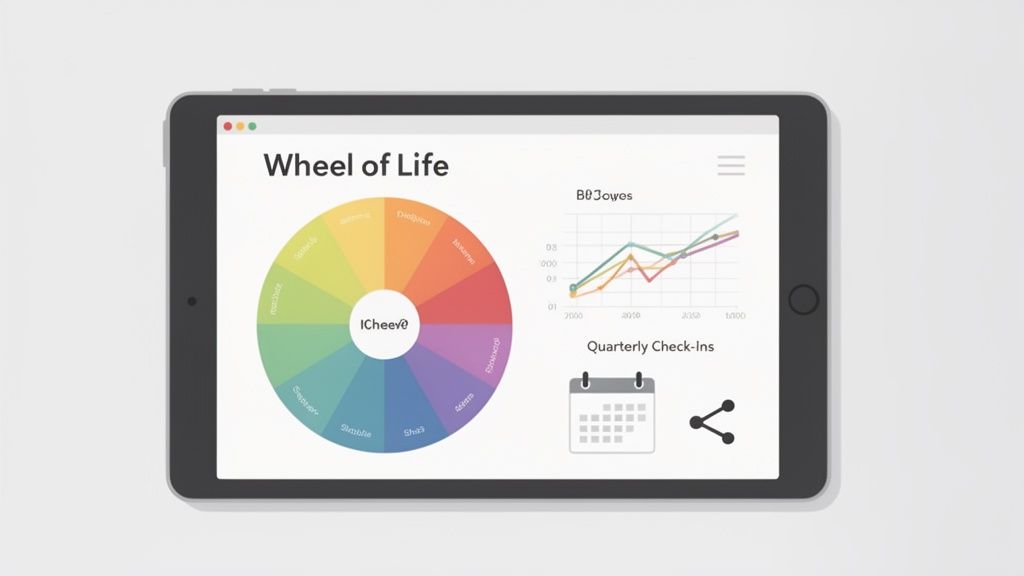
That initial "aha" moment is powerful. But its true value isn't in a single snapshot. Your inner coach knows that follow-through is everything. So, how do you make this more than just a one-off exercise? You position it as a dynamic benchmark, a living tool for charting their growth.
Using the Wheel for Benchmarking and Progress Tracking
Think of that first wheel as the "before" photo. It captures their starting point in vivid detail, giving you both a clear baseline. But the real magic happens when you come back to it.
By scheduling a "Wheel of Life Check-in" every quarter, you build a compelling visual record of their journey. This is where the client sees the impact of their work. A score in ‘Health’ that creeps from a 3 to a 6 isn’t just a number—it’s proof of their commitment and your guidance.
This recurring check-in is the ultimate evidence of your coaching’s ROI. It transforms a vague feeling of "I think I'm doing better" into a tangible, shareable dashboard of progress, reinforcing their investment in themselves.
For example, when you overlay the new wheel on the old one, you can say, "Look at this. Three months ago, 'Fun & Recreation' was a 2. Now it's a 5. What did you do to make that happen?" This reinforces their agency and success. This rhythm turns the Wheel of Life from a static diagram into a living document of their transformation. To learn more about structuring these sessions, check out our guide on how to write a coaching curriculum.
Digitizing the Process with Coaching Platforms
While a pen-and-paper wheel is a classic, modern coaching platforms offer a serious upgrade. Your internal dialogue might be, "Is it worth the tech? Will my clients use it?" The answer is a resounding yes, because it makes the process seamless.
Picture this workflow:
- Onboarding: You kick off your relationship by sending a link to an interactive, online Wheel of Life as part of your intake process.
- Tracking: The platform automatically saves those initial scores, creating a digital baseline.
- Revisiting: Three months later, you send a new assessment, and the system overlays the new results on top of the old ones.
This creates an instant visual comparison, showing how the jagged spikes on their wheel are starting to smooth out. It’s an incredibly motivating visual that makes progress undeniable. After using the wheel to find focus areas, you can use tools like a life coaching intake template to formalize goals.
This tech-forward approach is becoming standard. With the global coaching market valued at an estimated $5.34 billion in 2025 and projected to hit $5.8 billion in 2026, coaches need efficient ways to demonstrate value. Digital tools are essential for scaling a modern practice. You can read the full research about the coaching industry's growth for more details.
Common Questions About Using the Wheel of Life
Even the most experienced coaches hit a snag. You might be thinking, "This all sounds great, but what happens when...?" It’s a smart question. Facilitating the Wheel of Life isn’t just walking through steps; it's about confidently handling the human moments that come up.
Think of this section as your playbook for those tricky situations.
What if My Client Thinks It’s Too Simplistic or “Corny”?
This is a totally fair objection, especially with analytical or executive clients. They see a colorful circle and their skepticism meter goes way up. They're wired for hard data, so a tool that looks simple can feel "fluffy."
The key is to reframe it immediately. Don't introduce it as a self-help quiz. Position it as a rapid diagnostic tool.
Coach: "I completely get why this might look a little simple on the surface. Try to think of it less as a typical exercise and more like a 30,000-foot view of your personal data. We could spend the next few weeks talking to uncover these same insights, or we can use this to create a clear snapshot in about 15 minutes. It’s a fast way to see where your energy is going and what areas might be creating bottlenecks for you."
This language shifts the tool’s perception from "corny" to "efficient." You're meeting them where they are by framing it as a data-gathering process that saves time and delivers clarity.
How Do I Handle a Client Who Scores Everything a 5?
Ah, the "neutral" client. When every category lands at a 5, it's almost never a sign of perfect, average balance. As a coach, your spidey-sense should be tingling. This usually indicates:
- Fear of Vulnerability: They might be hesitant to admit things are bad (or even really good).
- Disconnection: They might be so out of touch with their own needs that they genuinely don't know how they feel.
- Perfectionism: They could see any score below a 5 as a failure.
Don't challenge the scores directly. That can put them on the defensive. Instead, get curious and probe gently.
Coach: "That's interesting—a lot of areas seem to be sitting around a 5. In my experience, that often means things feel 'fine,' but maybe not 'fantastic.' Let’s just pick one, how about Career. What's one tiny thing that would need to shift for that 5 to feel like a 6? What's the smallest, most effortless step you could imagine in that direction?"
This question is brilliant because it’s not threatening. You're not asking them to justify their score. You’re inviting them to imagine a small, positive improvement, which can break the stalemate and open up a much richer conversation.
Can I Use This Effectively in Group Coaching?
Absolutely. The Wheel of Life can be incredibly powerful in a group, but you have to adapt your approach. The goal shifts from deep individual analysis to identifying shared themes.
Here's a simple way to structure it:
- Individual Reflection: Give the group 10-15 minutes of quiet time to fill out their own wheel.
- Thematic Questions: Pose broad questions to the group. For example, "Without sharing any numbers, which category was the most difficult for you to rate, and why?" or "Did anyone notice a surprising connection between two different areas of their life?"
- Breakout Pairs: Put people into pairs or small groups of three to discuss one insight they had. This creates a safer, more intimate space for sharing. For example, one person might share, "I realized my low score in 'Fun' is because I feel guilty taking time for myself," and their partner might say, "Me too!"
This method builds a powerful sense of community. When a client realizes they aren't the only one who struggles with this, it instantly reduces feelings of isolation and builds connection.
The Wheel of Life is just one tool in a coach's toolkit. To explore other coaching resources and discover new methodologies, it's always helpful to see what's working for other professionals in the field.
What Are the Biggest Mistakes Coaches Make?
By far, the biggest pitfall is treating the Wheel of Life as the final destination instead of the starting point.
A beautifully colored-in wheel means absolutely nothing if it doesn't lead to action. The exercise is a complete miss if it ends with the client saying, "Well, that was interesting," before they file it away forever.
Another common mistake is rushing through the "insight" part of the process. The scores themselves aren't the prize; the real value is in the client's reflection on why they chose those scores. Don't just let them fill in the numbers and move on. Guide them through the thoughts and feelings behind each rating. Your job is to facilitate discovery, not just administer a test.
Ready to embed the Wheel of Life and other powerful tools into a seamless client experience? Coachful brings everything you need—from onboarding and scheduling to progress tracking and payments—into one unified platform. Stop juggling tools and start focusing on what you do best: coaching. Discover how Coachful can elevate your practice today.