Appreciative Inquiry Coaching: Principles, Evidence, Limits
Appreciative inquiry coaching applies appreciative inquiry, an approach to change built on studying what works rather than diagnosing what is broken, to coaching individuals and teams. The coach asks about times the client or team was at its best, uses those stories to imagine what more of that could look like, and builds practical changes from there. It began in organizational development in the 1980s, and the research on it is mostly case studies, with mixed results that tell coaches a lot about when it works.
We already have a step-by-step guide to running the 4-D cycle in coaching, with a worksheet and worked example. This article covers the rest: where appreciative inquiry came from, the five principles underneath the 4-D cycle, what the research shows about when it transforms and when it doesn't, a one-to-one session with dialogue and 10 questions, who it suits, its blind spots, and training routes. If you coach on Coachful, our team will build the worksheets and program in this guide in your account for free.
Where appreciative inquiry came from
Appreciative inquiry was first described by David Cooperrider, then a doctoral student at Case Western Reserve University, and his adviser Suresh Srivastva, in a 1987 chapter titled "Appreciative Inquiry in Organizational Life". Its starting point was that the questions an organization asks about itself shape where it goes: inquiry into problems tends to produce more problem talk, while inquiry into what works can produce energy for change. The approach grew into a method for whole-system change, usually run as the 4-D cycle: Discovery, Dream, Design and Destiny.
The coaching version was set out most fully by Sara Orem, Jacqueline Binkert and Ann Clancy in Appreciative Coaching: A Positive Process for Change (2007), which adapts the stages for one-to-one work. Appreciative inquiry also sits close to positive psychology, which arrived about a decade later and asked similar questions about individuals; see our guide to positive psychology coaching.
The five principles behind the 4-D cycle
Most articles stop at the four stages. The principles explain why the stages work, and they are what you lean on when a session doesn't follow the script.
| Principle | The idea | What it means for a coach |
|---|---|---|
| Constructionist | People and groups build their reality through conversation | The words used in a session shape what the client sees as possible |
| Simultaneity | Inquiry and change happen at the same time | The first question is already an intervention; choose it carefully |
| Poetic | A life or an organization can be read in many ways, like a text | There is always more than one story to study; pick a useful one |
| Anticipatory | Images of the future guide present behavior | A vivid, specific picture of the future pulls action toward it |
| Positive | Positive questions and emotion sustain change | Energy from stories of success fuels follow-through, if it is genuine |
What the research says about appreciative inquiry
- It doesn't transform every time. Gervase Bushe and Aniq Kassam examined 20 published cases of appreciative inquiry. All of them collected positive stories, followed the 4-D model and used the five principles, but only seven (35%) produced transformational change. The transformational cases had two things in common: they focused on changing how people think rather than what they do, and they supported self-organizing change that came from new ideas, rather than a top-down action plan.
- In health care, the evidence is weak but encouraging. A 2022 systematic review found 33 studies of appreciative inquiry in clinical settings, including only one randomized controlled trial. Study quality was generally poor. Most studies reported positive changes in attitudes, behavior and organizations, and the authors concluded there is "minimal empirical evidence" for its effectiveness, while calling it worth considering.
- For one-to-one coaching, we found no controlled trials of appreciative coaching specifically. Coaching overall has better support, for example a meta-analysis of workplace coaching with positive effects on performance, well-being and goal-directed self-regulation.
The practical lesson from Bushe and Kassam is the most useful thing in this article. Appreciative inquiry works best when it changes how the client sees the situation, and when the client, not the coach, generates what happens next. An appreciative session that ends with the coach's action list misses the point.

A one-to-one appreciative inquiry coaching session
This version runs in 50 to 60 minutes. For the full 4-D worksheet, use our 4-D cycle guide.
- Agree an affirmative topic. Turn the presenting problem into something the client wants more of, and check the wording with them.
- Ask for one peak story. A specific time things went well in this area, told in detail.
- Find the conditions. What made it possible: the client's actions, other people, timing, resources.
- Name the themes. Ask the client what patterns they see across the story.
- Imagine more. What would an ordinary week look like if those conditions were more common?
- Write a provocative proposition. One sentence in the present tense describing the future as if it were true.
- Let the client choose the first move. Small, self-chosen, and connected to the conditions they named.
- Agree how you'll both notice progress.
A short sample dialogue
Kwame runs a small design studio and says his team "never takes ownership". Illustrative, not a transcript.
Coach: Before we look at what's missing, tell me about a project where your team did take ownership.
Kwame: The museum rebrand last spring. They ran with it. I barely had to check in.
Coach: What was different about that project?
Kwame: I gave them the brief and the budget on day one, and then I was traveling for two weeks.
Coach: So they had the whole picture and some space. What else?
Kwame: They met the client directly. Usually everything goes through me.
Coach: If projects looked more like that, how would you describe your studio?
Kwame: "Our designers own their client relationships from kickoff to launch."
Coach: What's one move toward that, on the next project?
Kwame: I'll invite Lena to the kickoff call and let her run it.
The "ownership problem" turned out to be partly a design problem in how Kwame ran projects, which he saw for himself. That's the shift in thinking Bushe and Kassam describe.
10 appreciative inquiry coaching questions
- Tell me about a time this went really well. What happened, step by step?
- What did you do that made a difference?
- What did other people, or the situation, make possible?
- What do you value most about that experience?
- What patterns do you see across your best experiences?
- If that became more common, what would an ordinary week look like?
- What would people notice if you were at your best here?
- How would you describe that future in one sentence, as if it were already true?
- What's one small move toward it you could make this week?
- Who else needs to be part of this?
For more question banks, see our strengths-based coaching questions and the miracle question, which reach the future from a different angle.

Who appreciative inquiry coaching suits, and who it doesn't
It suits teams and organizations that have been through a hard period and are fluent in their own problems; leaders trying to shift culture; first sessions with groups, where peak stories build trust quickly; and individuals who keep defining themselves by what is wrong.
It suits less well situations where something genuinely needs to be named and fixed (a safety issue, harassment, a broken process), clients in acute distress, and teams where people don't feel safe being honest. In those cases, starting with "what's working" can feel like being told not to complain.
The blind spots of appreciative inquiry
- Suppressed problems. If a real grievance can't be said, every positive story after that rings hollow. Acknowledge the problem, then ask permission to look at what has worked.
- Coach-led action plans. The research above suggests transformation comes from self-organizing change. Resist writing the plan for the client or team.
- Cherry-picked stories. One peak story is a hypothesis. Look for patterns across several before building on them.
- Power in the room. In team sessions, the most senior person's story often sets the tone. Collect stories in pairs first.
- Not a treatment. For grief, trauma or mental health concerns, appreciative questions can wait; see our guide to trauma informed coaching.
Appreciative inquiry training routes
One program we checked on its own site in October 2026: Case Western Reserve University's Weatherhead Executive Education offers a Change Management and Appreciative Inquiry Certificate. It requires four courses (two required, including Practical Tools for Leading Change: Appreciative Inquiry in Action, and two electives) completed within 24 months, listed at $3,580, or $2,685 for nonprofits and alumni.
Appreciative inquiry training teaches facilitation and change methods rather than coaching competencies. For a coaching credential, combine it with ICF-accredited coach training; the ICF credentialing pages describe the requirements.
Running appreciative inquiry coaching inside Coachful
The 4-D cycle produces stories, a picture of the future, a design and commitments. This is where each one lives in Coachful, all included in your membership.
Discovery worksheets
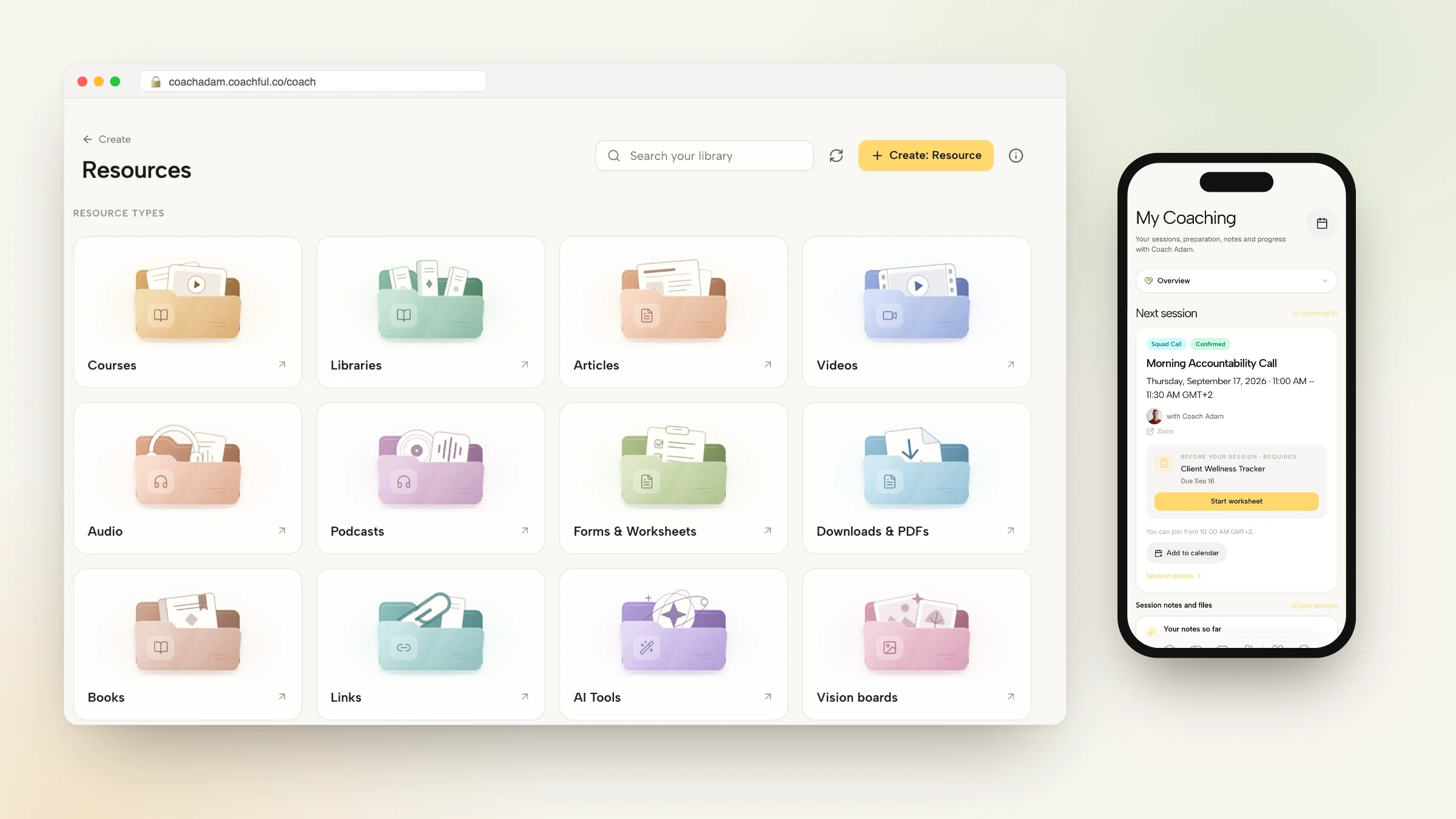
Build a Discovery worksheet in Create > Resources > Forms & Worksheets with the peak-story questions above, and assign it before the first session so clients arrive with a story. Tools > Explore also includes editable Strengths story and Appreciation letter templates that work for Discovery.

Dream on a vision board
Clients can build the Dream stage as a vision board, with images and words that describe the future they want. Ask them to explain each image in practical terms.
Design and Destiny as a journey
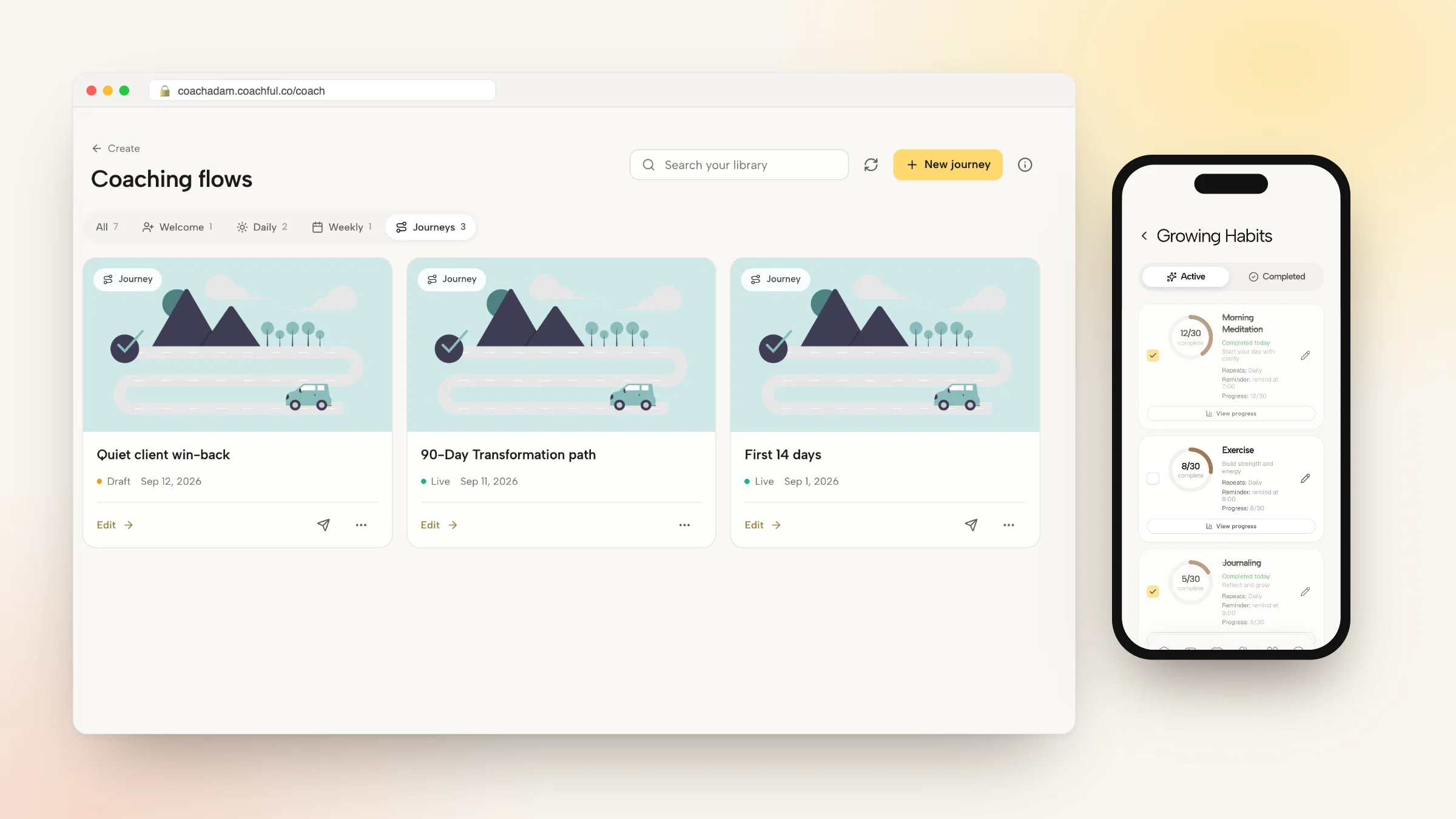
Lay out the cycle as a journey (Discovery, Dream, Design, Destiny) so the client sees where they are, with a next step such as "Create your 90-day vision" opening their vision board directly.

Team inquiry in a community space
For team coaching, a community space gives members somewhere to share peak stories and themes between workshops, and to celebrate progress in a wins channel.

Commitments the client chose
Save the client's own first move as a task or goal. It shows up on their My Coaching page and their phone, so the next session can start with what happened.

Have our team build your appreciative coaching program
Coachful's white-glove service is free on every plan. From Create > We'll build it for you, ask the team to build Discovery worksheets, a 4-D journey, a team program or a website. Attach any materials you use now. The team replies by email, usually within about 24 hours, and builds it in your account so you can edit it. Read what the free white-glove service includes, and see our pages for executive coaches and business coaches.

Frequently asked questions
What is appreciative inquiry coaching?
It is coaching based on appreciative inquiry, which studies what works rather than what is broken. The coach asks about peak experiences, helps the client imagine more of what made them possible, and supports the client in designing and testing changes, usually through the 4-D cycle of Discovery, Dream, Design and Destiny.
Who created appreciative inquiry?
David Cooperrider and Suresh Srivastva at Case Western Reserve University, in a 1987 chapter called "Appreciative Inquiry in Organizational Life". Sara Orem, Jacqueline Binkert and Ann Clancy adapted it for one-to-one coaching in Appreciative Coaching (2007).
What are the five principles of appreciative inquiry?
Constructionist (we build reality through conversation), simultaneity (inquiry is already change), poetic (there are many ways to read a situation), anticipatory (images of the future guide action) and positive (positive questions and emotion sustain change).
Does appreciative inquiry work?
Sometimes. A review of 20 cases found only seven (35%) were transformational, and those focused on changing how people think and supported self-organizing change. A 2022 review of 33 health care studies found encouraging but low-quality evidence.
What is the difference between appreciative inquiry and positive thinking?
Positive thinking asks you to feel better about a situation. Appreciative inquiry studies real experiences of things working, finds the conditions behind them and designs changes from that evidence. It doesn't require ignoring problems.
Can appreciative inquiry be used in one-to-one coaching?
Yes. The 4-D cycle adapts to individual sessions: one peak story, the conditions behind it, a picture of more of that, and one self-chosen first move. Our 4-D cycle guide has a worksheet for it.
Can Coachful build an appreciative inquiry program for me for free?
Yes. The white-glove service is free on every Coachful plan. Ask from Create > We'll build it for you and the team will build Discovery worksheets, a 4-D journey or a team program in your account, usually within about 24 hours.