Team Coaching: How It Works, What It Costs, How to Sell It
Team coaching is coaching an intact team, people who work together toward a shared goal, as a single client. Instead of helping individuals with their own goals, a team coach works on how the team works: its purpose, roles, decisions, meetings, conflict, trust and follow-through. Engagements usually run six to twelve months, with regular team sessions, observation of real meetings and short individual check-ins. The research base is young, but it links team coaching to more group effort, better interpersonal processes and more team learning, and a meta-analysis of structured debriefs, a core team coaching tool, found performance gains of about 20 to 25 percent.
This guide is for two readers: coaches who want to offer team coaching, and the leaders and HR teams who buy it. It covers how team coaching differs from group coaching and facilitation, when it is the right intervention, how an engagement runs, what happens in a session, what the evidence shows, the ICF team coaching credential, how to price and sell it, and how to run it without drowning in spreadsheets. If you would rather not build the program, the sales page and the intake survey yourself, Coachful's team will build them for you as part of the free white-glove service, covered below.
Team coaching vs group coaching, facilitation and team building
| Who is in the room | Whose goal | Typical length | |
|---|---|---|---|
| Team coaching | An intact team that works together | The team's shared goal and how it works | Six to twelve months |
| Group coaching | Individuals who may not work together | Each person's own goal, pursued in a group | Weeks to months |
| Facilitation | Any group with a task | Getting through one meeting or workshop well | Usually one session |
| Team building | A team | Relationships and morale, often through activities | Usually one event |
| Training | Learners | A defined skill or body of knowledge | Fixed curriculum |
| Leadership coaching | One leader | The leader's development | Three to twelve months |
The ICF draws the same line in its team coaching credential: team training, consulting or team building on their own do not count as team coaching experience. Our explainer on what group coaching is covers the group format in depth, and what leadership coaching is covers the one-to-one version many team engagements are paired with.
When team coaching is the right call
Team coaching earns its cost when the problem lives between people, not inside one person. Common triggers:
- A new leadership team, or a new leader inheriting a team.
- A merger or reorganization that put two cultures in one room.
- A team that is individually strong but collectively slow: decisions get reopened, meetings run long, priorities collide.
- A high-stakes launch or turnaround where the team needs to be aligned for months.
- Persistent, low-level conflict that nobody names.
It is the wrong tool when the issue is one person's performance (that is a management conversation, maybe with individual coaching), when the leader will not take part, or when trust has been broken by misconduct, which belongs with HR or legal first. A good team coach will turn down work that fails these tests.
How a team coaching engagement runs
Most engagements follow a similar arc. Coachful's 2026 Coaching Business Report puts typical corporate coaching contracts at six to twelve months.
| Phase | What happens | Rough timing |
|---|---|---|
| Contracting | Agree goals, success measures, confidentiality and roles with the sponsor and team leader; sign the agreement | Weeks 1 to 2 |
| Discovery | Short interviews with each member, a team survey, observe one or two real meetings | Weeks 2 to 4 |
| Launch session | Share themes, agree the team's purpose, two or three priorities and working agreements | Month 1 |
| Regular team sessions | Every three to six weeks, half a day or shorter, working on real issues | Months 2 to 5 |
| Live observation | Sit in on real meetings and debrief straight after | Throughout |
| Midpoint review | Re-run the survey, check progress against the success measures with the sponsor | Month 3 |
| Close and handover | Agree how the team will keep the habits going without the coach; final review | Months 6 to 12 |
Contracting is where engagements succeed or fail. Our guides to stakeholder alignment meetings, confidentiality expectations in groups and coaching proposal examples cover the pieces you need.
What happens in a team coaching session
A half-day team session might look like this:
- Check-in (15 minutes). One sentence each on where they are, so everyone speaks early.
- Review (30 minutes). What the team committed to last time, what happened, what got in the way.
- Real work (90 minutes). One live issue: a decision the team keeps reopening, a handoff that fails, a priority conflict. The coach asks questions, names patterns as they happen and keeps the team from solving the wrong problem.
- Process debrief (30 minutes). Not what was decided, but how: who talked, who did not, what was avoided.
- Commitments (15 minutes). Two or three agreements, with owners and dates.
Two ideas guide most good team coaches. The first comes from J. Richard Hackman and Ruth Wageman's 2005 theory of team coaching, which focuses on the team's task more than on interpersonal relationships: many conflicts come from an unclear goal or process, not personalities, so clarify the work first (review). The second is psychological safety, the belief that you will not be punished or humiliated for speaking up with ideas, questions, concerns or mistakes, which is the most studied enabling condition in team learning research (overview).
What the research says
- The evidence base is young. A 2024 review describes team coaching as found to increase group effort, improve interpersonal processes and increase team knowledge and learning, while noting a significant lack of empirical work that limits firm conclusions (Fernández Castillo, Linhardt and Salas, 2024).
- Debriefs work. A meta-analysis of 46 samples (2,136 people) found that structured debriefs, or after-action reviews, improved effectiveness by about 25 percent over controls, similarly for teams and individuals and in medical and nonmedical settings (Tannenbaum and Cerasoli, 2013). A later meta-analysis of 61 studies found an even larger effect (Keiser and Arthur, 2021).
- Coaching behavior inside teams matters. In a study of 52 health and social care teams, coaching by leaders and peers was linked to higher satisfaction with the team and more positive emotions, and peer coaching to better team performance as rated by the leader (Dimas and colleagues, 2016).
For buyers, that means team coaching is a reasonable bet with a sound theory behind it, and the debrief habit alone is worth building. For coaches, it means measuring outcomes properly, because your own results are your best evidence.
Skills and credentials for team coaches
Team coaching asks for everything one-to-one coaching does, plus the ability to track several people and the system between them at once. The core extra skills are contracting with multiple stakeholders, observing group dynamics live, naming patterns without blaming individuals, handling conflict in the room, and staying neutral when the leader is also the sponsor. Our guide to core coaching skills covers the foundation.
The ICF's Advanced Certification in Team Coaching (ACTC) is the best-known credential. Its requirements, from the ICF's ACTC page:
- Hold an ICF credential (ACC, PCC or MCC) in good standing.
- Complete 60 hours of team coaching education, at least 48 of which apply the team coaching or core competencies, or an ICF advanced accredited team coaching program.
- Show five team coaching engagements within the past five years, each with real-time interaction with the team.
- Complete five hours of coaching supervision with an eligible supervisor.
- Pass the ICF Team Coaching Certification Exam.
See ICF credentialing for the full rules.
How to price and sell team coaching
Team coaching is sold to organizations, which changes almost everything about the sale. Coachful's 2026 Coaching Business Report compares the two markets:
| Consumer coaching | Corporate coaching | |
|---|---|---|
| Average engagement fee | $1,500 to $8,000 | $10,000 to $50,000+ |
| Sales cycle | 1 to 3 weeks | 1 to 6 months |
| Credentialing | Preferred | Often mandatory |
| Decision-maker | The individual | HR, L&D or the executive team |
| Renewal likelihood | 35 to 50 percent | 55 to 65 percent |
The same report puts senior corporate coaching at $300 to $800 an hour, organization-level retainers at $3,000 to $10,000 a month, and enterprise programs at $50,000 to $500,000 or more (ICF Global Coaching Study 2025 and practitioner reports; see coachingrates.com). A single engagement fee that includes discovery, sessions, observation and reviews is usually easier for a buyer to approve than an hourly rate, and it stops every extra meeting turning into a negotiation.
Practical selling notes:
- Start with a paid pilot, such as discovery plus a launch session, so the buyer can judge you on real work. Our guide to an employer-paid coaching pilot pitch walks through it.
- Agree measures the sponsor cares about: decision speed, meeting time, engagement scores, delivery dates. Re-measure at the midpoint.
- Make billing boring. Invoices to the company, purchase order numbers, payment terms. See company-funded coaching program billing.
Running team coaching on Coachful
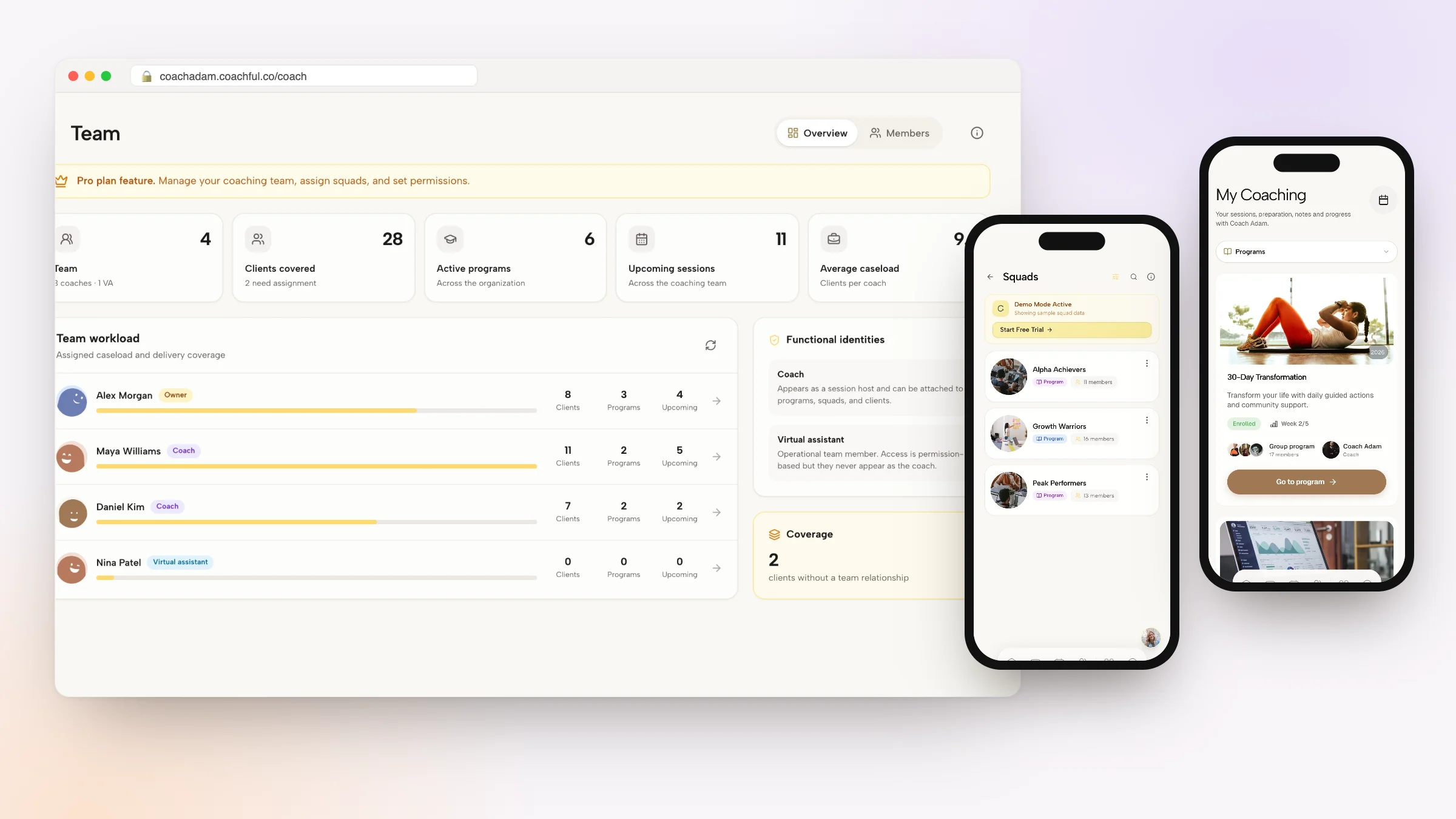
Coachful runs group work as programs with cohorts: enrolling the team in a program creates a cohort group with its own community feed, group chat and group calls, while every member keeps an individual record with goals, habits and check-ins. In this demo account, each cohort is tied to a program and shows its member count.

Team members see the program on their phone, with the current week and the rest of the group.

The discovery survey and pulse checks between sessions can be forms the team fills in; responses land on each person's record. Our guide to a cohort pulse survey has questions to start from.

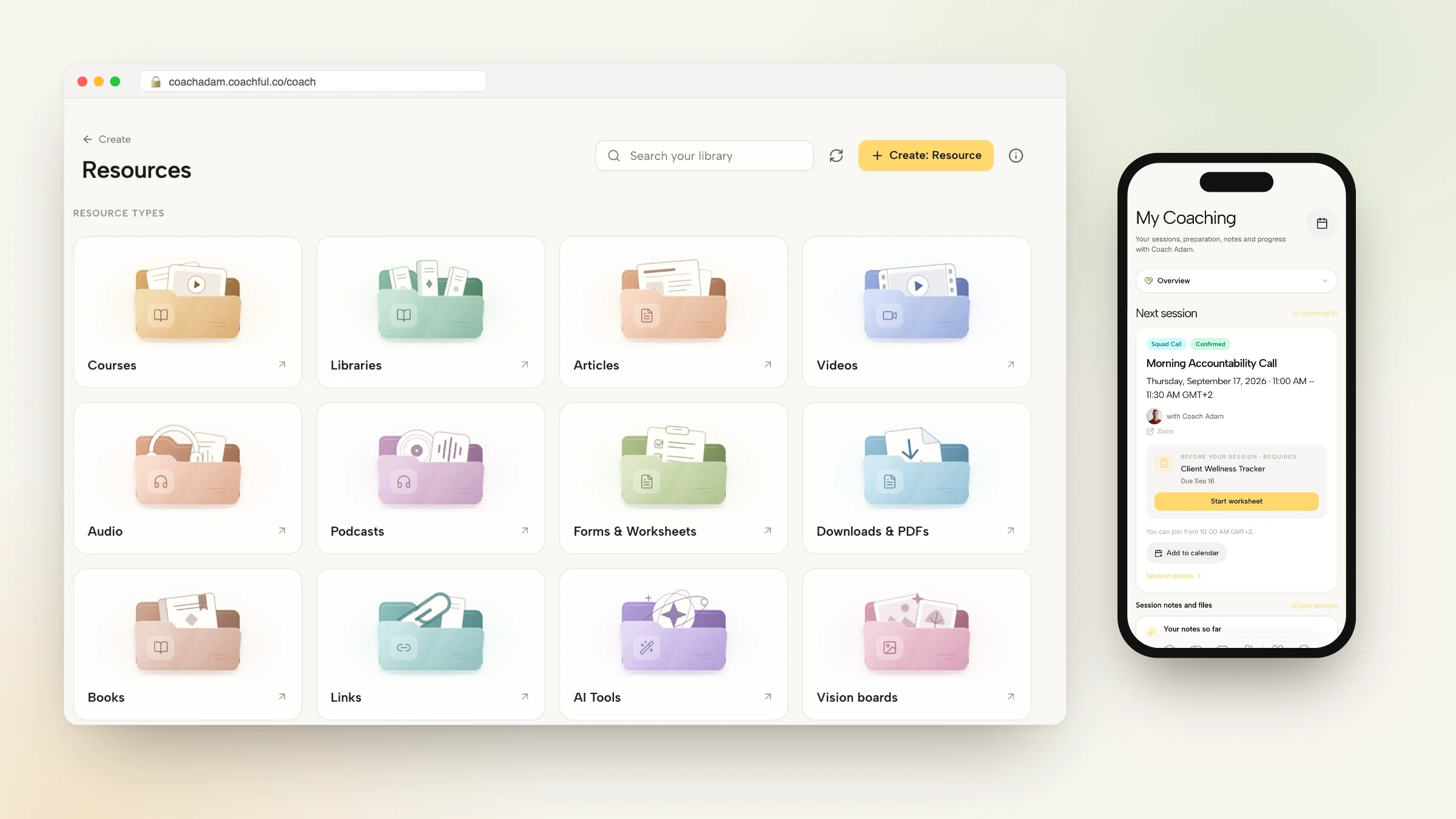
Team sessions, observed meetings and individual check-ins sit on one calendar, with group calls on built-in video or Zoom, Meet and Teams links and attendance recorded per member.

Group chat keeps the commitments alive between sessions, next to direct messages for individual check-ins.

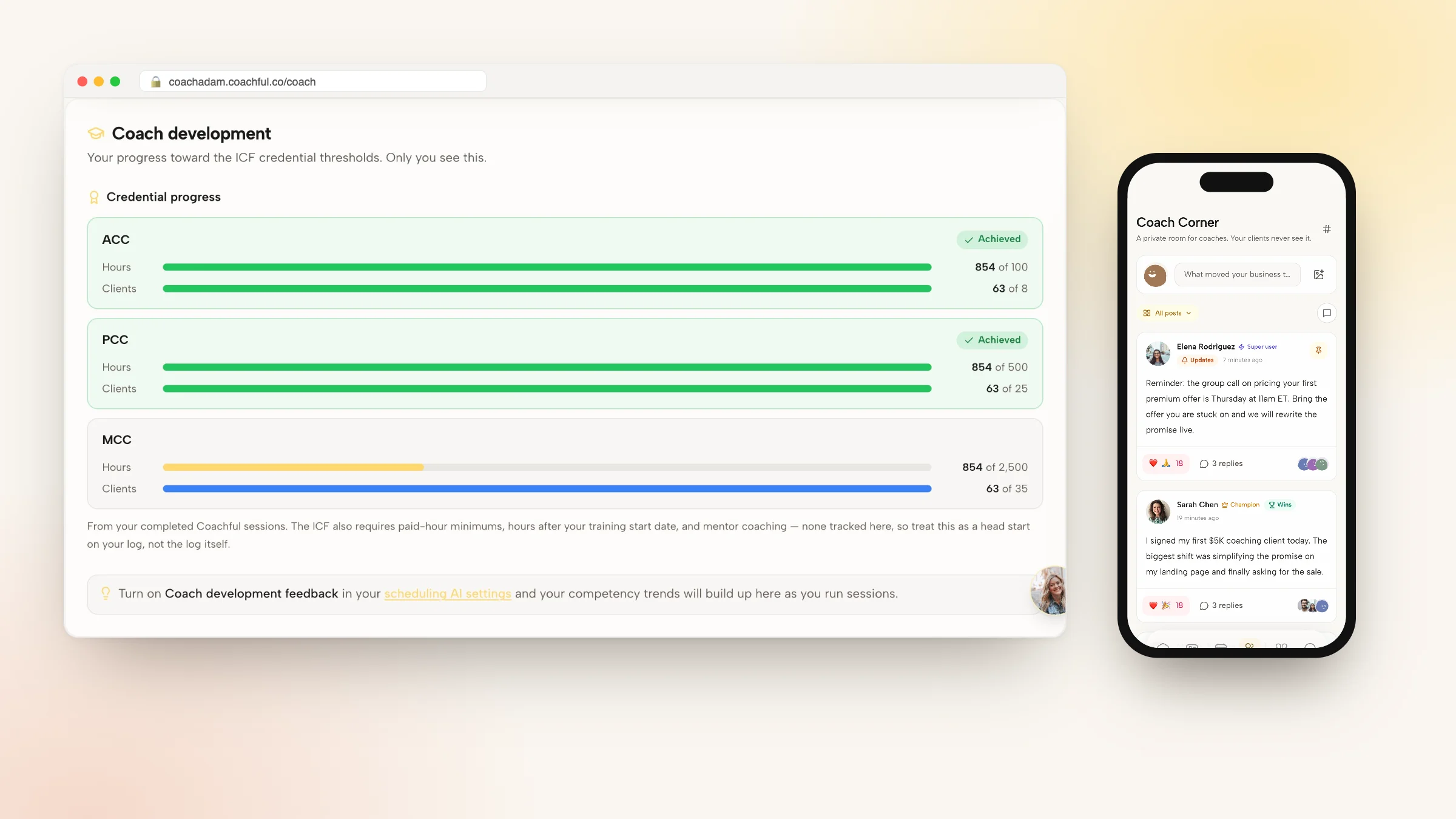
And the client overview shows who is engaged and who has gone quiet, which in a team engagement is often the first sign of trouble.

Payments run through your own Stripe account with a 0% Coachful platform fee, and you can raise manual invoices for company-paid engagements. Coaching agreements go out for e-signature before the first session. See group coaching software for the full feature list, and Coachful for teams if several coaches deliver your engagements.
Get your team coaching program and website built for free
Coachful's white-glove service is free on every plan. In the app, open Create and choose We'll build it for you · FREE, then pick what you want: a website, a program, an offer or sales page, a funnel, forms or an email sequence. Tell the team who the work is for, what visitors should do, and attach your existing materials, such as a proposal deck, a methodology document or your logo (up to 10 files and 8 reference links). The team replies by email, usually within about 24 hours, and builds the work inside your own account, so you can edit everything afterwards.
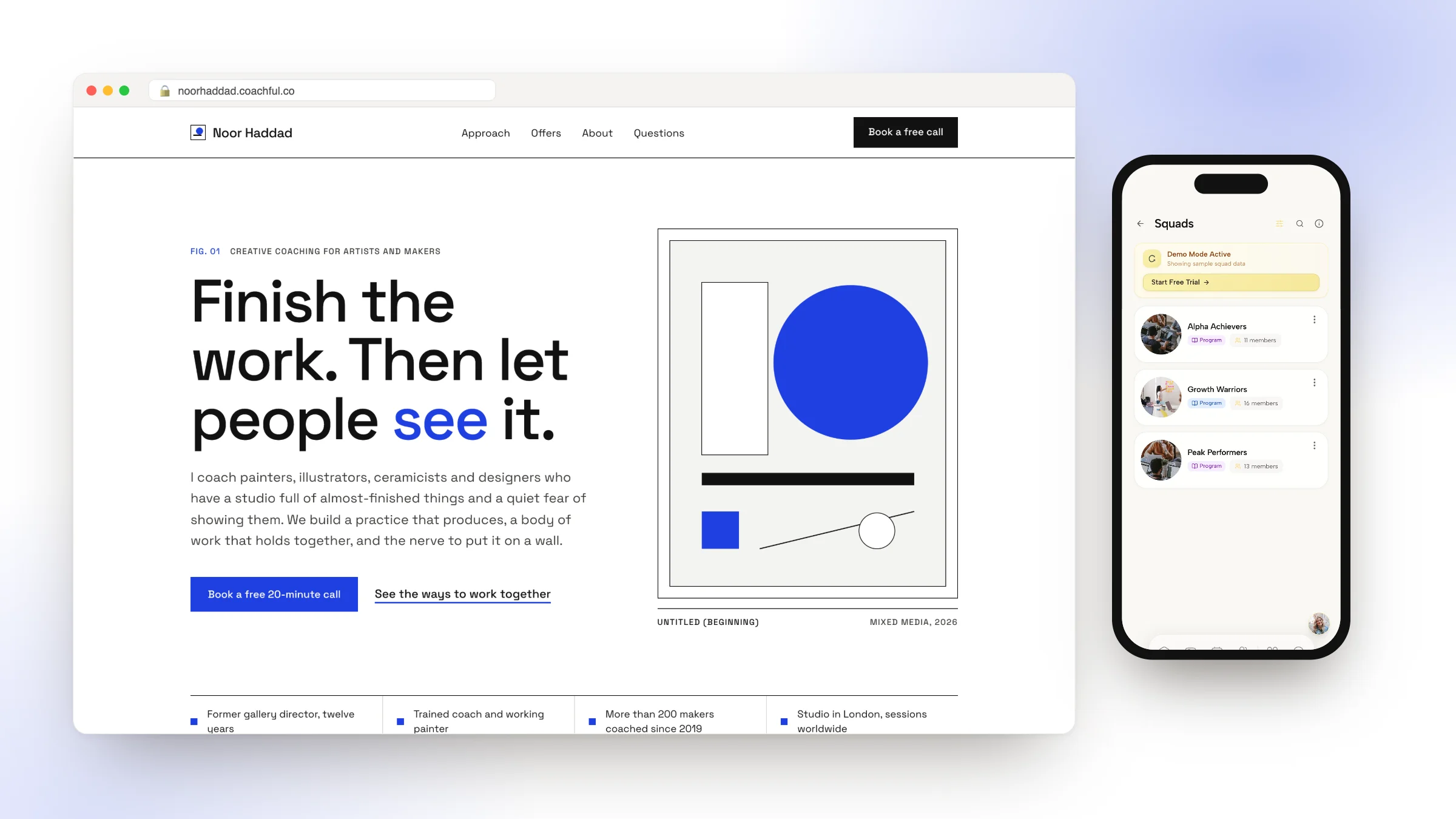
For a team coaching practice, that might be a services page aimed at HR and team leaders with a "book a scoping call" button, a program with discovery, launch and session phases, and a pre-engagement survey form. It does not include paid-ad management, ongoing marketing or recording your videos, and nothing is invented: credentials, results and prices you have not supplied are left for you to fill in.


Frequently asked questions
What is team coaching?
Team coaching is coaching an intact team as one client, working on how the team works together toward a shared goal: purpose, roles, decisions, meetings, conflict and accountability. It usually runs six to twelve months with regular team sessions, observation of real meetings and individual check-ins.
What is the difference between team coaching and group coaching?
In team coaching, the members work together and share one goal. In group coaching, individuals who may not know each other each pursue their own goals in a group setting. Team coaching focuses on the team as a system; group coaching uses the group to support individual change.
How much does team coaching cost?
It is usually priced per engagement. Coachful's 2026 Coaching Business Report puts corporate coaching engagements at $10,000 to $50,000 or more, senior corporate coaching at $300 to $800 an hour, and organization-level retainers at $3,000 to $10,000 a month.
Does team coaching work?
The research is young but positive. A 2024 review links team coaching to more group effort, better interpersonal processes and more team learning, and a meta-analysis found structured debriefs, a core team coaching tool, improved performance by about 20 to 25 percent.
What qualifications does a team coach need?
None are legally required. The ICF's Advanced Certification in Team Coaching requires an existing ICF credential, 60 hours of team coaching education, five team coaching engagements in the past five years, five hours of supervision and an exam.
Can a manager be the team's coach?
Yes. Hackman and Wageman's approach holds that a team's own leader can do much of the coaching, and studies link leader and peer coaching to team satisfaction and performance. An external coach adds neutrality, which helps when the leader is part of the problem.
Will Coachful build my team coaching website and program for free?
Yes. The white-glove build is free on every Coachful plan. Request it from Create, describe what you need and attach your materials; the team usually replies within about 24 hours and builds the pages, program and forms in your own account.