VIA Character Strengths Coaching: A Practical Guide
VIA character strengths coaching uses the VIA classification, 24 character strengths grouped under six virtues, to help clients see what is already best about them and use it on purpose. A coach typically has the client take the VIA Survey, explores their top or "signature" strengths through real stories, and designs small experiments that use those strengths toward a goal. Of the strengths approaches, it has the deepest research base, although the evidence is strong for only some of the 24 strengths.
This guide covers where the VIA classification came from, the full list of strengths, what the research supports, a session with sample dialogue and 12 questions, overuse and underuse, who it suits, the cautions, and training routes, with prices as listed in October 2026. If you coach on Coachful, our team will build the strengths worksheets and program in this guide in your account for free.
Where the VIA classification came from
In the early 2000s, psychologists Christopher Peterson and Martin Seligman led a project to classify positive human traits, a deliberate counterpart to manuals that classify disorders. The VIA Institute on Character says 55 scientists contributed over several years. The result was Character Strengths and Virtues: A Handbook and Classification (2004), published by the American Psychological Association and Oxford University Press, which named 24 character strengths under six virtues found across cultures and traditions.
The VIA Institute on Character, a nonprofit, runs the VIA Survey that measures them. Its site says more than 40 million people have taken it, and recommends retaking it every couple of years because rankings can shift with life experience. Ryan Niemiec, its education director, wrote Character Strengths Interventions, the main practitioner guide for using the strengths in coaching and therapy.
The 24 VIA character strengths and six virtues
| Virtue | Character strengths |
|---|---|
| Wisdom | Creativity, curiosity, judgment, love of learning, perspective |
| Courage | Bravery, perseverance, honesty, zest |
| Humanity | Love, kindness, social intelligence |
| Justice | Teamwork, fairness, leadership |
| Temperance | Forgiveness, humility, prudence, self-regulation |
| Transcendence | Appreciation of beauty and excellence, gratitude, hope, humor, spirituality |
Three ideas shape how coaches use the list:
- Everyone has all 24. The survey ranks them, but a low-ranked strength is a lesser strength, not a weakness or a gap.
- Signature strengths are the ones near the top that feel most like "the real me", energize the client and come naturally. The top five on a report are a starting point, not the answer; the client decides which feel like signatures.
- Character strengths are not talents. Being good at spreadsheets is a skill. Perseverance in finishing the spreadsheet is a character strength.

What the research supports, and what it doesn't
- The landmark experiment. In a placebo-controlled online study, Seligman and colleagues tested five exercises against a control and found three lastingly increased happiness and reduced depressive symptoms. Using signature strengths in a new way was one of the exercises that made the approach famous.
- Signature versus lesser strengths. A randomized placebo-controlled trial of 375 adults compared using five signature strengths in new ways with using five lesser strengths. Both increased happiness for up to three months and reduced depressive symptoms in the short term, and participants found both equally rewarding. People with generally high strength scores benefited more from working on lesser strengths, and people with lower scores from working on signature strengths.
- The big picture. A 2025 synthesis of 162 randomized trials (33,032 participants) found the best evidence for interventions that build kindness, humor, hope, perspective and gratitude, and "insufficient evidence on the efficacy of most of the 24 strengths". Many of the strengths simply haven't been tested in good trials.
- Positive psychology exercises overall have small average effects once small-study bias is accounted for, according to a 2019 reanalysis.
Two practical conclusions. First, the "always focus on signature strengths" rule is weaker than it looks: working on lesser strengths can help as much, depending on the person. Second, a client choosing a strength to build, with a concrete plan, is more defensible than a coach promising that strengths work "increases happiness".
How to run a VIA character strengths coaching session
- Have the client take the VIA Survey before the session, and bring their ranked list.
- Ask for reactions first. What surprised them? What fits? What doesn't?
- Find the signature strengths. Ask which of the top strengths feel most like them, and why.
- Spot strengths in a story. Ask for a recent time they were at their best, then name the strengths you both hear in it.
- Look at overuse and underuse. Where is a strength turned up too high or too low?
- Connect to the goal. Which strength could help with what they're working on now?
- Design a new-way experiment. Use one strength in a new way, daily, for a week.
- Agree how to notice the effect. A one-line note each evening works.
A short sample dialogue
Leah is a project lead whose top strengths came back as judgment, honesty and perseverance. Illustrative, not a transcript.
Leah: Judgment, honesty, perseverance. Sounds like a very serious person.
Coach: Which of those feels most like you?
Leah: Honesty. I can't let a bad plan slide.
Coach: Tell me about a time honesty went well at work.
Leah: I told a client their deadline was impossible. We moved it, and the project worked.
Coach: And a time it went less well?
Leah: Last week, in a team meeting. I picked apart a junior's idea in front of everyone.
Coach: So it might be honesty turned up a bit high. Is there another strength on your list that could help?
Leah: Kindness is around number twelve.
Coach: What would honesty plus kindness look like this week?
Leah: Saying one thing I like about an idea before I say what worries me. In every meeting this week.
12 character strengths coaching questions
- What surprised you about your results?
- Which of your top strengths feel most like the real you?
- Which one would people who know you well recognize first?
- Tell me about a time you were at your best. Which strengths do you hear in it?
- Where might one of your strengths be turned up too high?
- Where is a strength you value turned down too low?
- Which strength could help with the goal you're working on?
- How could you use that strength in a new way this week?
- Which lesser strength would you like to grow?
- Whose strengths do you admire, and what do you notice them doing?
- Which strengths did you see in someone else today?
- What did you notice when you used the strength deliberately?
For more questions that don't depend on the VIA list, see our strengths-based coaching questions, which also covers coaching strengths without any assessment.

Overuse and underuse: the most useful idea in strengths coaching
Practitioners in the VIA tradition, notably Niemiec, encourage thinking of each strength as a dial: there is an optimal level for the situation, and problems come from overuse or underuse more than from missing strengths.
| Strength | Underuse can look like | Overuse can look like |
|---|---|---|
| Honesty | Avoiding hard truths | Bluntness that hurts people |
| Perseverance | Giving up early | Refusing to drop a failing plan |
| Kindness | Indifference | Over-helping, no boundaries |
| Prudence | Reckless decisions | Never deciding at all |
| Curiosity | Boredom, disengagement | Distraction, starting everything |
| Humor | Heaviness | Joking to avoid serious topics |
These are illustrative coaching examples rather than research categories. Ask the client to fill in their own row for their top strength.
Who VIA strengths coaching suits, and who it doesn't
It suits clients who struggle to name what they're good at; people in career transitions, where strengths travel between roles (see our sibling guide to ikigai coaching); leaders and teams building a shared language; and young adults working out what they bring.
It suits less well clients who distrust questionnaires, people in acute distress who need support rather than a self-assessment, and situations where the real issue is a skill gap that strengths talk would paper over.
Cautions for strengths coaches
- Rankings aren't fixed. They are a snapshot from a self-report survey. Treat them as a conversation, not a profile.
- Bottom strengths aren't flaws. Say this out loud. Clients often read the bottom five as a list of failings.
- Don't oversell the science. The trials support some strengths and some exercises. "Using your strengths boosts happiness" is broader than the evidence.
- Use the official survey and reports on VIA's terms, and don't copy its questions into your own forms.
- Refer when needed. Persistent low mood is not a strengths problem. See our guide to trauma informed coaching for how to raise it.
VIA character strengths training routes
From the VIA Institute's site in October 2026:
- Character Strengths Interventions, with MentorCoach. An on-demand course of eight one-hour sessions taught by Ryan Niemiec, with research, interventions and client examples, listed at $498 with no prerequisites.
- Mindfulness-Based Strengths Practice (MBSP) Certification. For coaches and other professionals who want to teach the eight-week MBSP program: six live virtual sessions plus three one-to-one training sessions, two years to complete and certification for three years, listed at $3,999.
VIA also offers a professional dashboard for sending the survey to clients. None of these is a coaching credential; for that, see the ICF credentials.
Running VIA strengths coaching inside Coachful
Strengths work sticks when the client keeps using the strength after the session. This is how coaches set that up in Coachful, all included in your membership.
Strengths worksheets ready to edit
Tools > Explore includes editable Strengths in action (strengths, evidence, opportunities, action), Strengths story and Strengths and energy match templates. Add a first question asking for the client's top five VIA strengths, then assign it before the session where you debrief.
Send clients to the survey
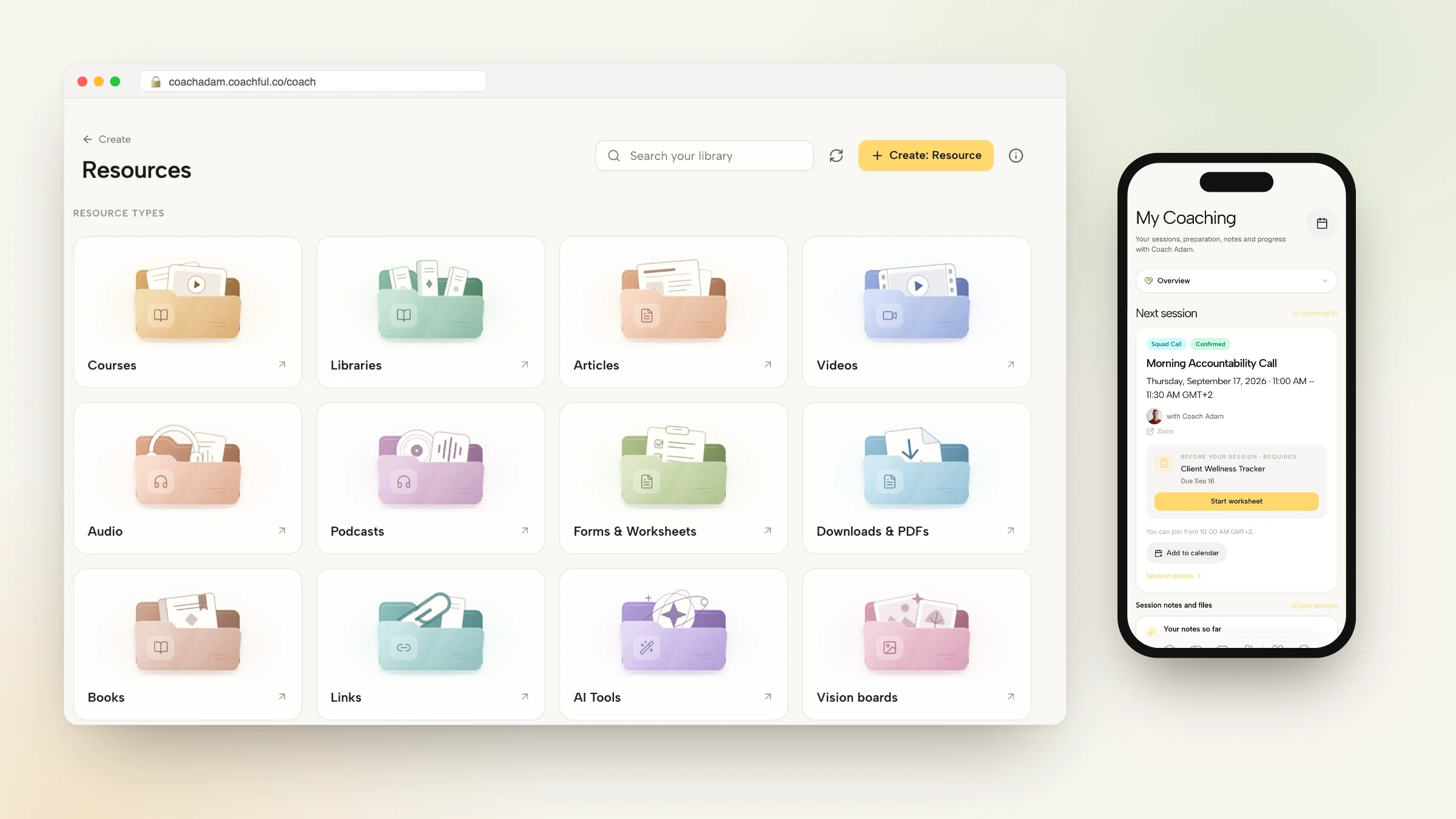
Add the survey link as a Links resource, or include it in an onboarding flow, so new clients take it before the first session and arrive with results.
The new-way experiment as a habit
"Say one thing I like about an idea first, every meeting" becomes a habit with a reminder. The client ticks it off and can see their progress across the week.
Strengths tied to the goal
Save the goal with milestones and use the weekly reflection to ask which strength helped. That keeps strengths connected to results rather than staying a profile on the wall.

A strengths program
A six-week strengths program, with one virtue a week, a short lesson, a worksheet and a practice, works well for groups and teams.

Strengths-spotting in a group
In a group program, a community space where members name strengths they noticed in each other turns strengths-spotting into a weekly habit.

Seeing the journey
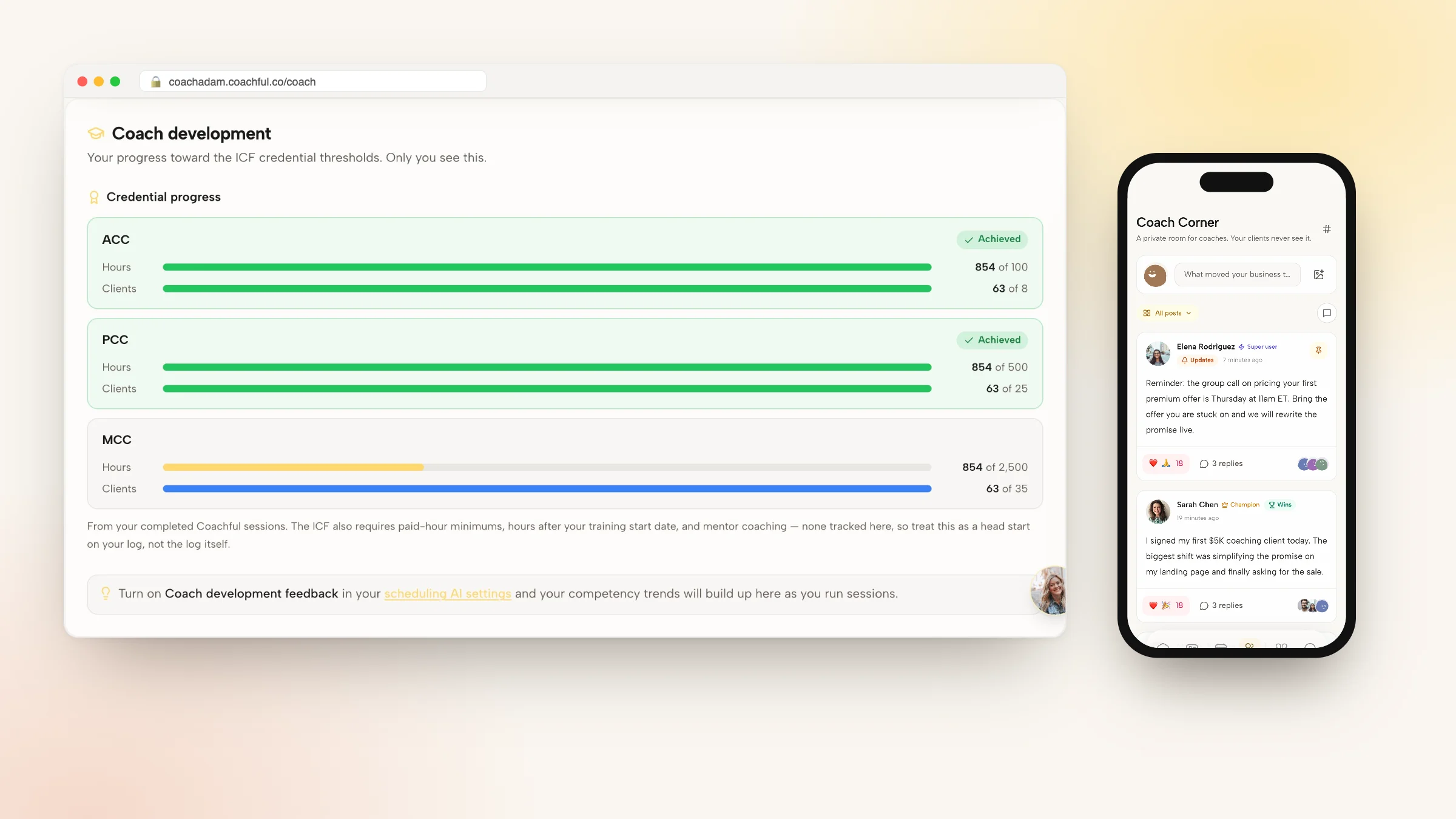
The client's Progress tab shows their journey and programs together, so the strengths work sits inside the larger arc of the engagement.

Let our team build your strengths program
Coachful's white-glove service is free on every plan. From Create > We'll build it for you, ask the team for strengths worksheets, an onboarding flow that sends clients to the survey, a six-week strengths program or a website. Attach your materials. The team replies by email, usually within about 24 hours, and builds it in your account so you can edit it. Read what the free white-glove service includes, and see our pages for life coaches and confidence coaches.

Related: positive psychology coaching, the wider field VIA came from, and Enneagram coaching, if you're comparing personality frameworks.
Frequently asked questions
What are the 24 VIA character strengths?
Creativity, curiosity, judgment, love of learning, perspective (wisdom); bravery, perseverance, honesty, zest (courage); love, kindness, social intelligence (humanity); teamwork, fairness, leadership (justice); forgiveness, humility, prudence, self-regulation (temperance); and appreciation of beauty and excellence, gratitude, hope, humor, spirituality (transcendence).
What are signature strengths?
They are the strengths near the top of your VIA ranking that feel most like you, come naturally and give you energy. The top five on a report are a starting point; a coach helps you confirm which ones are truly signature strengths through real examples.
Does using character strengths really work?
Partly. Trials show strengths exercises can increase happiness for weeks to months, and a 2025 synthesis of 162 trials found good evidence for building kindness, humor, hope, perspective and gratitude, but not enough evidence for most of the 24 strengths.
Should I focus on top strengths or bottom strengths?
Either can help. In a trial of 375 adults, using signature strengths and using lesser strengths both increased happiness, and people with higher overall strength scores benefited more from working on lesser strengths. Let the client choose, with a concrete plan.
How is VIA different from StrengthsFinder?
VIA measures character strengths, meaning moral and personal qualities such as honesty or kindness, using a classification developed by psychologists. CliftonStrengths, once called StrengthsFinder, measures talent themes linked to work. Many coaches use both for different questions.
Do I need certification to use VIA in coaching?
Training is optional rather than a credential. VIA offers courses such as its eight-session Character Strengths Interventions course with MentorCoach, and a professional dashboard for sending the survey to clients. Check VIA's terms before using its reports in paid work, and pair strengths training with accredited coach training.
Will Coachful build a VIA strengths program for me for free?
Yes. The white-glove service is free on every Coachful plan. Ask from Create > We'll build it for you and the team will build strengths worksheets, an onboarding flow or a full program in your account, usually within about 24 hours.