Ikigai Coaching: The Real Concept, the Venn Myth, a Session
Ikigai coaching helps clients find and strengthen their ikigai, a Japanese word usually translated as "a reason for living" or "what makes life worth living". In practice, coaches use it in two different ways: the Japanese sense of everyday sources of meaning and joy, and the popular Western four-circle diagram (what you love, what you're good at, what the world needs, what you can be paid for) as a career and purpose tool. Most clients don't know these are different, and a good ikigai coach explains it before starting.
This guide covers what ikigai really means and where the famous diagram came from, what research shows (large Japanese cohort studies, all observational), a session with sample dialogue and 12 questions, who ikigai coaching suits, the cautions, and training. If you coach on Coachful, our team will build the ikigai worksheet, daily check-in and program in this guide in your account for free.
What ikigai actually means
The word combines iki (life) and kai (effect, worth), and the Oxford English Dictionary, as cited in the Wikipedia entry on ikigai, defines it as "a motivating force; something or someone that gives a person a sense of purpose or a reason for living". In Japan it can be very ordinary: a morning walk, a grandchild, a garden, the regulars at your café, or your work.
The psychiatrist Mieko Kamiya is credited with popularizing the idea in her 1966 book On the Meaning of Life (Ikigai ni tsuite), written from her work with leprosy patients at Nagashima Aiseien Sanatorium. In English, the neuroscientist Ken Mogi's Awakening Your Ikigai (2017) and Héctor García and Francesc Miralles's bestseller Ikigai: The Japanese Secret to a Long and Happy Life (2016) brought the word to a wide audience.
The ikigai Venn diagram is not Japanese
The four-circle diagram that appears on most ikigai posters has a Western origin. According to the Wikipedia entry, the diagram in García and Miralles's book was made by Marc Winn and was likely inspired by a 2011 "purpose" diagram by Andrés Zuzunaga, with "purpose" replaced by "ikigai". Ikigai Tribe, a group that teaches ikigai to coaches, states plainly on its site that ikigai "is not a Venn diagram to find your bliss".
| Japanese ikigai | The Western four-circle diagram | |
|---|---|---|
| Main question | What makes my life feel worth living, day to day? | Where do passion, skill, need and income overlap? |
| Does it need to pay? | No. Many people's ikigai has nothing to do with money | Yes. Being paid is one of the four circles |
| Scale | Often small and plural: people, routines, roles | Usually one big answer, often a career |
| Best used for | Well-being, transitions, retirement, recovering meaning | Career exploration and positioning |
| Risk | Can feel vague without structure | Can make people feel like failures if their life doesn't fit all four |
Both can be useful. The honest move is to say which one you're using. "Let's use a career framework that borrowed the word ikigai" is fine. Calling the diagram "the ancient Japanese secret" is not.
What the research says about ikigai
- Mortality in a large Japanese cohort. The Ohsaki Study asked 43,391 Japanese adults "Do you have ikigai in your life?" and followed them for seven years. People who said they did not have ikigai had about 1.5 times the risk of dying from any cause, driven by cardiovascular disease and external causes, but not cancer.
- Health in older adults. A 2022 outcome-wide study of Japanese adults aged 65 and over found that having ikigai was associated with a 31% lower risk of functional disability and 36% lower risk of dementia over three years, along with fewer depressive symptoms and higher life satisfaction. Some associations were stronger for men and for people with higher socioeconomic status.
- Purpose in life outside Japan. In a US study of 6,985 adults over 50, people in the lowest life-purpose category had 2.43 times the all-cause mortality risk of those in the highest.
Two big caveats. All of these are observational: they show that ikigai and health go together, not that finding ikigai improves health, and sickness can reduce ikigai as easily as the other way round. And none of them tested ikigai coaching, or the Venn diagram. We found no trials of ikigai coaching at all. What the research does support is that a sense of meaning in everyday life matters, which is a sound reason to coach for it, without promising longevity.

How to run an ikigai coaching session
- Explain the two meanings. Ask which the client wants: everyday meaning, a career direction, or both.
- Start small. Ask what already makes life feel worth living, this week, including small things.
- Map the sources. People, roles, routines, places, work. Notice which ones are fading.
- If it's a career question, use the four circles as questions, not a test. Explore each one separately, and treat "what you can be paid for" as a practical constraint rather than a condition for meaning.
- Look for overlaps worth testing. Not the one perfect answer; two or three directions to try.
- Design small experiments. A conversation, a volunteer shift, a side project, an hour a week.
- Protect daily ikigai. Choose one small source of meaning to keep, whatever else changes.
- Review and refine after the experiments, not before.
A short sample dialogue
Margaret is retiring from a 30-year accounting career. Illustrative, not a transcript.
Margaret: I filled in that ikigai diagram online and I've got nothing in the middle. It's depressing.
Coach: That diagram is a career tool that borrowed the word. The Japanese idea is simpler. What makes a day feel worth it for you right now?
Margaret: Walking the dog with my neighbor. And helping my nephew with his small business taxes, actually.
Coach: What do you enjoy about helping your nephew?
Margaret: Watching it click for him. I never got to teach at work.
Coach: So teaching and being useful show up. Where else could you try that, in small ways?
Margaret: The library runs a tax help clinic in spring. And maybe a money basics session at the community center.
Coach: Which one could you test in the next month?
Margaret: I'll call the library this week. And the dog walks stay, whatever happens.
12 ikigai coaching questions
- What makes a day feel worth living for you right now?
- What small things would you miss most if they disappeared?
- Who are you glad to be needed by?
- When do you lose track of time?
- What do people come to you for?
- What did you love doing at ten years old?
- What problem in the world do you notice and care about?
- What could you be paid for that you'd also enjoy?
- Which part of your current life feels most like you?
- Which source of meaning has quietly faded?
- What small experiment could tell you more within a month?
- What will you protect, whatever else changes?
Ikigai work overlaps with values clarification and the Wheel of Life; many coaches run one of those first.

Who ikigai coaching suits, and who it doesn't
It suits people in career change or early retirement (see our sibling guides to career change coaching and retirement coaching); people recovering from burnout who need meaning rebuilt in small pieces; empty-nesters and people after a move; and anyone whose life has become efficient but flat.
It suits less well clients facing an urgent financial crisis, who need a practical plan first; people who want a definitive answer from one worksheet; and clients who say nothing makes life worth living at all.
Cautions for ikigai coaches
- "Nothing makes life worth living" is a clinical flag. If a client says this and means it, pause the exercise and ask about their safety and support. Refer to a licensed professional or crisis line; our guide to trauma informed coaching covers how to have that conversation.
- Don't sell longevity. The cohort studies are associations. "Find your ikigai and live longer" is a claim nobody has tested.
- Respect the culture. Ikigai is a living Japanese word, not a brand. Describe it accurately and avoid exoticizing it.
- Don't make the circles a test. A client with nothing in the middle hasn't failed. Most people's meaning comes from several places.
Ikigai coaching training
There is no recognized credential for ikigai coaching. One provider we checked on its own site in October 2026, Ikigai Tribe, run by Nicholas Kemp, offers an Ikigai Tribe Coach Certification in cohorts; the site did not list its length, price or any accreditation. Treat any ikigai certificate as continuing education on top of coach training, and check whether it carries ICF Continuing Coach Education units. For a coaching credential, see the ICF credentials.
Running ikigai coaching inside Coachful
Ikigai work is a mix of reflection and small experiments, both of which need a place to live between sessions. This is how coaches set it up in Coachful, all included in your membership.
The ikigai worksheet, edited honestly
Tools > Explore includes an editable Ikigai exploration worksheet built on the four questions (what you love, what you're good at, what the world needs, what you can be paid for), and a Purpose exploration worksheet (meaning, strengths, contribution, legacy). Since the four-question version is the Western framing, add an introduction that says so, and a first section on everyday sources of meaning.
Daily ikigai as a check-in
A short evening coaching flow can ask "What made today feel worth it?" with a Journal Page the client keeps private. Over a few weeks, the answers show which sources of meaning actually recur.

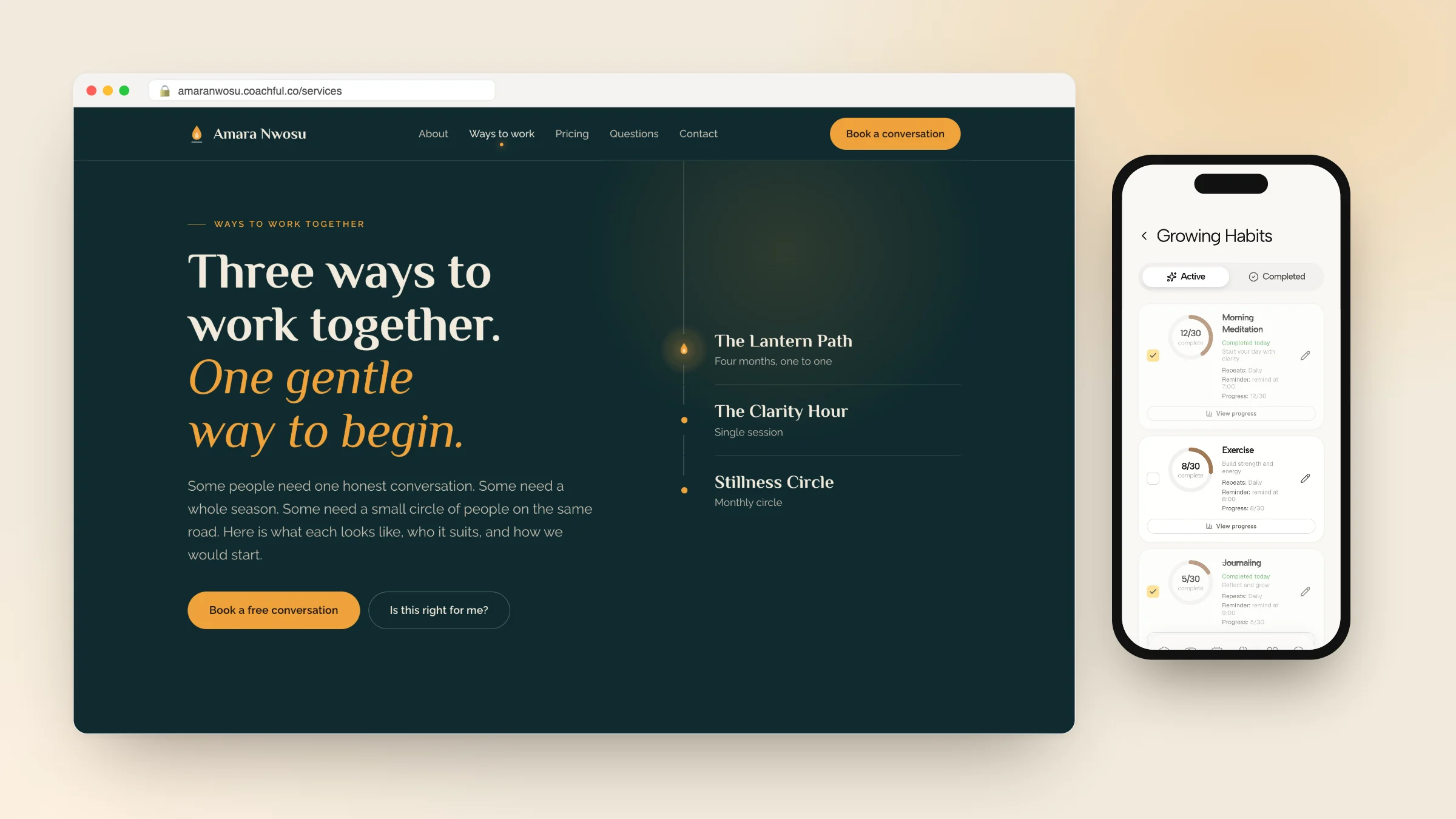
Protected sources as habits
The source of meaning the client wants to protect ("walk with my neighbor") can become a habit with a reminder, so it doesn't get squeezed out during a transition.
Experiments as goals
Each experiment ("call the library about the tax clinic") can be a goal with milestones, and the client can start a weekly reflection from it.

The bigger picture
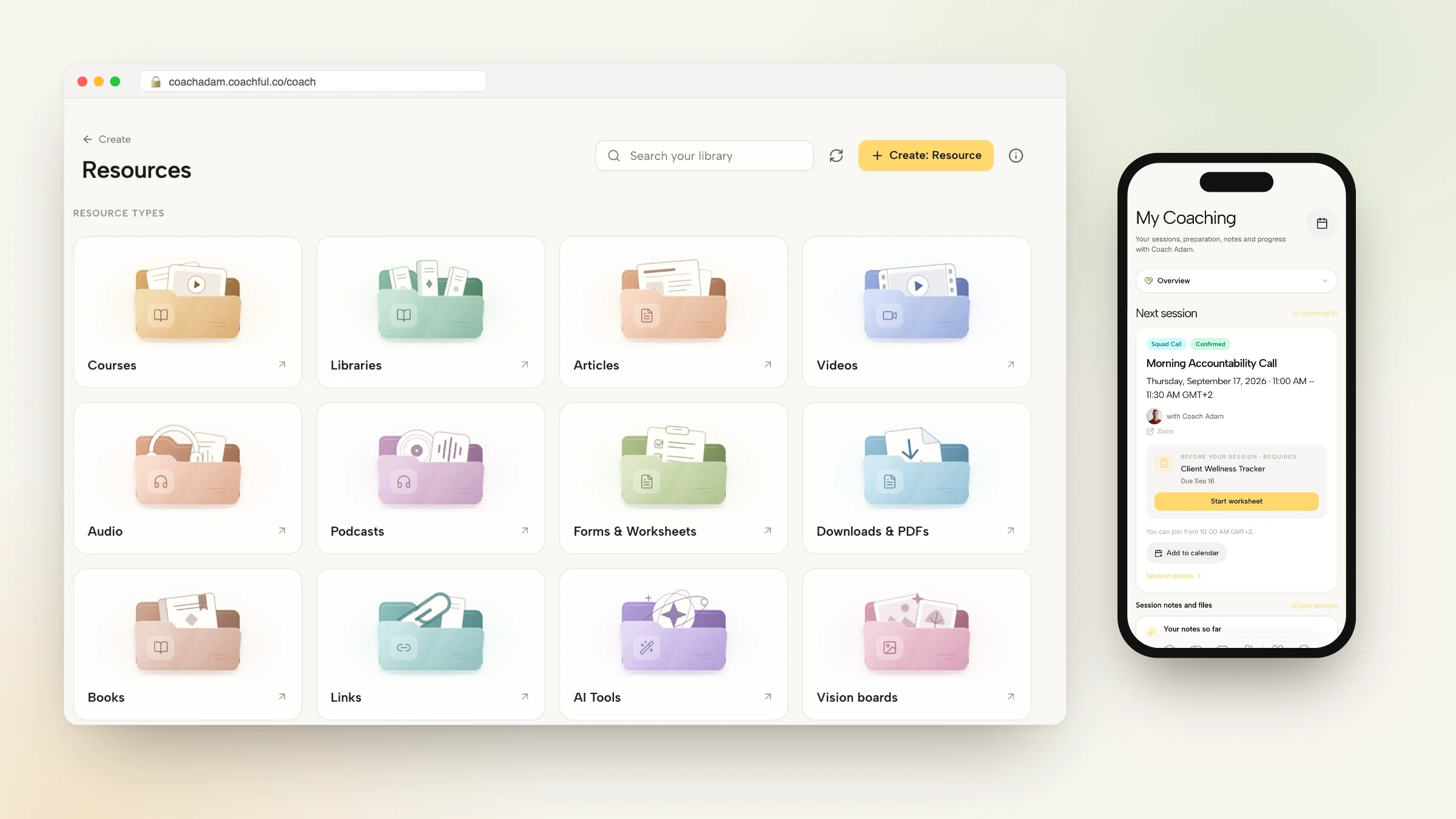
Many clients like to collect images for what they're moving toward. Coachful's vision boards hold those, and the client's My Coaching page shows what to do next across sessions, worksheets and goals.

A purpose coaching website
Coachful's designed homepage templates include one written for spiritual and purpose coaching. See our pages for spiritual coaches and career coaches.

Let the Coachful team build it
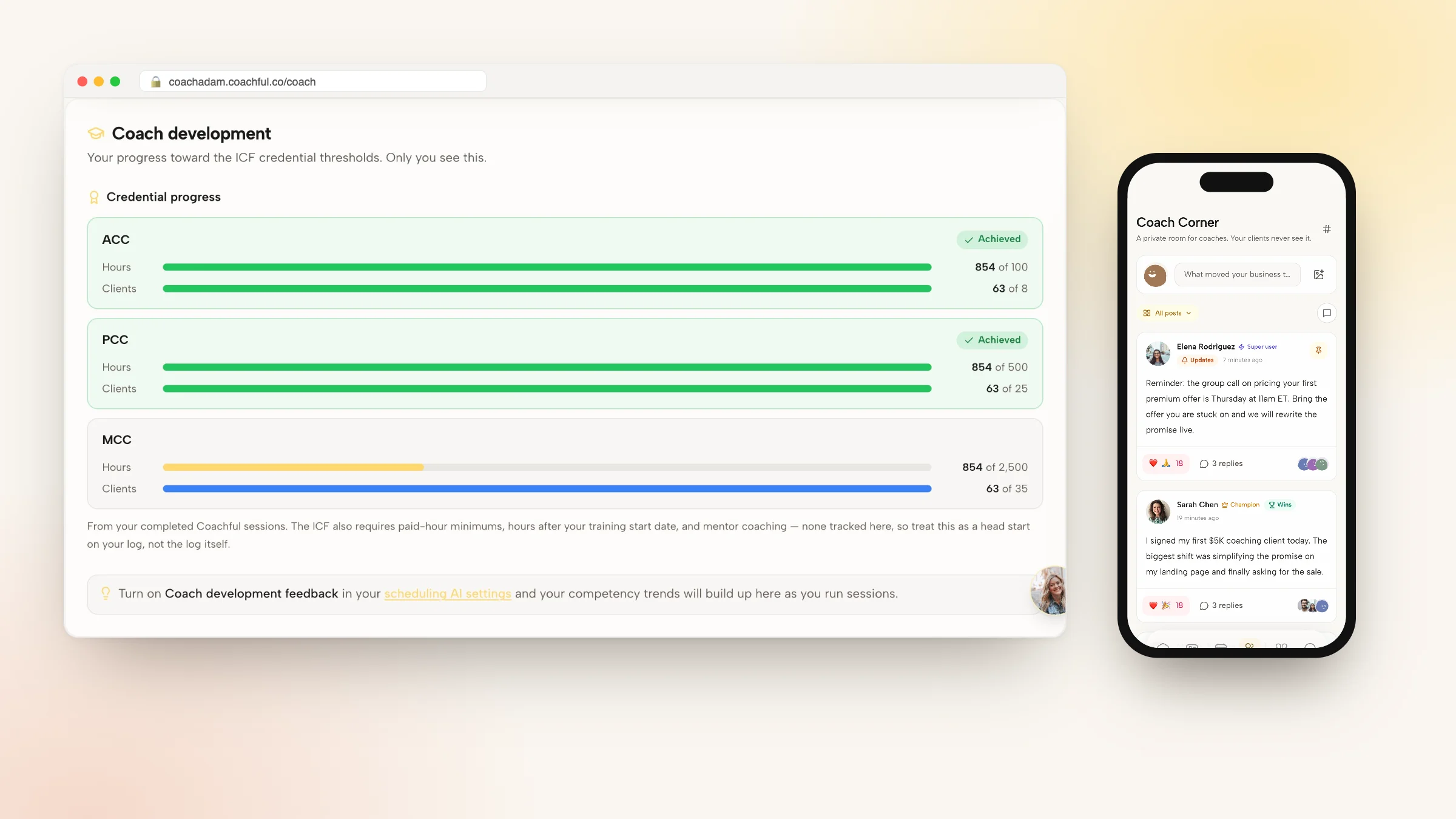
Coachful's white-glove service is free on every plan. From Create > We'll build it for you, ask the team to build your ikigai worksheet, a daily meaning check-in, a retirement transition program or a website. Attach anything you use now. The team replies by email, usually within about 24 hours, and builds it in your account so you can edit it. Nothing is invented, including research claims. Read what the free white-glove service includes.

Related: VIA character strengths coaching for the "what you're good at" circle, and positive psychology coaching for the wider research on meaning.
Frequently asked questions
What is ikigai coaching?
It is coaching that helps clients find and strengthen their ikigai, their reasons for feeling life is worth living. Some coaches use the Japanese sense of everyday meaning; others use the Western four-circle diagram for career and purpose. A good coach explains which they're using.
Is the ikigai Venn diagram really Japanese?
No. The four-circle diagram (love, skill, need, pay) appears to come from a 2011 "purpose" diagram by Andrés Zuzunaga, later relabeled "ikigai" by Marc Winn. In Japan, ikigai doesn't require being paid or combining all four elements.
Does having ikigai make you live longer?
Large Japanese studies link having ikigai with lower mortality and lower risk of disability and dementia, but they are observational. They don't prove that finding ikigai causes better health, and no trial has tested ikigai coaching.
How do you find your ikigai?
Start with what already makes your days feel worth living, including small things, then notice which sources are fading. If you want a career direction, explore the four questions separately and test two or three overlaps with small experiments instead of looking for one perfect answer.
Who wrote the first book on ikigai?
The psychiatrist Mieko Kamiya is credited with popularizing the concept in her 1966 book Ikigai ni tsuite (On the Meaning of Life). Ken Mogi's Awakening Your Ikigai and García and Miralles's Ikigai introduced it to English readers.
Is there an ikigai coaching certification?
There is no recognized credential. Some private providers, such as Ikigai Tribe, offer ikigai coach certifications. Treat them as continuing education alongside accredited coach training.
Will Coachful build an ikigai program for me for free?
Yes. The white-glove service is free on every Coachful plan. Ask from Create > We'll build it for you and the team will build your ikigai worksheet, a daily check-in or a full program in your account, usually within about 24 hours.