
Career Change Coaching: How It Works, Costs and Tools
Career change coaching helps you move into a different line of work with fewer false starts. A coach works with you through four stages: getting clear on what you want and what you are good at, exploring realistic options, testing them before you leap, and planning and running the move itself, from finances and retraining to applications and interviews. Most engagements run about three months of regular sessions. A coach does not hand you the answer, and is not a licensed career counselor unless they say so.
The hard part of changing careers is rarely the CV. It is the months of circling: knowing you want out, not knowing what "in" looks like, and being unable to justify the risk to yourself or the people who depend on you. That is where coaching helps most. This guide covers what career change coaching involves at each stage, how it compares with career counseling, what the research on career interventions found, the free tools worth using first, what coaching costs and how to choose a coach.
A career change, or a job change?
It helps to be honest about which one you need. Changing employers is common: the Bureau of Labor Statistics follows a group of Americans born between 1957 and 1964, and they held an average of 12.9 jobs between the ages of 18 and 58, most of them before 35 (BLS, National Longitudinal Survey of Youth 1979). A "job" there means time with one employer, so most of those moves were not career changes at all.
A real career change means different work: a teacher becoming an instructional designer, an accountant moving into nonprofit leadership, a nurse moving into health tech. If what you dislike is your manager, your hours or your company, a new job in the same field may solve it faster. A good coach will test this with you in the first session rather than assuming you need a whole new career.
The four stages, and what a coach does in each
| Stage | Your questions | What the coach helps you do |
|---|---|---|
| 1. Clarity | What do I actually want? What am I good at? What can I not stand? | Values, interests and strengths exercises; a clear picture of the must-haves and deal-breakers |
| 2. Exploration | What roles fit that? Which are realistic for me? | A shortlist of directions, research, informational conversations with people in those roles |
| 3. Testing | Will I like it? Can I do it? | Small experiments: a course, a volunteer project, freelance work, shadowing, a side project |
| 4. Transition | How do I make the move without wrecking my finances? | Financial runway, retraining plans, a story that connects old and new, applications, interviews and negotiation |
People often want to skip from stage 1 straight to stage 4. Coaches tend to slow that down, because stage 3 is where expensive mistakes get caught cheaply. When you get to applications, our guide to interview coaching covers the final stretch.
Career coach, career counselor, recruiter or mentor?
| Who | What they do | Good to know |
|---|---|---|
| Career coach | Clarity, options, action plan, job search support | Unregulated title; credentials are voluntary |
| Career counselor | Assessment, counseling and career planning, sometimes alongside mental health support | Some states require a license for career counselors, and requirements vary by state (BLS) |
| Recruiter | Fills specific roles for employers | Paid by the employer, so focused on their openings, not your whole career |
| Mentor | Advice from someone already in the field you want | Invaluable for exploration, rarely structured |
See a licensed professional when...
- The urge to change careers comes with persistent low mood, hopelessness, exhaustion or anxiety. Burnout and depression can make every job look wrong. A doctor or therapist can help you tell the difference, and coaching can follow.
- You need a financial plan for a pay cut, a period without income or retraining costs. A licensed financial adviser or planner can model it properly.
- You are leaving a job with a contract, a non-compete or a severance offer you do not understand. Ask an employment lawyer.
- You have thoughts of harming yourself. In the US, call or text 988 to reach the 988 Suicide and Crisis Lifeline.
What career change coaching sessions look like
A first session usually covers your work history, what you liked and disliked in each role, what is pushing you to change now, your constraints (money, location, family, time) and what a good outcome would look like a year from now. Many coaches send a short questionnaire first.
Early sessions lean on reflection exercises: values, the high points of your working life, a wheel-of-life check on what else is going on. Coachful's Wheel of Life assessment is a quick way to try this yourself. Some coaches use vision boards to help clients picture the work and life they are aiming for.

Middle sessions are about exploration and experiments: who you will talk to this month, what small test you will run, what you learned. A coach keeps this moving when your current job eats the week. Some coaches structure the whole change as a journey with steps, so you can see where you are and what comes next.

Later sessions shift to the move itself: dated goals for applications, conversations and retraining, then interview practice.

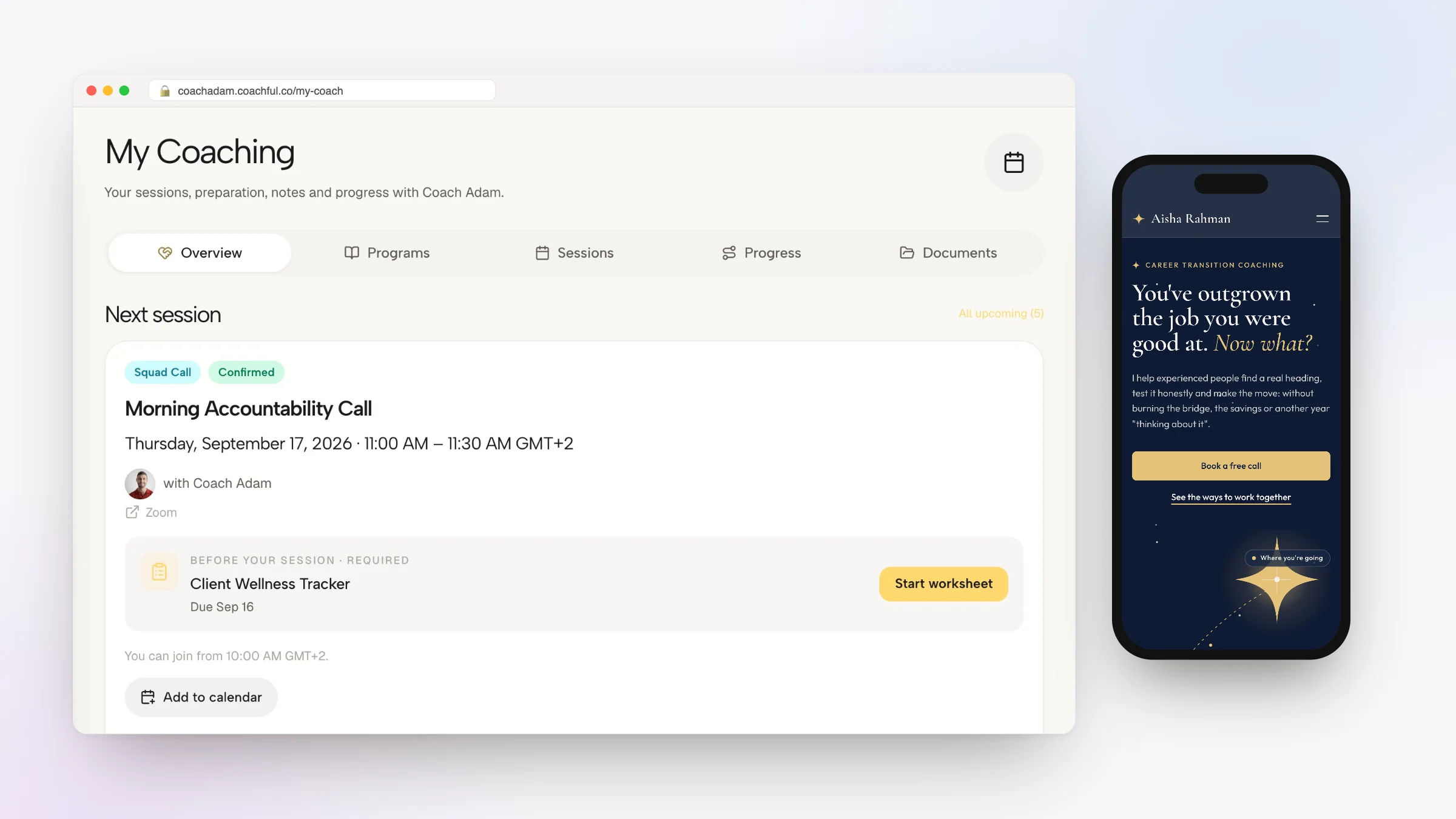
In Coachful's client app, the coach can also set prep before each session and a short list of what is due, which helps when the change is happening around a full-time job.

What the research says about career interventions
There is little research on career change coaching under that name, but career counseling and career interventions have been studied for decades.
- Specific ingredients make career help work. A widely cited analysis by Brown and Ryan Krane (2000) found career interventions worked better when they included written exercises, individual interpretation and feedback, information about the world of work, modeling from people who have made similar choices, and building support for your plans, and that combining three or more of these was much more effective than one or two.
- Later work confirmed part of that and added more. A 2017 meta-analytic replication by Whiston and colleagues in the Journal of Vocational Behavior identified counselor support, values clarification and psychoeducation as additional helpful components, as a 2024 review in Frontiers summarizes (Wang and colleagues, 2024).
- Coaching in general has positive effects. A meta-analysis by Theeboom, Beersma and van Vianen found coaching improved performance, well-being, coping and goal-directed self-regulation.
That list is a useful checklist for choosing a coach. Ask whether they give you written exercises, interpret them with you, push you to gather real information about the work, connect you with people who have done it and help you line up support. A coach who only talks about mindset is leaving out most of what the research says works.
Do the free groundwork first
CareerOneStop, sponsored by the US Department of Labor, has a hub for career changers and a six-step guide to switching careers with a worksheet. Two of its tools are worth an hour:
- The Skills Matcher, where you rate yourself on 40 workplace skills and see occupations that use them.
- The Interest Assessment, 30 questions in about five minutes, powered by the O*NET Interest Profiler.
Bring the results to your first coaching session. You will get further, faster, and you will know whether you need a coach at all.
What career change coaching costs
Career change coaching falls under career coaching in Coachful's 2026 Coaching Business Report, which compiles published research and practitioner reports for the second quarter of 2026.
| Package | What it usually includes | Typical price |
|---|---|---|
| Single session | One 50-minute session prepared from an intake form | $99 to $280 |
| Job search sprint | Four 50-minute sessions over four to six weeks, CV review and LinkedIn audit | $500 to $1,000 |
| Career transition | Eight 50-minute sessions over three months, interview prep and negotiation coaching | $1,200 to $2,500 |
US dollars, Q2 2026. Single-session range from 35 coaches' published rates on one marketplace, Career Contessa; packages from practitioner reports. Career coaching generally runs $100 to $250 an hour (PayScale and practitioner reports). See coachingrates.com. Practitioner figures are estimates.
For a career change, the three-month transition package is the most common shape, since clarity and testing take time. The report notes that career coaching is usually bought at a moment of urgency, which supports a high single-session price but rarely a long engagement. If you are early and unsure, a single session to map the options is a reasonable first spend. More detail is in how much career coaches charge.
How to choose a career change coach
Credentials and backgrounds
- NCDA credentials. The National Career Development Association's Certified Career Services Provider (CCSP), for coaches, advisors and resume writers, requires its Facilitating Career Development training and, from January 2026, an exam. Its Certified Career Counselor (CCC) requires a master's degree in counseling plus career counseling experience or training.
- ICF credentials for coaching skills and supervised hours (ICF credentialing).
- A personal career change, or deep experience in the field you are moving toward. Ask about both.
Questions to ask
- How many people have you helped change careers, and into what kinds of work?
- What exercises and assessments do you use, and how do you interpret them with me?
- How do you help clients test a direction before committing?
- Do you help with the job search and interviews too, or only the clarity stage?
- How do we know, by week six, whether this is working?
Red flags
- Promises of a new career, or a salary, by a set date.
- A single personality test presented as the answer.
- Pressure to quit your job before you have tested the new direction.
- Upselling expensive certifications or courses the coach profits from.
- No written agreement on sessions, price and cancellations.

The sample template above, with a fictional career transition coach, shows the right promise: help to find a real heading, test it honestly and make the move "without burning the bridge, the savings or another year thinking about it".
Find a career change coach on Coachful
Coachful's Find a Coach directory is public, so you can browse without an account. Search "career change", "career transition" or "career" to find coaches whose headline or bio mentions them, or browse the Tech and Skills and Business categories. The Find My Coach quiz asks what you want to improve, where you are now (including "stuck" and "transforming"), your preferred style and your monthly budget, and returns a shortlist.
Each profile shows the coach's background, credentials and method where they have added them, any programs and prices, and a calendar to book a discovery call or a form to send a message. Our guide to how to find a career coach has more on shortlisting.


Are you a career coach?
Read how to become a career coach for training and first clients. Coachful's page for career coaches covers job search cohorts, mock interview booking and client trackers for connections, applications and CVs, and the team will build your website or funnel for you at no extra cost through the free white-glove service.
Frequently asked questions
What does a career change coach do?
A career change coach helps you work out what you want, explore realistic options, test them with small experiments and plan the move, including finances, retraining, applications and interviews. They ask questions and give structure rather than telling you which career to choose.
Is career change coaching worth it?
It often is if you have been circling a change for months and want structure to act on it. Research on career interventions finds they work best with written exercises, individual feedback, real information about work, role models and support, which good coaches provide. Try the free CareerOneStop tools first.
How much does a career change coach cost?
A three-month career transition package of eight sessions typically costs $1,200 to $2,500, and career coaching generally runs $100 to $250 an hour, according to Coachful's 2026 Coaching Business Report. Single sessions on one marketplace ranged from $99 to $280.
How long does a career change take with a coach?
Coaching packages for career transitions commonly run about three months, which covers clarity, exploration and a plan. The change itself can take longer, especially if it needs retraining or a financial runway.
What is the difference between a career coach and a career counselor?
A career counselor usually has a counseling degree and may be licensed, depending on the state, and can combine career planning with mental health support. A career coach focuses on goals, options and action, and the title is unregulated.
Is it too late to change careers at 40 or 50?
Not necessarily. People change careers at every age, and a coach can help you build on experience rather than start from zero. The practical questions are money, retraining time and how to tell a story that connects your past work to the new direction.












