
Interview Coaching: How It Works, Costs and Results
Interview coaching is focused preparation with a coach for job interviews: researching the role, building a bank of strong examples from your experience, practicing answers out loud in realistic mock interviews, getting specific feedback, and preparing to negotiate the offer. It can be one session before a big interview or a few weeks of practice during a job search. Research on candidates in structured interviews links coaching and practice to better interview performance. A coach cannot guarantee an offer, and a good one never scripts you to say things that are not true.
Most people do not fail interviews because they lack the experience. They fail because the right story does not come out in the right two minutes, or because nerves turn a good answer into a ramble. That is very coachable. This guide covers what interview coaching involves, what a mock interview session looks like, what the research found, what it costs, the excellent preparation help that costs nothing, and how to pick a coach worth paying.
What an interview coach helps with
| Stage | What the coach does |
|---|---|
| Before you apply | Reads the job description with you, works out what the employer is really testing for, sharpens how you describe yourself |
| Your story bank | Helps you pick six to ten experiences that show the skills the role needs, and shape each into a clear situation, action and result |
| Practice | Runs mock interviews in the format you will face, from a phone screen to a panel or case interview, and gives specific feedback |
| Hard questions | Gaps in your CV, being laid off, career changes, "why are you leaving?", salary expectations |
| Presentations and tasks | Interview presentations, take-home exercises and live tests |
| The offer | Preparing to negotiate pay and terms, and deciding between offers |
Interview coaching is often one part of wider career coaching. If you are still deciding what job to go for, our guide to career change coaching covers that stage, and what is career coaching explains the field as a whole.
What a mock interview session looks like
A good first session starts with the job: the description, what you know about the company and the interview format if you have it. Then the coach asks you a handful of likely questions, often recorded, and you answer as you would on the day.
The useful part is the review. Expect feedback like:
- "Your answer about the project was strong, but the result came at minute three. Lead with it."
- "You said 'we' eleven times. What did you do?"
- "When they asked about the gap year, you apologized. Try the version that explains it in two sentences and moves on."
- "You are speaking fast at the start of every answer. Breathe before you begin."
Then you answer again with the change. A session usually covers four to eight questions properly, rather than twenty badly. Between sessions you practice out loud, refine your stories and send the coach new drafts.
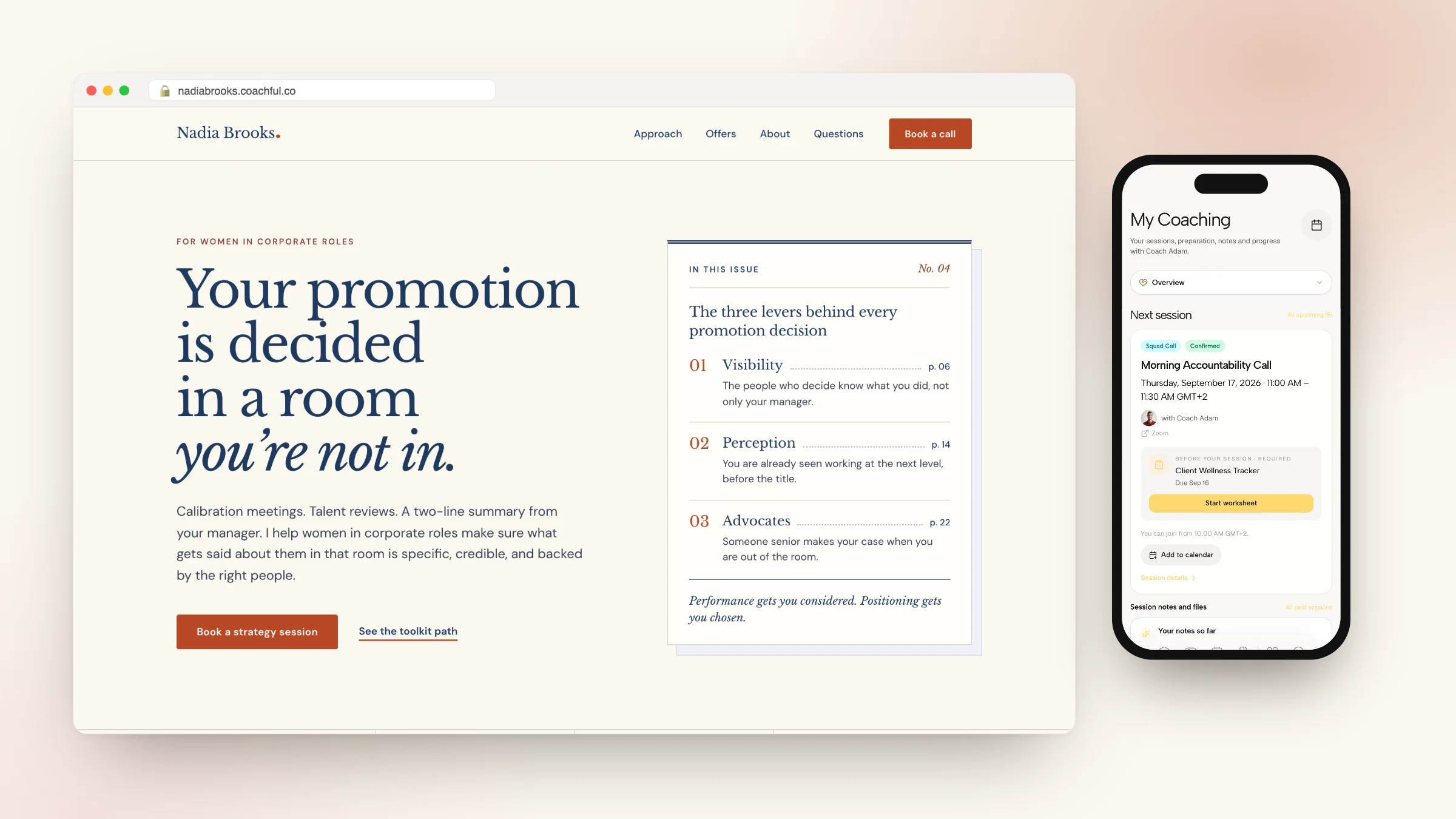
Where a coach uses a client app, the next session and any prep sit together. In Coachful's client app the coach can require a short worksheet before a session, such as a list of your target roles or a draft answer, so the time goes on practice.

The coach's notes become a running summary you can reread the night before the real interview, which is far more useful than trying to remember feedback from a week ago.

During an active job search, a dated goal keeps the search moving: a set number of tailored applications a week, or three informational conversations before the end of the month. Coachful's career coaching tools, for example, include a shared tracker for applications and interviews with reminders for follow-ups.

And a quick message after the real interview ("they asked about the reorg, I froze a bit") gives your coach material for the next round.

Does interview coaching work?
Interview coaching has been studied mostly in public-sector promotion interviews, where the stakes are high and the interviews are structured. The findings are encouraging and specific.
- Coaching attendance predicts better interview scores. In police and fire promotion interviews, attending a coaching program was linked to better scores in three of four jobs, after accounting for job knowledge and motivation (Maurer, Solamon and Troxtel, 1998). A follow-up with 213 candidates found the same, and that study groups and role-play added further benefit. Coaching seemed to work partly by helping candidates organize their answers (Maurer and colleagues, 2001).
- Good coaching does not "game" the interview. Later research found that coaching focused on job-relevant content made structured interviews more reliable and more predictive of performance, not less (Maurer, Solamon and Lippstreu, 2008, in the Journal of Organizational Behavior). More comprehensive coaching produced higher ratings in an experiment with 144 people (Tross and Maurer, 2008).
- Practice volume matters. Across four randomized trials of virtual reality job interview training, people who completed more practice interviews developed better interview skills, which in turn predicted job offers within six months. Two of the authors are linked to the company that makes the tool (Smith and colleagues, 2017).
Why structured interviews matter: a 2022 re-analysis of decades of hiring research ranked structured interviews as the top selection procedure for predicting job performance (Sackett and colleagues, 2022). If employers increasingly ask every candidate the same job-related questions and score them consistently, preparing clear, relevant examples is exactly the right thing to practice.
Help that costs nothing
Before paying anyone, use CareerOneStop, a site sponsored by the US Department of Labor. Its interview preparation guide recommends researching the employer and practicing answers on paper and out loud, and notes you can ask for a free mock interview at an American Job Center. It also explains the common types of interviews, from screening calls to panel and group interviews, and how to negotiate your salary: wait for an offer before raising pay, ask for at least 24 hours to decide, base your request on the value you bring and remember that future raises build on starting pay. If you are a student or graduate, ask your college's career office what it offers.
What interview coaching costs
Interview coaching falls under career coaching in Coachful's 2026 Coaching Business Report, which compiles published research and practitioner reports for the second quarter of 2026.
| What you buy | Typical price | Where the number comes from |
|---|---|---|
| One hour of career coaching | $100 to $250 | PayScale and practitioner reports |
| A single session, such as one mock interview | $99 to $280 | Published rates from 35 coaches on one career coaching marketplace, Career Contessa |
| Job search sprint | $500 to $1,000 | Four 50-minute sessions over four to six weeks, with CV review and LinkedIn audit; practitioner reports |
| Career transition package | $1,200 to $2,500 | Eight sessions over three months, with interview prep and negotiation coaching; practitioner reports |
US dollars, Q2 2026. Full ranges on coachingrates.com. Practitioner figures are estimates, and the marketplace sample reflects that marketplace's pricing.
For most people, two or three focused sessions before an important interview is the efficient way to buy it. If you are interviewing for an internal promotion, ask whether your employer pays. For more on rates and packages, see how much career coaches charge.
How to choose an interview coach
Backgrounds and credentials
- Hiring experience. Recruiters, HR professionals and hiring managers in your field know what interviewers listen for. Ask how recently they hired.
- Certified Career Services Provider (CCSP). The National Career Development Association's credential for coaches, advisors and resume writers requires its Facilitating Career Development training and, from January 2026, an exam.
- Certified Career Counselor (CCC). Also from NCDA, it requires a master's degree in counseling plus career counseling experience or training. Some states require a license for career counselors, and requirements vary by state (Bureau of Labor Statistics).
- ICF credentials for coaching skills (ICF credentialing).
Questions to ask
- Have you coached people for roles like mine, at companies like the ones I am targeting?
- Do you run mock interviews in the format I will face, and do you record them?
- How do you help with nerves, or with a gap or a layoff in my history?
- Do you help with salary negotiation?
- How many sessions do you recommend for my timeline?
Red flags
- Guaranteed job offers or salary increases.
- Coaching you to exaggerate or invent experience.
- One script for every job and every company.
- Pushing an expensive CV and LinkedIn bundle before understanding your situation.
- No written terms on sessions, price and cancellations.
See a licensed professional when...
- Interview anxiety is so intense that you avoid applying, have panic attacks or cannot function on the day. A therapist trained in cognitive behavioral therapy can help, alongside practice.
- Job loss has brought on low mood, hopelessness or heavy drinking. Talk with a doctor or therapist; in the US, call or text 988 if you have thoughts of harming yourself.
- You believe you faced discrimination in hiring, or you need advice on a contract or severance. That is a question for an employment lawyer or the relevant government agency.

The sample template above, with a fictional career coach for women in corporate roles, shows what to look for on a coach's site: a precise audience, a clear point of view on how hiring and promotion decisions get made, and an obvious first session to book.
Find an interview coach on Coachful
Coachful's Find a Coach directory is public, so you can browse without an account. Search "interview", "career" or "job search" to find coaches whose headline or bio mentions them, or browse the Tech and Skills and Business categories, which cover career growth and landing better roles. The Find My Coach quiz asks what you want to improve, your preferred style, including a structured option, and your monthly budget, then shows a shortlist.
On a profile, look at the coach's background and credentials, check whether they offer a single session or a short package, and book a discovery call from their calendar or send a message.


Are you an interview or career coach?
Read how to become a career coach and career coach certification for training routes. Coachful's page for career coaches covers mock interview booking, interview prep packs and the client trackers for applications, interviews and CVs, and the team will build your website or funnel for you at no extra cost through the free white-glove service.
Frequently asked questions
What does an interview coach do?
An interview coach helps you prepare for job interviews: understanding what the employer is testing for, building strong examples from your experience, practicing answers in mock interviews with specific feedback, handling difficult questions and negotiating the offer.
Is interview coaching worth it?
It often is before an important interview or during a long job search. Studies of structured interviews link coaching and practice to better interview scores, partly because coached candidates organize their answers better. It cannot guarantee an offer, and you still need relevant experience.
How much does an interview coach cost?
Career coaching typically costs $100 to $250 an hour, and single sessions on one marketplace ran $99 to $280, according to Coachful's 2026 Coaching Business Report. A four-session job search sprint typically costs $500 to $1,000.
How many interview coaching sessions do I need?
For one important interview, one to three sessions is common: an assessment, practice on likely questions and a final run-through. During a longer job search, a four to eight session package covers preparation, practice and negotiation.
Can I get interview practice for free?
Yes. CareerOneStop, sponsored by the US Department of Labor, publishes interview and salary negotiation guides and notes you can ask for a free mock interview at an American Job Center. Your college's career office may help if you are a student or graduate, and a friend in your field can run a practice round.
Will interview coaching make me sound rehearsed?
Not if it is done well. Good coaching helps you know your examples well enough to tell them naturally, rather than memorizing scripts. Research on structured interviews found coaching on job-relevant content made interviews more accurate, not less.
What is the difference between an interview coach and a career coach?
Interview coaching is one focused part of career coaching. A career coach may also help you choose a direction, change careers, plan a job search, improve your CV and LinkedIn, and grow in your current role.












