
Career Coach Certification: NCDA, CCE, ICF and More
Career coach certification comes from three kinds of bodies, and they certify different things. Career development associations, chiefly the National Career Development Association (NCDA) and the Center for Credentialing & Education (CCE), certify career services knowledge and experience. Coaching bodies, chiefly the International Coaching Federation (ICF), credential coaching skill. And career-industry associations such as Career Directors International and PARW/CC award their own member certifications, often tied to résumé and interview work.
Which one you need depends on where your clients come from. NCDA and CCE credentials are built for career services work, the kind done in career centers and workforce programs, and CCE lists states that recognize its GCDF. Coachful's 2026 Coaching Business Report notes credentials are often mandatory for corporate coaching buyers, which usually means an ICF credential, while individual clients weigh outcomes and testimonials more. This guide compares the options as each body listed them in October 2026, with requirements and fees.
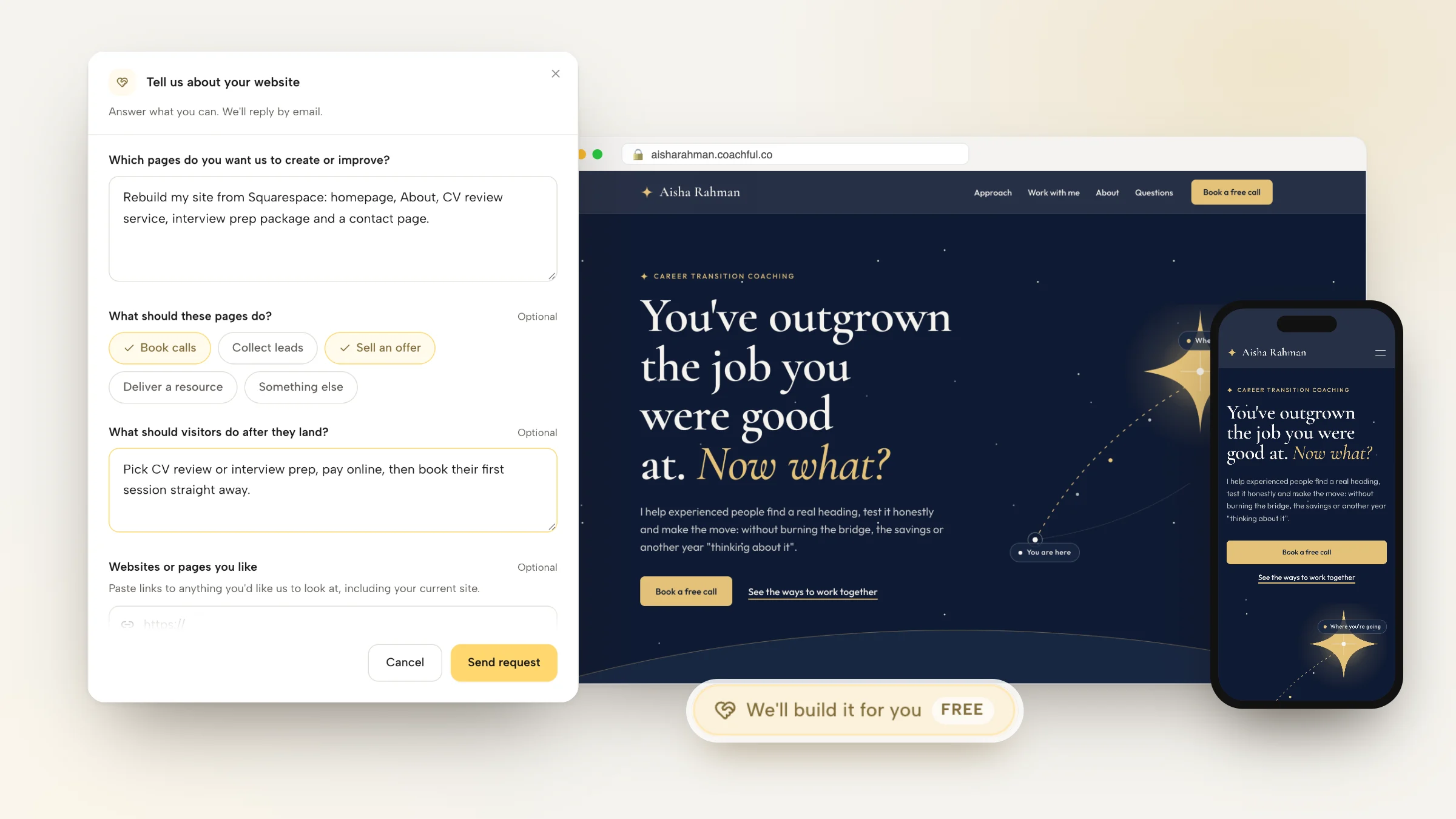
And once you're certified, Coachful's team will build your career coaching website for free on every plan, from the CV review page to the interview prep package.
Career coach certifications compared
Criteria: who issues the credential, then how much experience it requires.
| Credential | Issued by | Key requirements | Fees as listed, October 2026 |
|---|---|---|---|
| Certified Career Services Provider (CCSP) | NCDA | Complete NCDA's Facilitating Career Development (FCD) training; a 72-question exam, 70% to pass; no set education or experience level | $100 application (NCDA's FCD pages say graduates apply at no additional fee) |
| Global Career Development Facilitator (GCDF) | CCE | 120+ hours of training from a CCE registered provider, plus 1,400 to 5,600 hours of experience depending on your education | $100 application, $40 a year |
| ICF ACC or PCC | ICF | 60 or 125 hours of coach education, 100 or 500 coaching hours, mentor coaching, evaluation and exam | ACC $175 to $625; PCC $375 to $900 |
| Board Certified Coach (BCC) | CCE | 30 to 120 hours of coach training depending on your degree, coaching experience, an endorsement and the BCC exam | $279 ($229 for NCCs), $40 a year |
| Certified Master of Career Services (CMCS) | NCDA | A bachelor's and 7 years full time in career services, or a master's and 5 years; CCSP, GCDF or FCD | $175 |
| Certified Career Counselor (CCC) | NCDA | A master's or higher from a CACREP, CORE or APA accredited program, 8 core graduate courses, supervised career counseling experience | $175 |
| Certified Professional Career Coach (CPCC) | PARW/CC | 4 hours of documented coaching, a coaching plan, an open-book exam; membership required | $1,395 member, $1,570 non-member |
| Certified Employment Interview Consultant (CEIC) | Career Directors International | Self-study modules with emailed mentor feedback; membership required | $1,497 for members |

The credentials in more detail
NCDA: CCSP and Facilitating Career Development
NCDA's Facilitating Career Development (FCD) course is the usual entry point: up to 120 hours of instruction across 12 competencies, taught by registered NCDA instructors in person or online, in intensive six-week or semester-long formats. Tuition is set by each instructor, so it isn't published centrally; the course manual costs $275 in print or $250 electronically. FCD graduates can apply for the CCSP, which NCDA says needs no specific education or work experience, and whose 72-question exam moved online from January 1, 2026. FCD graduates are also eligible for CCE's GCDF. NCDA credentials cost nothing to maintain in year one, then $40 a year or $50 for two years, with a $100 recertification fee and 30 continuing education hours at year three.
NCDA: CMCS, CCC and CSCP
These are for experienced practitioners. The Certified Master of Career Services needs seven years of full-time career services work with a bachelor's (14,000 hours) or five years with a master's (10,000 hours). The Certified Career Counselor requires a counseling-type master's from a CACREP, CORE or APA accredited program and supervised clinical career counseling experience, though NCDA notes "certifications, licensure, and permission to practice are unrelated concepts." The Certified Supervisor of Career Practitioners, formerly the Certified Clinical Supervisor of Career Counseling, is for people who supervise others.
CCE: GCDF and BCC
The GCDF asks for at least 120 hours of training from one of CCE's registered providers, plus supervised experience that shrinks as your education rises: 1,400 hours with a graduate degree, 2,800 with a bachelor's, 4,200 with an associate degree and 5,600 with a high school diploma. It's valid for five years with 75 continuing education hours, and CCE lists states that recognize it. The BCC is CCE's general coaching credential, with seven pathways that set coach training at 30 to 120 hours depending on your degree, plus an exam.
ICF credentials for career coaches
The ICF credentials coaching skill, not career knowledge, and that's the point: it's the credential corporate coaching buyers check. Coachful's 2026 Coaching Business Report, drawing on the ICF Global Coaching Study 2025, notes credentials are often mandatory in corporate coaching. In October 2026 we couldn't confirm an ICF Level 1 or Level 2 program that specializes in career coaching, so most career coaches combine a general accredited program with career-specific training. Our guide to ICF accredited coaching programs lists options.
PARW/CC and Career Directors International
Both are career-industry associations whose certifications require ongoing membership. PARW/CC's Certified Professional Career Coach involves a 600-page manual, 4 hours of documented coaching, client goal forms, a coaching plan and an open-book exam, usually finished in 8 to 12 weeks; membership is $175. Its "CPCC" shares an acronym with a different, well-known coaching certification from the Co-Active Training Institute, so expect occasional confusion. Career Directors International's Certified Employment Interview Consultant is a self-study program of 18 modules over about six weeks, with no live classes; CDI membership is $267 a year. Neither names ICF or CCE accreditation.

Which certification matches your career coaching work
| If your clients come from... | Consider | Why |
|---|---|---|
| University career centers, workforce agencies, outplacement | FCD, then CCSP or GCDF | The career development field's own credentials |
| Companies buying coaching for employees | ICF-accredited training, then the ACC or PCC | Corporate buyers check coaching credentials |
| Individual job seekers and career changers | ICF training plus résumé or interview certifications | Skill and a visible specialty matter most |
| Résumé writing and interview prep clients | PARW/CC or Career Directors International | Industry-specific craft, with membership |
| Licensed counseling settings | A counseling license, then NCDA's CCC | Counseling is a licensed profession |
| Years in career services already | NCDA's CMCS | Recognizes long practice |
For the full career path, including niches and first clients, see our guide to how to become a career coach.
Career coaching versus career counseling
The two overlap, but they aren't the same profession. Career counseling is often practiced by licensed counselors, and NCDA's Certified Career Counselor requires a counseling-type graduate degree. Career coaching is unlicensed in most places: you help clients clarify direction, build a search, prepare for interviews and negotiate offers. When a client's job search is tangled up with depression, anxiety or a crisis, refer them to a licensed professional and keep coaching alongside if appropriate.

What career coaching pays
Coachful's 2026 Coaching Business Report puts career coaching at $100 to $250 an hour, from PayScale and practitioner reports, with newer coaches at $75 to $150 and experienced ones at $150 to $300. Its verified sample of published career coaching rates clustered between $99 and $280. The report notes career coaching is bought "at a moment of urgency," which supports a strong single-session price but rarely a long engagement, so packages matter. See career coaching rates and our guide to what career coaches charge.
Red flags in career coach certifications
- "Certified and accredited" without naming the body that accredits.
- Very low practice requirements, such as a handful of documented coaching hours, presented as a professional credential.
- Membership locks: credentials you lose when you stop paying dues.
- Acronym confusion: CPCC means different things from different bodies.
- Job placement or income guarantees.
Our seven checks before you enroll apply to career coach training too.

Where Coachful fits after you certify
Coachful doesn't train or certify career coaches. It's the platform the practice runs on, and a Coachful membership includes the Career Coaching power-up, which brings four things career clients usually track in spreadsheets into one shared place: networking connections, job applications and interviews, a LinkedIn content plan, and their CV. Each client gets a private tracker you can see and edit, with reminders for follow-ups, interviews and planned posts, and you get an overview of what's due across every client. Alongside it:
- Paid booking and offers for CV reviews and interview prep packages.
- ICF hour tracking for coaches working toward the ACC or PCC; see ICF hour tracking.
- Programs and session notes for multi-week job search coaching.
The Coachful page for career coaches shows the setup, and our roundup of software for career coaches compares alternatives.

Why Coachful stands out: a free white-glove service. Coachful's team builds your career coaching website, first offer page and first program in your own account, free on every plan, usually within about 24 hours. Tell the team which services to show, say CV review and interview prep, and how clients should pay and book. Nothing gets invented: no credentials you don't hold, no testimonials you don't have. See what the free build includes.

Frequently asked questions
What is the best career coach certification?
It depends on your market. For career centers and workforce settings, NCDA's FCD training and the CCSP or CCE's GCDF are the field's own credentials. For corporate coaching buyers, an ICF credential such as the ACC or PCC carries more weight. Many career coaches hold one of each.
How much does career coach certification cost?
Credential fees are modest: $100 to apply for the CCSP or GCDF and $175 for NCDA's advanced credentials, as listed in October 2026. Training is the larger cost: FCD tuition is set by each instructor, and ICF-accredited coach training costs thousands.
Do you need a certification to be a career coach?
No. Career coaching isn't licensed in most places. Certification helps with institutional and corporate clients; with individual clients, Coachful's 2026 Coaching Business Report notes outcomes and testimonials carry more weight than credentials.
What is the NCDA CCSP?
The Certified Career Services Provider is NCDA's entry credential. You become eligible by completing NCDA's Facilitating Career Development training, then pass a 72-question online exam with a score of 70% or higher.
Is there an ICF-accredited career coach certification?
We couldn't confirm an ICF Level 1 or Level 2 program specializing in career coaching in October 2026. Career coaches typically take a general ICF-accredited program and add career-specific training such as NCDA's FCD.
How long does it take to get a career coaching certification?
NCDA's FCD runs as an intensive six-week or a semester-long course, and PARW/CC's CPCC usually takes 8 to 12 weeks. The GCDF also needs 1,400 to 5,600 hours of experience, and ICF credentials need logged coaching hours.
Will Coachful build my career coaching website?
Yes. Coachful's team builds your website, first offer page and first program for free on every plan, usually within about 24 hours. Coachful itself is a paid membership with a free trial; the build costs nothing extra.












