How to Become a Career Coach: A Guide to Building a Thriving Practice

Coachful
You're standing at a crossroads. You've built a successful career, navigated the ups and downs, and now there's a persistent thought: “I could help people do this. I could guide them past the mistakes I made.” This isn't just a fleeting idea; it's a pull toward a more meaningful way to use your hard-won experience. But right behind that excitement comes the flood of questions: Where would I even begin? Do I have what it takes? How do I turn this passion into an actual business that pays the bills?
It’s a fantastic field, but the path from expert professional to expert coach can feel overwhelming. It’s not just about giving great advice. It’s about building a real business from the ground up—defining who you help, mastering the art of coaching, and creating systems that attract a steady stream of clients you love working with.
Your Journey to Becoming a Career Coach

If you're feeling that pull to guide others but the "how" feels murky, you're not alone. That little voice asking, 'Do I really have what it takes?' or 'Where do I even start?' is something every successful coach has had to push past. It’s easy to get paralyzed by the sheer thought of launching something new.
This guide is here to quiet that noise and give you a clear, actionable path. That desire you feel to make a tangible impact on someone's professional life is your biggest asset. Modern career coaching goes way beyond just polishing resumes. It’s about helping people discover meaningful work, navigate tricky career transitions, and build confidence that lasts a lifetime.
The Milestones on Your Path
Instead of looking at this as one giant mountain to climb, let's break it down into a series of manageable steps. Each milestone builds on the last, creating a solid foundation for a business that's not only successful but also deeply fulfilling.
Here's what we'll walk through together:
- Define Your Unique Value: We'll help you pinpoint exactly who you serve and the specific transformation you offer. This is how you'll stand out and attract your ideal clients.
- Acquire Foundational Skills: You’ll get a feel for the core skills of great coaching, like active listening and asking powerful questions, and we'll explore whether certification makes sense for you.
- Build Your Business Systems: This is where you'll create your signature coaching packages, set your pricing with confidence, and get a primer on how to start a coaching business online.
- Find Your First Clients: We'll cover simple, authentic marketing strategies to connect with the people who need you most and turn them into paying clients.
You’re not just starting a business; you’re building a platform to channel your experience into someone else’s success story. The goal is to move from feeling uncertain to feeling prepared and empowered.
By the time you're done with this guide, you won't just know how to become a career coach—you'll have an actionable roadmap to get there. You’ll feel ready to build a meaningful career helping others do the exact same thing.
Define Your Niche and Craft Your Value Proposition
The second you decide to become a career coach, a nagging thought almost always follows: “But there are so many coaches out there. How could I possibly stand out?” It's a completely normal fear, but it's also a crucial signal. It’s telling you that being a generic, one-size-fits-all coach just won't cut it.
The most reliable way to build a thriving practice is to get laser-focused on who you help and how you help them. In a crowded market, specificity is your greatest asset. In fact, research shows that a huge number of coaches struggle because clients simply can’t tell them apart, leading to a massive "discovery gap." A study of over 1,000 coaches dug into this very problem, highlighting how generic language kills business before it even starts.
This is where finding your niche comes in. Think of it as the unique intersection of your personal story, your hard-won professional expertise, and the specific problems you’re genuinely excited to solve.
Discover Your Coaching Identity
Forget picking a broad category like "tech" or "creatives." The real gold is buried in your own story. Your most powerful and authentic niche is often hiding in the challenges you’ve personally overcome—that journey is now a roadmap you can share with others.
That little voice might be saying, "But my experience isn't that special." Yes, it is. Someone out there is standing exactly where you were five years ago, wishing they had a guide.
Start by asking yourself a few pointed questions:
- What professional mountains have I actually climbed? Did you successfully pivot industries after a decade? Did you learn to navigate a toxic workplace and come out stronger? Example: "I spent 10 years in marketing, felt completely burnt out, and successfully transitioned into a product management role. I know the exact steps to take."
- What industry conversations genuinely pull me in? When you’re scrolling through articles or listening to podcasts, what topics make you lean forward and think, “Yes, this matters!”? Example: "I'm obsessed with the future of remote work and how companies can build better culture for distributed teams."
- Who do I feel a natural pull to help? Are you drawn to new graduates drowning in their first job search, or do you connect with executives on the brink of burnout? Example: "I have a real soft spot for first-generation graduates who have the degree but lack the 'insider' knowledge of the corporate world."
Your answers are the breadcrumbs. For instance, a project manager who became a master at securing promotions could specialize in helping mid-level managers build their case for the C-suite. An artist who finally cracked the code on making a living from their craft could coach other creatives on monetizing their passion.
Don't chase a niche just because you think it's profitable. Choose one that represents a problem you genuinely care about solving. That authenticity will be your single most effective marketing tool.
From Niche to Powerful Value Proposition
Once you've zeroed in on your niche, you need to articulate the transformation you deliver. This is your value proposition—a crystal-clear statement that tells your ideal client exactly why you're the right person to help them. It directly answers their unspoken question: “What’s in it for me?”
A weak value proposition is vague, forgettable, and sounds like it could have come from anyone. A strong one, on the other hand, is specific, outcome-driven, and speaks directly to a client's biggest pain point.
Let’s look at the difference.
Weak Value Propositions (Forgettable):
- "I help people with their careers."
- "I’m a career coach for professionals."
- "I help clients find job satisfaction."
These are so broad they end up attracting no one. Now, let’s inject some specificity and focus on the result.
Compelling Value Propositions (Magnetic):
- "I empower women in tech to crush imposter syndrome and confidently land senior leadership roles."
- "I help first-generation college graduates translate their degrees into fulfilling, high-paying jobs in their dream field."
- "I guide burnt-out corporate lawyers through a proven process to find and launch a new career they love in just 90 days."
See the shift? The compelling examples identify a specific person, name their unique struggle, and promise a clear, desirable outcome. This kind of clarity doesn't just attract the right clients; it gives you the unshakeable confidence that comes from knowing exactly how you change lives.
Get Certified and Build Your Core Coaching Skills
So you've carved out your niche and have a value proposition that truly resonates. Right on cue, that little voice of doubt starts to creep in. “Am I really qualified for this? Do I need a fancy certificate to be taken seriously? What happens when a client asks about my credentials?”
This is the certification crossroads, and it's a place every new coach finds themselves. Let’s get one thing straight: the coaching industry is unregulated. Technically, anyone can hang out a shingle and call themselves a career coach. But just because you can doesn't mean you should jump in without a solid foundation.
The decision to get certified is less about following a rulebook and more about strategy, confidence, and real competence.
To Certify or Not to Certify
For many aspiring coaches, getting a credential isn't just about the piece of paper. It’s about building a core of self-trust. A well-structured program gives you a proven framework, a deep understanding of coaching ethics, and a community of peers to grow with. This kind of structure is often the perfect antidote to the imposter syndrome that can paralyze even the most experienced professionals.
Think of it this way: your career experience gives you the what—the industry knowledge and context. A great certification program teaches you the how—the actual art and science of effective coaching.
Organizations like the International Coaching Federation (ICF) and the Center for Credentialing & Education (CCE) offer globally recognized programs that signal a high standard of professionalism. An ICF-accredited program, for example, trains you in specific competencies that elevate your work from simply giving good advice to facilitating genuine breakthroughs.
The real value of certification often isn't the certificate itself, but the confidence it gives you to charge what you're worth and the competence it provides to deliver incredible results for your clients.
The Non-Negotiable Skills You Need
Whether you decide to pursue a formal certification or not, your success ultimately comes down to a handful of core skills. These are the pillars that build trust, drive real change, and create clients who rave about you. Without them, even the most knowledgeable industry veteran will struggle to be an effective coach.
You need to become a master of:
- Active Listening: This is so much more than just waiting for your turn to talk. It's about hearing what's not being said—the hesitation in their voice, the fear hiding behind a casual statement, or the subtle shift in energy when they talk about a particular job. You’re listening to truly understand, not just to formulate a response.
- Powerful Questioning: This is arguably the most critical tool in your entire coaching toolkit. A weak, leading question shuts down a client's thinking. A powerful, open-ended question blows it wide open. Your role is to help clients break free from their own limiting assumptions and explore what's truly possible.
- Creating Accountability: A great coach isn't just a cheerleader. You're a strategic partner who helps clients commit to meaningful action. This means co-creating clear, achievable steps and building a system to follow up, ensuring they maintain momentum toward the goals they've set for themselves.
Powerful vs. Leading Questions: A Quick Example
Let's say you have a client who is hesitant to accept a promotion because it involves more public speaking, which terrifies them.
A leading question sounds like this: "Shouldn't you just take the public speaking course your company offers?" See what happened there? It's just advice dressed up as a question. It imposes your solution and closes the door on any other possibility.
Now, a powerful question sounds more like this: "If you knew you couldn't fail, what would your first step be to becoming a more confident speaker?" This question flips the script. It opens up a world of possibilities, puts the client in charge of their own solution, and sparks their innate creativity.
You can dive deeper into this client-led approach in our guide on what transformational coaching is and how it creates such lasting change.
Ultimately, your skills are what clients are paying for. While a platform like Coachful gives you the professional structure to manage your sessions, set goals, and track milestones, the real magic happens in the conversation. It's all guided by your ability to listen deeply, question powerfully, and hold your client accountable for the future they want to create. This is the bedrock of a successful and deeply trusted coaching practice.
Structure Your Signature Offerings and Pricing
You've nailed down your niche and started to really sharpen your skills. Now for the part that trips up almost every new coach: talking about money. It's so easy to get stuck in a loop of self-doubt. "What am I really worth? Am I charging too much? Or even worse, am I charging too little?" That kind of thinking can stop you dead in your tracks.
Let's cut through that noise with a clear strategy. The most successful and sought-after coaches don't just sell their time by the hour. They sell transformations. This is a crucial mindset shift—moving away from hourly rates and toward creating a signature coaching program.
A signature program isn't just a block of sessions; it's a complete, A-to-Z solution designed to guide a client from a specific, painful problem to a clear, desired outcome over a defined period.
Designing Your Signature Program
To build your program, think through the entire journey your ideal client must take to get the result they crave. What are the essential milestones they need to hit? What tools, resources, or support would help them get there faster and with more confidence? Your program should bundle all these elements into one high-value, irresistible offer.
Let's say you're coaching mid-level managers who want to break into the executive suite. Your signature "Career Accelerator" package could look something like this:
- A 3-Month Journey: This timeframe immediately signals that you're focused on deep, lasting change, not just a quick chat.
- Bi-Weekly Coaching Sessions: Six powerful one-on-one sessions focused on strategic career mapping, leadership development, and navigating tricky corporate politics.
- Resume & LinkedIn Overhaul: A hands-on, collaborative process to rebrand them as an executive-level candidate.
- Mock Interview Prep: Two intense sessions that simulate C-suite interviews, complete with detailed, actionable feedback.
- Unlimited Email Support: This is a huge value-add, giving clients a lifeline to ask questions and get guidance between your scheduled calls.
See the difference? This structure shifts the conversation from, "How much for an hour?" to "What's the value of this entire career transformation?" It positions you as a premium expert who delivers a complete, guided experience.
The visual below breaks down some of the core competencies that are the bedrock of delivering this kind of value. Things like certification, active listening, and asking powerful questions are what make the transformation possible.
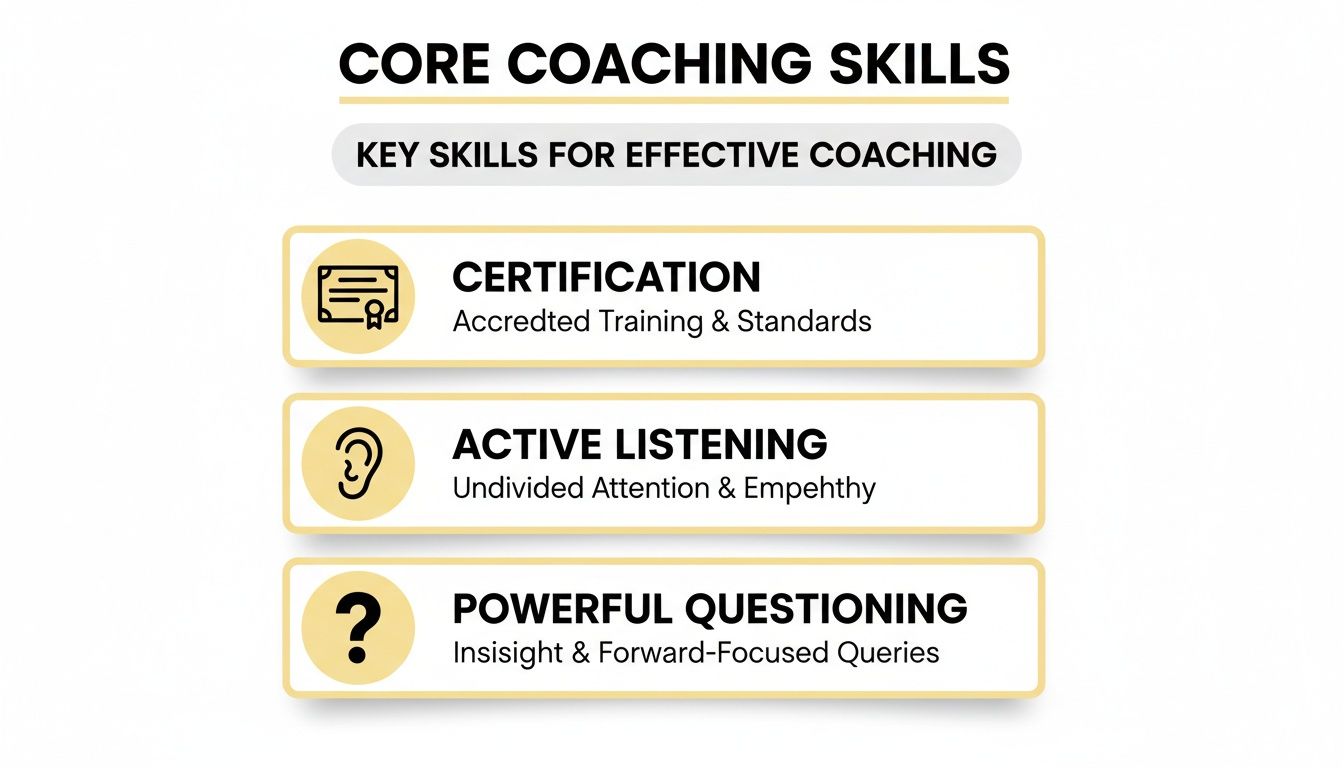
These skills are the engine that powers any successful coaching package, giving you the ability to deliver on your promises.
Comparing Coaching Business Models
As you step into the world of career coaching, you'll see that one-off sessions and comprehensive packages serve very different clients and business goals. Let's break down the common models to see which one aligns with building a sustainable, profitable business.
Coaching Package Model Comparison
| Model | Best For | Pros | Cons |
|---|---|---|---|
| One-Off Sessions | Clients who need a quick answer to a single, specific problem (like a last-minute salary negotiation). | Lower barrier to entry for clients; a good way to gather your first testimonials. | Unpredictable income; encourages a transactional mindset; client commitment is low. |
| Signature Packages | Clients who are genuinely committed to achieving a significant career goal or a major transformation. | Creates predictable, higher revenue; fosters deep client relationships and trust; delivers far better results. | The higher price point can be a barrier for some; requires more upfront work to design the program. |
While a one-off session might solve an immediate problem, a signature package creates real, lasting change. It gives your clients the time, space, and support they need to internalize new habits and mindsets. This not only leads to more powerful testimonials but also turns happy clients into your best source of referrals.
Setting Your Prices with Confidence
Pricing your signature program can feel like you’re just pulling a number out of thin air. The key is to anchor your price to the value of the outcome you provide, not the hours you put in.
Stop asking, "What's an hour of my time worth?"
Instead, ask this: "What is the financial and emotional value for my client when they land a leadership role that comes with a $30,000 raise and a profound sense of fulfillment?"
When you frame it that way, a price point of $2,500 or $5,000 for your 3-month accelerator program suddenly feels like a smart investment, not a cost. As a career coach, you're in a profession where expanding your offerings can dramatically increase your income. Globally, many coaches now offer services like training (60%), consulting (57%), and group facilitation (55%), which creates multiple streams of income. You can discover more insights about the global growth of the coaching industry to see just how others are diversifying.
Start by pricing your first package at a point that feels like a slight stretch but still accurately reflects the immense value you deliver. You can—and should—raise your rates as you gain more experience, testimonials, and confidence. A well-structured, value-based package is the clearest way to communicate your worth.
Getting Your Name Out There and Landing Your First Clients
Alright, you’ve done the heavy lifting. Your signature program is built, your pricing feels right, and your systems are ready to go. Now for the part that often trips up new coaches: actually finding people to pay you.
It's easy to get stuck here, thinking, "Okay… but where do I actually find my first clients?"
Let me put your mind at ease. You don't need to transform into a slick, pushy salesperson overnight. The best marketing for a career coach isn't about sales tactics; it's about being authentic, generous, and building real connections. It’s about showing up where your ideal clients already hang out and proving your value long before you ever ask for their credit card.
Make LinkedIn Your Home Base
For a career coach, LinkedIn is more than just a place to list your old jobs—it's your digital office. This is where your people are: the ambitious professionals, the hiring managers, and the industry leaders you want to work with. Your job is to stop scrolling and start contributing.
But the thought of creating content can be paralyzing. I get it. The internal monologue is loud: "What do I even post? What if no one likes it? I don’t have time to be a full-time influencer!"
Let’s ditch the complexity. You don’t need a fancy content calendar. You just need a simple, consistent rhythm that shows you know your stuff.
Try this weekly plan to get started:
- Share one insightful post: Offer a unique take on a common problem your niche faces. If you help mid-level managers, that might be a quick tip on delegating work without feeling the need to micromanage.
- Tell one client story (with permission, of course): Share an anonymized win. Something like, "A client was dreading interviews due to anxiety. We worked on one simple reframing technique, and this week they landed a role they thought was totally out of reach." This is powerful social proof.
- Ask one interactive question: Get a conversation started. A simple, “What’s the single best piece of career advice you’ve ever received?” can work wonders for engagement and community building.
The coaching industry has absolutely exploded, which means a focused approach is non-negotiable. The number of coaches worldwide has shot up to 122,974—that's a 15% jump from 2023. To make a mark, you have to connect authentically, and for career coaches, there's no better place to do that than LinkedIn.
This simple routine quickly turns your profile from a dusty, static resume into a living, breathing resource that attracts the right people to you.
Master the Discovery Call
Your content will eventually lead people to your calendar for a free discovery call. This is probably the most nerve-wracking part of the whole process for a new coach.
The self-doubt can be intense: "What if I sound like a total fraud? What if they say I'm too expensive? How do I go from a friendly chat to actually asking them to pay me?"
Here’s the secret: reframe the entire conversation in your mind. A discovery call isn't a sales pitch. It’s a coaching audition. Your only job is to show up, listen with your full attention, and help the person on the other end of the line gain one small, powerful piece of clarity. When you do that, the value of working with you becomes obvious.
You can dive deeper into this in our guide on how to get coaching clients without spending a dime on ads.
Having a simple, repeatable flow for these calls takes all the pressure off and makes you feel like a seasoned pro, even if it's your very first one.
A Simple Flow for Your First Call
- Connect and Set the Stage (First 5 mins): Kick things off with genuine curiosity. Ask them about their day and what led them to book the call. Then, set the expectation: "My goal for our chat today is to get a really clear picture of where you are now, where you're trying to go, and see if I'm the right person to help you close that gap."
- Dig into the Problem (Next 15 mins): This is where you put your coaching hat on and listen. Use powerful, open-ended questions. Instead of "What's your goal?" try, "If we were talking again three months from now and you were absolutely thrilled with your career, what would have changed?"
- Paint the Picture of Possibility (5 mins): Briefly summarize what you heard them say, reflecting their vision back to them. "So, what I'm hearing is you're ready to go from feeling stuck and overlooked to confidently leading major projects in a senior role."
- Introduce Your Solution (5 mins): Now, you simply connect the dots between their dream and your program. "The challenges you're describing—like navigating office politics and building that executive presence—are exactly what we tackle in my 'Career Accelerator' program. It's the roadmap to get you from here to there."
- The Invitation (Final 5 mins): This isn't a hard close. It's a confident, low-pressure invitation. "If you're truly ready to commit to making this happen, I’d be thrilled to invite you into the program. The investment is [Price], and we could start as soon as next week. How does that feel to you?"
This structured, conversational approach turns what could be a sweaty-palmed sales call into a valuable, trust-building experience. It allows the right clients to sell themselves on the idea of working with you, making that first "yes" feel natural, seamless, and incredibly well-deserved.
A Few Lingering Questions About Becoming a Career Coach
Even with a perfect roadmap, it's natural to have a few nagging questions pop up. That little voice in the back of your head asking, “But what if…?” can be just enough to make you hesitate. Let’s get those questions out in the open and answer them head-on.
These are the most common things aspiring coaches ask right before they take the leap.
How Much Can I Realistically Earn as a New Career Coach?
Ah, the money question. It’s always front and center, isn't it? You see established coaches with full client rosters and can't help but wonder if you can actually make a real living doing this.
The truth is, while top-tier coaches can bring in thousands per month from a single client, your starting income will hinge on your niche, how you package your services, and your marketing. A solid starting point for a new coach is to price a comprehensive, three-month package somewhere between $1,500 and $2,500.
Let's do some simple math. If you land just two new clients a month at that rate, you’re already on track for a $36,000 to $60,000 annual income. That's a fantastic foundation to build on while you're gathering testimonials and proving your process. The trick is to avoid the hourly rate trap from day one and price based on the outcome you deliver.
As you collect those success stories, you can raise your prices with confidence. Interestingly, while the average hourly rate for a coach is about $234 (leading to a typical US income of $71,719), 59% of coaches expect their income to grow not from fee hikes, but from adding more clients and sessions. You can dig into more coaching industry income trends to see where the market is headed.
Do I Need a Specific Degree to Become a Career Coach?
This is a huge one, and it’s a major source of imposter syndrome. You might be thinking, “I don’t have a degree in HR or psychology. Who am I to coach people on their careers?”
Let me be clear: No, you do not need a specific degree. Your years of hands-on professional experience are precisely what make you credible. That’s where your unique value comes from. Clients are paying for your real-world insights, not for a diploma.
Instead of worrying about a degree you don't have, focus on getting a reputable coaching certification. A credential from an organization like the ICF teaches you the core skills of coaching, which are very different from consulting or therapy. You'll learn the art of powerful questioning, how to hold space for your clients, and how to maintain ethical boundaries.
Your real-world experience is your unique asset; a certification simply teaches you how to wield it effectively as a coach.
What Is the Difference Between a Career Coach and a Career Counselor?
Getting this distinction right is crucial, both for your own clarity and for how you talk to potential clients. It’s an easy thing for people to get confused about, so you need to be able to explain it simply.
- Career Counselors often look backward. They use assessments and therapeutic models to help people understand their personality, past experiences, and how those things have shaped their journey so far.
- Career Coaches are intensely future-focused. We partner with clients to set clear, ambitious goals and then hold them accountable for taking the concrete steps needed to hit them.
Think of it this way: a counselor might help a client understand the deep-rooted reason for their fear of public speaking. A coach, on the other hand, helps that same client create and execute a step-by-step plan to prepare for and nail their big presentation next month. Counseling is often about understanding the "why," while coaching is all about creating forward momentum.
How Do I Manage the Business Side Without Getting Overwhelmed?
This is a big one. The fear of drowning in administrative work stops so many talented people from ever getting started. You want to coach, not spend your days chasing invoices, fiddling with schedulers, and sending contracts. It's a completely valid concern.
This is exactly why all-in-one coaching platforms are such a game-changer for new coaches. Instead of trying to duct-tape five different tools together for your calendar, payments, contracts, and client notes, you have a single, integrated system. It immediately makes your business look and feel more professional.
Imagine setting up an automated onboarding flow. The moment a new client signs up, the system automatically sends their welcome packet, the coaching agreement for an e-signature, and their first invoice. By putting systems in place for these tasks from day one, you free up your time and mental energy to focus on what you actually love to do: coaching.
Ready to stop juggling tools and start coaching professionally? Coachful brings your scheduling, payments, programs, and client management into one seamless platform, giving you the freedom to focus on making an impact. Get started with Coachful today.