
What Is Career Coaching? What Happens and What It Costs
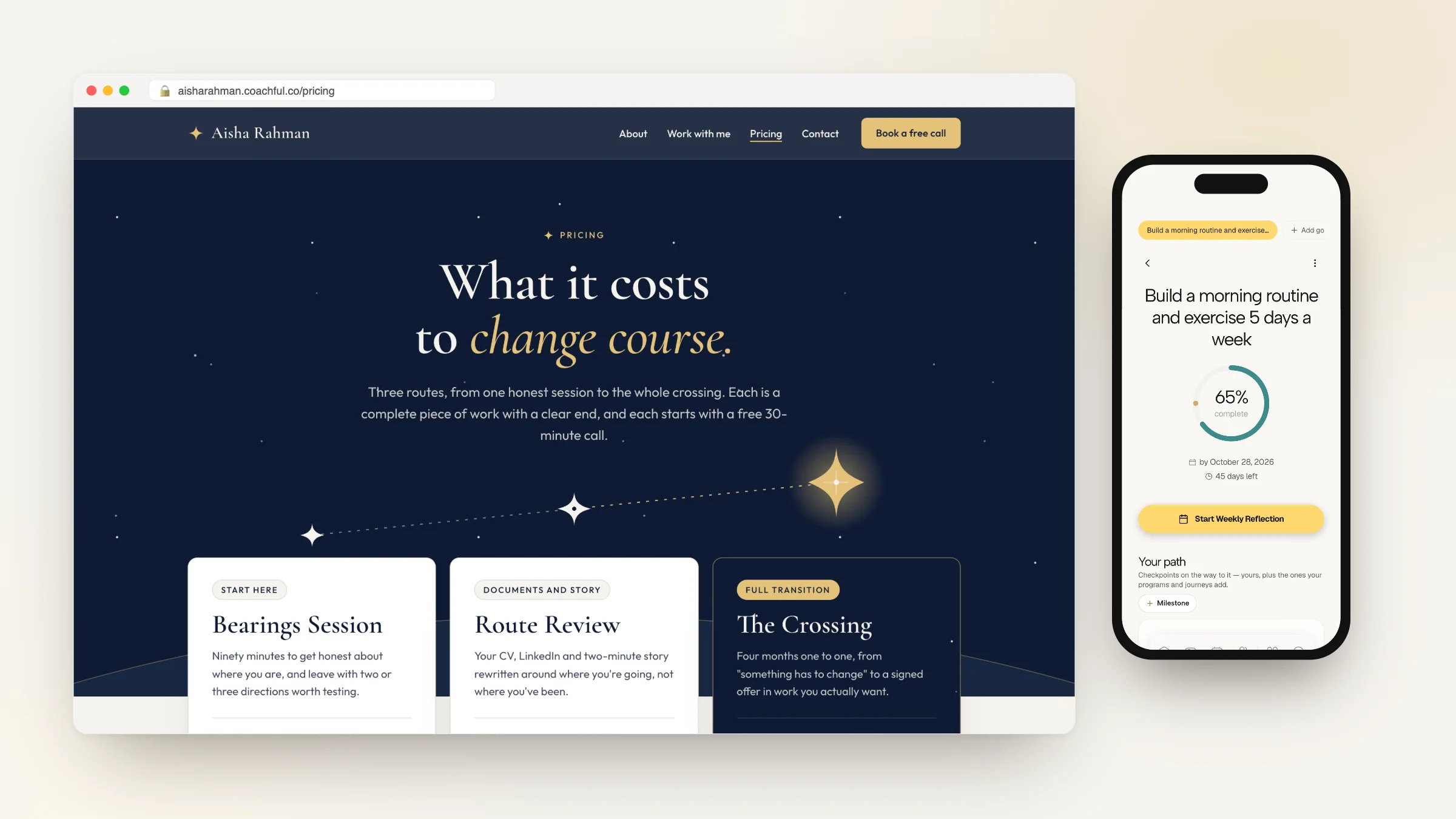
What is career coaching? It is a paid, one-to-one working relationship in which a coach helps you make and act on a decision about your work: what to do next, how to get there, and how to do well once you arrive. A career coach helps you get clear on what you want and what you offer, turns that into a plan (a target role, a CV, a LinkedIn profile, a list of people to talk to, interview practice, a negotiation script), and checks in while you carry it out. You make the choices and do the applying. The coach brings structure, honest feedback and momentum.
People often expect a career coach to find them a job. That is a recruiter's role, and the difference matters when you are deciding who to hire. Below: what career coaches help with, how an engagement runs, what a session looks like, how coaching differs from career counseling and recruiting, what the research shows, what it costs and how to choose a coach.
What a career coach helps with
| Your situation | What the coach does |
|---|---|
| "I don't know what I want next" | Values, strengths and interests work; testing options through conversations and small experiments |
| Changing field | Mapping transferable skills, closing gaps, finding a route in, planning the money; see career change coaching |
| Active job search | Target list, CV and LinkedIn, outreach, an application tracker, weekly targets |
| Interviews | Story bank, mock interviews, feedback; see interview coaching |
| Promotion or a raise | Making your work visible, finding sponsors, rehearsing the conversation |
| Returning to work | Explaining a gap, rebuilding confidence and a network |
| A new manager role | Often overlaps with leadership coaching; see what leadership coaching is |
How career coaching works
- A discovery call. A short call to see whether you are a fit and agree what you want from the work.
- An intake form and goals. Your history, what you have tried, what you want to be different in three months, and any constraints: money, location, family, visa.
- Assessment, if useful. Values exercises, a strengths inventory, an interests questionnaire, or a structured look at what you have enjoyed and been good at.
- Regular sessions. Often around 50 minutes (the packages in our rates data below use 50-minute sessions), weekly during an active search or every two weeks for bigger decisions.
- Work between sessions. This is most of it: rewriting the CV, sending outreach messages, informational interviews, applications logged in a tracker, practice answers recorded on your phone.
- A review. Against the goals you set at the start, with a plan for keeping going once coaching ends.

What a career coaching session looks like
A typical mid-engagement session during a job search might run like this:
| Minutes | What happens |
|---|---|
| 0 to 10 | Review the week: applications sent, replies, conversations held, against the targets you set |
| 10 to 35 | The main topic, for example preparing for Thursday's second interview |
| 35 to 50 | Practice: answer the two hardest questions out loud, get feedback, try again |
| 50 to 60 | Next week's targets and anything to send the coach for review |
And a short example of the coaching itself, on a salary conversation:
Client: If they offer 85, I'll just take it. I don't want to seem greedy.
Coach: What did you find when you looked up the range for this role?
Client: 82 to 98, in this city.
Coach: So 85 is near the bottom. What would you say if you were advising a friend with your experience?
Client: To ask for 95 and explain the team I built.
Coach: Let's practice saying that until it sounds like you.

What to bring to your first career coaching session
You will get more from the first hour if you arrive with a few things ready. None of them needs to be polished.
- Your current CV and LinkedIn link, even if you hate them.
- Two or three job ads that interest you, and one that looks right on paper but leaves you cold. The contrast tells the coach a lot.
- A short list of what you enjoyed and what drained you in your last two or three roles.
- Your constraints: the salary floor, the commute you will accept, the start date, anything family or visa related.
- One sentence on what "this worked" would look like three months from now.
If you are not sure where you stand overall, the free Wheel of Life assessment takes a few minutes and shows whether work is really the area pulling everything else down.
Career coach vs career counselor vs recruiter vs resume writer
| Career coach | Career counselor | Recruiter | Resume writer | |
|---|---|---|---|---|
| Main job | Helps you decide and act, with accountability | Helps you make career decisions; may use formal assessments | Fills an employer's open roles | Writes or rewrites your CV and LinkedIn |
| Who pays | You, or sometimes an employer | You, a school, or a public service | The employer | You |
| Training and licensing | Unregulated; voluntary certifications | Often a counseling degree; some states require a license | No license | No license; voluntary certifications |
| Works for | You | You | The hiring company | You |
| Best when | You need a plan and someone to keep you moving | You need structured assessment or mental health is part of the picture | You fit a role they are filling | Your documents are the main problem |
The US Bureau of Labor Statistics describes career counselors as helping people with career decisions, building skills, exploring occupations and teaching job-search skills, and notes that some states require a license, including for counselors in private practice (BLS Occupational Outlook Handbook). Coaching, by contrast, has no formal entry requirements; the BLS calls the field unregulated (BLS Career Outlook). If anxiety or depression is tied up in your work situation, a licensed counselor or therapist is the better first step; our guide to life coach vs therapist explains how to tell.
Does career coaching work? What the research says
There is little research on "career coaching" under that exact name, but job search help with the same ingredients has been studied well.
- Job search programs raise the odds of getting hired. A meta-analysis of 47 experimental and quasi-experimental job search interventions found the odds of finding employment were 2.67 times higher for participants than for comparison groups (Liu, Huang and Wang, 2014).
- Certain ingredients mattered. Programs worked better when they taught job search skills, improved self-presentation, boosted self-efficacy, encouraged proactivity, promoted goal setting and enlisted social support, and they worked only when they combined skill-building with motivation.
- Coaching in general helps goal pursuit. A meta-analysis of workplace coaching found positive effects on performance, well-being, coping, work attitudes and goal-directed self-regulation (Theeboom, Beersma and van Vianen, 2014).
The practical reading: a good career coach covers both the skills (CV, outreach, interviews) and the motivation (confidence, goals, someone expecting an update on Friday). A coach who only does one of the two is offering half of what the research supports.

How much does career coaching cost?
Coachful's 2026 Coaching Business Report compiles PayScale salary data, practitioner reports and the published rates of 35 career coaches on the Career Contessa marketplace. Its US dollar benchmarks:
| What you buy | Typical price | Source |
|---|---|---|
| One hour, typical coach | $100 to $250 | PayScale and practitioner reports |
| Newer coach | $75 to $150 an hour | Practitioner estimate |
| Experienced coach | $150 to $300 an hour | Practitioner estimate |
| Top of the niche | $300 to $600 an hour | Practitioner estimate |
| Single 50-minute session | $99 to $280 | Published rates, 35 coaches |
| Job search sprint, 4 sessions over 4 to 6 weeks | $500 to $1,000 | Practitioner reports |
| Career transition, 8 sessions over 3 months | $1,200 to $2,500 | Practitioner reports |
Q2 2026. The 35-coach sample comes from one marketplace, so read it as a picture of mid-market rates. More detail on coachingrates.com.
Before paying yourself, check whether your employer offers coaching through a learning budget, or whether a severance package includes career support. For more on prices by package, see how much career coaches charge.
How to choose a career coach
- Match the specialty. A coach who mostly helps engineers into management is a poor fit for a teacher moving into UX, and vice versa. Ask who they usually work with.
- Ask about their process. What happens in the first three sessions, and what will you do between them?
- Ask how progress is measured. Applications sent, conversations held, interviews landed, offers: a good coach tracks something.
- Check background and training. HR, recruiting or hiring-manager experience helps with job search; formal coach training (such as an ICF-accredited program) helps with the coaching itself. Neither is legally required.
- Watch for red flags: guaranteed job offers, pressure to pay on the first call, large fees tied to a promise of placement, or a coach who wants to apply to jobs for you.
Our list of career coaching questions shows the kind of questions a good coach will ask you, which is a decent test of whether a discovery call felt like real coaching.

Find a career coach on Coachful
Coachful's Find a Coach directory is public, so you can browse without creating an account. Search "career", "career change" or "interview" to find coaches whose headline or bio mentions it, or browse the Tech and Skills and Business categories. You can switch between browsing coaches and browsing their programs, or take the Find My Coach quiz, which asks what you want to improve, where you are now, your preferred style and your monthly budget before suggesting coaches. Profiles show each coach's background, programs and prices, and either a calendar to book a discovery call or a way to send a message.

For career coaches
If you are thinking about doing this work, our guide on how to become a career coach covers training, niches and first clients, and the sibling guide to career coach certification compares the credentials. Coachful's page for career coaches shows the platform, including the Career Coaching power-up: each client gets a private tracker you can see and edit for networking connections, job applications and interviews, a LinkedIn content plan with weekly growth check-ins, and a CV builder with export, plus reminders for follow-ups and interviews and an overview of what is due across every client.
If your website does not yet explain what you do as clearly as this page tries to, the Coachful team will build it for you in your account at no extra cost through the free white-glove service, starting from a template such as Northstar or Editorial.


Frequently asked questions
What is career coaching in simple terms?
Career coaching is paid, one-to-one help to decide what to do next in your work and to act on it. A coach helps you clarify goals and strengths, builds a plan with you (target roles, CV, LinkedIn, networking, interview practice) and checks in while you carry it out.
What does a career coach actually do?
A career coach runs sessions, often around 50 minutes, gives you exercises and targets between them, reviews your CV and outreach, runs mock interviews, helps you prepare negotiations and keeps you accountable to weekly goals. They do not apply for jobs or hire you.
Is career coaching worth it?
It is usually worth it when you have a specific goal and will do the work between sessions. Research on job search programs found participants' odds of employment were 2.67 times higher, especially when programs combined skills with motivation, which is what good career coaching does.
How much does a career coach cost?
Typical rates run $100 to $250 an hour, and a single session from published rates costs $99 to $280. A four-session job search sprint usually costs $500 to $1,000, and a three-month transition package $1,200 to $2,500, according to Coachful's 2026 Coaching Business Report.
What is the difference between a career coach and a career counselor?
Career counselors often hold a counseling degree and, in some states, a license, and may use formal assessments. Career coaches are unregulated and focus on planning and action. If mental health is part of what is holding you back, start with a licensed counselor.
Can a career coach find me a job?
No. A career coach helps you find and win the job yourself. Recruiters find candidates for employers' open roles and are paid by the employer. Be wary of any coach who guarantees a job offer.
How many career coaching sessions do I need?
For a focused job search, four sessions over four to six weeks is common. A career change typically takes eight or more sessions over about three months. Interview preparation can be as short as one session before a specific interview.












