What Is Group Coaching and How It Really Works

Coachful
Group coaching is a small, time-limited, coach-led process where peers learn from each other as much as from the coach. A practical group often includes 5 to 20 participants, although the right size depends on the goal and the amount of interaction each person needs.
You may be considering it because your one-to-one calendar is full, several prospective clients share the same challenge, or you want to make coaching available at a more accessible price. Then the doubts arrive: Will the work feel diluted? Will the quiet person disappear? Am I building a coaching program, or just hosting a course with a nicer name?
Those are sensible questions. Group coaching can create powerful learning and accountability, but only when the design protects individual progress while using the group as an active resource. The format isn't “one coach talking to many people.” It's a carefully held environment in which each participant pursues a personal goal, reflects with others, and turns insight into action.
What Group Coaching Actually Is and Why It Feels Different
A useful working definition is simple: group coaching is a small, time-limited, coach-led process where participants work toward personal or professional goals while learning through peer reflection, shared experience, and accountability. Coaching literature describes it as a facilitated group process that draws on the combined energy, experience, and wisdom of participants, and it can follow either a shared theme or a less thematic structure (Wiley's coaching literature excerpt).
The coach's private worry often sounds like this: If I divide my attention, won't every client receive less? Sometimes they will receive less uninterrupted airtime. That isn't the same as receiving less value. A participant hears how another person frames a similar obstacle, tests their own assumptions against different perspectives, and makes a commitment in front of peers. The coach supplies structure and inquiry, while the group adds context the coach alone can't manufacture.
Practical rule: Group coaching works when the group is part of the method, not merely the audience.
The format has a clear operating shape:
- Defined cohort: Participants enter with a meaningful connection to the topic, audience, or desired change.
- Fixed program arc: The group meets for an agreed number of sessions rather than continuing indefinitely.
- Shared theme or curriculum: The coach brings a developmental spine, not a script that eliminates responsiveness.
- Coach-held process: The coach manages safety, pacing, agreements, participation, and reflection. Participants own their goals and decisions.
The coach doesn't become a lecturer. A course primarily transfers information, while group coaching helps people interpret and apply ideas to their own situations. Therapy addresses clinical concerns and personal history within a therapeutic relationship. Consulting typically brings specialist recommendations or solutions. Group coaching may include models, exercises, and resources, but the central work remains facilitated self-directed change.
That's why the room feels different from the first meeting. In one-to-one work, the client looks to the coach for attention. In a group, attention begins to circulate. A client's challenge can become a prompt for another participant's insight, and a single commitment can create momentum across the cohort.
How Group Coaching Differs from One-on-One, Team, and Mastermind Work
Coaches often use “group coaching” as an umbrella term for any call with multiple people. That shortcut creates confusion. In 2009, Brown and Grant helped clarify a central distinction: team coaching supports an existing work team's functioning, while group coaching brings together individuals who may not know one another and may have different personal aims (Coachello's group coaching glossary).
| Format | Coach's Primary Role | Typical Cohort Size | Best Fit For | Common Failure Mode |
|---|---|---|---|---|
| Group coaching | Hold the process, guide inquiry, and protect peer learning | Often 5 to 20 | Individuals with a shared developmental theme and personal goals | The coach over-teaches or lets group dynamics replace individual accountability |
| One-on-one coaching | Provide deep, individualized attention | One client | Sensitive, complex, or highly personal goals | The client becomes dependent on the coach or the work moves slowly without wider perspective |
| Team coaching | Improve the functioning of an existing team | An intact work team | Shared performance, relationships, decision-making, and team goals | The coach serves individual agendas while ignoring the organizational sponsor and team system |
| Mastermind | Facilitate lightly while members exchange experience and challenge one another | A small peer circle | Experienced members who can contribute relevant expertise | Value becomes uneven because members rely on status, advice, or informal influence |
The buyer also changes the design. A private client buys access to you. An organization buying team coaching usually has a sponsor, business context, and expectations around team-level outcomes. A mastermind member buys access to peers and a structured exchange. A group-coaching participant buys a guided developmental experience, with the coach responsible for the container and each participant responsible for their own movement.
A group coach may still teach a framework, but the framework serves reflection. A mastermind may include coaching questions, but members remain the primary source of expertise. A team coach may work with individuals inside the team, but the team's collective functioning remains the central client.
For a deeper example of how a coach can shape a shared membership experience, explore Coachful's Leather Apron Club example.
Pick one-on-one if the goal requires privacy, intensive customization, or close attention to personal history. Pick team coaching if the participants already work together and the sponsor cares about how the system performs. Pick a mastermind if members have useful experience to exchange and need light structure. Pick group coaching if you can name a common developmental problem while preserving individual goals.
When Group Coaching Is the Right Format and When It Isn't
A new manager joins a cohort worried that delegation advice will feel generic. In the first session, another participant describes a difficult conversation, and a third explains how a similar attempt failed. The coach does not hand everyone the same answer. Instead, the shared problem gives each person better questions, useful examples, and a reason to test a different response at work.
Group coaching fits when participants face a related challenge but do not need identical solutions. A cohort for new managers might explore delegation, difficult conversations, and confidence. Each member brings a different workplace, while peer stories add practical texture to the coach's guidance.
Research defines group coaching as a collaborative, time-limited intervention combining peer learning, coaching interventions, and social support. A 2023 analysis identified these elements as key impact factors, reporting 95.71% agreement and a mean effectiveness rating of 4.74 (SAGE analysis of group coaching). Those findings do not guarantee a successful cohort. They support a useful design judgment: peers can actively shape change rather than merely observe it.
Other research points beyond participant satisfaction. A pre/post study found improvements in reflective self-development, acceptance of self and others, and proactivity at work. A pilot randomized clinical trial involving 101 female resident physicians found that a 6-month online group-coaching program significantly reduced emotional exhaustion and improved self-compassion compared with the control group (International Coaching Federation research portal report).
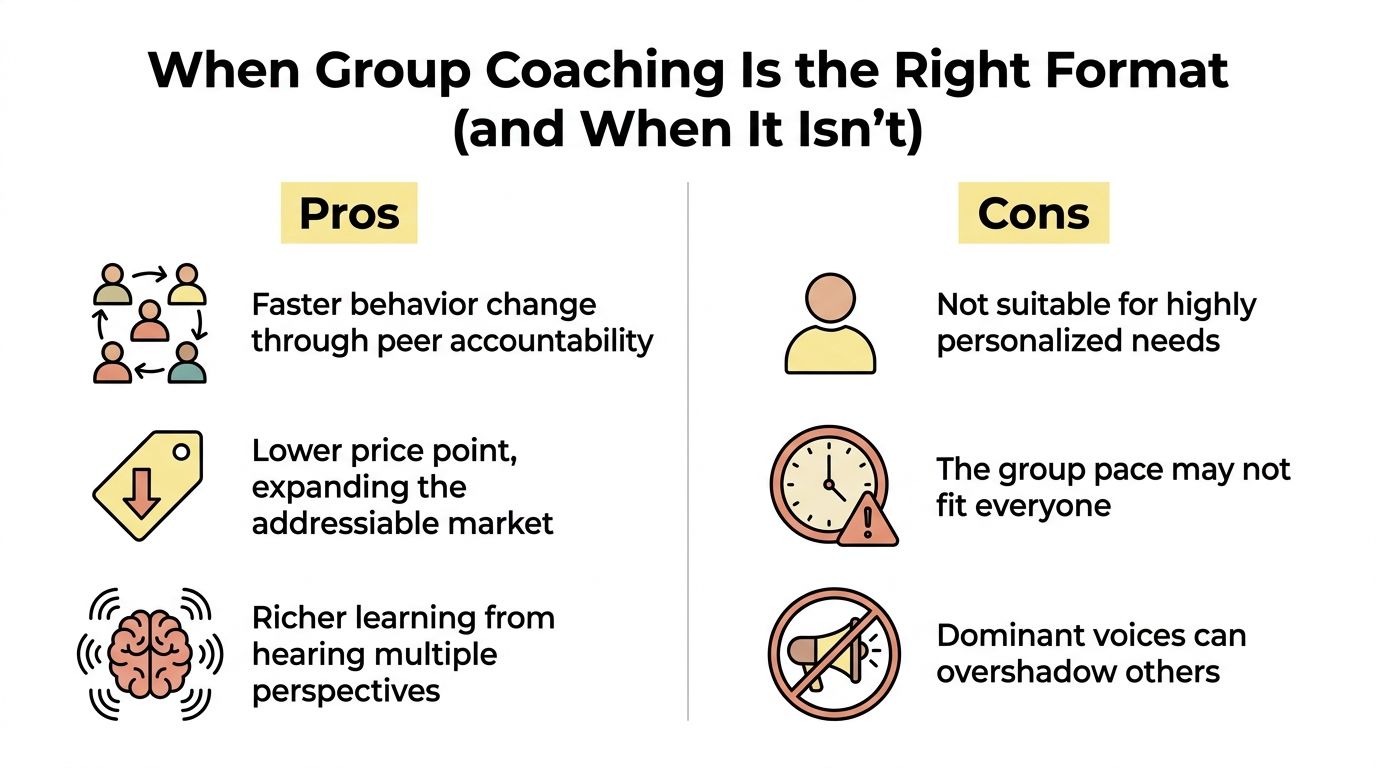
The format is a good fit when:
- The problem repeats across people: Members recognize the theme in one another's experiences.
- Social proof helps: Participants benefit from seeing others learn, experiment, and recover from imperfect attempts.
- Accountability matters: A commitment carries more weight when someone will ask about it next session.
- You can hold a room: The coach can manage silence, emotion, airtime, disagreement, and boundaries without rushing to rescue everyone.
The format is poorly suited to acute crisis, individualized technical work, or situations where the cohort cannot provide adequate confidentiality. Someone who needs clinical care should receive a clear referral, not an invitation to “bring it to the group.” A client whose progress depends on confidential organizational politics may need one-to-one support.
Before building the offer, ask: Do participants share a meaningful problem? Will peer interaction add insight or pressure? Can I support progress without treating the group as a substitute for clinical, managerial, or specialist help? If any answer is no, change the format before changing the sales page.
Designing a Group Coaching Program That Holds Together
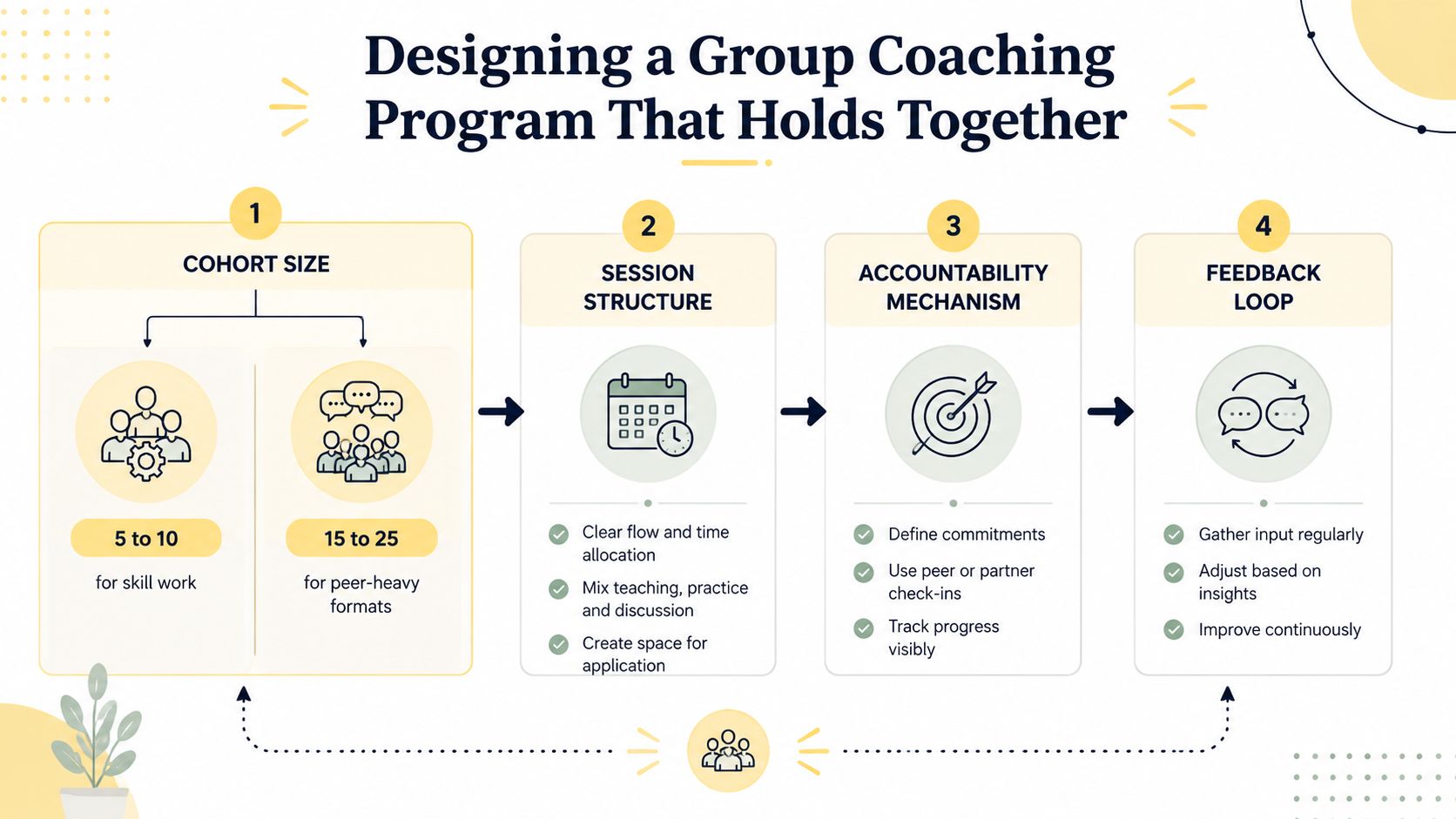
A coach may begin with a quiet worry: will the group format dilute the result? Design answers that concern before the first worksheet. Set the cohort size according to the access you promise. Practitioner guidance commonly describes groups as small, often 5 to 20 participants (Coachello's overview of group coaching structure). A practical starting point is 5 to 10 people for skill work and 15 to 25 for peer-heavy formats. Treat those ranges as design defaults, not fixed rules.
A smaller group gives each participant more room for individualized attention. A larger group brings more perspectives, much like adding voices to a working session, but it requires tighter rounds, breakout structures, and asynchronous support. If every participant is promised substantial live coaching, reduce the cohort or raise the price to match the access you provide. The awkward pricing question is part of the design, not a separate sales problem.
Choose the arc before filling the calendar
A weekly cadence builds rhythm and keeps commitments visible. Biweekly sessions leave more time to apply learning, while sprint blocks suit a focused implementation push. For many offers, 6 to 12 weeks allows practice and reflection without making the promise feel indefinite. A longer arc can support behavior change. A shorter one can suit a bounded skill.
Build the curriculum as a sequence:
- Kickoff: Establish goals, agreements, confidentiality expectations, and shared language.
- Core modules: Introduce only the concepts participants need for their next action.
- Recalibration: Review progress, surface obstacles, and adjust the emphasis.
- Integration: Consolidate learning, identify continuing practices, and plan support after the final session.
Pricing adds another design decision. You might offer a standard rate with an early-bird option, a tiered pay-what-you-can structure, or an alumni rate for returning participants. State the terms plainly. A lower-access tier needs a defined rationale and clear boundaries, rather than an apology disguised as a discount.
A reliable facilitation rhythm includes a brief arrival check-in, focused teaching or framing, individual reflection, peer exchange, coached exploration, and a concrete commitment. Break that rhythm when the group needs a longer practice lab, a private conversation, or a slower session for a sensitive transition. Good structure gives you something to adjust when the room goes quiet, without forcing every session into the same shape.
Onboarding, Facilitation, and Engagement Tactics That Work
The first session is often quieter than the sales page promised. You open the call, welcome everyone, and hear the kind of silence that makes a coach wonder whether the entire concept was a mistake.
Don't fill it with a lecture. Start with a low-risk, relevant prompt such as, “What would make this conversation useful today?” Let people answer in the chat, privately write for a moment, or speak in a timed round. A pre-submitted question also helps because participants arrive with something concrete to explore instead of having to invent vulnerability on demand.
Then a confident participant begins answering every question. They aren't necessarily trying to dominate. They may be enthusiastic, anxious, or accustomed to leading meetings. Your job is to protect the room without turning them into a problem.
Use a timed round, invite everyone to speak before reopening the floor, or move into pairs before returning to the full group. If the program is large or emotionally demanding, a co-facilitator can watch the chat, track airtime, and support transitions. Say, “I'm going to pause there so we can hear from people who haven't spoken yet,” rather than naming the person as disruptive.
The third moment is more subtle. Two members complete every action, while others attend, nod, and disappear between calls. Add accountability pods, a visible progress tracker, and a short weekly check-in:
- Progress: What did you try?
- Learning: What did you notice?
- Next step: What will you do before we meet again?
- Support: What do you need from the group?
A private community space can hold questions and small wins between sessions, but set norms for response time, confidentiality, and promotion. The client onboarding portal guide can help you think through how to collect goals, agreements, and practical details before the first call.
For coaches building facilitation capability, The OKR Hub adoption guide offers useful context on the skills required to guide participation and adoption around shared goals.
Measuring Outcomes and ROI Without Drowning in Data
Measurement should answer a buyer's question, not decorate a dashboard. Begin with leading indicators, which show whether the program is functioning, and lagging outcomes, which show whether the promised change occurred.
| Metric | How to Capture | What It Signals |
|---|---|---|
| Attendance | Record presence and late cancellations | Whether the format fits participants' working reality |
| Completion | Track finished actions or modules | Whether participants move beyond attendance |
| Peer feedback | Use a short reflection after selected sessions | Whether members experience useful exchange |
| Goal attainment | Ask participants to rate progress against their stated goal | Whether the program supports individual movement |
| Behavior change | Collect a specific before-and-after example | Whether insight became observable action |
| Client-reported ROI | Ask what changed in work, wellbeing, time, or confidence | Whether the outcome matters to the buyer |
A solo coach can run a pre/post survey with 3 to 5 outcome questions, then send a 30-day follow-up pulse. Ask participants to describe the behavior they want to change, the evidence they'll look for, and what happened after the program. Add a simple experience question such as an NPS item if it helps you identify advocates and detractors, but don't confuse recommendation with impact.
Measure the promise you sold. If buyers funded better delegation, don't report only attendance and enthusiastic comments.
For an organization, connect the conversation to the outcome it funds, such as retention, team performance, revenue lift, or wellbeing. A defensible ROI formula is:
ROI = (financial value attributed to the program minus program cost) divided by program cost.
For example, if a buyer can document $12,000 in value and paid $4,000, the calculation is ($12,000 minus $4,000) divided by $4,000, or 2, expressed as a 200% return. Only use figures the buyer can reasonably attribute. If the value can't be defended, report the operational or behavioral outcome instead of manufacturing precision.
A one-page spreadsheet is enough. Use one row per participant, columns for baseline goal, attendance, action completion, post-program result, follow-up result, and notable evidence. Ignore raw chat volume, social reactions, and applause unless they connect to a stated outcome. A practical progress-tracking workflow can help keep the record lightweight.
Common Pitfalls and How Experienced Coaches Avoid Them
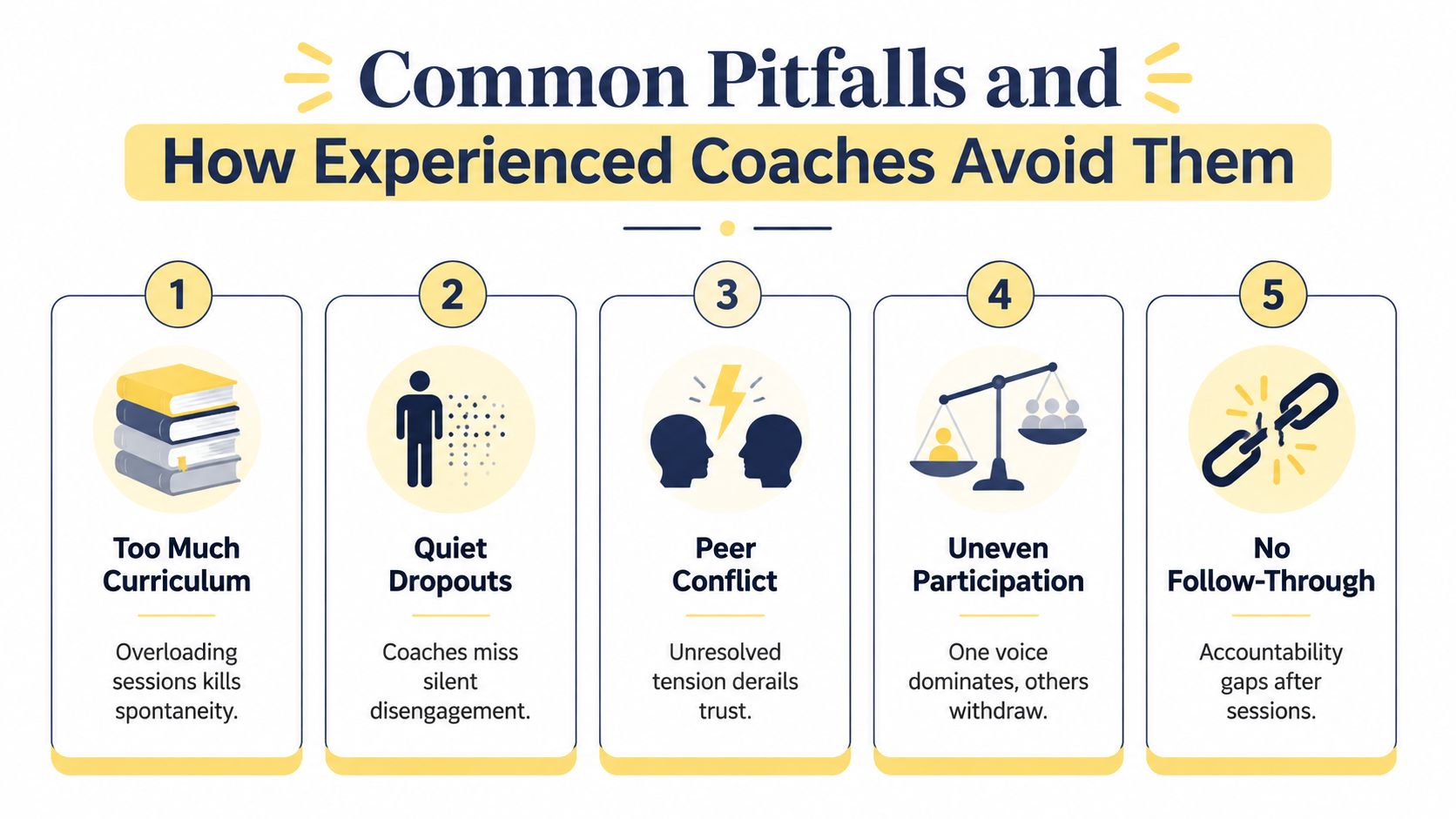
Most weak group programs don't fail because participants are difficult. They fail because the coach made a predictable design error and then interpreted the consequences as a personality problem.
Trap one is overloading the program
If every session contains a model, worksheet, exercise, and assignment, participants stop reflecting and start collecting materials. The warning sign is a packed agenda that leaves no time for a participant to examine what the idea means in their own context. Remove content, protect inquiry, and ask whether each concept changes the next action.
Trap two is quietly delivering one-to-one coaching
A participant asks for a detailed personal solution, and you spend most of the session solving it for them. The repair is to coach the individual briefly, then invite the group to notice patterns or offer reflections without turning peers into advisers. State the live-coaching boundaries before enrollment so the program promise matches the available attention.
Trap three is enrolling for interest rather than fit
People can be interested in a topic and still be wrong for the cohort. Screen for the problem, desired outcome, readiness to participate, and willingness to respect confidentiality. A clinician-researcher intervention reported a 76% completion rate, 16 of 21 participants, with themes including self-reflection, shared experience, community, and empowerment (published clinician-researcher intervention). Completion is not the same as transformation, but it reminds us that participation depends on program fit and engagement.
A manager who turns every breakout into a monologue may need a clear airtime agreement and a timed round, not public humiliation. A founder cohort whose members compete may need a private conversation about confidentiality, comparison, and the purpose of peer learning before the next meeting.
The remaining traps are uneven participation and unclear pricing. Use visible norms, participation choices, and direct check-ins when some members coast. Explain what the price includes, what it doesn't include, and why a smaller group or additional access costs more. Ambiguity invites comparison and resentment.
Some discomfort is normal. A serious confidentiality breach, safety concern, clinical need, or unresolved conflict isn't. Move quickly to a private conversation, referral, or removal process when the group can no longer provide a responsible container.
A Practical Starter Checklist and Decision Framework
You don't need a perfect flagship program to test group coaching. You need a narrow promise, a compatible cohort, and enough structure to learn from the first run.
Before inviting anyone, write one page containing:
- Audience: One clearly defined participant type.
- Outcome: One urgent, observable change.
- Inclusion criteria: Who belongs, and who needs another format.
- Promise: What participants can expect to practice or achieve.
- Cadence: Meeting frequency, session length, and program arc.
- Curriculum spine: The few ideas that support the outcome.
- Group norms: Participation, confidentiality, advice-giving, and attendance.
- Onboarding questions: Goal, context, readiness, access needs, and boundaries.
- Measurement plan: Baseline, end-of-program review, and follow-up.
- Referral process: What happens when a need exceeds coaching.
- Price: The investment, payment terms, and included access.
Use this go or no-go test:
- Do participants share a meaningful goal without needing identical solutions?
- Can you support progress without diagnosing personal history or providing specialist treatment?
- Will peer interaction add value rather than friction?
A sensible first configuration is 6 to 8 people, 6 to 8 weeks, one 75-minute live session each week, a short application, a private kickoff, and one or two measurable outcomes. Those are starting parameters, not guarantees. Choose a smaller cohort for sensitive transitions, a larger one for scalable skill practice, and hybrid office hours when accountability requires occasional individualized attention.
The decision tree is straightforward:
- Choose group coaching when the theme is shared and peers add useful perspective.
- Choose one-on-one coaching when privacy or customization drives the work.
- Choose team coaching when an intact team and organizational sponsor own the outcome.
- Choose a mastermind when members themselves hold most of the relevant expertise.
Copy-ready intake language can be direct: “What change do you want to make, and why now?” For confidentiality: “Participants agree to protect personal information shared in the group, while recognizing that the coach can't guarantee another participant's behavior.” For feedback: “What became clearer, what changed in your actions, and what support would have improved the experience?”
If you can answer those questions, group coaching is worth a controlled pilot. If you can't yet define the shared problem or protect the room, start with one-to-one work and use what you learn to refine the cohort.
Coachful gives coaches a practical place to organize group programs, including cohort communication, session scheduling, goals, assignments, and progress tracking. Visit Coachful to explore a more structured way to run your first group-coaching cohort and keep the participant experience consistent from onboarding through follow-up.