Coaching Mastermind: How to Join or Run One That Works
A coaching mastermind is a small group, usually four to eight people, that meets on a fixed rhythm to work on each member's goals through hot seats, accountability and shared experience. Coaches join one to grow their own practice with peers who will tell them the truth. Many coaches also run a coaching mastermind as a premium group offer for their clients. This guide covers both: what it is, how to choose and join one, and how to run one that people renew.
If you end up running a paid mastermind, you will need an application page, a sales page and somewhere for the group to meet. Coachful's team will build those pages inside your account for free on every plan, and we explain how further down.
Where the mastermind idea comes from
The word comes from Napoleon Hill, whose 1937 book Think and Grow Rich described a "Master Mind" as two or more people working together in harmony toward a definite purpose. The format is older than the name. In 1727 Benjamin Franklin started a weekly club of tradesmen in Philadelphia, often called the Junto or the Leather Apron Club, who met to discuss questions, share books and help each other's businesses. We wrote about what coaches can learn from the Leather Apron Club.
What both versions share is the core of every good mastermind today: a small, committed group, a regular meeting, real problems on the table, and members who leave with something to do before the next session.
Mastermind, group coaching, community or circle?
These overlap, and people use the words loosely. The differences are worth getting straight before you join or sell one.
| Format | Size | Who leads | What a session looks like | Best for |
|---|---|---|---|---|
| Coaching mastermind | 4 to 8 | A facilitator, or members in rotation | Check-ins, one or two hot seats, commitments | Business or career goals with peer accountability |
| Group coaching program | 6 to 20 or more | The coach | Teaching plus coaching on a shared curriculum | A method delivered to many people at once |
| Coaching community | Dozens to thousands | Moderators and members | Ongoing posts, questions and chat | Daily answers and broad connection |
| Coaching circle | 3 to 6 | Nobody, or a rotating facilitator | Turns at being coached with questions, not advice | Reflection and coaching skill |
The mastermind is the most demanding of the four. It asks members to show up, bring something real and be useful to people whose businesses differ from theirs. That is also why it works. If you want the circle format instead, see our guide to running a coaching circle. If you want something broader and lighter, a coaching community may fit better.
How to join a coaching mastermind
Most coaches find masterminds in three places: through people they already know in a community, through a paid program run by a coach or mentor, or by starting one with peers. Whichever route you take, ask these questions before you commit.
- Who else is in it? The group is the product. You want people a step or two ahead of you in some areas and behind you in others, so everyone both gives and gets. Ask how members are selected.
- How often does it meet, and for how long? Every two weeks for 90 minutes is common. Weekly is intense. Monthly can lose momentum unless there is contact in between.
- What happens between sessions? A chat or community space where members post progress keeps the group alive between calls.
- What is the commitment? A fixed term (six or twelve months) with an attendance expectation is a good sign. Drop-in masterminds rarely build trust.
- What are the agreements? Confidentiality, attendance and how advice is given should be written down.
- What does it cost, and what is included? Paid masterminds vary enormously. Compare what you get (facilitation, hot seats per member, access to the leader) rather than the headline price.
Some red flags: a group of thirty called a mastermind, no selection at all, a leader who does all the talking, or pressure to upgrade to a bigger program in the first month.
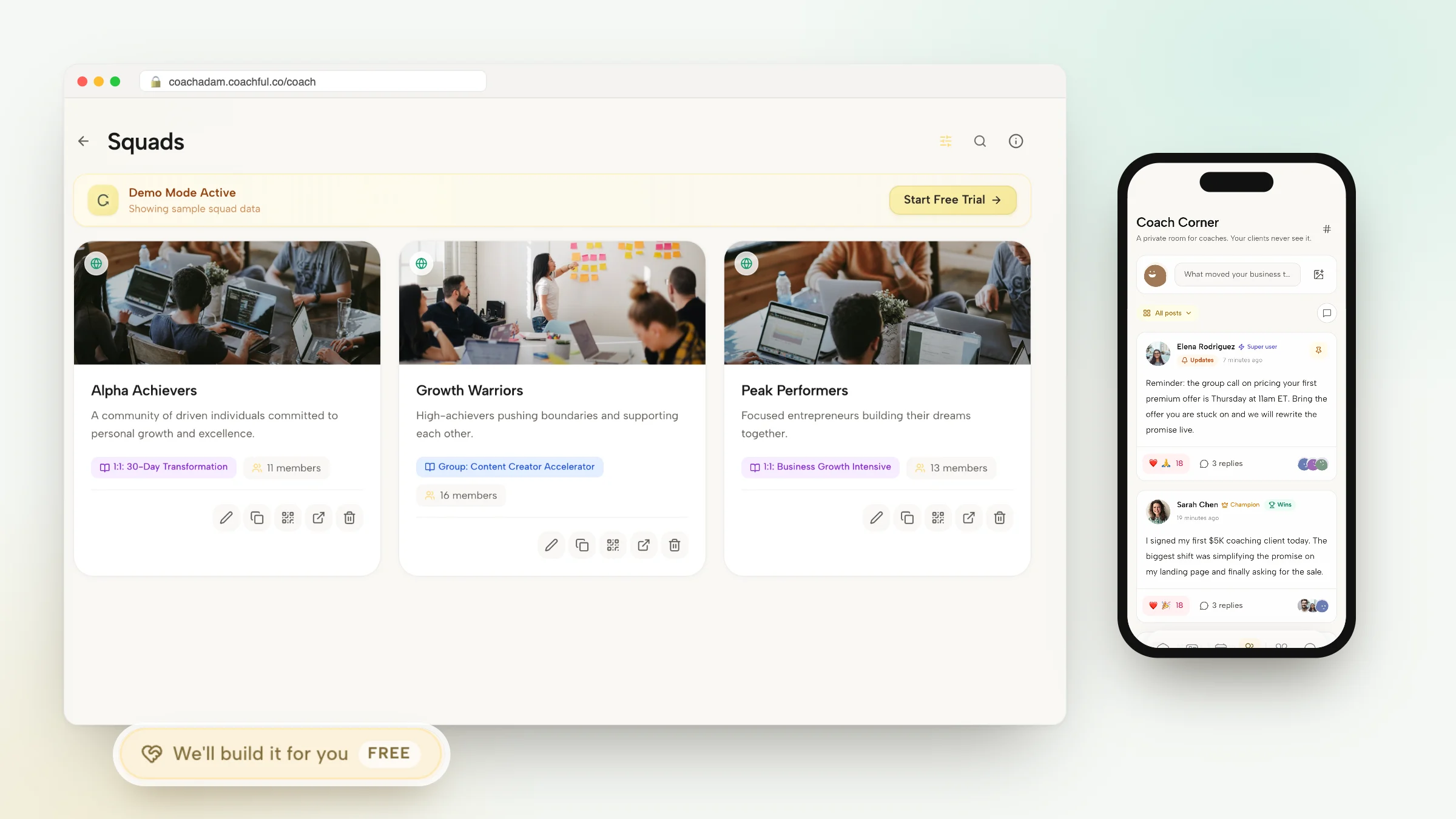
A practical way in is to get known in a coach community first. In Coachful's Coach Corner, the coaches directory shows each coach's business name and lets you message them directly, and the kind of help a good mastermind gives is already visible in threads like the one below from the demo community, where one coach offers to work on another's offer first because he can't make the call.

How to run a coaching mastermind that people renew
Running a mastermind is mostly design work done before the first session. Get these six decisions right and the sessions largely run themselves.
1. Decide who it is for, narrowly
"Coaches who want to grow" is too broad. "Coaches with an existing one-to-one practice who want to launch their first group program this year" gives every member a shared stage, which makes hot seats relevant to everyone listening.
2. Choose the size
Four to eight members works best. With fewer than four, one absence guts the session. With more than eight, people wait too long for a hot seat and the quieter members disappear. Six is a comfortable default.
3. Set the cadence and term
Fortnightly 90-minute sessions over six months is a sensible starting shape. It gives roughly twelve sessions, enough for each member to take the hot seat at least twice, plus the shorter check-ins every time.
4. Design the hot seat
The hot seat is the heart of a mastermind: one member brings a question, the group asks clarifying questions, offers perspective, and the member leaves with a decision. Our mastermind hot seat template lays out the five steps and a preparation prompt members fill in before the call. Two hot seats per 90-minute session is about right.
5. Write the agreements
Put these in a one-page document every member signs before session one:
- Confidentiality: what is said in the group stays in the group, including names, numbers and client details.
- Attendance: how many sessions a member can miss, and how to tell the group.
- Preparation: hot seat members send their question two days ahead.
- Advice etiquette: share experience rather than instructions ("what worked for me was…"), and no pitching your services to other members.
- Commitments: every member names one action per session and reports on it next time.
- Leaving: how a member exits and what happens to their seat.
6. Plan what happens between sessions
The calls are where decisions get made. The space between them is where members actually do the work, and where the group notices if someone goes quiet. A private chat or feed for the group, with a weekly progress prompt, is enough.

A 90-minute coaching mastermind agenda
Use this as a starting point and adjust after the first three sessions.
| Time | Segment | What happens |
|---|---|---|
| 0:00 to 0:05 | Arrive | Facilitator opens, reminds everyone of the agreements in one sentence |
| 0:05 to 0:25 | Commitment check-in | Each member: what I committed to, what happened, one win (about three minutes each) |
| 0:25 to 0:55 | Hot seat one | Question, clarifying questions, perspectives, decision |
| 0:55 to 1:25 | Hot seat two | Same structure, different member |
| 1:25 to 1:30 | New commitments | Each member names one action for the next session |
Keep the timings visible. The most common failure in a mastermind is the first hot seat swallowing the session, which teaches the second member that their turn doesn't matter.
Running a paid coaching mastermind for your clients
A mastermind for clients is one of the most natural premium offers a coach can sell: smaller than a group program, more intimate, priced above it, and built around the members' own goals rather than a curriculum. The structure above works unchanged. What changes is that you need to sell it and host it.
In Coachful, a mastermind is set up as a group program, and enrolling members places them in a cohort group automatically, with its own member list, group chat and call card. You set the maximum group size, so a mastermind of six stays at six and a new group opens if you sell more seats. Group calls run on built-in video with attendance recorded for each member, and each member still has their own record with goals, habits and check-ins, which is useful for tracking commitments over six months.

Between sessions, the group's community space can carry Engage posts. A Commitment post lets each member tap "I'm in" on the week's action, with an optional deadline and a Mark done step, and a Pulse post gives a quick anonymous read on how the group is feeling. A paid channel is another option if you want an ongoing membership after the mastermind term ends. The group coaching features page lists what is included, and our guide on how to create a group coaching program covers the delivery side.

Sign the agreements properly, too. Coachful sends coaching agreements for e-signature before the first call and stores them on the client record, so your mastermind agreement lives next to the payment and the attendance rather than in an email thread.

Let the Coachful team build your mastermind's application page
Masterminds sell through applications, not "buy now" buttons. You need a page that explains who it is for, what a session looks like and what members commit to, followed by an application form and a call booking. That is a lot of building for one offer.
Coachful's team will build it for you, free on every Coachful plan. Open Create > We'll build it for you · FREE, or use the Want us to build it for you? card on the Funnels page. Choose a funnel, offer or sales page, describe who the mastermind is for and what members get, and add up to 8 reference links and 10 files (your notes, logo, photos, a draft of the agreement). The team replies by email, usually within about 24 hours, and builds inside your account so you can change anything afterwards.

For a sense of scale, one recent request from a real-estate and money coach became a year-long cohort program with an application form, an eight-page website on the coach's own domain and a free nine-day bootcamp course with its own signup funnel and emails. The team doesn't invent testimonials, results or prices, and it doesn't run ads or film videos. Read the full guide to the free white-glove service for everything it covers.
If you would rather build a broader community around the mastermind, our playbook on how to create an online coaching community and the community features page are good next reads.
Frequently asked questions
What is a coaching mastermind?
A coaching mastermind is a small group of four to eight people who meet regularly, often every two weeks, to work on each member's goals. Sessions combine commitment check-ins with hot seats, where one member brings a problem and the group helps them reach a decision. Coaches join masterminds and also run them as premium offers.
How many people should be in a mastermind group?
Four to eight, with six as a comfortable default. Under four, one absence leaves the session thin. Over eight, members wait too long for a hot seat and quieter people stop contributing. If demand is higher, run a second group rather than growing the first.
How often should a coaching mastermind meet?
Every two weeks for about 90 minutes suits most groups. Weekly works for short, intense terms such as a 12-week launch sprint. Monthly sessions can work if the group stays in touch between calls through a chat or community space with a weekly progress prompt.
What is the difference between a mastermind and group coaching?
Group coaching is led by the coach and usually follows a curriculum for a larger group. A mastermind is smaller, centered on each member's own goals, and draws heavily on the members' experience through hot seats and peer accountability. The facilitator keeps time and structure rather than teaching.
How do I find a mastermind for coaches?
Start with communities you already belong to: your coach training alumni, a professional body's chapter, or a coach community such as Coach Corner inside Coachful. Get known by helping, then invite three to five peers at a similar stage to start one, or ask trusted peers which paid masterminds they would recommend.
What should a mastermind agreement include?
Confidentiality, attendance expectations, how hot seat members prepare, how advice is given, the rule against pitching each other, weekly commitments and how a member leaves. Keep it to one page and have every member sign before the first session. Coachful can send it for e-signature as part of onboarding, before the first call.
Will Coachful build my mastermind application page for free?
Yes. Request a funnel, offer or sales page from Create or the Want us to build it for you? card, describe the mastermind and attach your notes or files. The team replies by email, usually within about 24 hours, and builds it inside your Coachful account at no extra cost on any plan.
Whether you join one or run one, judge a mastermind by a single question after three sessions: did every member leave each call with a decision they would not have made alone?