Coaching Business Systems: Build One That Runs Without You
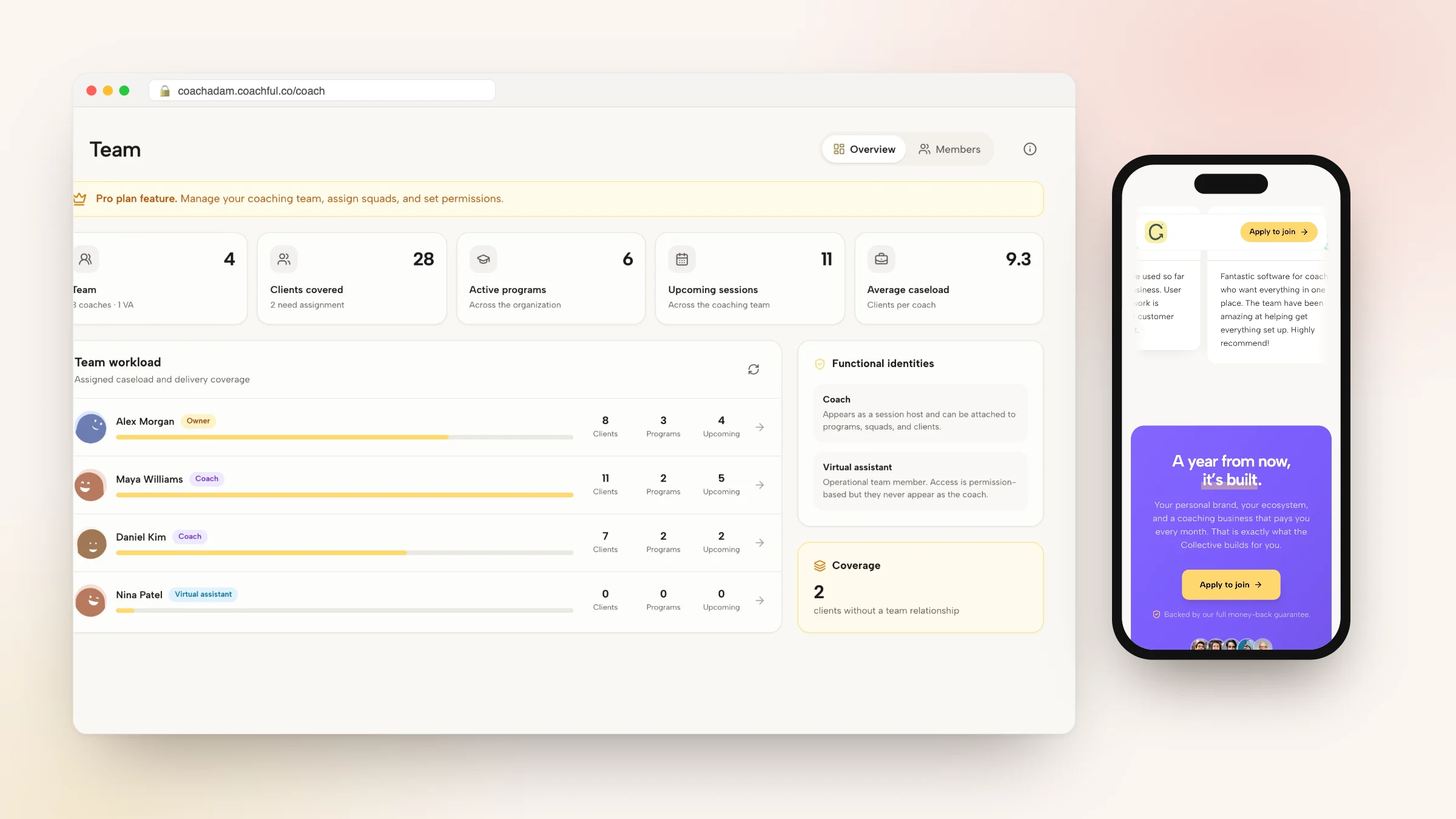
Coaching business systems are the documented, repeatable ways your business finds clients, sells, delivers and gets paid, set up so they keep working whether or not you are in the room. A coaching business runs without you when four things are true: revenue recurs instead of restarting every month, the systems are written down, delivery does not depend on your personal hours, and a team can operate it. Get those four right and you have a business you can step back from, and possibly one day sell. Miss them and you have a demanding job with your name on the door.
This guide covers each of the four pillars in practical detail, a test for how dependent your business is on you today, what actually makes a coaching business sellable (with the honest caveats), and a 12-month build order. It ends with how the Coachful Collective and its Exit Playbook bonus help you build in this direction. The video gives the overview.
The Coachful Collective in a few minutes: who it is for, the CLIMB method and how the year works.
The two-week test: how much does your business depend on you?
Picture yourself unreachable for two weeks. No phone, no laptop. Go down this table and be honest about which column describes your business today.
| If you vanished for two weeks... | Founder-dependent | Runs on systems |
|---|---|---|
| New leads | Stop when you stop posting | Keep arriving from evergreen funnels, search, referrals or ads |
| Discovery calls | Only you can take them | A booking and application flow routes them; someone trained can run them |
| Onboarding | Lives in your head and your inbox | A journey sends the agreement, intake and welcome steps automatically |
| Delivery | Every session is you | A program, group sessions and other coaches trained on your method |
| Client questions | Wait for you | Answered by the team, the community or a resource library |
| Billing | You chase invoices | Payments, renewals and failed-payment retries run automatically |
| Numbers | Nobody knows them | A weekly dashboard someone reviews |
Count the rows in the right-hand column. Zero to two is normal for a solo practice, and it is not a criticism. It is simply your starting point. The rest of this guide is about moving one row at a time.
Pillar 1: Recurring revenue
A business that restarts at zero every month cannot plan a hire, survive a slow quarter or attract a buyer. Recurring revenue turns your income from a scramble into a forecast. It does not have to mean a subscription box for coaching; it means clients who keep paying because they keep getting value.
| Model | How it works | Best for | Watch out for |
|---|---|---|---|
| Membership or continuity | Monthly access to group calls, a library and a community | Ongoing goals: fitness, business growth, wellbeing practice | Churn when the content gets stale or the community goes quiet |
| Retainer | Ongoing 1:1 or advisory support, billed monthly | Executives, founders, long-term performance work | Still tied to your hours unless others can deliver it |
| Program then continuation | A fixed program, then an optional lighter monthly plan | Most coaches with a signature program | Offering the continuation too late, after the client has gone |
| Annual program with renewal | A year-long engagement that renews | Deep transformations, cohorts, professional development | Renewal conversations left to the last week |
The simplest move for most coaches is the third row. Design a continuation offer for clients who finish your main program: a lighter rhythm, a new result to work toward, and a lower monthly price. Present it at the last big milestone, three or four weeks before the end, not on the final call. Our guides to client retention and subscription-based coaching cover the wording and setup, and our membership pause policy guide covers the edge cases that cause churn.

Pillar 2: Documented systems
A system is a repeatable answer to a recurring situation. Most coaching businesses run on eight of them. Map yours on one page before you try to improve any of them.
| System | Trigger | What should happen | Owner |
|---|---|---|---|
| Lead capture | Someone opts in or books | Resource delivered, lead tagged by source | Automation |
| Nurture | New lead | Welcome email sequence ending with an invitation | Automation, reviewed monthly |
| Sales | Application submitted | Call booked, call held, recap sent, follow-up for seven days | You, later a trained team member |
| Onboarding | Payment received | Agreement, intake form, welcome, first session booked | Automation plus an assistant |
| Delivery | Each week of the program | Plan released, session held, check-in sent | Coach and automation |
| Retention | A milestone or a missed check-in | Review, outreach, renewal offer at the right time | Client success |
| Billing | Renewal date or failed payment | Automatic charge or retry, clear notice to the client | Automation, checked weekly |
| Reporting | Every Friday | Leads, calls, sales, active clients, renewals and cash reviewed | You or an operations lead |
Each system eventually needs a short standard operating procedure (SOP). You can write a usable one in about 30 minutes:
- Record yourself doing the task once, screen and voice, explaining as you go.
- Turn the recording into numbered steps. One action per step, written for someone who has never done it.
- Add a "done means" line. "Done means the client has a signed agreement, a completed intake and a first session in the calendar."
- Hand it to someone else. Watch where they get stuck, and fix those steps.
- Date it and name an owner. An SOP nobody owns is out of date within a quarter.
Keep every SOP in one place that is easy to find, and link each one from the system map. Our guide to the shared systems to set up before adding a second coach lists the six that break first, and client onboarding automation covers the system most worth automating early.

Pillar 3: Delivery that does not depend on your hours
This is the hardest pillar for coaches, because the coaching is the part you love and the part clients say they are paying for. The goal is to make your method the product, so it can be delivered well by the program, the group and, eventually, other coaches, with you still steering.
- Name the method. Give your process a name and a fixed number of stages. A method with a name can be taught; "how I work with people" cannot.
- Write the curriculum. For each stage: the outcome, the teaching, the exercise, the milestone.
- Turn the teaching into a program. Record the core teaching once, then deliver it through a program with weekly actions instead of repeating it live for every client. Our guide to building a signature coaching program walks through it, and Coachful's program builder releases each week's actions on schedule.
- Move practice into groups. Small-group calls handle application and accountability for several clients at once. See how to create a group coaching program and Coachful's group coaching tools.
- Add check-ins and community. Automated check-ins catch drift early; a community lets clients help each other between calls.
- Train other coaches on the method. With a written curriculum and session reviews, an associate coach can deliver results that look like yours.

| Delivery format | Your hours per client | What protects quality |
|---|---|---|
| 1:1 sessions only | Highest | You, personally |
| 1:1 plus a program | Lower | The program does the teaching; sessions do the application |
| Small group plus a program | Lower still | Group format, program structure, check-ins |
| Groups, community and associate coaches | Lowest | The written method, coach training and session reviews |
Moving down the table is a gradual process, and quality has to come with you. Our guides to scaling without losing quality and structuring an associate coach model cover the guardrails, from revenue share to brand standards.

Pillar 4: A team, hired in the right order
Most coaches hire too late, then hire the wrong role first. A common, sensible order looks like this:
| Hire | Takes off your plate | Hire when |
|---|---|---|
| Virtual assistant or operations help | Inbox, scheduling, onboarding admin, SOP upkeep | Admin eats a full day of your week |
| Client success or community lead | Check-ins, engagement, renewal reminders, community moderation | You have more active clients than you can personally follow up |
| Associate coach | Delivery for part of your client base | Your method is written down and your calendar is full |
| Sales help | Discovery calls, using your script and your data | You have a proven script, a steady flow of calls and clear qualification |
| Marketing help | Editing, repurposing, publishing, ad management | You know which channel works and need more of it |
Two rules make every hire easier. Document the task before you delegate it, so the new person learns your system instead of inventing their own. And test before you commit: our virtual assistant test tasks give you five paid work samples to use. Give each person access to only what their role needs.

What makes a coaching business sellable, and what nobody can promise
An honest starting point: many coaching businesses are hard to sell, because the product is the founder. When the founder leaves, the clients, the content and the reputation often leave too. The answer is to build, one at a time, the specific qualities buyers look for.
| What buyers usually look for | Why it matters to them |
|---|---|
| Recurring revenue with steady retention | Predictable income they can plan around |
| Delivery by people other than the founder | The business keeps working after the sale |
| Documented systems | They can run it without reverse-engineering it |
| A brand beyond one person's face, or a plan to transition | Clients stay when the founder steps back |
| Clean, separate financial records | They can verify what they are buying |
| No dependence on one client, channel or platform | Less risk that revenue disappears |
| Clear ownership of the curriculum, contracts and client data handled properly | Fewer legal surprises |
No valuation is guaranteed. What a buyer pays depends on the buyer, the market, your numbers and how dependent the business still is on you, and plenty of owners find that the best outcome is not a sale at all. Hiring an operator and keeping the income, handing the practice to a successor, or closing well are all legitimate endings. Our guide to whether to sell or close a coaching practice walks through those options.
The useful part is that the qualities that make a business sellable also make it better to own. Recurring revenue, written systems and delivery that does not need you every hour are worth building even if you never meet a buyer.
A 12-month build order for coaching business systems
| Quarter | Focus | By the end of the quarter |
|---|---|---|
| 1 | Offer and recurring revenue | One core offer, a continuation or renewal option, the system map, a weekly numbers review |
| 2 | Systems and first help | SOPs for the eight systems, onboarding and billing automated, an assistant handling admin |
| 3 | Productized delivery | The method named and written, a program template, a group format, check-ins and a community |
| 4 | Team delivery and the test | A second person delivering part of the program, the sellability table reviewed, and a real two-week break |
The two-week break at the end of the year is the exam. Take it, then repeat the test from the top of this article and see how many rows moved. Whatever broke while you were away is next year's first project. If you are earlier in the journey and still building the first offer, start with our one-page coaching business plan and come back to this order once clients are arriving.
Building it with the Coachful Collective and the Exit Playbook
Coachful's founder, Nour, is an entrepreneur and a psychologist who built business after business before he built and exited a seven-figure coaching business. The lesson he describes on the Collective page is the theme of this article: "that initial spark gets you started, but only real systems keep it alive." He built that business on systems, then built Coachful on the same principles.

The Coachful Collective is the 12-month implementation program that grew out of that experience. It is designed for coaches and other experts who want a clear offer, a client acquisition system, recurring revenue, structured delivery, documented systems and a business less dependent on selling their own hours. It follows CLIMB, where the last step, Build delivery that keeps them, is exactly the pillar most coaches leave until too late. Our CLIMB method guide explains the full sequence.
Members get:
- 12 months of Coachful Pro, where the funnels, email, programs, community, scheduling, payments and team roles described above live.
- Coachful Intelligence, with live evidence of the offers, ads, funnels and messaging already working in your market.
- The CLIMB curriculum and templates.
- Weekly live group sessions where you ask questions, clear blockers and build the next piece with the team, plus community co-working and support, and personal daily feedback from the Coachful team in the private community.
- Bonuses: a sales script for coaching calls, the 2026 Coaching Industry Report shipped to your address, and the Exit Playbook.
The Exit Playbook is a complete course on building a coaching business you could exit. In general terms, it covers how to build toward the qualities in the sellability table above, so the business holds value beyond you. It does not promise a sale, a buyer or a valuation, and neither does anything else in the program.

The Collective does not include a one-on-one onboarding call or private coaching. The main support is the weekly live group sessions, plus personal daily feedback from the Coachful team in the private community. The guarantee is work-backed: do the work with the team, and if it still does not help you build your business, email support for a full refund. It does not guarantee revenue, clients, a valuation or an exit. You can see current pricing and intake on the Collective page.
Frequently asked questions
What systems does a coaching business need?
Most coaching businesses run on eight: lead capture, nurture, sales, onboarding, delivery, retention, billing and reporting. Map each one with its trigger, what should happen and who owns it, then write a short SOP for each. Automate the ones that follow the same steps every time, such as onboarding and billing, first.
Can a coaching business run without the founder?
It can, if revenue recurs, the systems are documented, delivery is built on a written method that others can run, and a team operates it day to day. Most solo practices get there gradually: an assistant first, then a program and group format, then associate coaches trained on the method.
Can you sell a coaching business?
Sometimes. Coaching businesses with recurring revenue, delivery that does not depend on the founder, clean financials and documented systems are far more attractive to buyers than practices built entirely around one person. No valuation or sale is guaranteed, and for many owners hiring an operator, handing over to a successor or closing well is the better outcome.
How do I create recurring revenue as a coach?
The simplest route is a continuation offer for clients who finish your main program: a lighter monthly rhythm toward a new result. Other options are a membership with group calls and a community, a monthly retainer, or an annual program that renews. Present the next step at a late milestone, not on the final call.
Who should I hire first in my coaching business?
Usually a virtual assistant or operations person, once admin takes up a full day of your week. Document the tasks first, run a paid test task, and give them access only to what the role needs. Associate coaches and sales help come later, once your method and your sales script are written down.
What is the Exit Playbook in the Coachful Collective?
It is one of the Collective's member bonuses: a complete course on building a coaching business you could exit, focused on the qualities that help a business hold value beyond its founder. It does not promise a sale or a valuation. Members also get a sales script, Coachful Intelligence and the 2026 Coaching Industry Report.
Can Coachful set up these systems for me?
Coachful's white-glove service, free on every plan, will build pieces of the system in your account: a website, a funnel, a program, an email sequence, an automation or an onboarding journey, usually within about 24 hours of your request. Writing your SOPs and hiring your team stay with you. The white-glove service guide explains how to ask.