The CLIMB Method: Build a Coaching Business in Order
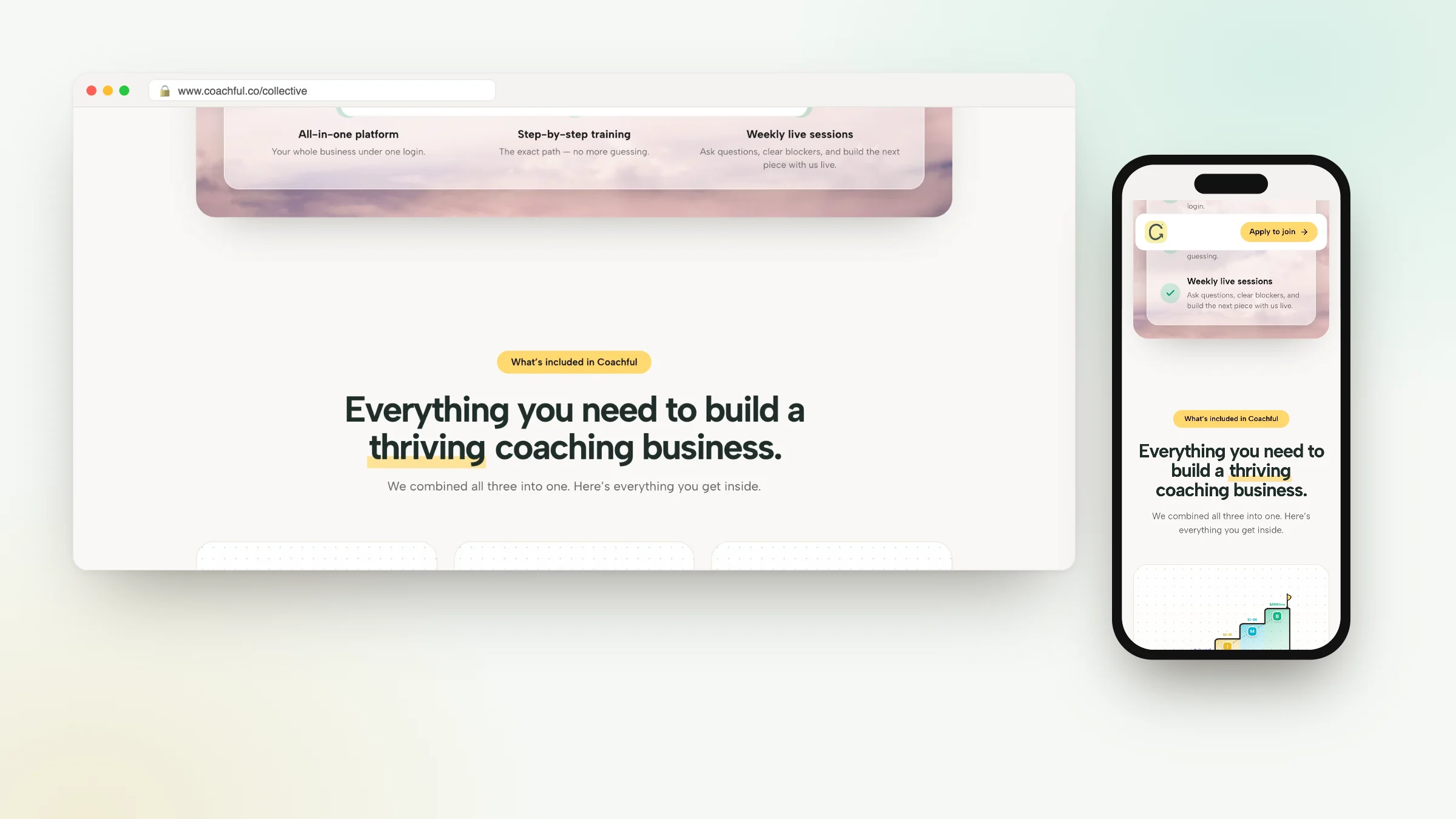
The CLIMB method is Coachful's five-stage model for building a coaching business in the order clients actually move through it: Capture attention, Lead people to trust, Initiate the first purchase, Multiply what works and Build delivery that keeps them. Each stage answers one question, has one number that tells you whether it works, and depends on the stage before it.
The order is the method. Many coaching businesses that stall are working hard on a stage that was never their problem, while an earlier handoff quietly loses people. This guide explains every stage in depth with examples, why the sequence matters, the seven conditions behind any purchase, a self-assessment to find your current stage, and how the Coachful Collective builds each stage into a business over a year.
The Coachful Collective in a few minutes: who it is for, the CLIMB method and how the year works.
The five CLIMB stages at a glance
Think of CLIMB as the path one person takes from never having heard of you to being a client who stays. Every coaching business has this path, whether or not anyone designed it.
| Stage | The question it answers | What you build | The number to watch |
|---|---|---|---|
| C: Capture attention | Are the right people seeing a message they recognize? | One channel, one clear message, a steady publishing rhythm | People who saw you |
| L: Lead people to trust | Does attention have one simple path to becoming someone you can follow up with? | A small, useful free thing and the page that delivers it | People who gave you their email |
| I: Initiate the first purchase | Can a lead see a credible, timely and affordable next step? | One offer, one invitation, a booking or checkout that works | Meaningful actions: calls booked, applications, purchases |
| M: Multiply what works | Is the next valuable result obvious after someone has said yes? | Renewals, referrals, the next offer, more of the channel that works | Clients who stayed, renewed, referred or bought again |
| B: Build delivery that keeps them | Can clients see and feel progress they credit to the coaching? | A program with an early win, check-ins and community | Clients actively making progress |
The Coachful Collective page draws CLIMB as a staircase: a stranger lands on your page, you get their email, they make a tiny first purchase, that buyer becomes a real client, and the system repeats until the business runs on recurring revenue. Each step only exists because the one below it holds.

Why the order matters more than any single stage
Every business is stuck in one place at a time. That is the principle Coachful's Diagnostics view is built on, and it is the reason CLIMB is a sequence rather than a checklist. Fix the constraint and everything after it starts moving. Work on anything else and you are polishing a part of the path nobody reaches.
Out-of-order work is one of the most expensive mistakes a coaching business can make. Four versions of it come up again and again:
- Ads before Lead. Paying for attention when visitors have nowhere to leave an email buys you strangers who leave.
- A premium second offer before anyone has bought the first. There is nothing to multiply yet.
- A loyalty program before delivery works. Clients who are not seeing progress will not be kept by perks.
- More content when calls do not close. The leak is at Initiate, and extra attention only adds people to the leak.
Two rules keep you in order. Fix the first material broken handoff, the earliest stage where people stop moving. And protect every healthy stage while you do it: if a message is earning attention, do not rewrite it just because the lead magnet below it is weak. Change one meaningful thing at a time and decide in advance what evidence would tell you it worked.

C: Capture attention
Capture is the stage where the right people see you and recognize themselves in what you say. The key word is right. Ten thousand views from people who will never buy coaching are worth less than two hundred from people in exactly the situation you help with.
What good looks like. You publish on one channel your buyers already use, on a rhythm you can keep. Your message names a specific person and problem. You also borrow other people's audiences through podcasts, workshops and partners.
An example. Take a fictional life coach, Maya, who helps people in the first year after a divorce. Her Capture is two short posts a week on Instagram about the practical side of starting over, plus a monthly free workshop at a local community center, and one podcast guest spot a month. A fictional career coach, Jon, who helps engineers move into management, captures on LinkedIn with one post a week on the first 90 days as a manager and a talk for an engineering meetup each quarter.
Signs you are stuck here. Hardly anyone new sees your work, or the people who do are mostly other coaches. Your engagement comes from peers rather than buyers.
The useful move. Repeat the clearest source of qualified attention you already have, and do not change a message that is already earning a response. What never to do: buy or create more attention to repair a destination, promise or handoff further down that is visibly broken.
Our guide to marketing yourself as a coach covers positioning, message and channels for this stage in detail.

L: Lead people to trust
Attention is fragile. Lead is the stage where a person who noticed you becomes someone you can reach again, usually by giving you their email in exchange for something small and useful. It is called Lead people to trust because the follow-up that this makes possible is where trust actually gets built.
What good looks like. One fast, honest result offered for free, continuing the same promise as the content that sent people there. A short quiz, a one-page plan or a ten-minute exercise beats a 40-page guide that feels like homework. The thank-you page points to the next step, and a short email sequence follows.
The example. Maya offers "The first-year reset", a one-page plan for the week, delivered by email with three follow-ups. Jon offers a five-minute "first-time manager scorecard" quiz that shows which of four skills to work on first.
Signs you are stuck here. People like your posts and visit your profile, but your list barely grows. In the demo numbers on Coachful's Diagnostics screen, about 2,500 people visit the pages and 74 leave their details, and the screen marks Lead as the bottleneck.
The useful move. Keep the message that is earning attention, and offer one fast, honest result and one next step you own. What never to do: start work on retention, expansion or a second offer while Lead is the constraint. Our guides to creating a lead magnet and quiz funnels for coaches show the build.

I: Initiate the first purchase
Initiate is the first meaningful step a lead takes toward working with you. On the Collective page's staircase it is drawn as a tiny first purchase, in the one-to-ten-dollar range, that turns a follower into a buyer. In Coachful's Diagnostics, Initiate counts any meaningful action that shows real intent: a booked call, a reply, a completed application, a checkout, attendance at a workshop or a payment.
What good looks like. One honest offer and one concrete action that is easy to take now. A lead can see who it is for, what it costs, what happens next and why now is a sensible time, without inventing urgency.
The example. Maya's third email invites readers to a free 30-minute call, with the call's purpose and length stated plainly, and her booking page asks three questions. Jon's quiz result page offers a small paid "first 90 days" planning session, which he credits toward his 12-week program if the client continues.
Signs you are stuck here. Your list grows but nobody books or buys; people book calls and then do not start; or they reach checkout and stop at the payment.
The useful move. Make one offer and one action easy to take now. Remove choices, say the price plainly and make the booking or checkout work on a phone. What never to do: use fake scarcity, invent proof or add options that postpone a decision. Our coaching sales script and the guide to a discovery call funnel cover the conversation and the pages.

M: Multiply what works
Multiply begins after someone has said yes. The small first step turns into a real engagement, and the relationships you already have deepen through renewals, referrals and the next offer. It also means doing more of whatever produced your best clients, which is why you need to know where each one came from. Lead management in Coachful records the source on every lead, so that question has an answer.
What good looks like. Coachful's method describes expansion as Progress, Gap, Path. First you reflect the progress the client has made. Then you name the next honest gap. Only then do you offer the fitting path: a renewal, a continuation, a referral or a next program. The client always keeps an independent option.
The example. In week ten of twelve, Maya reviews with each client what has changed since the first session, names what is still unsettled (often the social side of starting over) and offers a monthly continuation. Jon notices that three of his last five clients came from his meetup talks, so he books two more and drops a posting habit that produced none.
Signs you are stuck here. Clients buy once and disappear, renewals surprise you, and you rarely get referrals even from happy clients.
The useful move. Reflect progress, name the next honest gap, then offer the fitting next step. What never to do: manufacture dependency, hold back the original result or pitch a continuation before the client can see any progress. Our guides to the renewal conversation and referral emails have the wording.

B: Build delivery that keeps them
Build is the last stage in the order and the one that feeds all the others. Delivery that produces visible progress creates the outcomes, proof, renewals and referrals that make Capture, Initiate and Multiply easier. It is also what turns a run of good months into recurring revenue.
What good looks like. Clients can feel, see and attribute meaningful progress to the coaching. A first win arrives early, it is visible, and it predicts the bigger result rather than being a vanity milestone. Coachful's method describes retention as three things working together: attention (clients hear from you between sessions), advancement (they can see themselves moving) and attachment (they feel part of something, often through designed community rituals rather than an empty feed).
The example. Maya's program now has a week-two milestone, the first weekend planned entirely on the client's own terms, plus a Sunday check-in and a small group space for clients in the same season. Jon adds a progress review at week four where the client and their manager compare notes against the scorecard from the quiz.
Signs you are stuck here. Clients pay and then go quiet, finish modules without much changing, or stall in the middle and do not renew.
The useful move. Give the client one visible milestone, support at the real point of friction and a reliable progress review. What never to do: answer disengagement with more content, or treat module completion as proof that the client really moved. Our guide to increasing client retention goes deeper.

The seven conditions behind every purchase
CLIMB tells you where people stop. Coachful's method also names why. A stranger buys when seven conditions are present, and a weak CLIMB stage almost always traces back to one of them.
| Condition | What it means | Where it usually shows up |
|---|---|---|
| Visibility | The right people actually see you | Capture |
| Outcome | You promise something they already want | Lead, Initiate, Multiply |
| Method | The path to it is believable | Lead to Build |
| Story | They can relate to you or to someone you helped | Lead, Initiate |
| Proof | There is credible evidence it works | Lead to Build |
| Honest urgency | There is a real reason to act now | Initiate |
| Financial ability | They can afford it, or see how to | Initiate |
Coachful's method treats audience, outcome, method, story and proof as the durable foundation of your offer: you work them out once and reuse them everywhere. Visibility, honest urgency and financial ability change with the market and the buyer, so you keep measuring them. Proof matters at almost every stage, and it must never be invented.
Find your current CLIMB stage: a self-assessment
Read each statement and mark it true or false for the last 90 days. Your current stage is the first one where any statement is false. Work on that stage, and only that stage, until its statements are true.
| Stage | Statements to check |
|---|---|
| Capture | New people who match my buyer see my work every week. I publish on one channel on a rhythm I keep. My engagement comes mostly from potential clients, not other coaches. |
| Lead | I have one small free thing that delivers a result quickly. Visitors can get it on a phone in under a minute. My list grows every week without me pushing it. |
| Initiate | My offer, price and next step are stated plainly. People on my list book calls or buy without me chasing them. Most of the people I invite to start, start. |
| Multiply | I know where my last five clients came from. I raise renewals before the final session. Clients refer people to me. |
| Build | Clients get a visible win in the first two weeks. I hear from every client between sessions. I notice quiet clients within a week. |
If you run your business on Coachful, the Diagnostics view (Manage, then Growth Lab, then Diagnostics) reads your real numbers and marks the bottleneck on the same CLIMB rail, with a plain explanation and a suggested first move. Use it alongside the table above: the numbers show where people stop, and your answers explain why.
CLIMB in practice: two businesses, stage by stage
Here is how the two fictional coaches from above looked when each first ran the self-assessment, and the single change each one made first.
| Stage | Maya, life coach after divorce | Jon, career coach for new managers |
|---|---|---|
| Capture | Healthy: workshops fill and posts reach the right people | Healthy: LinkedIn posts reach engineers |
| Lead | Stuck: no free thing, just "DM me" | Healthy: the scorecard quiz gets steady sign-ups |
| Initiate | Untested, because nobody reached it | Stuck: quiz takers rarely book, because the result page has three different offers |
| Multiply | Untested | Weak, but not the constraint yet |
| Build | Clients love the work | Clients get results |
| First fix | Add the one-page reset and three emails | Replace three offers with one paid planning session |
Notice what neither of them did. Maya did not start a podcast, and Jon did not redesign his website. Each fixed the earliest stage where people stopped, then waited for evidence before touching the next one.
How the Coachful Collective builds each stage into a business
You can apply CLIMB on your own with this guide. The Coachful Collective is the 12-month program built around it: members build each stage into their business in order, with the CLIMB curriculum and templates, weekly live group sessions to work on the next piece, personal daily feedback from the Coachful team in the private community, community co-working and support, Coachful Intelligence for market evidence and a year of Coachful Pro to run it.
| Stage | What you build | Where it runs in Coachful | How the Collective helps |
|---|---|---|---|
| Foundations | Audience, outcome, method, story and proof | Your offer and homepage | Intelligence shows the offers and messaging already selling in your market |
| Capture | One channel and a steady message | Website, blog, link in bio, social planner | Weekly sessions to review your message and channel choice, plus personal daily feedback in the community |
| Lead | The free thing and its follow-up | Funnels, quizzes, email sequences | Templates for the stage and feedback while you build |
| Initiate | The first-purchase path | Booking pages, offers, checkout, leads | The sales script bonus and live help on stuck offers |
| Multiply | Renewals, referrals, the next offer | Analytics with lead sources, email broadcasts | Community with personal daily feedback, and weekly sessions to decide what to double down on |
| Build | Delivery that keeps clients | Programs, the client app, check-ins, community | Weekly sessions on program design and retention, plus personal daily feedback in the community |
Support is the weekly live group sessions plus personal daily feedback from the Coachful team in the private community, with no one-on-one calls or private coaching sessions, and the program carries a work-backed money-back guarantee: do the work with the team, and if it still does not help you build your business, email support for a full refund. Current pricing and intake are on the Collective page, and our guide to the Coachful Collective covers what a year inside looks like. If one stage just needs building, every Coachful plan includes a free white-glove build for things like a lead magnet funnel or a website.

Common misreadings of CLIMB
- "CLIMB is just a sales funnel." The first three stages overlap with a funnel. Multiply and Build are about clients who already paid, which is where much of a coaching business's long-term value sits.
- "You finish one stage forever." You move your constraint, then a later stage becomes the bottleneck. Growth brings you back to earlier stages at a larger scale.
- "Initiate has to be a tiny paid offer." A tiny purchase is one form. A booked call, an application or a paid first session all count, as long as it is a meaningful action.
- "Build is optional for new coaches." Delivery is what produces your first proof. Without it, every other stage gets harder.
For the client-getting side of CLIMB with scripts and a 30-day plan, see how to get more clients as a coach. Life coaches will find a niche-specific version in how to get life coaching clients.
Frequently asked questions
What does CLIMB stand for?
CLIMB stands for Capture attention, Lead people to trust, Initiate the first purchase, Multiply what works and Build delivery that keeps them. Each letter is a stage in the path from a stranger seeing you to a client who stays, renews and refers.
Who created the CLIMB method?
CLIMB is Coachful's method. The Collective page describes it as the five-step system the team uses to turn strangers into paying clients, and it is taught in the Coachful Collective's curriculum. Coachful's Diagnostics view uses the same five stages to show where a coaching business is stuck.
Is the CLIMB method the same as a sales funnel?
No. Capture, Lead and Initiate overlap with a typical funnel, from attention to email to first purchase. CLIMB adds Multiply and Build, which cover renewals, referrals, the next offer and delivery that produces visible progress. Those later stages are where much of the long-term revenue and proof come from.
How long does each CLIMB stage take?
There is no fixed timeline. It depends on your starting point, offer, market and how fast you implement. A coach with an audience may fix Lead in a couple of weeks; someone starting from zero may spend longer on Capture. Change one thing at a time and judge it on evidence, not on one slow week.
Do I need a tiny paid offer for the Initiate stage?
No. The Collective page's staircase draws Initiate as a tiny first purchase, but any meaningful action that shows real intent counts: a booked discovery call, a completed application, a paid first session or a checkout. Choose the one that fits your offer and say it the same way everywhere.
Can I use CLIMB without joining the Collective?
Yes. Everything on this page works on its own, and if you run your business on Coachful, the Diagnostics view marks your CLIMB bottleneck from your numbers. Every Coachful plan also includes a free white-glove build if you want a funnel or website set up for you. The Collective adds the curriculum, weekly group sessions, community with personal daily feedback from the team and Intelligence.
How is CLIMB different from coaching models like GROW?
GROW and similar models structure a coaching conversation with a client. CLIMB structures the business around your coaching: how clients find you, start working with you and stay. You would use GROW inside a session and CLIMB to plan your month. Our guide to coaching models every coach should know covers the session models.