How to Get More Clients as a Coach: The CLIMB System
How to get more clients as a coach comes down to one question: where, between a stranger first seeing you and a client renewing, do people stop? Find that step and fix it before you add anything else. There are five steps in the path, and almost every practice that has stalled at the same client count is leaking at one of them.
The five steps are the ones Coachful's CLIMB method is built on: Capture attention, Lead people to trust, Initiate the first purchase, Multiply what works and Build delivery that keeps them. This guide is the full system for getting more coaching clients: a ten-minute way to find your leak, the fix for each stage with scripts you can copy, a 30-day plan and the mistakes that cost coaches the most time. If you are still looking for your very first client, our 50-name outreach list is the faster start. Come back here once a few people have said yes.
The Coachful Collective in a few minutes: who it is for, the CLIMB method and how the year works.
Why doing more rarely gets you more coaching clients
When clients slow down, the instinct is to do more of everything: post more, redo the website, try a new platform. It feels productive and it usually changes nothing, because the extra effort lands on a step that was already working.
Here is an illustrative month for a coach who posts five times a week. The numbers are invented to show the shape of the problem, not a benchmark.
| Step | What happened this month | What it tells you |
|---|---|---|
| Capture | About 2,000 people saw a post | Visibility is fine for a small practice |
| Lead | 40 clicked the profile link; nobody left an email, because there was nothing to sign up for | This is the leak |
| Initiate | 3 people sent a message; 1 booked a call | Only the already-convinced got through |
| Multiply and Build | No new clients, so nothing to renew or refer | Downstream steps never get tested |
Doubling the posts would double the 2,000 and leave the same hole underneath it. One small lead magnet on the link page would change the month. That is the whole idea of this guide: more clients come from fixing the weakest handoff, and you only find it by looking at the steps in order.
Find the stage that is costing you clients
Read down this table and stop at the first row that sounds like you. That row is your stage, even if a later row also sounds familiar. The earliest broken step limits everything after it.
| If this sounds like you | You are stuck at | The first fix |
|---|---|---|
| "Hardly anyone new ever sees my work." | Capture | One channel where your buyers already look, every week, for 90 days |
| "People like my posts, but nobody joins my list." | Lead | One small, specific free thing worth an email address |
| "My list grows, but nobody books or buys." | Initiate | One offer, one invitation, one clear next step |
| "People buy once and then disappear." | Multiply | Renewal and referral conversations at the moment of progress |
| "Clients stall halfway and do not renew." | Build | An early visible win and a weekly check-in |
Two rules go with the table. Fix the first broken step, and leave the healthy ones alone while you do. And change one thing at a time, then give it long enough to show a result. One slow week is not a diagnosis.
If you run your business on Coachful, the Diagnostics view (Manage, then Growth Lab, then Diagnostics) does this from your own numbers. It names the CLIMB stage where people are dropping out and the one move that addresses it. The same five stages are the build order of the Coachful Collective, which comes up again at the end of this guide.

Capture: get in front of people who already have the problem
Capture is about the right people seeing you, which is different from many people seeing you. A hundred newly promoted managers reading your post beats ten thousand strangers watching a trending video.
Pick one home channel and stay for 90 days. Choose it by where your buyer looks for help, not by where other coaches post:
- Career, leadership and executive coaching: LinkedIn, and professional newsletters. Our guide to getting coaching clients on LinkedIn covers the profile and the messages.
- Life, wellness and relationship coaching: Instagram, short video, local and online communities.
- Problems people type into a search bar ("how to stop people pleasing"): a blog or YouTube, which compound slowly but keep working.
- Trust-heavy, higher-priced work: podcasts and talks, where people hear you think for 40 minutes.
Borrow audiences while you build your own. A guest spot on a podcast, a workshop for someone else's community or a feature in a partner's newsletter puts you in front of people who already trust the host. Our guide to getting booked on podcasts has the full process. A short pitch is enough:
"Hi Sam, I listened to your episode on going back to work after parental leave. I coach new parents through exactly that return, and I have a practical segment on the first two weeks back that your listeners might use: what to say to your manager, and the one boundary to set early. Happy to send three talking points if it's a fit."
Post things that make the right person stop. Four kinds of post do most of the work: the problem named in their words, the common mistake and why it backfires, a story (yours or a client's, with permission), and your method shown in a small step they can try. Every post ends with one next step, which is usually the free thing you build in the next stage. If you are not sure what to say in the first place, our guide on how to market yourself as a coach starts with positioning and message.
Give everyone one place to land. Your bio link should do one job: deliver the free thing, book the call or sell the first step. A link page with nine buttons is a polite way of asking people to leave.

Lead: turn attention into an email address
Attention fades in seconds. An email address lets you follow up for months. The Lead stage exists to make that swap easy and worth it.
A lead magnet that works is small, fast and specific. It delivers one honest result in under ten minutes and continues the exact promise of the content that sent people to it. Big guides feel like homework and get saved, never opened.
| Coach | Weak lead magnet | Strong lead magnet |
|---|---|---|
| Career coach | "The Ultimate Career Guide" (40 pages) | "The 5-minute career clarity scorecard" |
| Life coach | "My Free E-book on Living Your Best Life" | "The Sunday reset: a one-page plan for a calmer week" |
| Health coach | "Newsletter sign-up" | "Three 10-minute lunches for the 3pm crash" |
| Business coach | "Book a free strategy session" | "The pricing check: is your package underpriced?" (a short quiz) |
The page that delivers it needs four things: a headline that names the result ("Plan a calmer week in 10 minutes"), three bullets on what is inside, one field for an email and one button. The thank-you page is where most coaches waste the moment. Put the next step there: a short video and a link to book a call or see your offer. Our guide to creating a lead magnet for coaches has more examples by niche, and the funnel builder in Coachful handles the page, the delivery and the email capture in one place.

Then three emails over a week, written like a person:
- Day 0, deliver it. The link, one sentence on how to use it, and the first thing to do today.
- Day 2, teach one mistake. The thing most people get wrong about this problem, and what to do instead. No pitch.
- Day 5, invite. Who your coaching is for, what changes, and one clear next step.
Our welcome email sequence for coaches has five emails written out if you want a fuller version.

Initiate: make the first yes easy to say
Initiate is the first meaningful step a lead takes: a booked call, an application or a small purchase. This is where many coaches quietly lose clients, mostly through vague invitations and calls that turn into free coaching.
Start by choosing what the first step is. All three of these work. Pick one and say it the same way everywhere.
| First step | Why it works | Watch out for | Best for |
|---|---|---|---|
| Free discovery call | Low friction; you hear the problem in their words | Calls that drift into free sessions | Programs and higher-priced packages |
| Paid first session | Filters for commitment; you are paid for your time | Fewer bookings at the start | Coaches with demand or a waitlist |
| Small paid offer | Turns a follower into a buyer before any call | Needs a clear bridge to the main offer | Coaches selling to a larger audience |
Our comparison of discovery sessions and paid first sessions goes deeper on that choice. For a discovery call, the invitation should say what the call is, how long it lasts and what happens at the end:
"If you'd like help with this, I run a free 30-minute call. We'll look at where you are, what you want to change in the next three months, and whether my coaching is the right fit. If it is, I'll explain how it works and what it costs. If it isn't, I'll tell you, and point you somewhere better."
Then run the call in five parts:
- Frame it (2 minutes). "Here's how I'd like to use our time, and at the end I'll tell you honestly whether I can help."
- Where are you now (8 minutes). "What's going on that made you book this call? What have you already tried?"
- Where do you want to be (8 minutes). "If we were talking in three months and this had gone well, what would be different?"
- What's in the way (6 minutes). "What has stopped you getting there on your own?"
- The recommendation (6 minutes). "Based on what you've told me, here's what I'd suggest. It's my 12-week program, it costs [price], and it covers [the three things they named]. Would you like to start?"
Say the price as a plain sentence and then stop talking. If they say they need to think, ask what specifically they want to think through, and agree a date to follow up. Our guide on following up after a discovery call has the messages for the days after, and our coaching sales script writes out the whole conversation, objections included.

Multiply: get more from what already worked
Multiply starts once someone has said yes. It has two jobs: deepen the relationships you already have and do more of whatever produced them.
Know where every client came from. Ask on the booking form, record it on the lead, and look once a month. If three of your last five clients came from one podcast appearance and none from daily posting, your next month should have two more podcasts in it. Our guide to tracking which visibility activities bring clients shows a simple way to keep score.
Ask for referrals at the moment of progress. The best time is right after a client tells you something worked. Coachful's method calls the sequence Progress, Gap, Path: reflect the result, name what is still unsolved, then offer the fitting next step.
"You've gone from dreading Monday meetings to running them. That's a real change. Is there anyone in your world going through what you were going through in March? If you'd like, I can send you a short note you could forward to them."
For written versions, see our referral email templates for clients and alumni.
Have the renewal conversation early. Raise it a few weeks before the end of the engagement, while the client can still see what the next phase would give them, not in the last session. Our guide on when to start the renewal conversation has the timing.

Build: delivery that keeps clients and creates the next ones
Build sits last in the order, and it feeds every earlier stage. Clients who see progress renew, refer and give you the proof that makes Capture and Initiate easier.
- Design an early visible win. In the first two weeks, give the client one result they can point to and connect to the bigger goal: the first difficult conversation had, the first week of meals planned, the résumé rewritten.
- Keep three things alive between sessions. Coachful's method frames retention as attention (they hear from you), advancement (they can see themselves moving) and attachment (they feel part of something). A weekly check-in, a visible progress tracker and a small community cover all three.
- Watch for quiet clients. Silence is the earliest warning sign. Our guide to keeping clients engaged between sessions has the weekly routine.
- Ask for a testimonial after a win, never before. "Would you be willing to write two or three sentences about what changed? I'd only share it with your permission, and you can edit it first." Never invent or polish a quote into something the client did not say.
A 30-day plan to get more coaching clients
This plan assumes a few hours a week alongside your current clients. It works through the stages in order, so if your audit put you at Initiate, keep the first two weeks short and spend the extra time there.
| Days | Focus | What you do | Done when |
|---|---|---|---|
| 1 to 3 | Audit | Run the stage table above. Write your one-sentence positioning: who you help, what changes, by when. | You can name your stuck stage and say your sentence aloud |
| 4 to 7 | Capture | Pick one home channel. Draft eight posts using the four post types. Pitch two podcasts or communities. | Eight posts scheduled, two pitches sent |
| 8 to 14 | Lead | Make one small lead magnet. Build the page and thank-you page. Write the three emails. | A friend can sign up on a phone and get the email |
| 15 to 21 | Initiate | Write your call invitation. Practice the five-part call twice. Send 20 personal messages to people who already know your work. | Your booking link is live and at least a few calls are in the calendar |
| 22 to 26 | Multiply | Ask every current and past client for one referral, at a moment of progress. Note the source of every lead so far. | Every client has been asked once |
| 27 to 30 | Build and review | Add one visible win to your program's first two weeks. Count leads, calls and clients by source. Choose one change for next month. | You know your numbers and your one change |
Every day, protect two small blocks: 30 minutes on Capture and 15 minutes on follow-up. The follow-up block is the one coaches drop first, and it is often where the clients are.

Mistakes that keep coaches at the same client count
- Fixing the wrong stage. A new website does not fix calls that never close, and a better call does not fix a link page nobody signs up from.
- Changing five things at once. When something improves, you will not know what did it. Change one thing, then wait for evidence.
- Buying ads before Lead and Initiate work. Ads multiply whatever is underneath them, including the leak. Our guide to paid ads for coaches covers the numbers to know first.
- Coaching for free on the discovery call. The person leaves helped and has no reason to buy. Diagnose on the call; coach in the program.
- Hiding the price. A vague answer feels like pressure, not politeness. Say it plainly.
- Never asking. Many coaches do everything right and then never invite anyone to buy or refer. Asking is part of the service.
The older guides on this blog, such as our stepwise system for getting coaching clients, cover the niche and offer foundations in more depth if those are still unsettled.
Getting more clients with the system, support and tools around you
Everything above is CLIMB in miniature. You can run it yourself with this guide and any decent set of tools. Most coaches who stall do not lack information, though. They lack the order, someone to notice when they drift, and software that does not fight them.
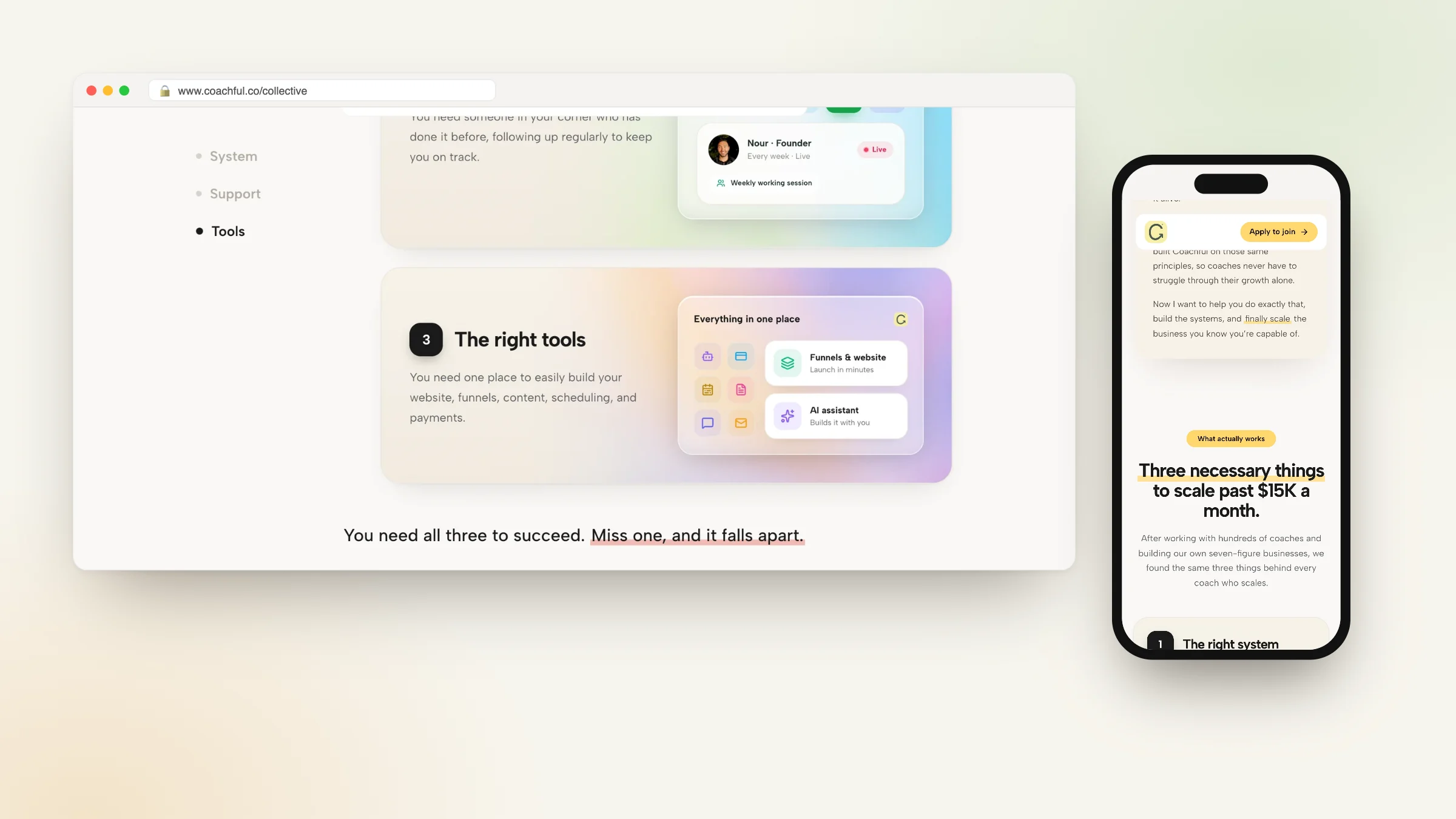
That is what the Coachful Collective is for. It is a 12-month program that builds each CLIMB stage into your business, in order, with weekly live group sessions where you work on the next piece, community co-working, personal daily feedback from the Coachful team in the private community, Coachful Intelligence for evidence on what is already selling in your market and a year of Coachful Pro to run it all on. The weekly live group sessions are the main support, with no one-on-one calls or private coaching sessions, and it comes with a work-backed money-back guarantee. You can see what is included and the current intake on the Collective page, and our full guide to the Coachful Collective explains who it fits.
If you only need one piece built, such as the lead magnet funnel from this guide, every Coachful plan includes a free white-glove build where the team sets it up in your account.

Frequently asked questions
How can I get more coaching clients fast?
The fastest route is the network you already have plus one clear offer. Write a one-sentence description of who you help and what changes, then send personal messages to people who know your work, asking who they know facing that problem. It is slower to scale than content, but it produces conversations this week.
How do I get more clients as a new coach with no audience?
Borrow audiences: guest on podcasts, run a free workshop for an existing community, or partner with someone who serves the same people. Pair that with direct outreach to a short list of named people. A small paid pilot, such as a five-day coaching challenge, turns those first conversations into clients.
How many leads does a coach need to get one client?
There is no honest universal number, because it depends on your offer, price, audience and how warm the leads are. Track your own: leads per month, calls booked and clients signed. After a few months, divide clients by leads and you have your own conversion rate to plan with.
Should I run ads to get more coaching clients?
Only once your Lead and Initiate stages work without ads. If people who already find you join your list and book calls, ads can bring more of them. If they do not, ads make the leak more expensive. Start small, know your cost per client and stop anything that does not pay back.
What is the best platform for getting coaching clients?
A platform converts demand. Marketplaces, content, referrals and ads are what create it. Look for one place that holds your link page, lead magnets, booking, payments and follow-up, with the lead source on every record. Our comparison of coaching platforms to get clients and our guide to whether Coachful brings you clients cover both halves.
Can Coachful build my lead magnet funnel for me?
Yes. Every Coachful plan includes a free white-glove build. You describe the funnel in a short form (what it should do, who it is for and where traffic comes from), and the Coachful team builds it in your account, usually within about 24 hours. You can edit everything afterwards.
What is the CLIMB method for getting clients?
CLIMB is Coachful's five-step build order: Capture attention, Lead people to trust, Initiate the first purchase, Multiply what works and Build delivery that keeps them. The order matters because each stage feeds the next. Our guide to the CLIMB method explains each stage with examples and a self-assessment.