How to Market Yourself as a Coach: The Six Layers
The short answer to how to market yourself as a coach: decide exactly who you help and what changes for them, write that in the words they use, say it the same way on one channel every week, collect proof as you go, and follow up with everyone who raises a hand. Most coaches do the third part first and skip the first two, which is why their marketing feels like shouting.
Marketing for coaches is a sequence of six layers: positioning, message, channels, content, proof and follow-up. Each one depends on the one before it. This guide takes them in order, with templates, sample copy and a weekly routine that fits around a full client load.
The Coachful Collective in a few minutes: who it is for, the CLIMB method and how the year works.
Marketing for coaches works as a sequence, not a menu
Advice about coach marketing usually arrives as a menu: try reels, start a podcast, write a newsletter, run a challenge. Each item on it can work, and none of them works on top of a fuzzy position. A beautifully edited video that says "I help people live their best life" is still a video nobody recognizes themselves in.
Here are the six layers, with the question each one answers and the sign that it is missing.
| Layer | The question it answers | Sign it is missing |
|---|---|---|
| 1. Positioning | Who exactly is this for, and what changes for them? | You describe your work differently every time someone asks |
| 2. Message | What do I say, in their words, every time? | Your homepage, bio and posts sound like three different coaches |
| 3. Channels | Where do my buyers already look for help? | You post everywhere and hear back from nowhere |
| 4. Content | What do I publish each week that earns attention? | You stare at a blank caption box three times a week |
| 5. Proof | Why should a stranger believe me? | People like your posts but ask "does this actually work?" |
| 6. Follow-up | What happens after someone shows interest? | Leads go quiet and you never hear from them again |
If you are short on time, fix the earliest layer that is weak. Everything downstream gets easier once it is in place.
Positioning: write the sentence everything depends on
Positioning is one sentence a stranger can repeat. A reliable shape is: I help [a specific person] [get a specific result] [within a container, or despite a constraint they have].
| Coach | Vague | Specific |
|---|---|---|
| Life coach | "I help people find balance." | "I help new moms going back to work plan a week that leaves room for them, in six weeks." |
| Career coach | "I help professionals thrive." | "I help mid-career engineers move into their first management role without burning out." |
| Health coach | "I help you feel your best." | "I help women over 45 stop the 3pm crash with habits that fit a full workday." |
| Business coach | "I help entrepreneurs grow." | "I help solo designers raise their rates and fill a three-month waitlist." |
| Confidence coach | "I help you believe in yourself." | "I help first-time speakers give a work presentation without dreading it for a week." |
Run three tests on your sentence before you build anything on it:
- The dinner-party test. Say it to a friend, then ask them to tell someone else what you do. If their version is vaguer than yours, simplify.
- The "that's me" test. Show it to three people who match the description. You want an immediate "that's me", not a polite "interesting".
- The "who is it not for" test. If you cannot name who it excludes, it is still too broad.
Specific positioning feels risky because it seems to close doors. In practice, the people outside your sentence can still hire you when they hear about you; they just are not who the marketing is written for. If you are still choosing, our guides to finding your niche and validating a niche with a paid pilot help you decide with evidence instead of a hunch.
Evidence helps here more than intuition. Look at the offers, ads and lead magnets already selling to your buyer and note the exact phrases that keep appearing. Coachful Intelligence, which comes with the Coachful Collective, is built for this kind of research: it shows the ads and content already working in your niche, so your positioning starts from what the market is responding to.

Message: the five things you say everywhere
Once the sentence is settled, expand it into a short message sheet. Write it once, keep it in a document, and copy from it whenever you write a bio, a homepage, a podcast intro or a post.
- Who it is for, in the way they would describe themselves ("I'm back at work and drowning"), not a demographic.
- The problem in their words, including what they have already tried. Take phrases straight from discovery calls.
- The result, concrete and time-bound where you can be honest about it.
- Your method, given a name and three or four steps, so it feels like a path rather than a vibe.
- The next step, one action: take the free thing, book the call or join the waitlist.
Here is a filled-in example for a fictional life coach:
For: moms six to eighteen months back at work who feel like they are failing at both jobs. Problem: "I've tried the planners and the 5am routines. I just end up more tired." Result: a week that has two hours in it for you, within six weeks. Method: the Room to Breathe plan: audit, cut, protect, repeat. Next step: the free Sunday reset, a one-page plan for a calmer week.
Then put the same message in five places: your homepage hero, your social bio, your link page, your podcast or workshop intro, and your email signature. Repetition is the point. Psychologists call the underlying pattern the mere-exposure effect: people tend to warm to what feels familiar. Changing your wording every week throws that familiarity away. Our coaching tagline examples and bio examples help with the short versions, and how to build a coaching brand covers the look that goes around them.

Channels: one home channel, one borrowed audience
You need two kinds of channel. A home channel is where you publish every week and build an audience you own over time. A borrowed audience is someone else's room you are invited into: a podcast, a community, a partner's newsletter, a workshop for an organization. The borrowed audience brings trust quickly; the home channel compounds.
| Channel | Best for | Speed to first inquiry | Good first move |
|---|---|---|---|
| Career, leadership, executive and business coaches | Medium | Rewrite your headline from your positioning sentence | |
| Instagram or short video | Life, wellness, relationship and fitness coaches | Medium | Three posts a week using the four post types below |
| Blog or YouTube | Problems people search for | Slow, then steady | Answer the five questions you hear on every call |
| Podcast guesting | Higher-priced, trust-heavy work | Fast once booked | Pitch five shows your buyer already listens to |
| Workshops and webinars | Coaches who teach well live | Fast | One free 45-minute workshop a month on one problem |
| Referral partners | Local and niche coaches | Medium | Three professionals who serve the same people |
| Coach directories | Getting found by people already looking | Varies | A complete profile pointing at one offer |
| Paid ads | Coaches whose funnel already converts | Fast, and it stops when you stop paying | Small budget behind a lead magnet that already works |
Pick the home channel where your buyer looks while they are trying to understand their problem, and commit to it for 90 days before judging it. For borrowed audiences, a pitch to a community host can be short:
"Hi Priya, your group has a lot of members asking how to go back to work after leave without losing themselves. I'd love to run a free 45-minute session for them: a practical plan for the first month back, with a worksheet they keep. No pitch in the session; I'd mention at the end that I coach on this, and that's it."
A directory listing is a third, quieter source. Coachful's own Find a Coach marketplace is one example, and our guide to whether Coachful brings you clients explains how it works and what to expect from it. For a fuller channel comparison written for coaches, the earlier guide to marketing for coaches on this blog has more examples by niche.

Content that markets you without pitching
Content is where many coaches get stuck, because they treat each post as a blank page. It goes faster with a fixed weekly shape: one longer piece (an article, a video, a podcast episode or a long post), three short posts cut from it, and one email to your list.
Four post types do most of the work. Here they are for the fictional life coach above:
- The problem post. "If you're back at work and every evening feels like a second shift, you're not disorganized. Your week has no empty space in it."
- The mistake post. "Why the 5am routine makes working moms more tired, and the 20-minute alternative that actually holds."
- The story post. A client story told with permission, or your own: what it was like, what changed, what helped.
- The method post. One step of your named method, small enough to try tonight, ending with the free thing as the next step.
To never run out of topics, keep a running note with four headings: questions clients ask, phrases prospects use on calls, objections you hear and mistakes you see. Every discovery call fills it. Our guide to turning discovery call questions into content shows how far one call can go, and how to start a coaching newsletter covers the weekly email.
Write from the thought your buyer has at 11pm, not from the theory you learned in training. "Why do I snap at my kids the minute I get home?" earns more attention than "the neuroscience of emotional regulation", even though they are the same topic.

Proof: how to market yourself when you do not have much yet
Proof answers the question every buyer is too polite to ask: does this work, and does it work for someone like me? It comes in more forms than testimonials.
- Client results, shared with permission and described accurately.
- Process proof: a worked example of your method, so people can see how you think.
- Demonstration: a free workshop or a short challenge where people experience the coaching.
- Your story, when you have lived the problem you coach.
- Credentials and experience, stated plainly and only if real.
If you are new, run a small paid beta with three to five people at a founding price in exchange for honest feedback and, if they are happy, a testimonial. Our guide to running a paid beta coaching program walks through it. Then ask at the right moment, right after a client names a win:
"You said last week felt like the first normal week in a year. Would you be willing to write two or three sentences about what changed? I'd only use it with your permission, and you can edit it before anything goes up."
Never invent a testimonial, merge two clients into one or round a result up. Sample data should be labeled as sample data, and a fictional example should say it is fictional. Trust is the asset you are building, and one exaggeration spends a lot of it. Our testimonial templates show formats that stay honest.

The follow-up system most coaches skip
Most people who are interested will not book the first time they see you. Follow-up is how they come back, and it is the layer most coaches leave to memory.
Run four loops:
- A nurture sequence for everyone who takes your free thing: deliver it, teach one mistake, invite. Our guide to turning a lead magnet into discovery calls writes it out.
- A weekly email to your whole list, so people who were not ready in March are reminded in May.
- A dated next step on every lead, so "I'll get back to her" becomes a task with a day attached.
- Post-call follow-up within a day of every discovery call, with a summary of what they said they want.
For a lead who went quiet, one honest message works better than three cheerful nudges:
"Hi Dana, you downloaded the Sunday reset a few weeks ago. I'm curious whether it helped, or whether something got in the way. Either answer is useful to me, and if the timing is wrong right now, no need to reply."
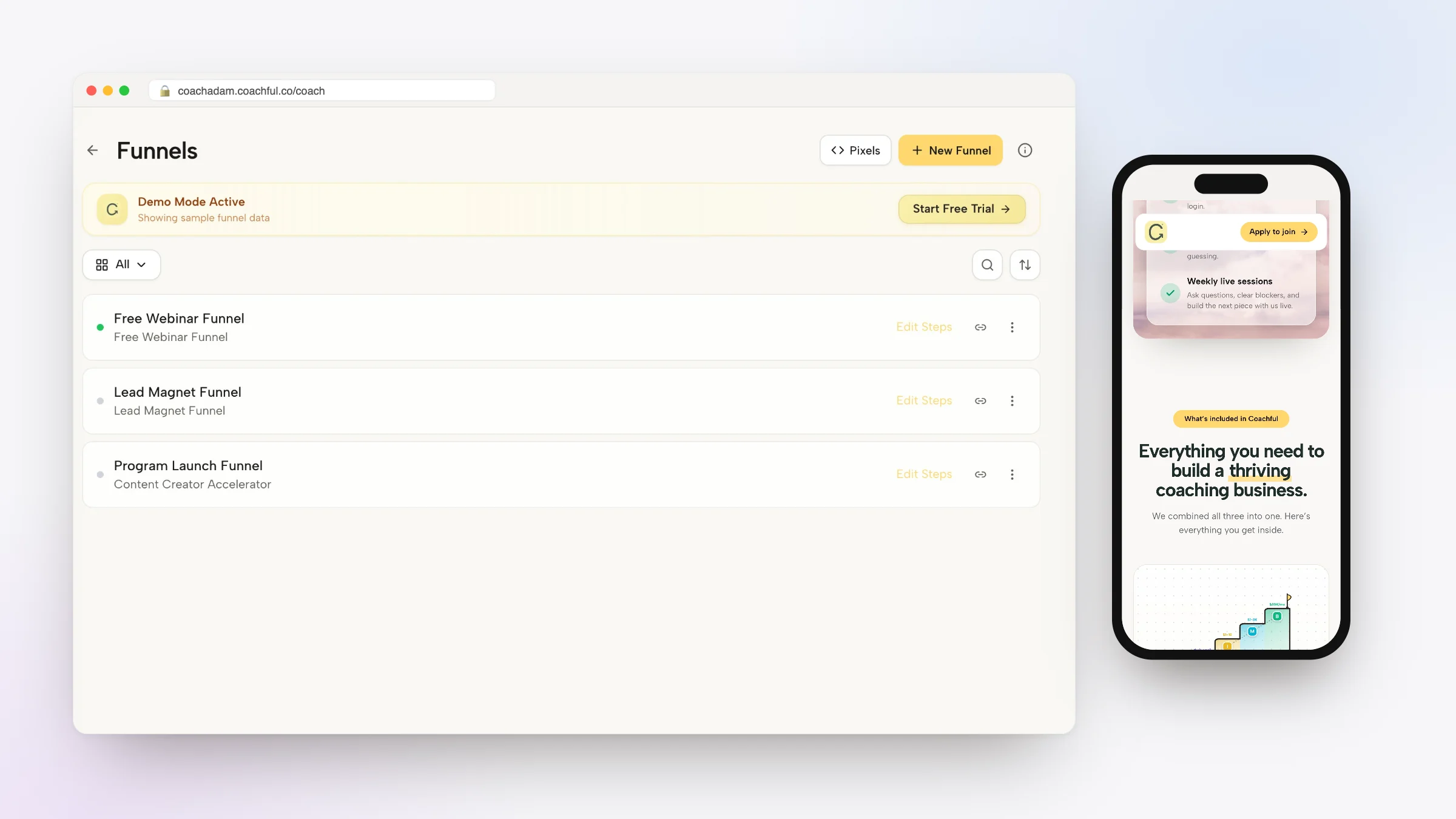
Keep one list of every lead with where they came from and what happens next. In Coachful, the Sell area groups this as how people find you, how you reach them and the people to follow up with, so leads from your funnel, link page and booking pages land in one place with their source attached.

A weekly marketing routine that fits around clients
The routine below takes about four hours a week, spread out so it survives a busy client week.
| Day | Task | Time |
|---|---|---|
| Monday | Write or record the week's longer piece | 90 minutes |
| Tuesday | Cut three short posts from it and schedule them | 30 minutes |
| Wednesday | One borrowed-audience pitch or partner conversation | 30 minutes |
| Thursday | Send the weekly email | 30 minutes |
| Friday | Follow up every lead with a due date, then fill in the scorecard | 45 minutes |
The scorecard has five numbers: new people who match your buyer, new email subscribers, discovery calls booked, clients signed and where each one came from. If you only track likes, you will optimize for likes. Our list of coaching business KPIs goes further once the basics are steady.
Mistakes that make coach marketing feel like shouting
- Starting at channels. A new platform does not fix a message nobody recognizes themselves in.
- Rewriting your positioning every month. It resets the familiarity you were building. Give a sentence at least a quarter.
- Talking about yourself. Your credentials matter to buyers once they believe you understand their problem, and rarely before.
- Posting without a next step. Every piece should point to one thing to do.
- Ignoring follow-up. Many of your future clients are already in your inbox or on your list.
Two older guides on this blog come at the same problem from other angles: marketing strategies to attract your ideal clients covers the mindset shifts and objection handling on calls, and marketing a coaching business goes further into niche filters and the four numbers to track.
Where the Coachful Collective fits in your marketing
The six layers above are the marketing half of what the Coachful Collective builds with you over a year. Its CLIMB curriculum starts with exactly this foundation: who you serve, the outcome, your method, your story and the proof you have, before any channel or campaign. Coachful Intelligence supplies the market evidence for positioning and messaging, the weekly live group sessions are where members bring a draft homepage or a stuck offer and work on it, you also get personal daily feedback from the Coachful team in the private community, and a year of Coachful Pro holds the website, funnels, email and leads list in one place.
It is a 12-month group program with weekly live group sessions as the main support, personal daily feedback from the Coachful team in the private community, community co-working and a work-backed money-back guarantee, and there are no one-on-one calls or private coaching sessions in it. You can see what is included on the Collective page. For how the marketing layers fit into the full client path, read our guides to getting more clients as a coach and the CLIMB method. And if you would rather have your website or funnel set up for you, every Coachful plan includes a free white-glove build.

Frequently asked questions
How do I market myself as a coach with no experience or clients yet?
Lead with process and story instead of results. Show your method in small worked examples, explain why you coach this problem, and run a short paid beta with three to five people for honest feedback and, if earned, testimonials. Borrowed audiences such as community workshops help you get in front of people before you have your own following.
What is the best marketing for coaches on a small budget?
Borrowed audiences and direct conversations cost time rather than money: podcast guesting, free workshops for existing communities, referral partners and personal messages to people who know your work. Pair them with one home channel you post on weekly. Leave paid ads until your free lead magnet and booking path already convert.
How do coaches market themselves on social media without being salesy?
Spend most posts on the problem, the common mistake, a story and one step of your method, and end each with a single low-pressure next step such as your free resource. Selling feels pushy when it comes before understanding. Posts that show you understand the reader's situation make the invitation feel like help.
How long does it take for marketing to bring in coaching clients?
It depends on your channel, your positioning and how warm your network is. Borrowed audiences and direct outreach can produce conversations within weeks; a blog or YouTube channel usually takes months to compound. Commit to one home channel for 90 days and judge it by inquiries and calls, not likes.
Do I need a niche to market myself as a coach?
You need a clear position, which is close to the same thing. You can coach a wide range of people, but your marketing has to speak to one recognizable person with one problem, or nobody recognizes themselves in it. Pick the group you understand best and test it before committing for years.
Do I need a website to market my coaching?
You can start with a social profile and a booking link, but a simple website or link page you control is where your message, proof and next step live. It also makes you findable in search. Coachful's page on coaching websites covers what to put on one.
Can Coachful set up my website or funnel for me?
Yes. Every Coachful plan includes a free white-glove build: you fill in a short form about the pages or funnel you want, attach your copy and branding, and the Coachful team builds it in your account, usually within about 24 hours. You can edit everything afterwards with the normal editors.