Marketing for Coaches: Proven Strategies to Attract Your Ideal Clients

Coachful
Solid marketing for coaches isn't about throwing spaghetti at the wall and hoping something sticks. It’s a real, repeatable system that turns your expertise into a business that actually supports you—ending the stressful ‘feast or famine’ cycle for good.
You know what I'm talking about. That inner voice that says, "I'm great at coaching, but I feel so awkward 'selling' myself. Where do I even start?" This guide is your answer. It's the difference between randomly posting on social media and having a predictable engine that brings your ideal clients to you, month after month.
Moving Past The Feast or Famine Cycle
That feeling of shouting into the void? Every coach knows it. You have life-changing skills, but your calendar has too many empty spots and client flow is a total rollercoaster. One month you’re on top of the world, and the next you're anxiously checking your inbox, wondering, "Did I do something wrong? Where did everyone go?"

This is the classic "feast or famine" trap, and it's exhausting. It’s also where the self-doubt starts to creep in, whispering things like, "Maybe I'm just not cut out for this."
From Guesswork to a Reliable Framework
Let's be honest, random acts of marketing—a social post here, a networking event there—don't build a stable business. They just create anxiety. This guide is all about moving you from that place of uncertainty to one of confidence by building a reliable client attraction engine.
You're in the right place. The global coaching market pulled in $5.34 billion in revenue in 2024 and is on track to hit $9.5 billion by 2032. But with over 122,974 professional coaches worldwide, standing out demands a smart strategy, not just more effort. You can dig into more coaching industry statistics to see the scale of the opportunity.
Think of this as building the foundation for your house. It’s the structure that turns your unique gift from a passion project or an expensive hobby into a sustainable, thriving business.
The Coach's Marketing Mindset Shift
Before we get into the nuts and bolts, we have to talk about mindset. So much of marketing success comes down to the stories we tell ourselves. Getting clients consistently starts with trading those common feelings of doubt for a commitment to strategic action.
Here’s a look at the mental shift required to make your marketing work.
The Coach's Marketing Mindset Shift
| Common (Unproductive) Thought | Productive (Actionable) Mindset |
|---|---|
| "I'm a coach, not a marketer. I hate selling myself." | "Marketing is how I find and connect with the people I'm meant to help. It's an act of service." |
| "I'll niche down later, I don't want to exclude anyone." | "A clear niche attracts my ideal clients and repels those who aren't a good fit. It makes my marketing easier." |
| "There are too many coaches out there already." | "My unique experience and voice are my advantage. No one can do what I do, exactly the way I do it." |
| "What if I build all this and no one signs up?" | "I'll test, measure, and adjust. Every action is a learning opportunity, not a final verdict on my worth." |
Seeing marketing as an extension of your coaching—a way to find and serve the right people—is the first real step.
The following sections will give you the complete playbook to make this happen. We're getting rid of the guesswork and building a clear, actionable framework. Your journey from client uncertainty to client consistency starts right now.
Defining Your Niche and Signature Offer
It’s the first instinct for almost every new coach: “I can help anyone.” It comes from a good place, a genuine desire to serve. But in marketing, it’s a fatal flaw.
Trying to be everything to everyone makes you nothing to anyone. It’s like being a whisper in a hurricane.
I know what you’re probably thinking, because I’ve seen this fear derail countless coaches. "But if I get too specific, I’ll miss out on so many potential clients! I’ll be leaving money on the table!" That fear is the single biggest roadblock to a profitable coaching business. The truth? The exact opposite is what actually happens.
When you get hyper-specific, you don’t shrink your client pool; you magnetize the right people to you. You become the only person who can solve their very specific problem, making you the obvious choice.
From Generalist to Specialist
Think about it this way. If you needed heart surgery, would you search for a "general doctor"? Of course not. You'd find the best cardiac surgeon you could. The same logic applies to coaching. Your ideal clients aren't just looking for a "life coach." They're desperately searching for someone who understands their immediate, painful problem.
Specificity is your competitive edge. It's what allows you to charge premium rates and finally break free from the "hours for dollars" trap.
And the market rewards specialists. The coaching industry in the United States is a massive $16 billion-a-year business, and it’s the largest in the world. Within that, specialized business and executive coaches pull in an average of $82,949—far more than their generalist peers. You can dig into the growth of the US coaching industry to see just how valuable specialization is.
So, how do you find that profitable sweet spot? It starts with answering three deceptively simple questions.
- Who do I absolutely love serving? Think about your favorite client ever. What were their struggles, their ambitions, their personality? Get granular. Are they first-time managers terrified of failing? Empty-nesters trying to launch a business? Creatives on the brink of burnout?
- What urgent, painful problem do I solve for them? People pay to escape pain, not for vague self-improvement. What's the "hair-on-fire" issue that keeps your ideal client tossing and turning at 3 AM?
- What is the tangible result they get? Move past feelings and into concrete outcomes. What is the specific "after" state you help them achieve?
Let’s look at what this transformation looks like in the real world:
| Generalist Coach | Niche Specialist | Why It Works |
|---|---|---|
| I'm a career coach for professionals. | I help first-generation women in tech land their first director-level role in 90 days. | This is incredibly specific. It speaks to someone's identity, their industry, and a clear, time-bound goal. |
| I'm a wellness coach. | I guide busy new moms to lose baby weight without restrictive diets or giving up wine. | This nails a specific demographic, their common pain point, and a relatable, non-judgmental promise. It feels human. |
| I'm a business coach. | I help freelance graphic designers double their project rates by packaging their services. | This targets a precise profession with a clear, measurable financial outcome. Who wouldn't want that? |
Getting this clear makes every other piece of your marketing fall into place.
Crafting Your Signature Offer
Once you’ve nailed your niche, you can finally stop selling one-off sessions. The "trading hours for dollars" model is a one-way ticket to burnout. The alternative is creating a Signature Offer—a high-value, results-oriented program that solves your niche's core problem from start to finish.
A Signature Offer is your unique methodology packaged into a premium experience. It’s the complete journey you take a client on, from their current painful reality to their desired future state.
Your offer isn't just a "12-pack of sessions." It's a complete, structured system. It’s your curriculum.
It might include things like:
- Core coaching calls: For guidance, strategy, and accountability.
- Targeted resources: Your own worksheets, video trainings, or templates that guide them through specific steps.
- On-demand support: Access to you via Slack, Voxer, or email for quick questions between sessions.
- A clear outcome: A defined result that the entire program is built to deliver.
For instance, that career coach for women in tech wouldn't just sell "career coaching." She'd create the "Director-Level Accelerator." This is a tangible system that includes resume optimization, mock interviews with VPs, and a personalized networking playbook.
When you package your expertise this way, you completely change the conversation. It's no longer, "How much is an hour of your time?" It becomes, "What is this result worth to me?" That shift is the foundation of a truly profitable and sustainable business. For a deeper dive into the business mechanics, our guide on how to start a coaching business online is a great next step.
Building Your Client Attraction Funnel
I get it. The word ‘funnel’ probably makes you cringe a little. It sounds so corporate and impersonal, right? As a coach, your entire business is built on genuine human connection, so the last thing you want is some rigid, automated machine.
Let’s reframe this. Forget the cold, technical term. Instead, think of this as the warm, guided path you create for your future clients. It’s the journey they take from "Who is this person?" to "I feel so seen—I need to book a call with them."
This is how you build trust at scale. It’s a core piece of sustainable marketing for coaches and the key to moving beyond relying solely on one-off referrals.
Create a Lead Magnet They Would Pay For
This path begins with your Lead Magnet. It’s the very first exchange of value, your initial handshake. A lot of coaches get stuck here, thinking, "What can I possibly give away for free that's actually valuable? I don't want to give away all my best stuff."
The secret is to offer a quick, tangible win. This isn't the time for a 50-page ebook that will gather digital dust. You want a highly specific tool that solves a small, nagging problem for your ideal client. Your goal is for them to think, "Wow, if this is the free stuff, imagine what their paid coaching is like!"
To get you started, here are a few examples:
- For a Leadership Coach for new managers: A 'Difficult Conversations' script template that gives them exact phrases to use when giving tough feedback to a team member.
- For a Career Coach: A 'Job Interview Prep Checklist' that breaks down the 10 most common questions and how to frame powerful answers.
- For a Brand Coach: A 'Canva Template Pack for Your First 10 Instagram Posts' to help new entrepreneurs establish a cohesive visual brand instantly.
This kind of strategic generosity is what starts building real trust, long before they ever see a price tag.
Whether it’s a lead magnet or just a social media post, all your content should stem from this simple, powerful formula.

It always comes back to understanding who you're helping, the specific problem they're facing, and the clear result you can deliver. That’s the foundation of a lead magnet that actually works.
Design a Simple Trust-Building Email Sequence
Okay, so someone just downloaded your awesome lead magnet. The journey has officially begun. You now have permission to show up in their inbox, but this is another place where I see coaches freeze. The fear is real: "I don’t want to be spammy! I hate getting pushy marketing emails."
Good. Your empathy is your greatest asset here. This isn’t about blasting out offers. It's about continuing the conversation and building a relationship, one email at a time. A simple, automated email sequence can do this for you, nurturing that new lead with genuine value.
Your email sequence should feel like a series of thoughtful letters from a guide who truly understands the path ahead. It’s not a sales pitch; it's a bridge of trust.
This sequence delivers on the promise you made and gently points them toward the next step, positioning you as the only person who can truly help them.
Here’s a simple, human-centered sequence you can make your own:
- Email 1 (Immediate): Deliver the Goods. The subject line should be obvious, like "Here's your checklist!" This email’s only job is to deliver the lead magnet and get them that quick win.
- Email 2 (Day 2): Share a Relatable Story. Tell a quick story about a client (or yourself!) who was stuck with the exact problem your reader is facing. For example, "Five years ago, I used to dread Monday mornings. I'd sit in the car and have to take a deep breath before walking into the office..." This shows them you get it.
- Email 3 (Day 4): Teach Something Valuable. Offer a powerful insight or a practical tip that builds on your lead magnet. For example, "You've got the script template, now here's the #1 mindset shift you need before walking into that meeting..." This reinforces your expertise without asking for a single thing in return.
- Email 4 (Day 6): Introduce Your Solution. Now that you've earned their trust, you can gently introduce your signature coaching offer as the answer to their bigger problem and invite them to book a discovery call.
Remember, this entire path is designed to attract, qualify, and warm up your ideal clients so that the people who get on your calendar are the right fit. For an even deeper dive into these tactics, check out our complete guide on how to get more coaching clients.
The Authentic Discovery Call: From Dread to Connection
All that work—defining your niche, building your funnel—it all leads right here. A potential client has booked a call. For many coaches, this is where the excitement turns to a familiar wave of dread. If you’ve ever thought, "Ugh, I really hate selling," you’re in good company.
It's the most common hurdle I see coaches face. We're wired to be helpers and guides, not slick closers. So let's reframe this right now: a discovery call is not a sales pitch. Think of it as a powerful, focused coaching conversation where you both decide if it’s a good fit.
Your goal isn't to "close the deal." It's to see if you can genuinely help this person create a transformation. That shift in mindset changes everything.
A Framework for Connection, Not a Script
Throw away the idea of memorizing a rigid script. A script puts you in your head, scrambling to remember your next line instead of listening to the human being in front of you. A truly great discovery call flows from genuine curiosity, not a sales checklist.
Your only job is to create a safe space for them to open up about their biggest challenges and, more importantly, help them get a clear vision of what’s possible. Sound familiar? It’s just coaching.
With the explosion of virtual coaching—a market valued at $3.2 billion in 2022 and projected to hit $11.7 billion by 2032—mastering this conversation is a non-negotiable skill. That's a growth rate of 14% every year, which means more and more of your work will happen through a screen. You can dig into more data on the online coaching boom to see just how massive this shift is.
Instead of a script, I want you to lean into a simple, human-centered framework:
- Make a Connection: Before you dive in, just be a person. Ask them about their day, find some common ground. For example, "I see you're calling from Austin! I've always wanted to visit. What's one thing I absolutely have to do there?" The first two minutes are for calming nerves—yours and theirs.
- Listen Deeply: This is where the magic happens. Ask powerful, open-ended questions like "What would need to happen for you to feel successful six months from now?" and then get comfortable with the silence that follows. This is how you make someone feel truly seen and heard.
- Clarify the Gap: Your next task is to help them articulate exactly where they are now (Point A) and where they desperately want to be (Point B). Get specific. Make both points crystal clear in their mind. You might say, "So what I'm hearing is, right now you feel completely overwhelmed and invisible at work. And where you want to be is leading your team with confidence and getting recognized for your contributions. Is that right?"
- Offer the Bridge: Only after you both fully understand that gap do you introduce your signature offer. It’s not a product; it's the bridge that will get them from Point A to Point B. For example, "Based on everything you've shared, it sounds like the Director-Level Accelerator could be a really powerful fit. It's designed to help you with exactly these challenges."
Handling Objections with Empathy
Here it is. The part most coaches fear. The prospect says, "I can't afford it," or "I need to think about it," and our stomach drops. We feel rejected or get defensive.
But here’s what I’ve learned: an objection is almost never a hard "no." It's usually a request for more information or a reflection of their own self-doubt.
An objection is not a rejection; it's an opportunity for deeper coaching. It’s where your prospect reveals their true limiting beliefs about what's possible for them.
Don't argue with an objection. Get curious about it. Treat it as the next step in the coaching process.
How to Navigate Common Objections
| What They Say | What They Might Really Mean | Your Empathetic Response |
|---|---|---|
| "I can't afford it right now." | "I'm not sure it's worth the investment," or "I'm scared to spend this much on myself." | "I completely understand. That's a very real consideration. If I may ask, if money wasn't an issue at all, is this something you'd want for yourself?" |
| "I need to think about it." | "I'm nervous about making the wrong choice," or "I need to feel more certain this will actually work for me." | "Of course. It's a big decision. What's the main thing you need to think over? Maybe I can provide some more clarity on that part." |
| "I need to talk to my partner." | "I need my partner's support and validation before I make this kind of investment." | "That makes perfect sense. What do you think their biggest questions will be? We could even brainstorm some answers together so you feel fully prepared." |
When you respond with empathy, you turn a potential dead-end into a moment of trust. You stay in your role as a coach, helping them navigate their own resistance. That’s how you lead calls that feel amazing to you and get a confident "yes" from the clients you were born to serve.
Scaling Your Coaching Business Without Burnout
Your calendar is booked solid with one-on-one clients, and that old ‘feast or famine’ cycle finally feels like a thing of the past. It's a great problem to have, but a new, quieter kind of panic is probably creeping in.
You start asking yourself, "Is this it? If I want to earn more, do I just have to work more? How can I possibly grow this business without completely burning out?"
This is the exact moment your marketing needs to shift gears. Growth isn't about cramming more client calls into your day anymore. It’s about getting strategic with your time and using what’s already working to reach more people—without you being the bottleneck.

Tap Into Other People's Audiences
One of the fastest ways to expand your reach is to simply borrow someone else's. Instead of spending months trying to build an audience from scratch, you can get in front of a community that already knows, likes, and trusts its leader. This is relationship marketing, and it's a game-changer.
Think about other coaches or businesses who serve the exact same people you do but aren't direct competitors. For example, a business coach for female founders could partner with a brand designer. A health coach helping busy executives could team up with a productivity expert.
This opens up some powerful, practical opportunities:
- Be a Podcast Guest: Find the podcasts your ideal clients are already listening to. Getting interviewed instantly positions you as an expert and puts your voice directly in the ears of hundreds, sometimes thousands, of potential clients.
- Host a Joint-Venture Webinar: Team up with a complementary expert to co-host a free training session. You both promote it to your email lists, effectively doubling your reach and sharing your audiences.
- Run a Newsletter Swap: Find another coach with a similar-sized email list and agree to feature each other’s lead magnets in your newsletters. It’s a simple, win-win way to get new, warm leads onto your list.
These collaborations create a powerful "halo effect." The audience's trust in the host gets transferred to you, dramatically shortening the time it takes to build a connection.
Make Paid Ads Your Friend
The idea of running paid ads is enough to make most coaches sweat. The fear of "I'm just going to waste money" is completely valid. But you don’t need a huge budget to make paid ads work for you. The secret is to start small and just put a little fuel on what's already on fire.
Don't start by running ads for a high-ticket program to a cold audience—that's a recipe for frustration. Instead, take a small, manageable budget on platforms like Meta (for Facebook/Instagram) or LinkedIn and use it to promote something that already works well for you organically.
A perfect place to start is to put a tiny budget (think $5-$10 per day) behind your best-performing lead magnet. You already have proof that people want it. Now you're just showing it to a wider, highly-targeted audience of people just like them.
Your Systems and Metrics Are Your Lifeline
As you grow, you can't be the one manually sending every welcome email, invoice, and scheduling link. It's just not sustainable. This is where systems become non-negotiable; trying to scale without them is a fast track to burnout.
Your systems are the team members that work for you 24/7. They handle the administrative tasks so you can stay in your zone of genius—coaching your clients and growing the business.
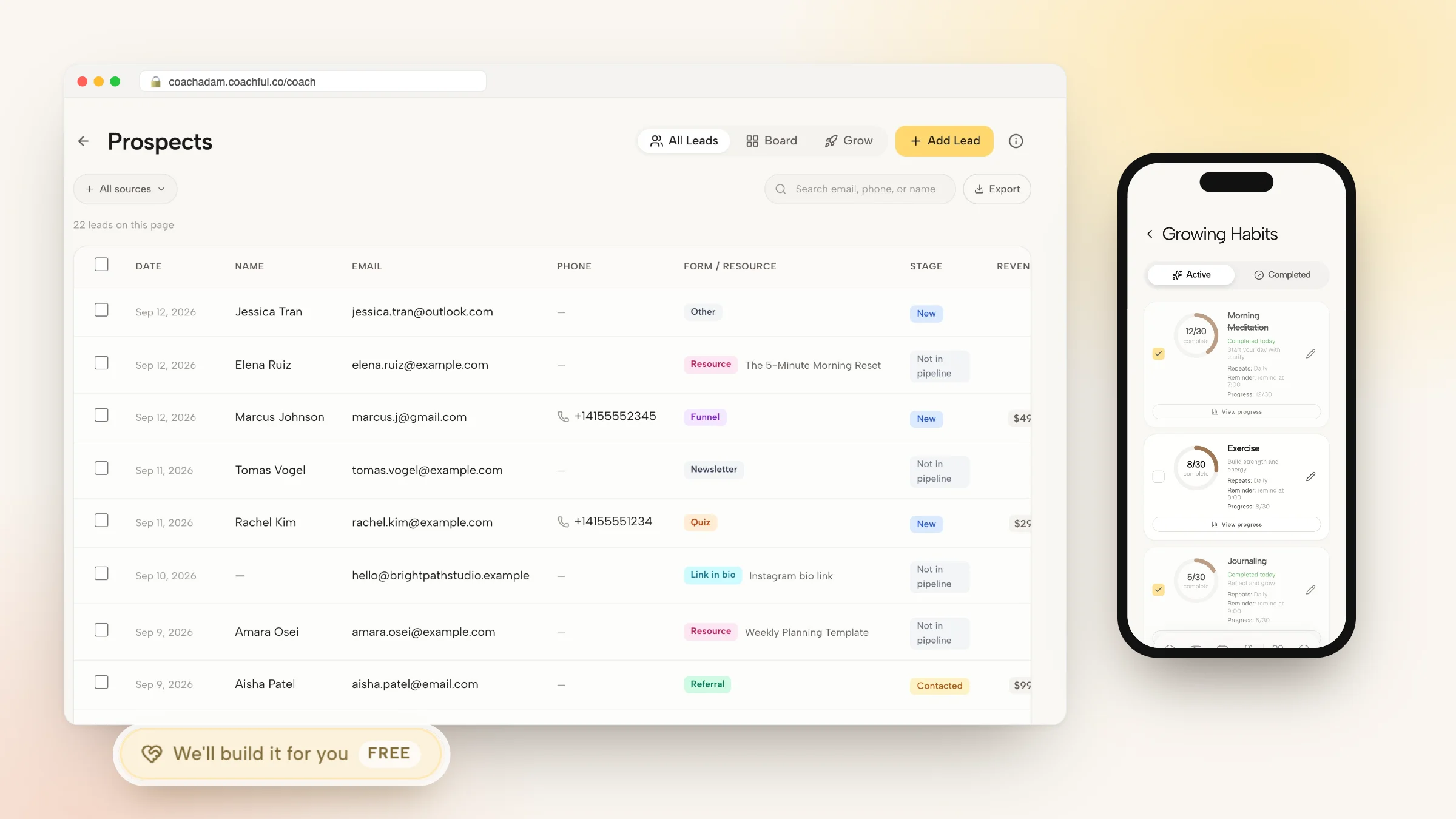
Platforms like Coachful are built for this exact stage. They handle the client onboarding, scheduling, payments, and reminders, which can easily free up dozens of hours a month. It allows you to focus on high-impact work instead of getting bogged down in admin. An organized client system can also create a stronger bond; you can explore this further in our guide on how to build an online community.
Finally, to make smart decisions about where to put your time and money, you have to know your numbers. Don't let the acronyms scare you. They’re much simpler than they sound and they tell a really important story about the health of your business.
To get started, here are the essential metrics every coach should be tracking.
Essential Marketing KPIs for Coaches
| Metric (KPI) | What It Tells You | Simple Way to Track It |
|---|---|---|
| Cost Per Lead (CPL) | How much you spend in ads to get one new email subscriber. | Total Ad Spend / Number of New Leads = CPL. |
| Client Lifetime Value (CLV) | The total revenue you can expect from a single client over time. | Average Program Price x Average Number of Programs a Client Buys = CLV. |
| Conversion Rate | The percentage of discovery calls that turn into paying clients. | (Number of New Clients / Number of Discovery Calls) x 100 = Conversion Rate. |
Understanding these key numbers turns your marketing from a guessing game into a predictable growth engine. It helps you answer critical questions like, "If I spend $10 to get a lead, and 1 in 20 leads becomes a $3,000 client, are my ads actually profitable?"
This is how you build a business that can grow beyond your personal time, creating a coaching practice that is truly sustainable and impactful.
Your Top Coaching Marketing Questions, Answered
Let's be honest—diving into marketing can feel overwhelming. It brings up a lot of questions and a fair bit of "am I even doing this right?" uncertainty. I've heard these same concerns from hundreds of coaches, so let's clear the air and tackle the big ones head-on.
How Much Should I Spend on Marketing When I’m Just Starting Out?
This is usually the first question, and it’s always tinged with a little bit of fear. You're thinking, "I'm not even making consistent money yet, how can I spend it on ads?"
It’s a totally fair question. And the answer is, you don't need a big budget right away. In the beginning, your most valuable marketing asset isn't your money; it’s your time.
Focus your energy on organic strategies that build momentum without breaking the bank.
- Create genuinely helpful content. Just one solid blog post, video, or podcast episode a week that solves a real problem for your ideal client is a fantastic start.
- Show up where your clients are. Pick one, maybe two, social platforms and get active. The goal isn't to sell; it's to connect, comment, and become a familiar, trusted voice.
- Build real relationships. Have actual conversations in the DMs. Connect with peers who serve a similar audience but aren’t direct competitors.
Once you have a steady stream of income, a great rule of thumb is to reinvest 10-15% of your coaching revenue back into marketing. Start small by putting a little ad spend behind a lead magnet or offer that you've already proven works well organically.
What Is the Single Most Effective Marketing Channel for Coaches?
I see this all the time. A coach will say, "Everyone says I have to be on Instagram, but I can't stand it. Do I really have to?" The answer is a huge relief: absolutely not.
There is no magical "best" marketing channel that works for every coach. The most effective channel is simply the one your ideal client already uses and trusts.
Trying to be everywhere is a surefire path to burnout. Instead, pick one channel and go deep. Master it.
- If you're a B2B executive coach working with VPs, you'll get the most traction from being active on LinkedIn or guesting on business podcasts.
- If you're a relationship coach for millennials, you'll probably find your people on Instagram, TikTok, or by writing for popular online magazines.
Don't force a platform that feels unnatural for you or your audience. The real secret is to go where the conversation is already happening.
How Long Does It Take to See Results From All This Marketing?
Ah, the big one. You've been posting consistently for a month, and all you hear are crickets. The doubt creeps in: "Is this even working?"
Here’s the thing: marketing is all about building trust, and trust doesn't happen overnight. It’s a marathon, not a sprint. With consistent, focused effort, you can realistically expect to see real traction—more followers, email sign-ups, and discovery calls—within 60-90 days.
Building out a more automated system, like a full client attraction funnel, takes a bit longer. Plan for around 3-6 months to get it running smoothly and optimized. It's an investment of time, but the payoff is a predictable stream of qualified leads that can sustain your business for years to come.
Do I Really Need a Website to Be a Successful Coach?
The practical side of your brain is probably saying, "A website seems like a ton of work. Can't I just use my social media profile and a booking link?"
You can absolutely land your first few clients that way. But for long-term, sustainable growth, a website is non-negotiable.
Think of it as your digital home base. It’s the one piece of the internet you actually own and control. It's where you'll host your blog, feature your best testimonials, and capture leads with your signature freebie. Even if people find you on Instagram, a professional website signals you’re a legitimate, credible business, not just a hobbyist.
Ready to stop juggling spreadsheets, calendars, and payment tools? Coachful brings your entire coaching business into one intuitive platform. From client onboarding and scheduling to progress tracking and payments, we give you the systems you need to scale your impact without scaling your admin work. Discover how Coachful can free you to do more coaching.