How to Create a Group Coaching Program, Step by Step
Our group coaching programs playbook covers whether a group is right for your practice and how to sell one. This guide is the build itself: the decisions, the outline and the setup that turn an idea into a group coaching program people finish together. It includes a complete seven-week cohort for adults with ADHD, a minute-by-minute call agenda, what happens between calls, group norms, pricing structures and enrollment.
The short version: decide the shape (cohort or rolling, size, length), write one promise the whole group shares, give every week one theme and one shared action, run calls to a fixed agenda, and give members a reason to talk to each other between calls. Groups that skip that last part become webinars with a chat box.
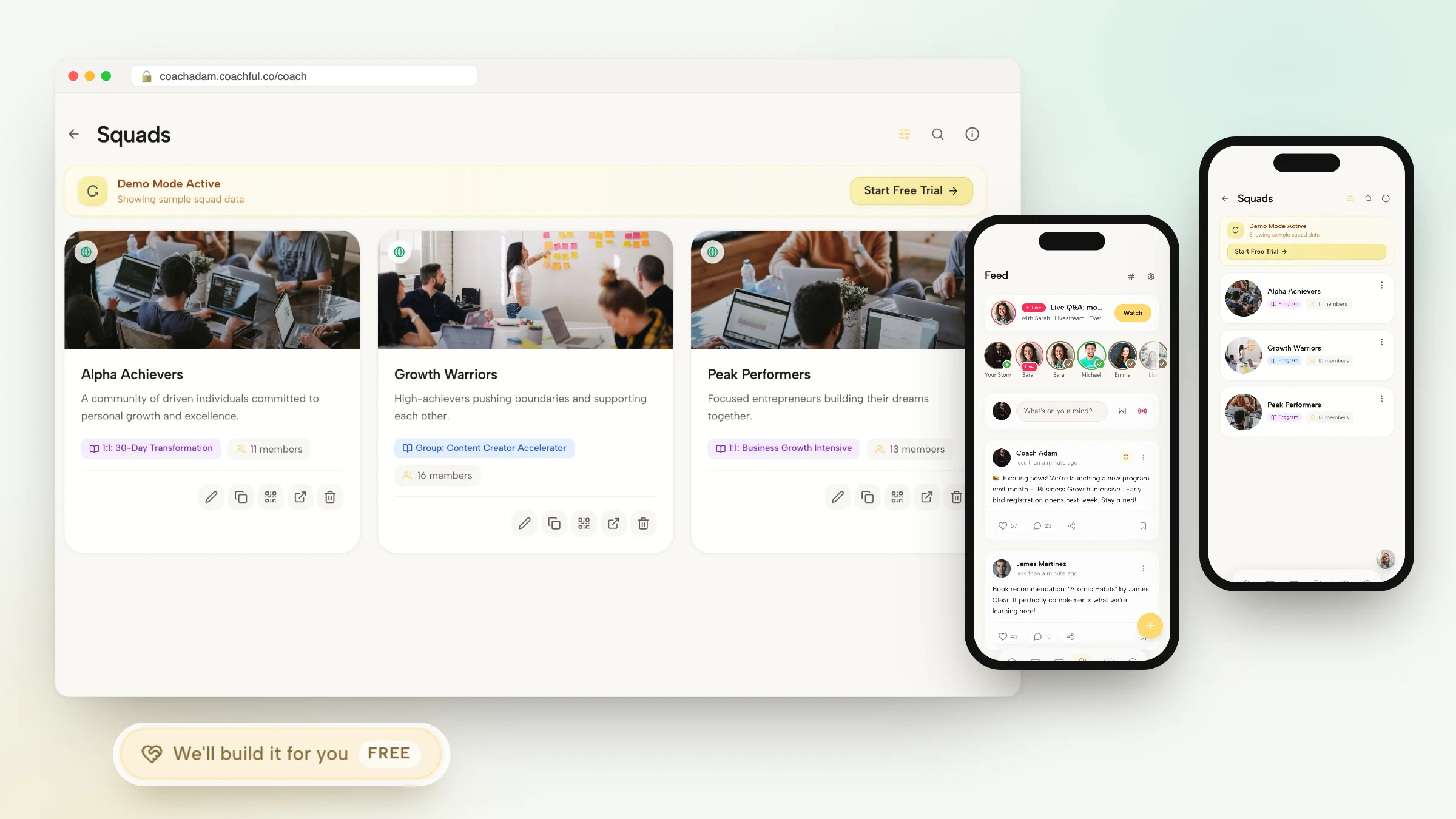
You can also have it built for you. Coachful's team sets up group programs for free on any Coachful plan: send your outline or a voice memo through the request form and the weeks, tasks, worksheets and resources are created in your account.
Decide the shape first
| Decision | Options | How to choose |
|---|---|---|
| Timing | Cohort (everyone starts together) or continuous (join any time) | Cohorts suit a fixed arc with a clear end. Continuous suits ongoing support and memberships. |
| Size | Small (4 to 8), medium (8 to 15), large (15+) | Small for deep personal work and hot seats; medium for most programs; large needs breakout rooms or pods. |
| Length | 4 to 6 weeks, 8 to 12 weeks, ongoing | Follow the outcome. A single habit fits six weeks; a transition needs longer. |
| Mix | Group only, or group plus 1:1 calls | Add a 1:1 at the start and end if the topic is personal or clients start from very different places. |
With a small audience, a cohort with a start date fills more reliably than an open door, because the date gives people a reason to decide. Our piece on cohort or evergreen for a small audience explains why, and the group size guide covers how numbers change the room.
Write one promise the whole group shares
In 1:1 coaching the goal can bend to each client. In a group, everyone needs to be heading to the same place, or the calls splinter. Write the promise as a sentence every member could say at the end: "I have a weekly planning routine I've kept for four weeks, and I know what to do when a week falls apart."
Then write three or four group norms alongside it: what is shared stays in the group, cameras on when possible, no fixing other people unless they ask, and a way to say "pass". Put them on the first slide of the first call and the top of the community feed. Our guide to group coaching confidentiality expectations has wording you can adapt.
Sample: a seven-week group coaching program for adults with ADHD
The program is "Plan the Week", a cohort of eight to twelve adults with ADHD who want a planning routine that survives real life. One 75-minute call a week, a shared action, and accountability buddies between calls.
| Week | Theme | Group call | Between calls | Check-in |
|---|---|---|---|---|
| 1 | How your week really runs | Welcome, norms, map last week honestly | Meet your buddy; log three days | What surprised you about your week? |
| 2 | One place for everything | Choose a single capture tool, paper or app | Capture everything for five days | How many times did you use it? |
| 3 | The Sunday plan, in 20 minutes | Live planning session, everyone together | Run the plan with your buddy on video | Did the plan survive Wednesday? |
| 4 | Time blindness | Estimating, timers and buffers | Time three regular tasks | Which task took longest compared with your guess? |
| 5 | When the week falls apart | Hot seats: two members bring a messy week | Write your "reset in 10 minutes" plan | Did you need the reset? Did it work? |
| 6 | Energy and interest | Matching tasks to energy, using interest as fuel | Reorder one day around energy | Energy from 1 to 10 at three points in the day |
| 7 | Keep it going | Review, celebrate, plan the next month | Agree a buddy check-in for the month after | What will you keep, and what will you drop? |
Week three is deliberately done together, live, because planning alone is the exact thing the group struggles with. Body doubling in a group call does more than a lecture on planning ever could.

Run every call to the same agenda
A fixed agenda makes calls feel safe and saves you planning time. A 75-minute version:
| Minutes | Segment | What happens |
|---|---|---|
| 0 to 10 | Arrive and check in | One word or a 1 to 10 for the week, in the chat or out loud |
| 10 to 25 | Wins and tries | Three or four members share what they tried with the last action |
| 25 to 40 | Teach | The week's theme in 15 minutes, no longer |
| 40 to 65 | Practice or hot seats | Pairs or breakout rooms work on the action, or two members get focused coaching |
| 65 to 75 | Commit | Everyone writes the week's action in the chat and names their buddy check-in time |
Record the teaching segment only, if at all, and tell members before you start. The hot seats stay unrecorded. For more on running the session itself, see our guide to running a group coaching session.
Between calls: where groups succeed or fail
Members bond in the gaps. Plan three things between calls:
- A community feed with one pinned post per week from you: the theme, the action and a question to answer.
- Accountability buddies or pods of two or three, with one short check-in a week.
- A weekly check-in form to you, so quieter members are seen even if they never post.

Post first in the feed every week. Members copy your tone: if you post a messy week honestly, they will too.
Pricing a group coaching program
Group programs are priced per seat. Work from your floor upward: the hours you will spend (calls, prep, feed replies, check-in replies, admin) times your hourly figure, divided by a realistic number of seats. Then set structures around it:
- An early-bird price with a real deadline, to give people a reason to decide. Our guide to early-bird pricing for group coaching covers deadlines and amounts.
- A minimum number below which you postpone, said clearly on the sales page.
- A premium seat that adds two 1:1 calls, for people who want both.
- A payment plan in two or three parts.
Setting up the group program online
Members need one place for the call link, the week's theme, the worksheet, the feed and their buddy. In Coachful, a group program runs either continuously or as cohorts with start dates, and enrolling places members in a cohort group with its own community feed, group chat and group calls, while each member keeps an individual record with goals, habits and check-ins. Group calls are scheduled from Sessions, payments go to your own Stripe account with a 0% Coachful platform fee, and members join from the portal or the client app on iPhone and Android. See the group coaching software page for the full picture and the page for ADHD coaches for a niche setup.


Mistakes that empty a group by week four
- A promise that fits nobody. If members want different outcomes, the calls fragment. Narrow the group, not the content.
- Too much teaching. Members came for each other as much as for you. Keep teaching to 15 or 20 minutes.
- A silent feed. If you don't post, nobody does. Post first, every week.
- No plan for quiet members. The weekly check-in form catches people who would never speak up on a call.
- No ending ritual. Groups that just stop leave people deflated. Celebrate, share before and after, and offer what comes next.
Planning to run your own method as a group? Our guide to creating a signature coaching program shows how to shape it first.
Free group program setup from our team
Coachful's team will build your group coaching program inside your account, free on every Coachful plan. The app labels it FREE and Complimentary gift.
On the Create page, choose the first chip under "Unleash your creativity", We'll build it for you · FREE. Or scroll to the bottom of your Programs list and use the Want us to build your program? card, which invites your outline, notes or even a voice memo and opens the form with Program selected.

Describe the program ("a seven-week cohort for adults with ADHD, one group call a week, a weekly check-in, accountability buddies and one worksheet in weeks 1, 3 and 5"), who it is for and what it should achieve. Add up to eight links and up to ten files: your call agenda, slides, worksheets, group norms or an audio recording of you describing the program. Video files are not accepted. The last box takes deadlines and anything to avoid.
The team replies by email with next steps, usually within around 24 hours. That is a typical turnaround, not a guaranteed deadline. The weeks, tasks, worksheets and resources are built in your own account, ready for you to review, schedule the calls and open enrollment.
Group builds from recent requests include a year-long cohort program with an application form for a real-estate and money coach, along with a free nine-day bootcamp course and its signup funnel, and a free-community funnel that delivers a guide for a psychologist-turned-coach working on emotional eating.
The service does not include recording videos or audio, hosting or facilitating your group calls, logo design, ad management or ongoing marketing. And nothing gets invented: no fake credentials, testimonials, member results or prices. Anything missing is left for you to fill in. The guide to the free white-glove service has the full list.
Pick your start date before you finish the outline. A date on the calendar has a way of making the remaining decisions for you.
Frequently asked questions
How do I create a group coaching program?
Choose cohort or continuous, a group size and a length; write one promise every member shares plus group norms; give each week one theme and one shared action; run calls to a fixed agenda; and plan what happens between calls, such as a community feed, buddies and a weekly check-in.
How many people should be in a group coaching program?
Eight to fifteen suits most programs: enough for varied perspectives, small enough for everyone to speak. Four to eight works for deep personal topics and hot seats. Larger groups need breakout rooms or pods so people still feel known.
How long should a group coaching program be?
Six to twelve weeks is common for cohorts. Shorter programs suit one habit or skill; longer ones suit transitions. Continuous groups and memberships run indefinitely with a monthly theme instead of a fixed arc.
How do you structure a group coaching call?
A reliable shape is check-in, wins and tries, a short teaching segment of about 15 minutes, practice or hot seats, and a closing commitment where everyone names their action. Keeping the same agenda every week makes members comfortable.
Will Coachful build my group coaching program for free?
Yes. Choose Program in the request form from Create or the Programs list, describe the program, audience and call rhythm, and attach your agenda, worksheets or a voice memo. The team replies by email, usually within around 24 hours, and builds it in your account at no extra cost on any Coachful plan.
What is the difference between group coaching and a course?
A course teaches content people consume at their own pace. A group coaching program adds live calls, shared actions, coaching on individual situations and peer support. Many group programs include short course lessons so call time goes on coaching rather than teaching.