Small Audience? Give Your First Group Coaching Program a Start Date

You have a group program half built and an audience you could fit in a school hall. Every launch guide says the same thing: open the doors for a week, then close them. You can already see how that goes. You announce a date, post every day, two people sign up, and now there is a public record that you tried and it did not fill. So you leave the offer open instead. Three months later the page is still up, it has sold twice, and nobody has a reason to decide this week.
Give the live group a fixed start date, and size it to the people you can name. With a small audience, skip the open-and-close launch aimed at a crowd you do not have yet. Write down who has actually shown interest, set a small minimum, invite those people one at a time, and decide before you start what happens if you fall short. Self-paced material can stay open all year. The date belongs on the part that needs other people in the room.
The worry is a fair one. In a public r/lifecoaching thread about failure, a newer coach replied: “I'm kinda there. I saw the other comment saying urgency and open/close registration, but that works if you already have a following and 'people waiting'. Being newer and only growing my audience if I open close... nobody will be there.” Their workaround: “So I just open the self paced ones, and offer bonus live sessions during a period of time for urgency. Still feels slow growing.” That coach is right about the launch. The workaround is close, and it is slow for a reason you can repair.
Fixed start date or open enrollment: what a small coaching audience changes
Open-and-close enrollment does one job. It makes a large group of undecided people decide by Friday. If 300 people follow you and five of them are seriously considering the program, the deadline lands on five people. That is a conversation, and you can have it without a countdown.
Getting this wrong costs more than a quiet week. You either run a two-person “group” at a loss, or you refund both buyers and go silent for a couple of months. The money is small. The damage is that you stop offering the program at all.
Leaving a group program open has a quieter cost. One person buys in March and another in May. The March buyer shows up to a group call alone, so you coach them 1:1 at a group price. By the time a third person joins, the first has finished. Nobody describes an empty room to a friend, and “still feels slow growing” is how that looks from the inside.
The way out is to separate two things that launch advice glues together. A start date is a delivery fact: it says when the group meets. A launch is a marketing event, and it needs an audience to watch it. A first group program needs the date and can do without the event.
| Enrollment model | What it needs to work | What goes wrong with a small audience | Use it when |
|---|---|---|---|
| Open-and-close launch | A waiting list or a large, engaged audience | The deadline reaches a handful of people, and a thin result is public | You have run the program before and people ask when it opens |
| Always-open group | New buyers arriving every week | Members join an empty room at different times, and you deliver 1:1 at a group price | Enquiries arrive weekly without you chasing them |
| Fixed date, filled by invitation | A short list of people who have shown interest | It takes direct conversations, which feels slower than posting | This is your first group and your audience is small |
| Open self-paced course with dated live rounds | Finished course material | Live calls become a vague perk unless each round has dates and a cap | You already sell a self-paced course and want a live layer |
If you are still deciding between a course, a group and 1:1, start with choosing your online coaching program format, then come back for the enrollment question.
Demand signals to count before you launch a group coaching program
Follower counts tell you very little about who will pay. Count people who have done something. Open a blank note and write names under these headings:
- People who booked a call with you in the last three months, including the ones who said no to 1:1 because of the price.
- Current and past clients who could use a group as a next step.
- People who replied to an email or sent a message about the exact problem this program solves.
- People who came to a workshop, webinar or live session you ran.
- Anyone who has asked whether you run groups, or whether there is a cheaper way to work with you.
Leave out total followers, likes, list size and anyone whose only signal is a friendly comment. What you have now is a name list, and it is the real size of your audience for this offer.
There is no reliable conversion rate to borrow for the next step. Anyone who quotes you one is guessing about your audience. The number that decides it is simpler: how many of those people pay by a date you set. If the list is shorter than the smallest group you could run, no enrollment model will fix that, and the honest move is to keep selling 1:1 while the list grows.

Minimum viable cohort: set the number and a go or no-go date for group coaching
Your minimum is the smallest group that still works as a group and still pays for your time. Run two tests.
The room test. Picture a week when one person cannot make the call. With three enrolled, you are left with two people and the call turns into a joint session. With four, three people can still have a group conversation. Treat four as a working floor for a discussion-based group. That is a judgment call, not a statistic, so move it if your format is different. Our coaching group size guide covers caps by format.
The money test. Take a hypothetical six-week program at $400 a seat. Each week costs you about three hours: a 90-minute call, an hour of preparation and half an hour of messages. That is 18 hours. Four seats bring in $1,600, about $89 an hour before fees and tax. Three seats bring in $1,200, about $67 an hour. If your 1:1 work pays better than $67 an hour, three is too few and your minimum is four.
A first run can be worth a lower hourly rate because you are also testing the material. Decide that on purpose, and read how to run a paid beta coaching program before you discount it.
Set a cap as well, somewhere around six to eight for a first run. A cap you keep to is the only scarcity claim you will ever need to make.
Then pick a decision date about a week before the start date and write down, today, what happens on it.
| Paid seats on the decision date | What you do | What you tell people |
|---|---|---|
| At or above your minimum | Run the group on the start date | Confirm the call dates. Keep inviting until the cap or the last day to join. |
| One short of your minimum | Run it as a smaller pilot only if the room test still passes | Tell every buyer the group size before the first call and offer a refund to anyone who wanted a bigger room. |
| Two or more short | Give each buyer the choice you promised: a full refund, a 1:1 or paired version, or the next start date | Say it plainly, once. Move a date only one time. |
Put the rule in the invitation: “This group runs with at least four people. If fewer than four have joined by [date], you choose between a full refund and a place in the next round.” A buyer who read that sentence before paying sees you do what you said you would. The group career coaching pilot plan shows the same minimum-enrollment call for a niche pilot.
Founding cohort playbook for a first group coaching program
A founding cohort is a first run sold as a first run: a small group, a real start date, and buyers who know they are first. You fill it person to person.
- Set two dates. A start date about four to six weeks out, and a decision date a week before it.
- Write the offer in one paragraph. Who it is for, the result, the call dates, the price, the minimum and the cap. If it does not fit in a paragraph, the program is not ready to sell.
- Invite the name list one person at a time. A broadcast to 200 people gets skimmed, so send a note that only makes sense to one reader: “You mentioned the Sunday-night dread in March. I am running a six-week group on exactly that, starting on the 12th. Want the details?”
- Count payments. “Sounds great” is not a seat. A paid place or a deposit is.
- Say it is the first run. Founding members get more of your attention and a say in the material. You get feedback and, with permission, their words for the next round.
- Post publicly once seats are taken. “Two of six places left for the group starting on the 12th” is true, specific and enough.
For the wording of those first messages, see how to announce a group coaching offer to existing contacts. If you want a founding price that ends on a date, early-bird pricing for group coaching covers how to set it without training people to wait for discounts.

The Classy Career Girl channel (Anna Runyan) makes the same case. Going by the video's own description, it covers why your first 10 members matter more than your first 1,000, how to find first members through personal invitations, and why a small beta launch makes a better program.
“How to Launch Your First Group Program: Day 21 Summer Business School,” Classy Career Girl, published July 21, 2026. Source: watch the original video. The episode covers memberships and group programs in general. Its point about personal invitations is the part that applies to a founding cohort.

Self-paced course with live bonus calls: how coaches stop it feeling slow
The coach in the thread keeps self-paced offers open and adds bonus live sessions for a while to create urgency. The structure is sound. It feels slow because a bonus is a perk, and a perk with a fuzzy end date gives nobody a reason to buy today.
Turn the bonus into a round:
- The course stays open. Anyone can buy it and start any day.
- Live rounds have dates. A round is a fixed run of group calls, for example four weekly calls, with a start, an end and a cap. Publish the next round's dates on the sales page.
- Buying before a round starts gets you into it. Someone who buys between rounds starts the course now and joins the next round.
- A thin round merges into the next one. Say so up front, the same way you state the minimum for a cohort.
Now the deadline is real for everyone, because the round starts on a date with or without them. You also stop owing open-ended live calls to every buyer forever, which is the hidden cost of bonus sessions with no end.
Two decisions shape this model. The first is whether the live round is included in the course price or sold as an add-on. Included is simpler to explain and gives more reason to buy now, but every course sale adds to your calendar. An add-on keeps the course cheap to deliver, and fewer people will take it. The second is how lessons release. If your course releases lessons on a schedule, enroll a test account in the middle of a round and watch what a late buyer actually sees before you promise a pace.
What you must have: finished core lessons, the next round's dates and a cap. A community space, recordings and extra resources are optional, and none of them replaces the dates.

Honest enrollment deadlines for a coaching program
A deadline is honest when something real changes after it. With a small audience this matters more, because the same 200 people see every post. If a countdown resets or “doors closing” turns out to mean nothing, the people most likely to buy from you are the ones who notice.
Four deadlines that are true:
- The group starts. After the first or second call, nobody new joins until the next round. Publish the last day to join.
- The cap is reached. Six places means six places.
- The live round begins. The course is still for sale, and the calls for this round are not.
- The founding terms end. If the first run has a lower price or extra access, the next run has to be different in fact.
Skip the rest: timers on an always-available course, “only three spots” on a product with no cap, a closing date you quietly extend. If you extend once because of a genuine clash, say so to everyone who already paid.

When a round ends, decide what members keep. Alumni access after a coaching cohort ends walks through the options.
When to switch a coaching program from cohorts to open enrollment
Review after every round. Ask whether it reached the minimum, how each buyer found it, and whether anyone asked to join after it closed. The answers point to one of four moves.
- Stay with dated cohorts while each round fills mainly through your own invitations, or while the material still changes from round to round.
- Move to rolling starts when you have turned people away between rounds more than once. A new group on the first Monday of each month keeps a date in the offer without making anyone wait long.
- Go fully open when enquiries arrive every week without you asking, and a new member always lands among active people. A self-paced course can be open from day one, since it never depended on other members.
- Go back to 1:1 if two rounds in a row miss the minimum. The format is fine. There are not enough people yet, and 1:1 work is how the name list grows.
Running a cohort or an open group coaching program in Coachful
Coachful publishes this article, so weigh this section accordingly. The decision above is yours whichever tool you use, and no platform creates demand. What software can do is stop the delivery side from forcing the choice.
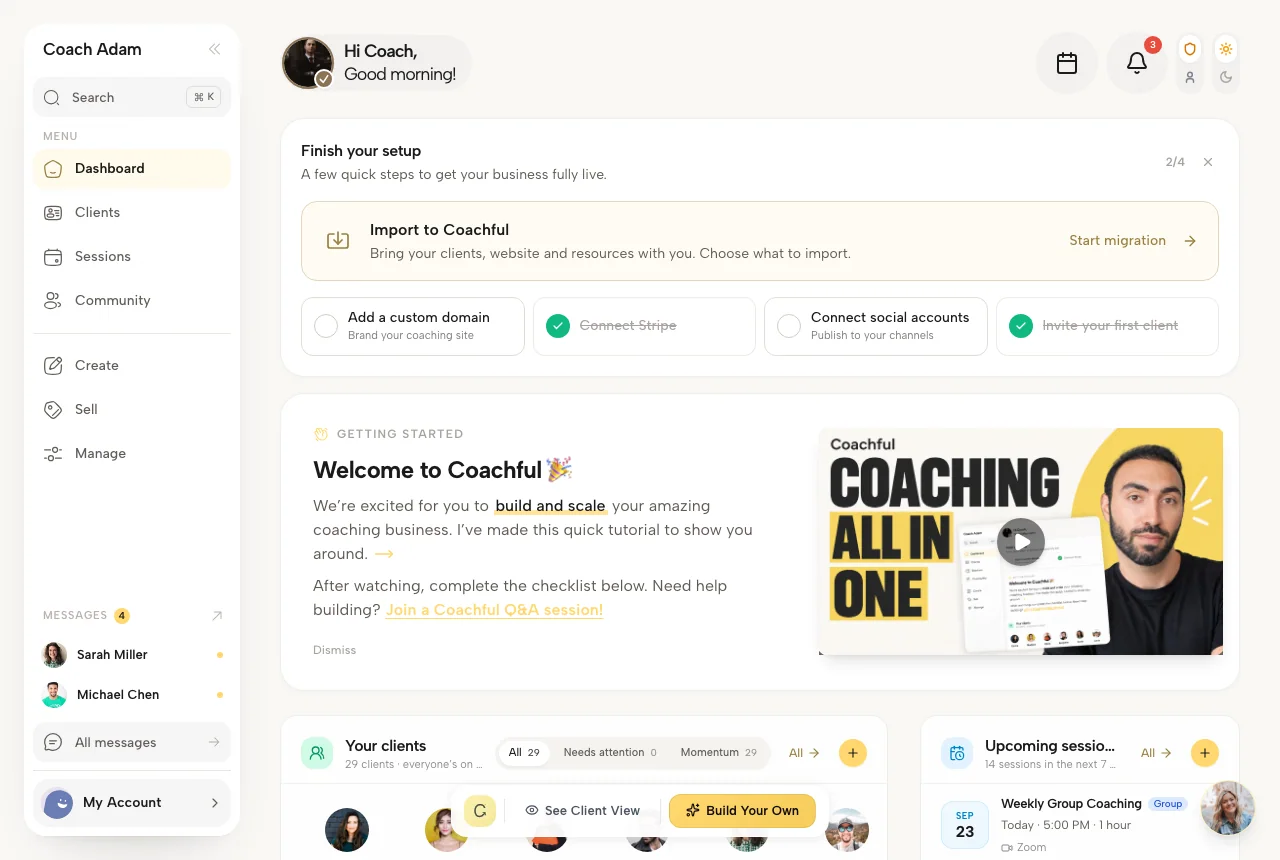
- Cohort groups. A cohort group is created when clients enroll in a group program, and group calls and webinars run from the same place.
- Self-paced courses. Video courses with modules, lessons, drip release and completion tracking.
- The live layer. A community feed, group chat and video events, with built-in video included in the subscription. You do not need to buy a separate video tool. If your clients prefer Zoom, Google Meet or Teams, Coachful can create those links instead.
- Taking the seat. Checkout and application funnels, with one-time payments, subscriptions and payment plans.
- Inviting and following up. Email broadcasts and multi-step sequences for the people on your list. The first invitations still work best as personal notes.
That means you can run a founding cohort first and keep a course open afterwards without moving to another tool. Closing a round is a manual step in this plan: on the decision date you stop inviting and stop sharing the checkout link. See group coaching in Coachful, self-paced courses for coaches and video calls for coaches, or weigh other tools in our group coaching platform comparison.
Frequently asked questions about start dates and open enrollment for group coaching
Should my first group coaching program have a fixed start date or stay open?
Give it a fixed start date if it includes live group calls, even with a small audience. A date means members start together, and it gives people a real reason to decide. Fill it by personal invitation with a stated minimum of about four people, in place of a public open-and-close launch. Keep only self-paced material open all year.
How many people do I need to start a group coaching program?
Enough that the call still works when one person is absent, and enough to pay for your hours. For a discussion-based group that is usually four. In the hypothetical example above, four seats at $400 over 18 hours of work comes to about $89 an hour. Set a cap too, around six to eight for a first run.
What if nobody signs up for my group program?
Decide before you invite anyone. Pick a decision date a week before the start and state the rule in the invitation: under the minimum, buyers choose a full refund or the next round. Because you invited people privately, there is no public launch to fail. If two rounds miss the minimum, return to 1:1 and grow the name list.
Does open and close enrollment work with a small audience?
Rarely as a public launch. Open-and-close enrollment pushes a large undecided group to act by a deadline, and a small audience may hold only a handful of serious buyers. Keep the closing date, since the group does start on a day, and replace the launch with one-to-one invitations to people who have booked calls, replied or bought before.
Can I keep a self-paced course open and add live bonus calls?
Yes, if the live part runs in dated rounds. Keep the course on sale all year, publish the next round's start date, cap the round, and tell buyers that anyone who joins between rounds gets a place in the next one. Open-ended bonus sessions give nobody a reason to buy now, and you owe them indefinitely.
When should I switch from cohorts to rolling or open enrollment?
When you have turned people away between rounds more than once, or enquiries arrive every week without you asking. Move to rolling starts first, such as a new group on the first Monday of each month. Go fully open only when a new member always lands among active people.
Do I need Zoom to run group coaching calls?
You need a way to host a live group call, and it does not have to be Zoom. Coachful includes built-in video in its subscription for sessions, group calls and webinars, so a Coachful user does not pay for a separate video tool. Zoom, Google Meet and Teams links can be created instead if your group prefers them.
Sources and Coachful capabilities reviewed October 4, 2026. Prices, seat counts, hours and totals in the examples are hypothetical. Group minimums, caps and timings are editorial judgments, not sourced statistics. This is general business information, not legal or financial advice.