
Coaching Community: Why You Need One and How to Choose
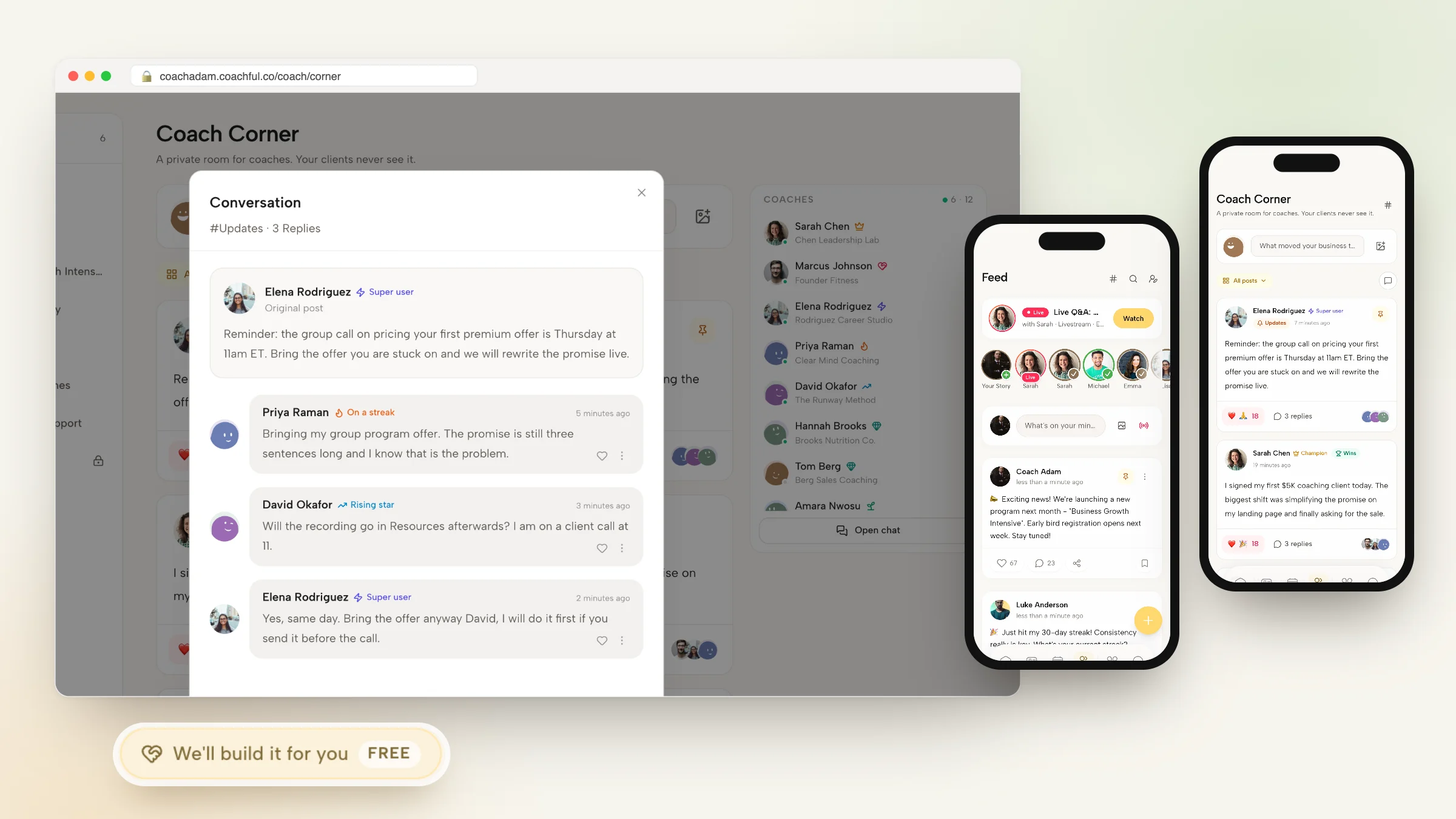
A coaching community is a group of coaches who help each other with the parts of the job nobody trained them for: the client who stalls in month three, the price that feels too high to say out loud, the referral you cannot take, the Tuesday when the calendar is empty. You join one to get answers faster, to send and receive referrals, to keep improving your coaching, and to have someone to tell when something goes well.
This guide covers why coaches need a coaching community, the kinds you can join, how to choose one, and how to show up so people are glad you did. Our worked example is Coach Corner, the private room for coaches inside Coachful, shown here with screenshots from the demo community. The coaches in those screenshots are sample personas, written to show how the space works.
One practical note before we start. Communities are very good at telling you that your website, sales page or funnel is the problem. If that happens, Coachful's team will build the fix inside your account for free, and we explain how near the end.
What a coaching community is, and what it is not
Two different things share the name. A community for coaches is a room of peers: other coaches, at different stages and in different niches, talking shop. A community a coach runs for clients is part of the coaching itself: a feed, cohort chat and live Q&A where your clients encourage each other between sessions. This guide is about the first kind. If you want to build the second, we wrote a full playbook on how to create an online coaching community for your clients.
It is also different from a course or a lead source. You will learn things and may get the odd referral, but the main value is people who understand the work and answer when you ask. Coaching is confidential, so much of your week cannot be discussed at the dinner table. A room of peers is where you can talk about it, with client details removed.
Why coaches need a coaching community
The quiet after the session
Solo coaching is an odd job. You spend hours in deep conversation, then close the laptop and there is no corridor, no colleague, no one who asks how the hard session went. Many coaches leave corporate jobs where a team was simply there. Six months into running a practice alone, they notice the silence. A community does not replace a team, but it gives you somewhere to say "that was a tough one" and get a reply from someone who has had the same session.
Referrals that actually fit
Coaches refer to coaches all the time, but only to people whose work they know. A career coach meets a prospect whose real problem is their marriage. A health coach gets an inquiry from a founder who needs a business coach. If you have watched another coach answer questions thoughtfully for three months, you know who to send that person to, and they remember you when the reverse happens. We wrote separately about referral partners for life coaches; a community is where most of those relationships start.
Skills you cannot get from a book
Training teaches the model. Practice teaches the edge cases: the client who wants to cancel mid-program, the sponsor who asks what was said in a session, the moment a coaching conversation drifts toward therapy. Peers who have handled those moments are the fastest way to learn them. Formal versions exist too. ICF credentials require mentor coaching (see our guide to ICF mentor coaching), and many coaches take part in coaching supervision to reflect on their practice with a trained supervisor.

Accountability for your own business
Coaches are often better at holding clients to their commitments than at keeping their own. "I'll launch the group program in spring" becomes summer, then next year. Saying it in front of peers who will ask about it in two weeks changes that. The demo community has a small example: a coach asks about webinar attendance, three coaches reply with the reminders that worked for them, and the person who asked writes back that they will add a text reminder this week and report the numbers. That reply is the accountability.
The kinds of coaching community, compared
Most coaches end up in two or three of these at once: one for standards and credibility, one for weekly questions, and one small group for depth.
| Kind | What happens there | Best for | What it asks of you |
|---|---|---|---|
| Professional bodies | Standards, ethics, credentials, conferences, research, member directories | Credibility, credentials, continuing education | Membership plus the events you choose |
| Local chapters and topic groups | Regular meetings, talks, special-interest groups inside a professional body | Local referrals and steady learning | An evening or a lunch a month |
| Peer groups and supervision | Small groups practicing together, co-coaching, reflecting on cases | Coaching skill and ethical judgment | 60 to 90 minutes every few weeks, and confidentiality |
| Masterminds | Four to eight people, hot seats, business goals, check-ins | Growing the business with accountability | A fixed commitment, often paid |
| Platform communities | A feed and chat inside software coaches use every day | Daily questions, wins, tool help, quick feedback | A few minutes a day |
| Open online groups | LinkedIn groups, Reddit and Facebook groups on coaching | Browsing, wide reach, early research | Patience with noise and self-promotion |
Professional bodies are the backbone. The International Coaching Federation lists over 140 chapters in more than 90 countries and territories, plus Communities of Practice by specialty. EMCC Global works through 29 affiliated countries and regions, and the Association for Coaching runs co-coaching forums where members practice on each other. Peer groups are easy to start yourself: our practice agenda for a peer coaching group gives you a format, and the mastermind hot seat template covers the business-focused version. For a ranked list of places to join, see our roundup of the best online coaching communities.
What a helpful coaching community looks like from the inside
It is easier to judge a community when you know what good looks like. Here is Coach Corner, Coachful's community for coaches, in the demo account. It is included with every Coachful plan, it lives under Community in the coach's menu, and its tagline says what matters most: a private room for coaches, and your clients never see it.

The feed mixes channels: Updates (announcements from the Coachful team, which any coach can reply to), General, Introductions, Wins, Marketing, Product, Resources, Questions and Off-topic. Each post carries its channel tag, so you can read everything or filter to the one you care about this morning. On the right sits the list of coaches with who is online, each with their business name, and an Open chat button for the real-time channels.
Three things in the demo are worth noticing, because they are the habits that make any community worth joining.
- People answer the actual question. A coach asks why webinar show-up is low despite healthy registrations. The replies are specific: which reminders went out and when, and a nudge to check whether the registration page promise was vague.
- People give things away. One coach shares the onboarding checklist she sends straight after payment, and when someone asks whether it goes before or after the welcome call, she explains why it goes first.
- New people get welcomed. A nutrition coach introduces herself and says she is moving from one-to-one work into a 12-week group program. Within the hour, two coaches reply: one on how cohorts changed her week, one on turning ten years of answered client emails into the program.

The thread above is the one we would show anyone who asks what a coaching community is for. A pinned post invites coaches to bring the offer they are stuck on. One coach admits her promise is still three sentences long. Another asks whether the recording will be shared because he has a client call at that time. A third tells him to send his offer over anyway and she will take it first. Nobody is selling anything. That is the tone you are looking for in any room you join.
Small design choices that reward helping
Coach Corner shows a status badge beside each coach's name, and nobody hands them out. A nightly job looks at what each coach actually did and awards badges such as Welcomer (for coaches whose replies, welcomes and reactions far outweigh their own posts), Champion (for the coaches doing the most for the room), Rising star, On a streak, Super user, Early adopter and New here, which literally invites you to say hello. The point is visible in the design: the room recognizes the people who lift others up, not the loudest posters.

The composer also has an Engage menu with four formats that make it easy to ask for help without writing an essay: a Poll, a Q&A (a question whose replies are the answers, and the coach who asked can mark the one that helped as the accepted answer), a Commitment (others tap "I'm in", with an optional deadline) and a Pulse (a one-tap scale, anonymous by default). Search covers posts and replies, and a Your contributions view lists what you have written. You can also open any coach's profile and message them directly, even though you run separate businesses.
Coach Corner also feeds the product. Coachful's public changelog credits several features to suggestions from coaches in Coach Corner, including iPhone home screen widgets and a set of milestones, badges and achievements. A community where your feedback changes the tools you use every day is a nice bonus.

How to choose a coaching community
You do not need the biggest community. You need one where your questions get good answers within a day and where the people are a stage or two ahead of you. Run each candidate through these questions.
- Who is actually in the room? Look at the last twenty posts. Are they coaches with clients, aspiring coaches, or vendors? A room of people one or two years ahead of you is the most useful mix.
- How fast are questions answered, and how well? A good answer includes what the person tried and what happened. "Great question, DM me" is not an answer.
- Is it moderated? Someone should remove pitches and keep confidentiality rules clear. If promotional posts outnumber questions, leave.
- Is it private? You will talk about real (anonymized) client situations and real numbers. Your clients should not be able to read the room, and strangers should not be able to search it.
- Does it fit your week? A monthly chapter meeting, a daily feed and a fortnightly peer group ask for very different time. Pick what you will actually show up to.
- Can you reach people directly? Referrals and friendships happen in direct messages and calls, not in public threads.
- Does it suit your stage and niche? Credential-focused bodies matter most if your buyers care about credentials.
Then run a two-week test. Read for a week without posting. In the second week, introduce yourself, answer one question properly and ask one question with real detail. Count how many replies you get and how useful they are. That small experiment tells you more than any sales page.

While you are choosing, keep the two kinds of community separate in your head. The screenshot above is the other kind: a demo coach's own client community, with a live Q&A, member stories and wins. You will probably want one of those for your clients eventually, and Coachful includes it, with program channels, cohorts and live sessions. See the community platform for coaches page for what it covers.
How to show up well in a coaching community
The coaches who get the most from a community are rarely the most experienced. They are the ones who post in a way that is easy to help.
Write an introduction people can reply to
A good introduction has four parts: who you coach, where you are in your business, the one thing you are working on now, and one thing you can help others with. For example: "I'm a career coach for mid-career engineers moving into management. Two years in, about eight clients at a time. This quarter I'm turning my one-to-one work into a small group program. Happy to help anyone with LinkedIn profiles or interview prep." Every sentence gives someone a reason to reply.
Ask questions that can be answered
Compare "How do I get more clients?" with "I run two discovery calls a week from LinkedIn, close about one in four, and lose most people when I say the price. Do you share the price before the call or on it?" The second gets you real answers, because people can see your situation.
Give two replies for every post
Before you post, answer two other people. It builds goodwill, it teaches you more than you expect, and in Coach Corner it is literally what the Welcomer badge measures.
Close the loop
Come back and say what you tried and how it went. It is the most underrated habit in any community, and it turns one-off advice into a relationship.
Protect your clients
Remove names, employers and identifying details from every case you share. If in doubt, describe the pattern rather than the person. A community that takes confidentiality seriously is one where you can be honest.
When the community says your website is the problem
Ask enough questions in a coaching community and someone will eventually say it kindly: the offer is fine, but the page selling it is confusing. That is where Coachful's free white-glove service helps. On every Coachful plan, the team builds the piece for you inside your account: a website, a funnel, an offer or sales page, a program, a course outline with written lessons, a form or worksheet, an email sequence, a lead quiz, a link in bio and more.

You ask from Create > We'll build it for you, or from the Want us to build it for you? card on Website and Funnels. The form asks what you want built and what it should do (book calls, collect leads, sell an offer, deliver a resource), and takes up to eight reference links and ten files such as your logo, photos or old copy. The team replies by email and usually builds it within about 24 hours, though that is not a guaranteed deadline. Everything lands in your own account, so you can edit it with the normal editors, and nothing gets invented: no fake testimonials, credentials or prices. The team does not film your videos, so a course comes as its structure and written material for you to record. The full details are on the free white-glove service page.
So the loop is simple: post the page, collect honest feedback, send it to the Coachful team with your request, then share the rebuilt version with your peers.
Frequently asked questions
What is a coaching community?
A coaching community is a group of coaches who support each other with questions, referrals, skill practice and accountability. It can be a professional body with local chapters, a small peer or supervision group, a mastermind, or an online community built into the software coaches use, such as Coach Corner inside Coachful.
Is there a community for coaches inside Coachful?
Yes. Coach Corner is Coachful's private community for coaches, included with every Coachful plan and found under Community in the coach's menu. It has a feed with channels such as Questions, Wins, Marketing and Resources, real-time chat, a coaches list with direct messages, and Engage posts for polls, Q&As, commitments and pulse checks. Your clients never see it.
How do I find a coaching community near me?
Start with the local chapter of a professional body. The International Coaching Federation has over 140 chapters, EMCC Global has affiliated branches in 29 countries and regions, and the Association for Coaching runs regional groups. Pair a chapter with an online community for day-to-day questions, since chapters usually meet monthly.
What is the difference between a coaching community and a mastermind?
A coaching community is usually open-ended and larger, with people dipping in when they need help. A mastermind is a small, fixed group, often four to eight coaches, that meets on a schedule and works through each member's goals with hot seats and check-ins. Many coaches belong to both.
Are online coaching communities worth it for new coaches?
Yes, if you pick one where working coaches answer questions in detail. New coaches gain the most: faster answers on pricing, contracts and first clients, and peers to practice with. Use the two-week test above before committing time or money, and see our guide to communities for new coaches.
Can a coaching community help me get referrals?
Over time, yes. Coaches refer prospects outside their niche to people whose work they have seen. Answer questions well, say clearly who you coach, and refer generously yourself. Direct messages and calls are where most referral relationships are formed, so choose communities that let you reach members directly.
Does Coachful really build my website or funnel for free?
Yes. The white-glove build is free on every Coachful plan. You fill in a short form inside your account, attach links and files, and the team builds the website, funnel, program or other piece in your account, usually within about 24 hours. Coachful itself is a paid membership with a free trial.
Should I also build a community for my own clients?
If you run programs or groups, often yes. A client community keeps people engaged between sessions and lets them help each other. It is a different space from a coaching community for peers. Coachful includes both: Coach Corner for you, and a branded community with program channels and cohorts for your clients.












