Best 12 Online Coaching Communities in 2026
The best online coaching communities are the ones where a working coach can post a real question on Tuesday morning and get a specific, kind answer from someone who has been there before lunch. That rules out a surprising number of places with impressive member counts, and it rules in some quiet ones. The deciding question is what you need the room for: daily help with the business, credentials and standards, deep practice, or simply not feeling alone.
We ranked 12 online coaching communities on exactly that, from a private platform community and the main professional bodies to the open groups most coaches start in. Each entry says who it suits, what stands out, where it falls short, and when to pick it over our first choice. Every organization was checked on its own website in October 2026, and we only quote numbers the organizations publish themselves.
A practical aside: if the advice you collect in these rooms points at your website or funnel, Coachful's team builds those for free inside your account. Details in the first entry.
How we chose the best online coaching communities
Our criteria, in order: how quickly a working coach gets specific help, how private and well moderated the room is, how much professional depth it adds (standards, practice, supervision), and how easy it is to take part.
We ranked in that order, so a body with superb standards but a monthly rhythm sits below a room that answers today's question. That is a judgment about day-to-day usefulness, not prestige. Most coaches should belong to one room from the top of this list and one professional body from the next few entries.
Online coaching communities compared
| Community | Type | Best for | How you take part |
|---|---|---|---|
| 1. Coach Corner (Coachful) | Private platform community | Daily business questions, wins, tool help | Feed, channels, chat, direct messages |
| 2. International Coaching Federation | Professional body | Credentials, chapters, specialty groups | Chapters, Communities of Practice, ICF Engage |
| 3. Association for Coaching | Professional body | Facilitated co-coaching practice | Co-coaching forums, events, accreditation |
| 4. EMCC Global | Professional body | Coaches, mentors and supervisors, especially in Europe | Country branches, The Conversation Space |
| 5. Institute of Coaching | Research-based membership | Evidence-minded coaches | Discussion groups, webinars, conference |
| 6. Coach training alumni networks | Alumni community | Practice within one method | Alumni groups, practice calls |
| 7. International Association of Coaching | Certification body | Skill-based certification | Chapters, webinars, directory |
| 8. Christian Coaches Network International | Faith-based network | Christian coaches | Live events, affinity groups |
| 9. Paid communities on Skool, Circle and Mighty Networks | Creator-run communities | Learning one teacher's system | Courses, calls, feed |
| 10. LinkedIn groups | Open groups | Visibility and research | Posts and comments |
| 11. Facebook groups for coaches | Open or private groups | Niche peer chat | Posts and comments |
| 12. Reddit coaching subreddits | Anonymous forums | Blunt outside opinions | Threads |
1. Coach Corner: the best online coaching community for working coaches
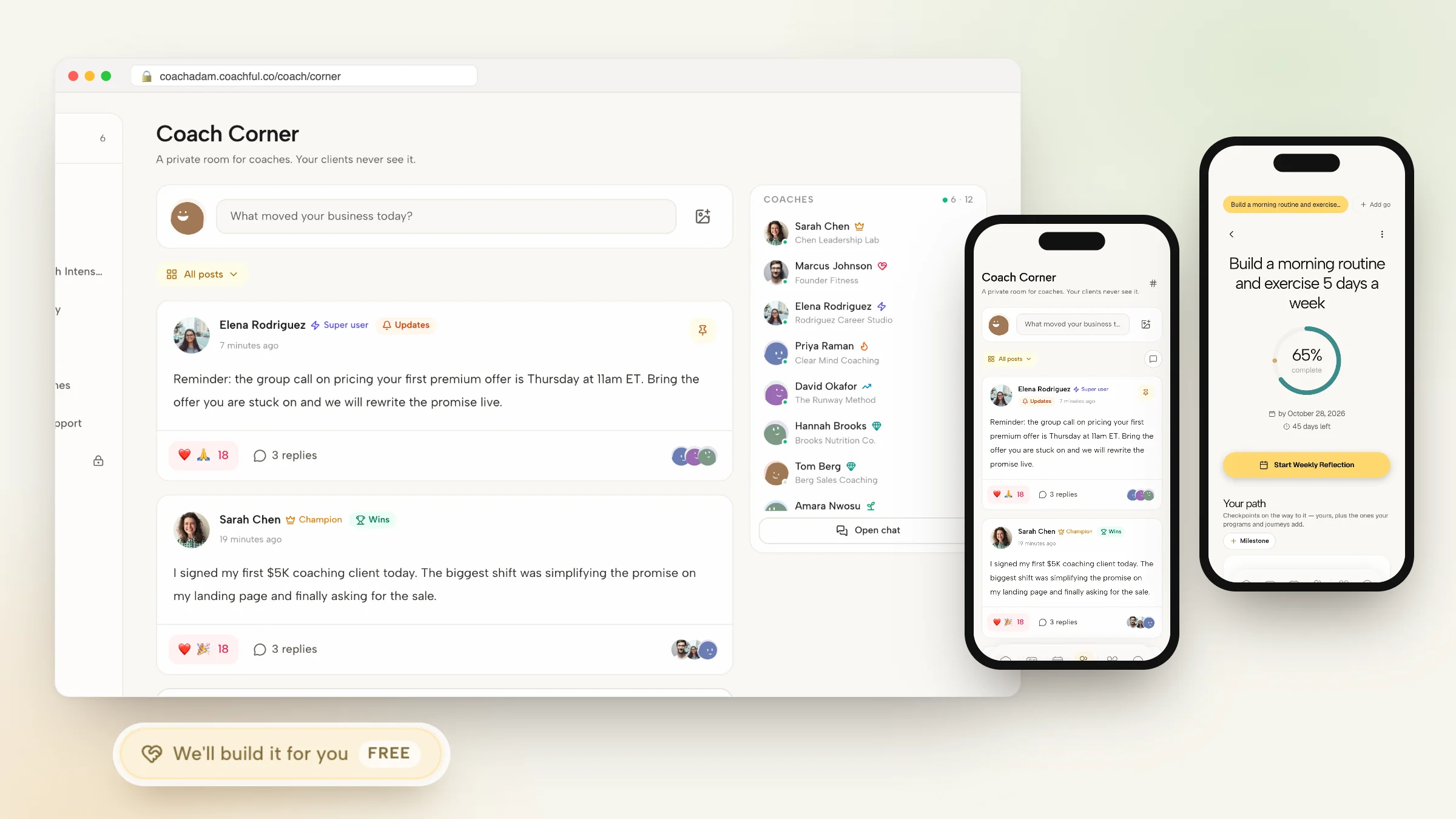
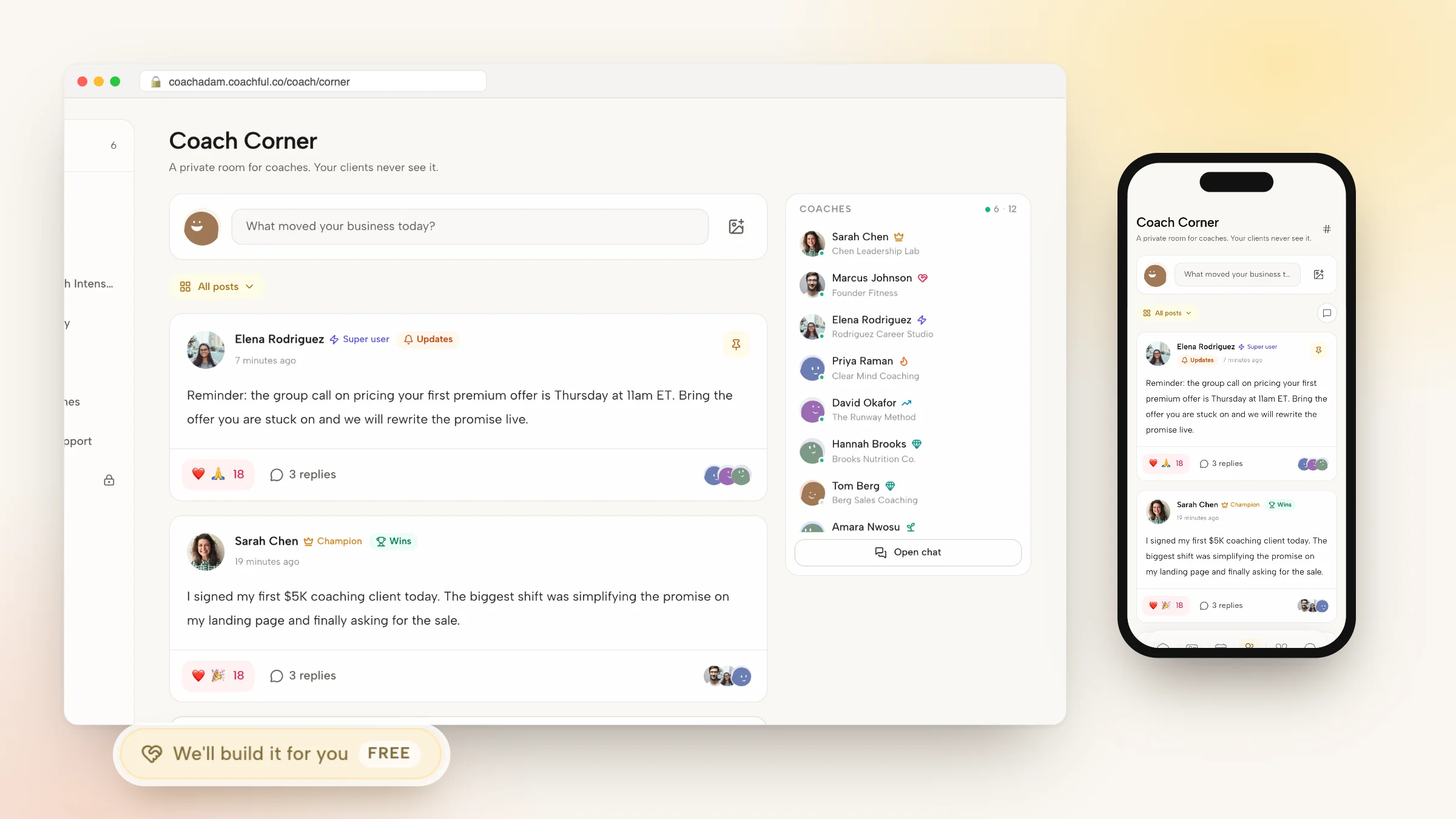
Coach Corner is the community for coaches inside Coachful, the coaching platform. It sits under Community in your menu, labeled Coaches only, and its tagline is the reason it works: a private room for coaches, and your clients never see it. It is included with every Coachful plan, and coaches on your team can join too.

The room is organized into channels: Updates, where the Coachful team posts announcements and anyone can reply, then General, Introductions, Wins, Marketing, Product, Resources, Questions and Off-topic. You can read everything as one feed or filter to a single channel. Real-time chat runs alongside the feed, and the coaches list shows who is online and which business each coach runs. You can open anyone's profile and message them directly, even though you work in separate businesses.
What it looks like when coaches help each other
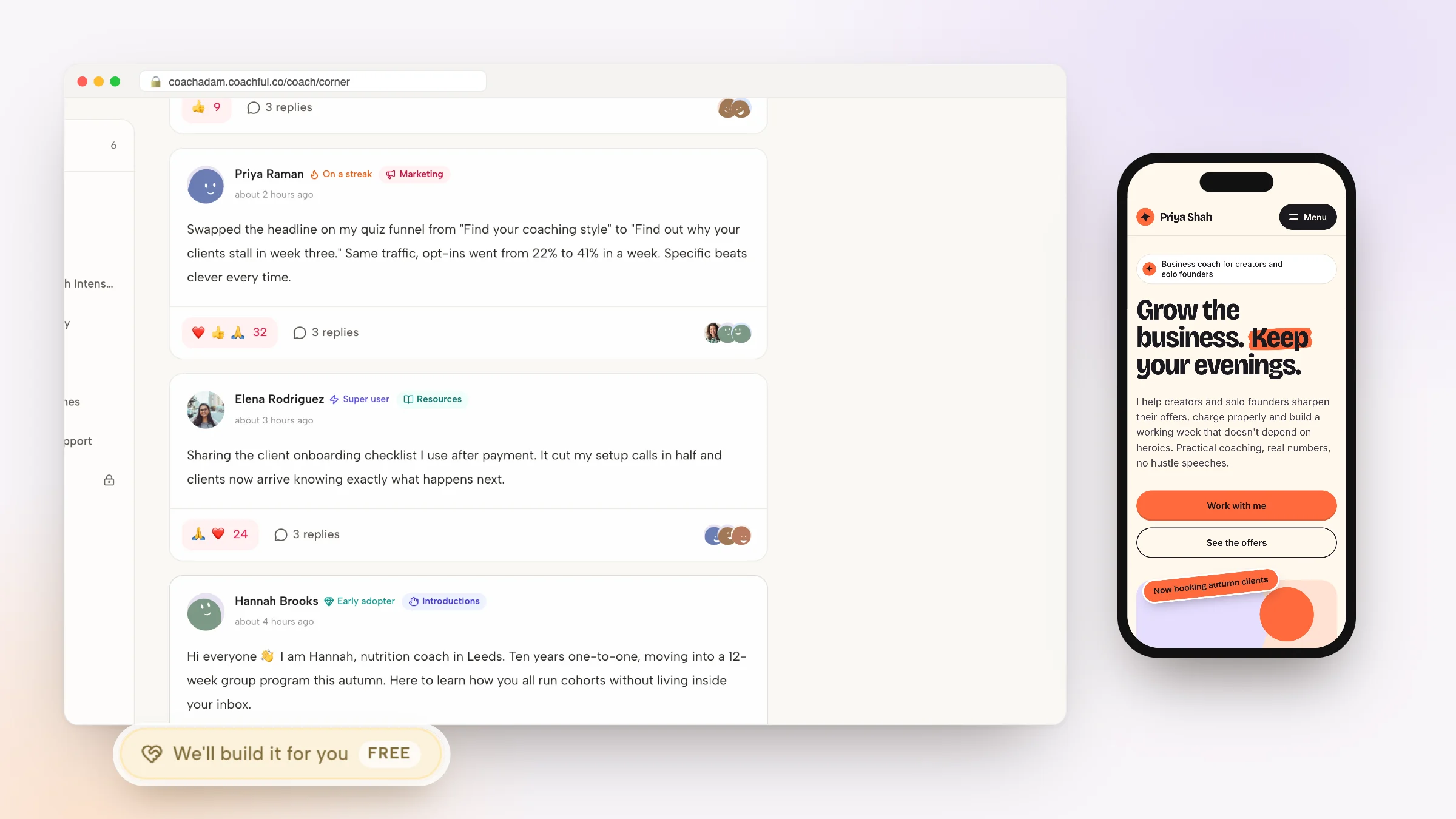
The screenshots come from Coachful's demo community, with sample coaches rather than real members, and they show the habits the space is built for. A coach asks why his webinar show-up rate is stuck. The replies explain which reminders went out and when, and one points out that a vague registration promise gives people no reason to attend. Another coach shares the onboarding checklist she sends straight after payment. A nutrition coach introduces herself as she moves into her first group program, and within the hour one coach describes how cohorts changed her week while another suggests turning years of answered client emails into the curriculum.

Our favorite demo thread starts with a pinned invitation to bring the offer you are stuck on. One coach admits her promise is still three sentences long. Another says he is on a client call at that hour. A third tells him to send his offer over anyway and she will take it first. That is the culture you want in any community, and Coach Corner's design nudges toward it.
Features that make helping easy
- Engage posts. The composer's Engage menu adds a Poll, a Q&A (replies are the answers, and the coach who asked can mark the accepted one), a Commitment (others tap "I'm in", with an optional deadline) or a Pulse (a one-tap scale, anonymous by default).
- Badges nobody hands out. A nightly job awards Champion, Welcomer, Rising star, On a streak, Super user, Early adopter and New here from what each coach actually did. Welcomer goes to coaches whose replies, welcomes and reactions far outweigh their own posts, so the room visibly rewards generosity.
- Search and Your contributions. Search covers posts and replies, and a private list shows everything you have written.
- It shapes the product. Coachful's public changelog credits several features to coaches' suggestions in Coach Corner, including iPhone home screen widgets.

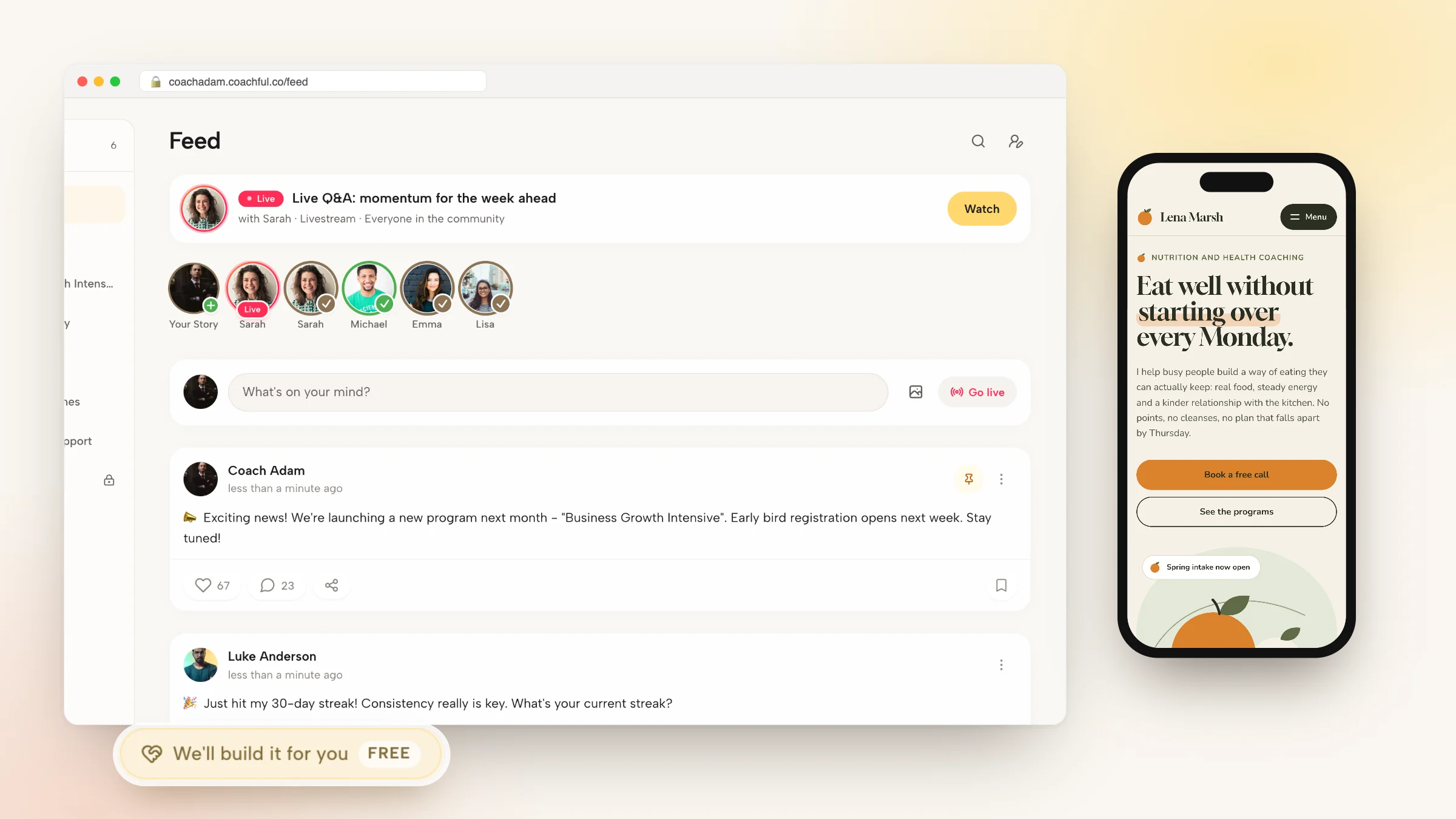
Why Coachful stands out: a free white-glove service. When Coach Corner tells you your sales page buries the offer, you do not have to rebuild it alone. On every Coachful plan, the team builds a website, funnel, offer page, program, course outline, worksheet or email sequence inside your account, usually within about 24 hours. You fill in a short form, add up to eight reference links and ten files, and edit the result with the normal editors. Read how it works on the free white-glove service page.

Best for: coaches who want daily, practical help with the business they run, from peers who use the same tools. Where it falls short: it is a peer community, not an accrediting body, so it gives you no credential, and you need a Coachful membership to get in. Pick something else if you need a credential, formal supervision or a body your corporate buyers recognize; join one of the next four alongside it.
2. International Coaching Federation (ICF)
The ICF describes itself as "the global gold standard of professional coaching", and its ACC, PCC and MCC credentials are the ones many coaches work toward. Its community runs on three layers. Chapters (the ICF says over 140, in more than 90 countries and territories) meet in person or online for learning, networking and pro bono projects. Communities of Practice gather coaches by specialty, from Career and Executive and Leadership to Health and Wellness, Team and Group, Ethics and Coaching Supervision, and anyone can attend their webinars. ICF Engage is the members' online community, with chapter and Community of Practice spaces and private messaging. Membership asks for 60 hours of coach-specific education, completed or in progress. See the International Coaching Federation for details.

Best for: coaches pursuing a credential or selling to buyers who ask for one. Where it falls short: it is big and formal, and a chapter meeting once a month will not answer this week's pricing question. Pick it over Coach Corner if credentials and specialty learning matter more to you right now than daily business help. Our guide to ACC vs PCC vs MCC helps you choose a level.
3. Association for Coaching (AC)
The Association for Coaching was established in 2002 and describes itself as an independent, not-for-profit professional body, with members in over 80 countries. Its standout for community seekers is co-coaching: facilitated forums, virtual and in person, where coaches practice on each other and get feedback, with regional groups and specialist forums. It also offers accreditation, events at international, national and local level, and a member directory. More on the Association for Coaching's site.
Best for: coaches who want regular, structured practice. Where it falls short: stronger on development than on quick business answers. Pick it over Coach Corner if your priority is sharpening the coaching itself with peers and a facilitator.
4. EMCC Global
EMCC Global began in 1992 as the European Mentoring Centre, became the European Mentoring and Coaching Council, and took its current name in 2023. It is a not-for-profit body for coaching, mentoring and supervision with 29 affiliated countries and regions; members join the branch where they live. Its online community, The Conversation Space, is where members talk between events, and its Centres for Excellence cover topics such as supervision, team coaching and ethics. Membership is open, and its accreditations cover coaches and mentors, supervisors and team coaches.
Best for: coaches and mentors in Europe, and anyone moving into supervision or team coaching. Where it falls short: formal, and less focused on the business side of a solo practice. Pick it over Coach Corner if your clients are organizations that value EMCC accreditation.
5. Institute of Coaching (IOC)
The Institute of Coaching is based at McLean Hospital, which its site describes as the largest psychiatric affiliate of Harvard Medical School. It is the most research-minded community here: what it calls the largest vault of coaching research, webinars, an annual Coaching in Leadership and Healthcare conference, and discussion groups such as Health and Wellbeing Coaching, LGBTQ+ Coaches and Allies, and Coaching in Higher Ed. Associate and Full membership need no application; the Professional Fellow tier does.
Best for: coaches who want evidence behind their methods. Where it falls short: more academic than practical for day-to-day business questions. Pick it over Coach Corner if you work in leadership or health settings where research credibility wins the work.
6. Coach training alumni networks
The school you trained with often keeps a community going. The Co-Active Training Institute's "Your Network for Life" invites graduates to keep learning together and refer opportunities to each other. iPEC runs a community for students and graduates, including a group for those who have completed Module III of its coach training. These rooms share a vocabulary, which makes practice easy.
Best for: practice partners within one methodology. Where it falls short: only open to that school's students and graduates, and quieter on business questions. Pick it over Coach Corner if you want to deepen one specific approach.
7. International Association of Coaching (IAC)
The IAC certifies coaches by demonstrated skill against its Coaching Masteries, with an online test and recorded coaching. Its community side includes chapters that members can start in their region, webinars in English, Spanish and Chinese, an international member directory and a quarterly newsletter. Its site says it has coaches from 80 countries.
Best for: coaches who prefer a skills-based certification route. Where it falls short: a smaller, quieter community than the bodies above. Pick it over Coach Corner if you want certification by recorded performance.
8. Christian Coaches Network International (CCNI)
CCNI has supported Christian coaches since 1998. Membership includes frequent live events (its site lists 10 to 16 a month), affinity groups and a learning community, monthly webinars and a video library, and you do not need a credential to join.
Best for: coaches who want their faith to be part of how they talk about their work. Where it falls short: narrow by design. Pick it over Coach Corner if faith-based peer support is the thing you are missing.
9. Paid coach communities on Skool, Circle and Mighty Networks
Many paid coach communities today are run by coach trainers, marketers and business mentors on community platforms. Skool's homepage is a Discover page listing communities you can browse and join; Circle and Mighty Networks host branded communities, courses and events. The platform is only the venue: what you are really choosing is the host and the members.

Best for: coaches who want a specific teacher's method plus a community of people learning it. Where it falls short: quality varies enormously, many are funnels into a higher-priced program, and the advice reflects one person's playbook. Pick one over Coach Corner if you want a particular system taught by a particular person, and you have checked who is really in the room.

If you later want to run a paid community of your own, our comparison of Coachful and Mighty Networks for coaching communities and our list of Circle alternatives cover the trade-offs.

10. LinkedIn groups
Search LinkedIn for your niche plus "coaching" and you will find groups. Most are broadcast channels, but they put you in front of HR leaders, managers and former colleagues who buy or refer coaching.
Best for: visibility with buyers. Where it falls short: public, noisy and promotional. Pick it over Coach Corner if you want to be seen rather than helped.
11. Facebook groups for coaches
Facebook still hosts many private groups for coaches, often organized by niche, country or training school. The good ones are well moderated and surprisingly warm.
Best for: niche peer chat. Where it falls short: moderation varies and posts disappear into the feed. Pick one over Coach Corner if a group exists for your exact niche and the moderators keep pitches out.
12. Reddit coaching subreddits
Subreddits such as r/lifecoaching and r/Coaching mix coaches, aspiring coaches and people deciding whether to hire one. That last group makes Reddit useful market research: you see how potential clients talk about coaching, including their doubts.
Best for: blunt outside opinions. Where it falls short: anonymous, mixed expertise and often skeptical of coaching. Pick it over Coach Corner if you want to hear from people who are not coaches.
How to get the most from any online coaching community
Whichever you join, the same habits work. Introduce yourself with who you coach and one thing you can help with. Answer two questions for every one you ask. Ask with context: what you tried, the number, the specific decision. Come back and report what happened. Remove client details from every story. For the longer version, read our guide to the coaching community, and if you work in one niche, see the lists of communities for life coaches, career coaches and new coaches. When you are ready to run one for your own clients, Coachful's community platform for coaches and our guide on how to create an online coaching community will get you started.
Frequently asked questions
What are the best online coaching communities?
For daily, practical help from working coaches, a private platform community such as Coach Corner inside Coachful. For credentials and standards, the International Coaching Federation, the Association for Coaching and EMCC Global. For research, the Institute of Coaching. Most coaches belong to one of each type.
Is there a free online community for coaches?
Open groups on LinkedIn, Facebook and Reddit cost nothing to join. Professional bodies charge membership, and private platform communities usually come with a subscription. Coach Corner is included with every Coachful plan rather than sold separately, and Coachful offers a free trial.
What is Coach Corner?
Coach Corner is Coachful's private community for coaches. It has channels for Updates, Introductions, Wins, Marketing, Questions, Resources and more, real-time chat, a coaches list with direct messages, and Engage posts for polls, Q&As, commitments and pulse checks. Badges are awarded automatically for helping others. Clients never see it.
Do I need to be ICF-certified to join an ICF chapter?
No credential is needed for ICF membership. The ICF asks for 60 hours of coach-specific education, completed or in progress, and you choose your chapter on the membership application. Anyone can attend ICF Community of Practice webinars.
Which online coaching community is best for a solo coach who feels isolated?
A community you will open every day, where people reply quickly and warmly. That usually means a private platform community or a small peer group rather than a large professional body. Coach Corner's New here badge and Welcomer badge exist for exactly that: new coaches get noticed and generous ones get recognized.
Are paid coaching communities on Skool worth it?
Some are excellent and some are sales funnels. Before paying, read recent posts, check whether members are working coaches, and see whether questions get real answers or a "book a call" reply. If the community mainly sells the founder's next program, look elsewhere.
Does Coachful build websites and funnels for free?
Yes. The white-glove build is free on every Coachful plan. You fill in a short form inside your account with what you need and attach up to eight links and ten files, and the team builds the website, funnel, program or other piece in your account, usually within about 24 hours. Coachful itself is a paid membership.