Best Coaching Communities for Career Coaches in 2026
The best communities for career coaches keep you current on a job market that changes faster than any certification, and they put you next to the people who send career coaches work: resume writers, recruiters, outplacement providers and other coaches who do not take the clients you do. A general coaching group will help with your offer. Only a career-focused room will tell you what hiring managers are screening for this quarter, or which interview format a company has switched to.
We compared eight communities for career coaches, including the professional associations built for career practitioners, a think tank, a specialty group inside the ICF and the private community inside Coachful. We also cover the public data sources career coaches lean on when the community debate needs a number. Each entry covers who it suits, what stands out, where it falls short and when to pick it over our first choice.
If the feedback you collect points at your website or your lead magnet, Coachful's team will build them for free inside your account. More on that in the first entry.
What career coaches need from a community
Career coaching sits closer to the market than most coaching. Your clients are measured by an external result (an offer, a promotion, a new field) and the rules of that game keep moving. A community earns its place if it helps with these:
| Career coaching need | What a good community gives you |
|---|---|
| Job-market intel | Which sectors are hiring and freezing, how applicant tracking and AI screening are changing, what salary ranges really look like |
| Referrals both ways | Resume writers, recruiters and other career coaches who send you the clients outside their niche, and take yours |
| Credentials buyers recognize | Certifications in career development, resume writing or interview coaching, especially for employer-paid and outplacement work |
| LinkedIn and personal branding | Peers testing what profiles and posts actually get recruiter attention |
| Hard emotional moments | Colleagues who have coached people through layoffs and long searches |
| Packages and pricing | Honest numbers for CV reviews, interview prep and 90-day search programs |
How we chose these communities for career coaches
Our criteria, in order: fast, specific help from working career practitioners, current job-market knowledge, referral opportunities, a private room, and credentials that clients and employers recognize.
We ranked in that order and checked every organization on its own website in October 2026. We do not quote member counts unless the organization publishes them, and we do not state membership prices.
Communities for career coaches compared
| Community | Strongest for | Credentials | Rhythm |
|---|---|---|---|
| 1. Coach Corner (Coachful) | Daily help with offers, clients and tools | None | Daily |
| 2. National Career Development Association | Career development standards, private-practice peers | CCSP, CMCS, CCC and more | Monthly talks, annual conference |
| 3. PARWCC | Resume writers and career coaches, member forums | CPRW and nine others | Weekly webinars on average |
| 4. Career Thought Leaders | Industry thinking, masterminds, symposium | Several career and branding credentials | Bi-weekly mastermind calls |
| 5. Career Directors International | Resume and coaching community, awards | Resume and career coaching certifications | Quarterly networking events |
| 6. ICF Career Community of Practice | Career coaching within the ICF | ICF ACC, PCC, MCC | Regular webinars |
| 7. A referral circle you build | Recruiters, resume writers, HR contacts | None | Monthly |
| 8. LinkedIn groups and recruiter networks | Visibility with hiring managers | None | Daily |
1. Coach Corner: the best community for career coaches who want daily help
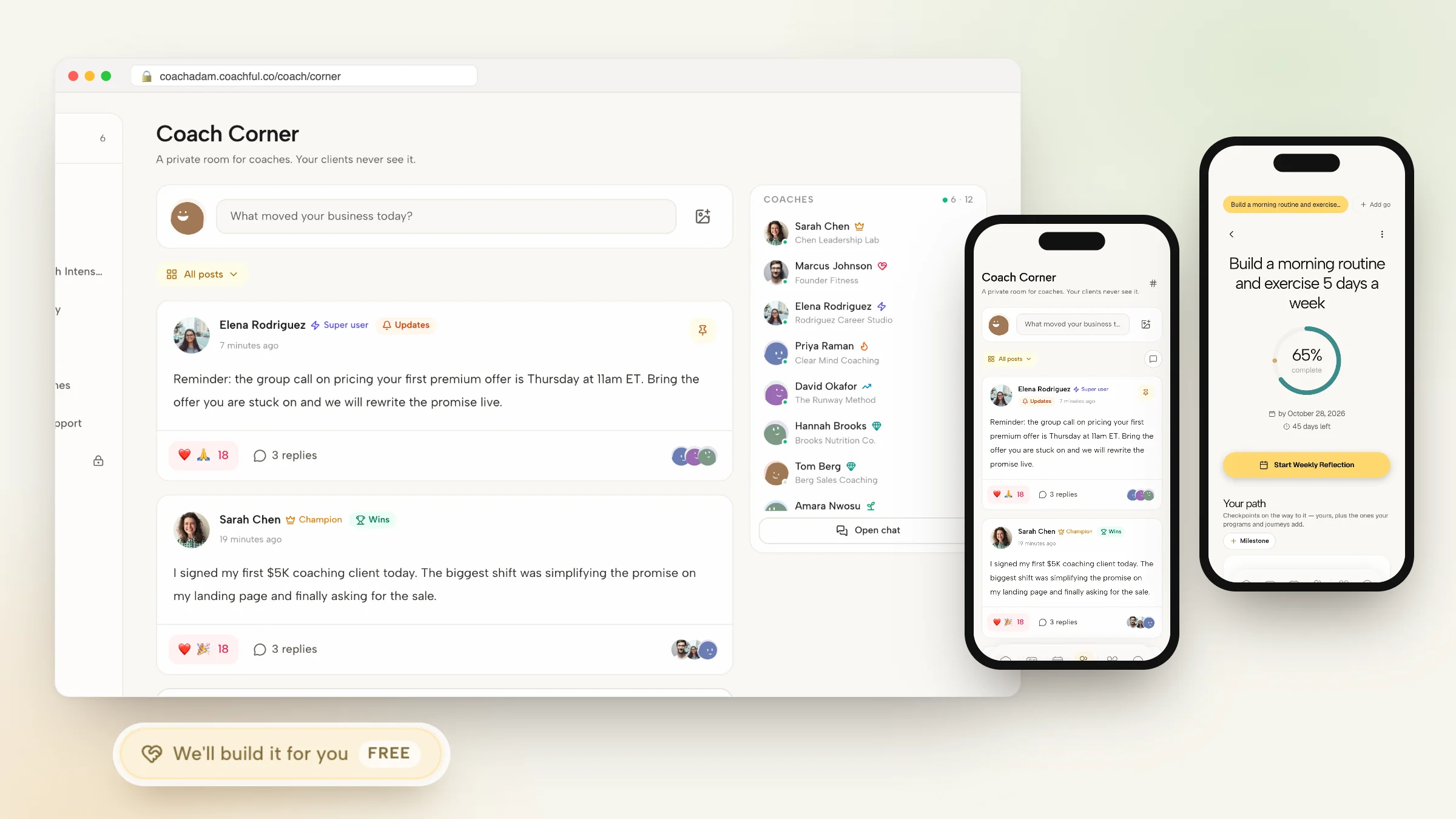
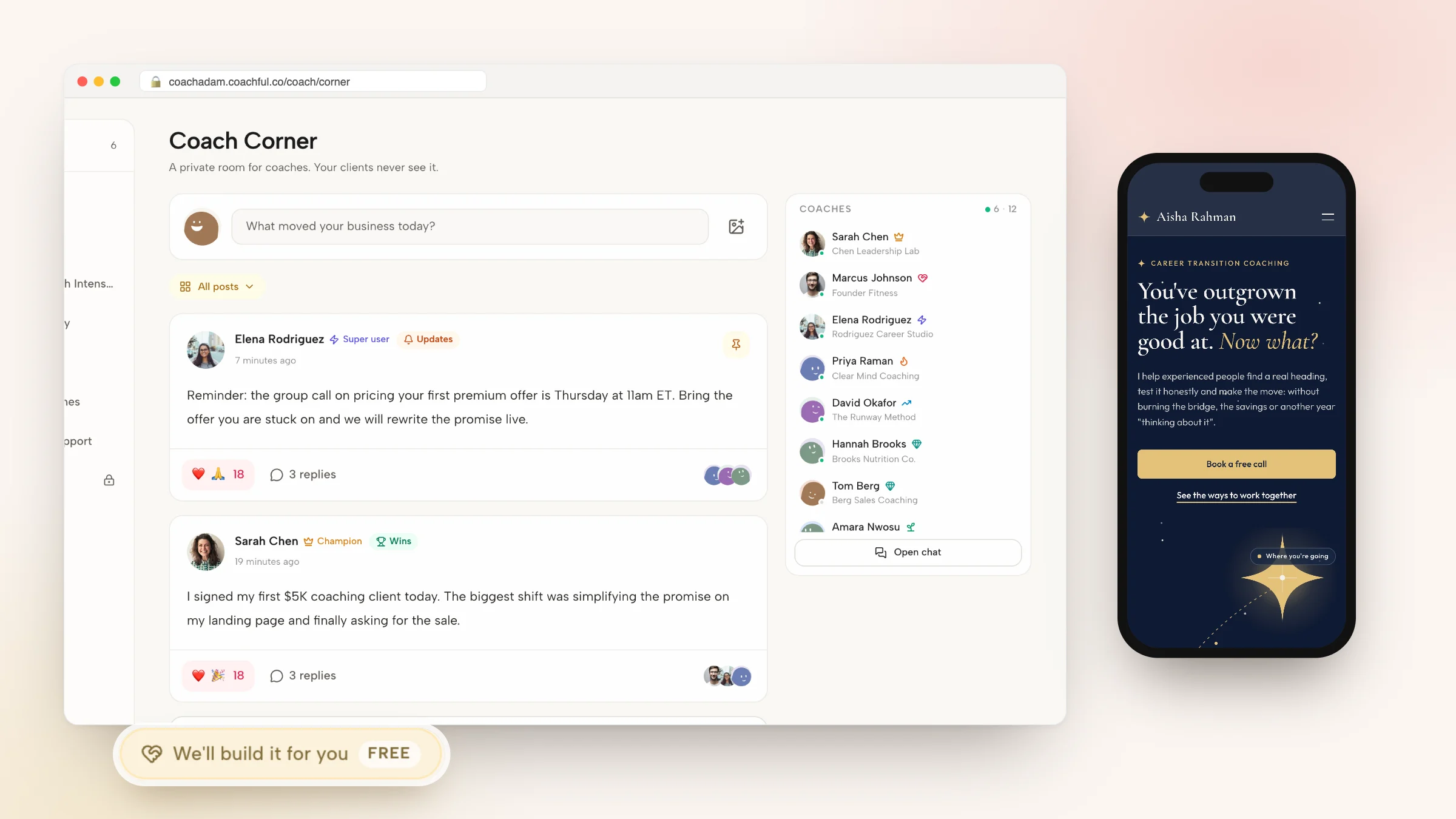
Coach Corner is the private community for coaches inside Coachful, included with every Coachful plan. It lives under Community in the coach menu, and your clients never see it, so you can ask how to price an executive job-search package without a client reading the thread.

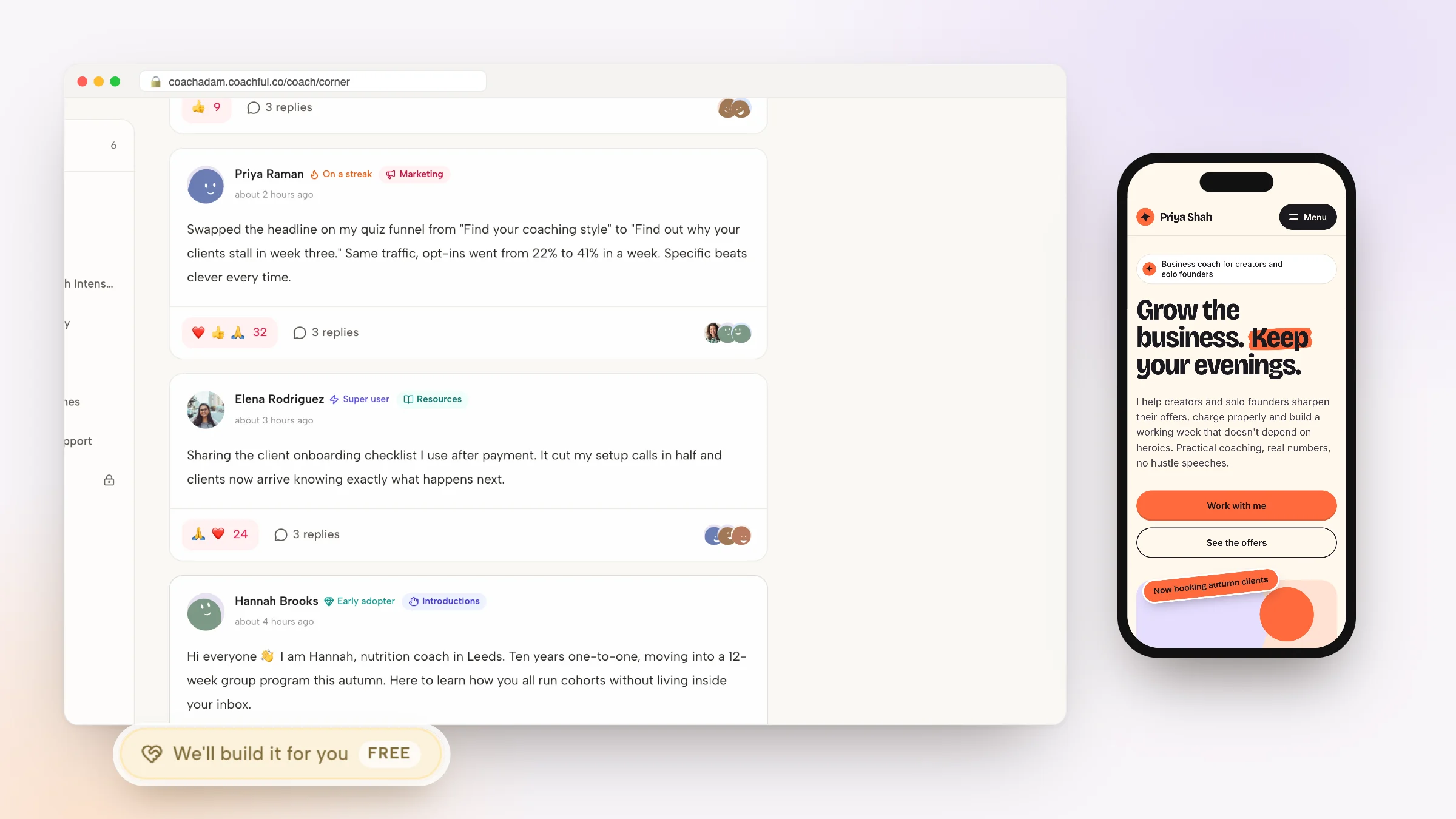
Career coaches use the channels in predictable, useful ways. Questions for "a client has two offers and wants me to pick", Marketing for LinkedIn post experiments and lead magnets, Resources for the interview prep checklist you are happy to share, and Wins for the client who negotiated a higher offer. In the demo community, a sample career coach who runs a career studio is one of the most active members, sharing an onboarding checklist and explaining that she sends it straight after payment, so the first call is about the client and not logistics.
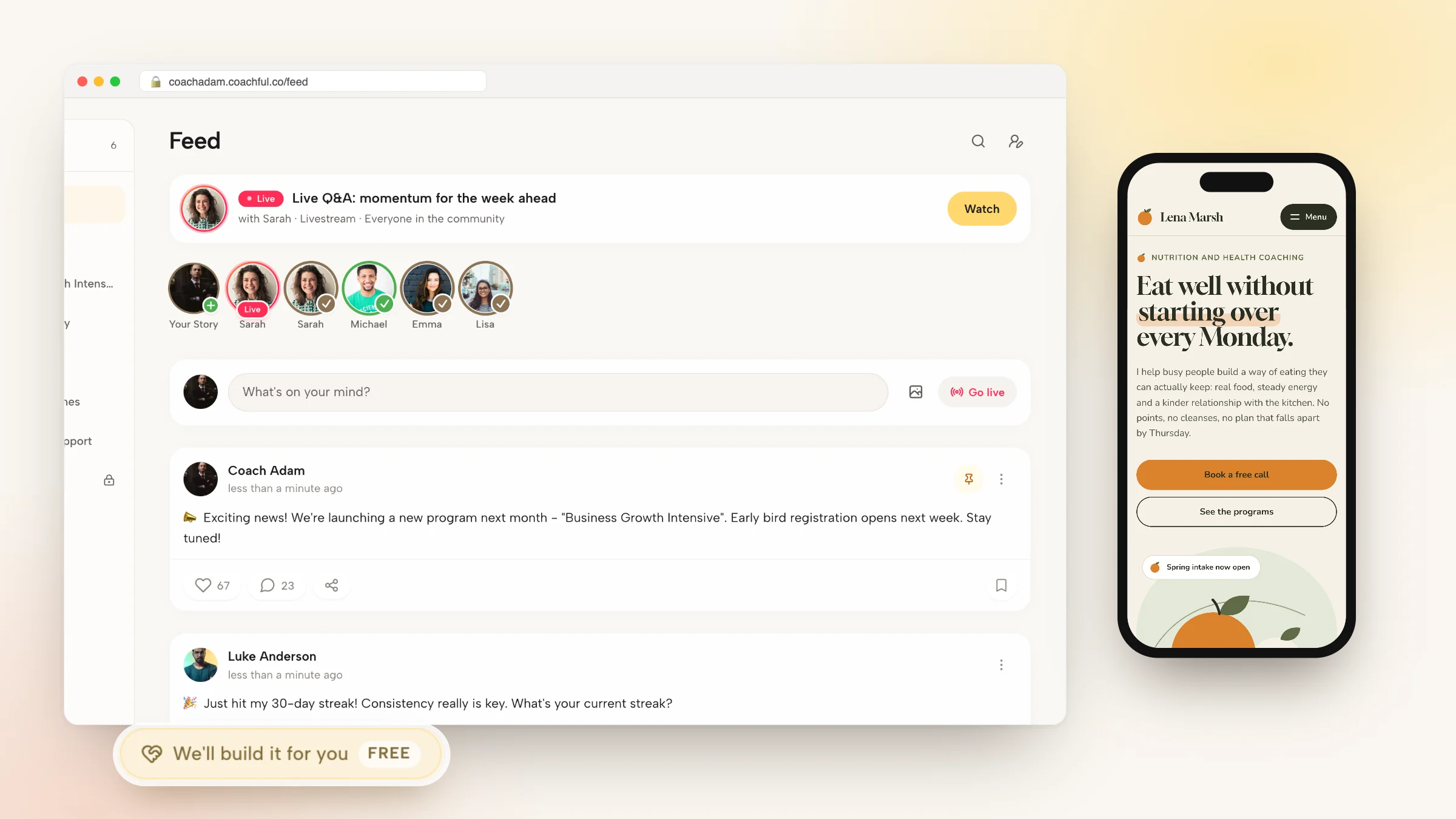
The Engage menu suits career coaches well. Post a Poll asking how others charge for a CV review, a Q&A and mark the reply that solved it as the accepted answer, a Commitment such as "publish three LinkedIn posts this week" for others to join, or an anonymous Pulse on how the market feels. The coaches list shows each coach's business, and you can message anyone directly, which is how coaches in different specialties end up referring to each other.

There is also a practical reason career coaches like having their community inside the platform they run on. Coachful's Career Coaching power-up gives each client a shared tracker for networking connections, applications and interviews, a LinkedIn content plan and a CV builder, and questions about setting those up get answered by coaches who use the same screens. See Coachful for career coaches for the full list.
Why Coachful stands out: a free white-glove service. When peers tell you your site makes clients hunt for the CV review, Coachful's team will rebuild it. On every Coachful plan, the team builds what you ask for inside your account, usually within about 24 hours: a website with your CV review and interview prep packages, a lead-magnet funnel such as a career clarity scorecard with follow-up emails and a strategy call, a 90-day search program, or an intake form. You fill in a short form and attach up to eight links and ten files, and everything stays editable. See the free white-glove service for what it covers.

Best for: career coaches who want daily, practical help from peers running real practices. Where it falls short: it is a cross-niche coaching community, so it will not replace a career-specific association for credentials or deep labor-market expertise. Pick something else if a career development credential is your priority this year; join one of the associations below as well.
2. National Career Development Association (NCDA)
The NCDA serves career development practitioners and educators, with professional development, publications, standards and advocacy. For independent career coaches, the most relevant corner is its Private Practice, Business/Industry, Agencies constituency group, which runs "Third Thursday Talks", a Zoom meeting on the third Thursday of each month. NCDA also has chartered state divisions, a mentoring program, committees open to all members, and a global career development conference; the 2027 one is set for Anaheim from June 29 to July 1. Its credentials include the Certified Career Services Provider (CCSP) and the Certified Master of Career Services (CMCS).
Best for: career coaches who want to be part of the wider career development profession. Where it falls short: its constituency groups span schools, universities and agencies as well as private practice, so business questions about a solo practice are one topic among many. Pick it over Coach Corner if standards, research and a career development credential matter most.
3. Professional Association of Résumé Writers & Career Coaches (PARWCC)
PARWCC has served resume writers and career coaches since 1990. Members get networking in members-only forums and private LinkedIn and Facebook groups, more than 50 live webinars a year plus a video library, and a searchable directory that potential clients use. It also issues a long list of certifications, the best known being the Certified Professional Résumé Writer (CPRW).
Best for: career coaches who also write resumes, or want to. Where it falls short: resume writing dominates, so pure coaching questions get less airtime. Pick it over Coach Corner if resume work is a big part of your revenue.
4. Career Thought Leaders (CTL)
Career Thought Leaders calls itself "a think tank for coaches, counselors, resume writers, and other professionals". Its community runs on bi-weekly mastermind calls with the community and its CEO, quarterly calls with the board, Career Jam discussions that feed an annual white paper, and an in-person Career Thought Leaders Symposium (the next is in Baltimore in April 2027). It also offers credentials in career coaching, job search and personal branding.
Best for: career coaches who want to stay ahead of where the industry is going. Where it falls short: more strategic than day-to-day. Pick it over Coach Corner if you want a mastermind rhythm with senior career practitioners.
5. Career Directors International (CDI)
CDI describes itself as a global professional association and "learning lab" for resume writers and career coaches. Membership includes a member community with live events, quarterly networking events, at least eight live webinars and trainings a year, a Facebook group, a directory, mentoring programs and its TORI awards for resume writing. It certifies resume writers and career coaches, including a Certified Career Success Coach credential.
Best for: career coaches who want peer recognition and a resume-industry network. Where it falls short: smaller and less structured than NCDA. Pick it over Coach Corner if you want industry awards and a resume-focused peer group.
6. The ICF's Career Community of Practice
The International Coaching Federation organizes Communities of Practice by specialty, and Career is one of them. Anyone can attend Community of Practice webinars, and ICF members also get a local chapter and the ICF Engage online community. If your buyers, or the employers who fund outplacement and internal mobility programs, ask for an ICF credential, this is where career coaching and the ICF meet. Details are on the International Coaching Federation's site.
Best for: career coaches working with corporate buyers or pursuing an ICF credential. Where it falls short: less hands-on with resumes and job-search tactics than the career associations. Pick it over Coach Corner if coaching credentials, rather than career-specific ones, open doors for you.
7. A referral circle you build
Career coaches have more natural referral partners than almost any other niche, and few of them are coaches. Build a small circle and meet monthly:
- Resume writers who do not coach, and coaches who do not write resumes.
- Agency recruiters in your clients' industries, who meet candidates that need coaching and clients who need candidates.
- HR and talent leaders who buy outplacement or promotion coaching.
- Other career coaches with different specialties: graduates, executives, career changers, returners.
- A therapist for clients whose job loss has become something heavier.
Post in Coach Corner's Introductions channel with the specialty you are looking for, and you will usually find the coach side of the circle there.

8. LinkedIn groups and recruiter networks
LinkedIn is where your clients' future employers are, so it matters more to career coaches than to anyone. Groups on career development, HR and recruiting will not give you deep peer support, but they show you what hiring managers and recruiters are talking about, and posting thoughtful comments there is a quiet form of marketing.
Best for: visibility and reading the market. Where it falls short: public and promotional. Pick it over Coach Corner if your priority is being seen by employers.
Job-market data every career coaching community quotes
Career coaches argue about the market constantly, and the best threads end with a source. Two free public tools are worth bookmarking. CareerOneStop, sponsored by the U.S. Department of Labor, offers occupation profiles, a salary finder, lists of fastest-growing occupations, a certification finder, a professional association finder and a section with resources for career advisors. Its occupation and wage data draw on O*NET and the Bureau of Labor Statistics, whose Occupational Outlook Handbook is the other reference most US career coaches use.

Bring that data into your marketing as well. A lead magnet such as a career clarity scorecard, followed by a few emails and an invitation to a strategy call, is a simple funnel for a career coach to run, and it is exactly the kind of thing Coachful's team builds for you on request.
Communities for your own career coaching clients
Group job-search programs work better when clients can see each other's progress: the applications sent, the interviews landed, the offers negotiated. That is a different community from the ones above, and Coachful includes it: program channels, cohort groups created when clients enroll, and live Q&A sessions. Read our guide to creating an online coaching community and see the community platform for coaches. If you are planning a cohort, our group career coaching pilot plan is a good next read.

For the broader picture, see the best online coaching communities, our pillar on the coaching community, and, if you are just starting out, the guide to becoming a career coach.
Frequently asked questions
What is the best community for career coaches?
For daily help with offers, clients and tools, a private community of working coaches such as Coach Corner inside Coachful. For career-specific standards and credentials, the National Career Development Association, PARWCC, Career Thought Leaders or Career Directors International, depending on whether your work leans toward career development, resumes or branding.
Which certification should a career coach get?
It depends on your buyers. NCDA's Certified Career Services Provider suits career development work, PARWCC's Certified Professional Résumé Writer suits resume-heavy practices, and an ICF credential helps with corporate and outplacement buyers. Ask peers in your niche which one their clients actually ask about.
How do career coaches stay current on the job market?
By combining peer conversation with data. Career-focused communities and recruiter contacts tell you what is changing in hiring. Public sources such as CareerOneStop and the Bureau of Labor Statistics give you occupation, wage and growth data to back it up.
Where do career coaches get referrals?
From resume writers, agency recruiters, HR leaders and other career coaches with different specialties. A monthly referral circle and direct relationships built in communities produce most of them. Be specific about who you help so others know when to send someone.
Is there an online community for career coaches who use Coachful?
Yes. Coach Corner is Coachful's private community for coaches, included with every Coachful plan. It has channels for Questions, Marketing, Resources and Wins, real-time chat, direct messages and Engage posts such as polls and Q&As. Career coaches there can also compare notes on the Career Coaching power-up.
Can Coachful build my career coaching website or funnel for free?
Yes. The white-glove build is free on every Coachful plan. You describe what you need, for example a rebuild of your site with CV review and interview prep packages, attach links and files, and the team builds it in your account, usually within about 24 hours, and you can edit every page afterwards. The membership itself is paid, with a free trial to start.