Best Coaching Communities for Health Coaches in 2026
The best communities for health coaches help with two things general coaching groups barely touch: credentialing, and the scope of practice that keeps health coaching on the right side of medicine. Health coaches work next to doctors, dietitians and therapists, with clients who often have a diagnosis, and the community you choose should make you better at staying in your lane while still changing lives. Everything else, from packages to group programs, comes second.
We compared nine communities for health coaches: the board that certifies health and wellness coaches in the US, a society for licensed clinicians who coach, alumni communities from training schools, national associations outside the US, and the private community for coaches inside Coachful. For each, we say who it suits, what stands out, where it falls short and when to pick it over our first choice.
If your peers tell you your website promises results you should not promise, Coachful's team will rewrite and rebuild it for free inside your account. The first entry explains how.
What health coaches need from a community
| Health coaching need | Why it matters | Where to get it |
|---|---|---|
| Credentialing | Employers and the public can look up board-certified coaches | NBHWC and approved training programs |
| Scope of practice | Coaches support behavior change; they do not diagnose, prescribe or write meal plans | NBHWC's scope of practice, ethics codes, peer discussion |
| Continuing education | Board-certified coaches need 36 continuing education credits every three years | Board events, school member classes, conferences |
| Referral relationships with clinicians | Many clients come from, and need to be sent back to, doctors, dietitians and therapists | Clinician networks, local partners |
| Supervision and support | Clients bring chronic illness, weight stigma and grief | Peer supervision groups, private communities |
| Group program design | Habit change works well in cohorts | Peers who run groups |
The scope point deserves a moment. The National Board for Health & Wellness Coaching's scope of practice describes the coach as an "accountability partner, not director" and says health and wellness coaches do not, on their own, diagnose, interpret medical data, prescribe or de-prescribe, or recommend supplements, and do not provide meal plans, exercise prescriptions or psychological therapy. They can support a treatment plan from the client's care team and share information from nationally recognized authorities. Any community you join should reinforce that line, not blur it.
How we chose these communities for health coaches
Our criteria, in order: practical help with the practice from working coaches, respect for scope of practice, support toward credentials and continuing education, and access to clinical referral partners.
We ranked in that order and checked every organization on its own website in October 2026. We quote only figures the organizations publish, and no prices.
Communities for health coaches compared
| Community | Who it is for | Credential or CE angle | Community format |
|---|---|---|---|
| 1. Coach Corner (Coachful) | Coaches running a practice on Coachful | None | Daily feed, channels, chat |
| 2. NBHWC community | Board-certified health and wellness coaches | NBC-HWC board certification, CE | Quarterly Connects, directory, events |
| 3. National Society of Health Coaches | Licensed clinicians who coach | Certified Health Coach | Member listserv, webinars |
| 4. Wellcoaches membership | Wellcoaches-trained coaches | CE credits through member classes | Monthly classes, Coach Chat |
| 5. Institute of Coaching | Evidence-minded coaches | Conference with NBHWC credits | Health and Wellbeing Coaching group |
| 6. ICF Health and Wellness community | Coaches with or seeking ICF credentials | ICF credentials | Community of Practice webinars |
| 7. National associations outside the US | Coaches in the UK, Canada, Australia and New Zealand | Registers and designations | Member meetings, peer supervision |
| 8. Training school alumni groups | Graduates of a specific school | Varies | Facebook groups, events |
| 9. A clinician referral circle | Your local care network | None | Monthly coffee or call |
1. Coach Corner: the best community for health coaches running a practice
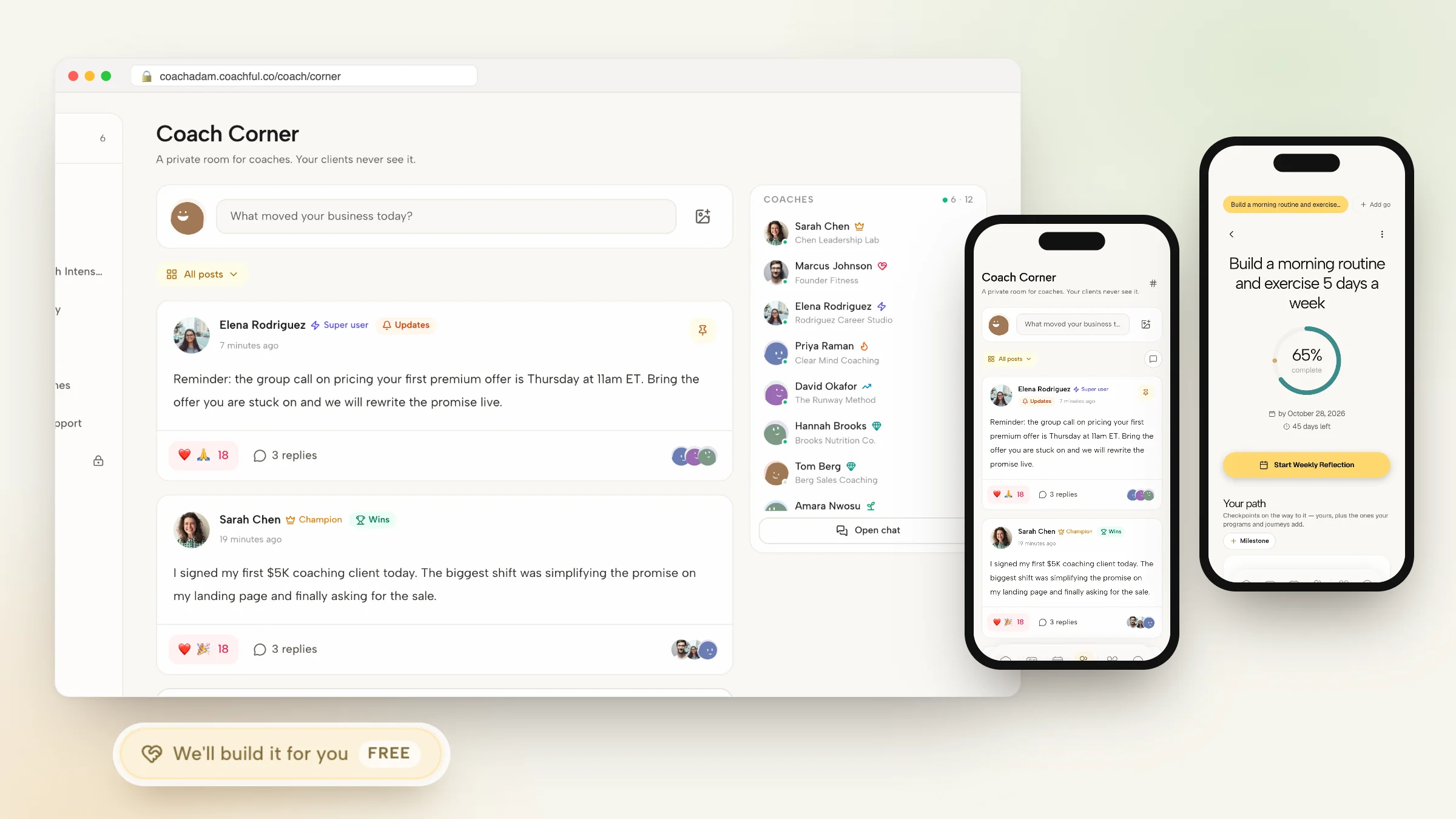
Coach Corner is the private community for coaches inside Coachful, included with every Coachful plan. It sits under Community in the coach menu and is coaches only, so your clients never see your questions about their progress, with details removed.

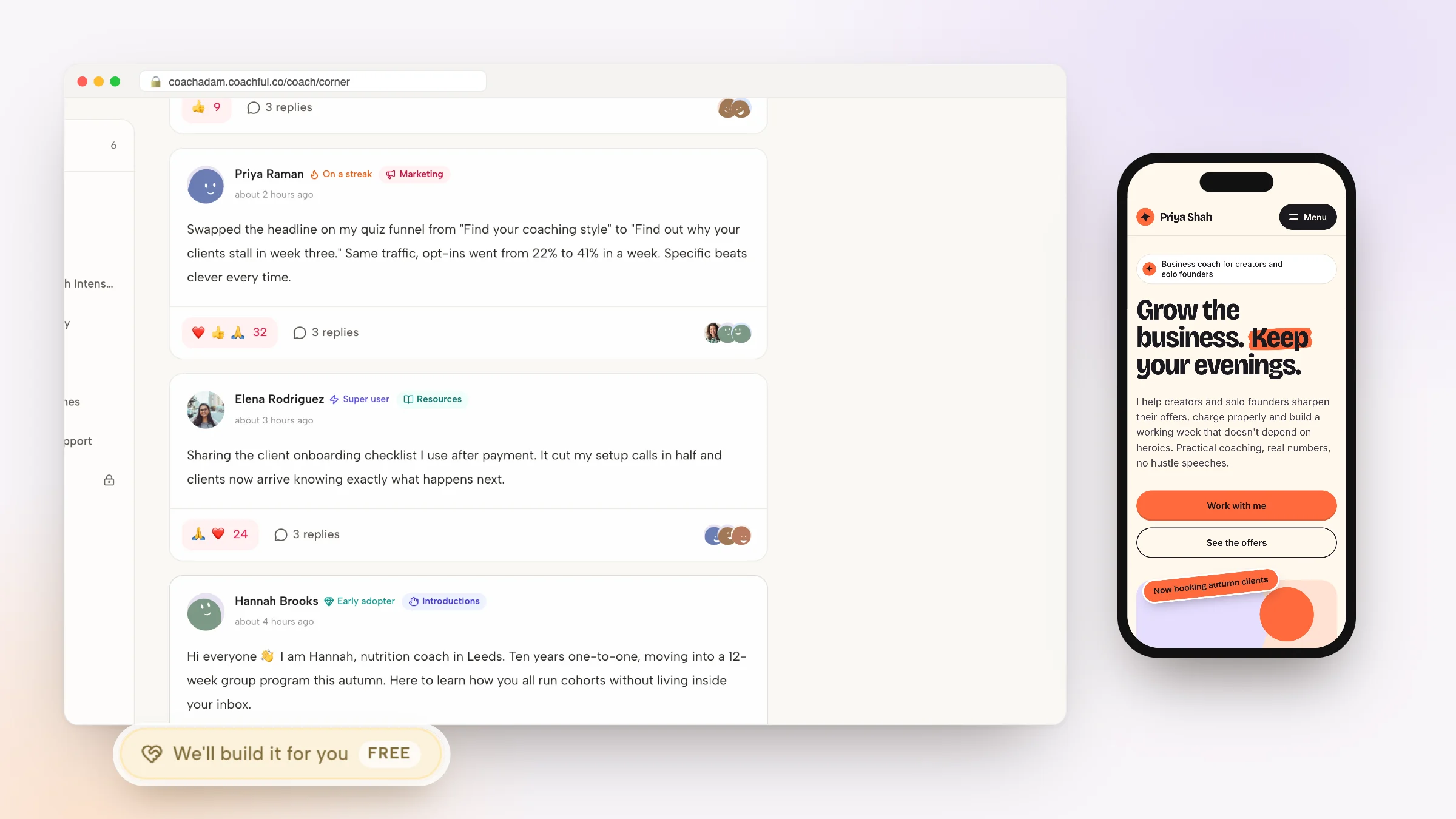
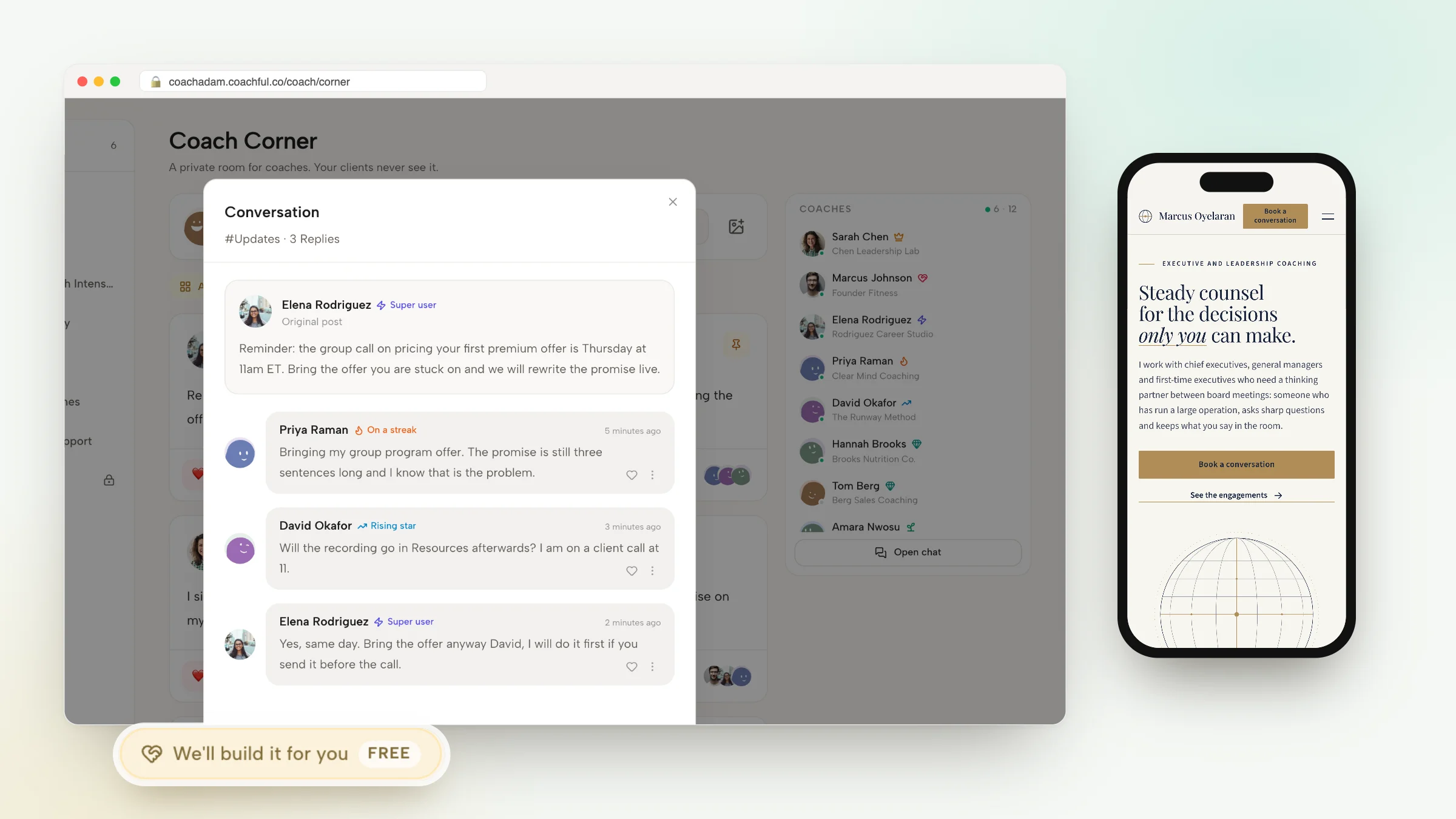
Health coaches will recognize the conversations in the demo community. A sample nutrition coach introduces herself: ten years of one-to-one work, moving into a 12-week group program this autumn, and wanting to learn how others run cohorts without living in their inbox. One coach replies that a single group call now replaces six repeated conversations. Another points out that ten years of answered questions means the curriculum is already written, and the nutrition coach replies that she has a folder of answered emails, so perhaps it is. In another thread, a coach asks why clients go quiet in month three, and peers explain that the novelty carries months one and two and the third needs a weekly check-in with real feedback. Anyone who has run a habit-change program knows that month.
The channels (Questions, Wins, Marketing, Resources, Introductions and more) keep it tidy, and the Engage menu lets you post a Poll, a Q&A whose best reply you can mark as the accepted answer, a Commitment others can join, or an anonymous Pulse. Badges are earned automatically from activity, with Welcomer reserved for the coaches who lift others most.

Coach Corner is a peer room, so it does not replace your board's guidance on scope, and good members will tell you so. It is where you ask how others word a referral to a client's doctor, how they handle a client who wants a meal plan, or how they price a three-month package.
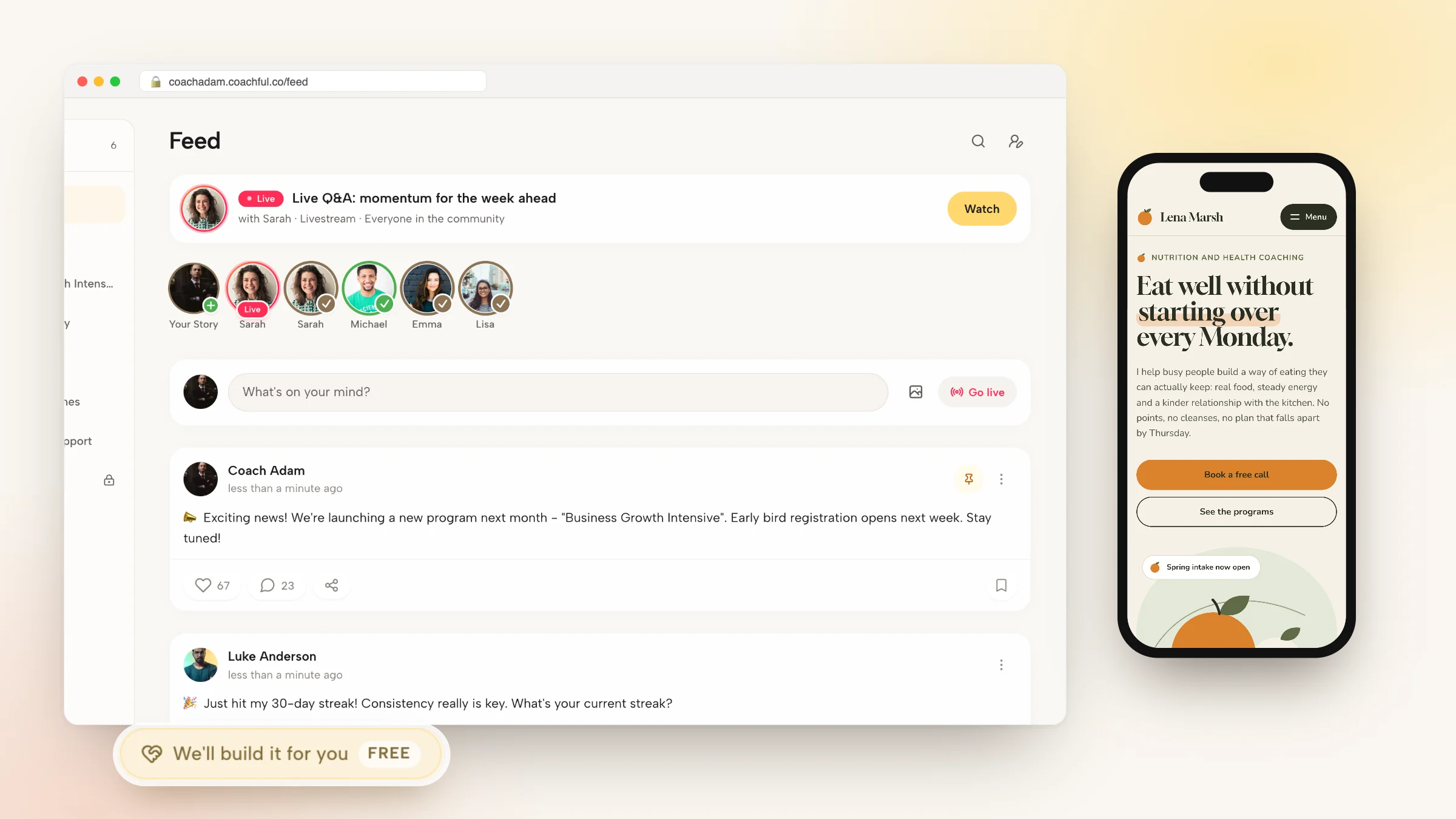
Why Coachful stands out: a free white-glove service. Health coaches are often told their website over-promises or under-explains. On every Coachful plan, Coachful's team builds what you need inside your account, usually within about 24 hours: a calm homepage, a Work With Me page for your package, a free-guide funnel, a habit-based program or an intake questionnaire. You fill in a short form and attach up to eight links and ten files, and the team follows a strict facts policy: nothing invented, no fake testimonials, credentials or results. Read about the free white-glove service.

Best for: health coaches who want daily, practical help from peers running real practices. Where it falls short: it is not a credentialing body, and Coachful is GDPR-ready but not HIPAA-certified, so it suits non-clinical health coaching rather than work that requires a HIPAA business associate agreement. Pick something else if board certification or clinical credentials are your priority; pair it with the next entries. See Coachful for health coaches for the rest.
2. The NBHWC community
The National Board for Health & Wellness Coaching, established in 2012, runs the NBC-HWC board certification. To sit the board exam, coaches complete an NBHWC-approved training program, hold an associate's degree or higher or 4,000 hours of work experience, and log 50 coaching sessions after their program's skills assessment; the details are on its board certification page. Recertification asks for 36 continuing education credits every three years.
The community side is small but useful. NBHWC hosts four Quarterly Connects a year for the board-certified community, each worth one continuing education credit, plus a public online directory employers use to find certified coaches, an events calendar and a job board.
Best for: health coaches who want board certification and the employers who look for it. Where it falls short: a certifying board rather than a daily community. Pick it over Coach Corner if certification is your next step.
3. National Society of Health Coaches (NSHC)
NSHC is for licensed clinicians who coach, such as nurses, nurse practitioners, physician assistants, dietitians and physical therapists. Its focus is what it calls evidence-based health coaching, and it certifies Certified Health Coaches. Members get a professional networking listserv, live practice webinars and a member registry employers use to verify certification. For registered nurses, there is also a pathway toward nurse coach board certification through another body.
Best for: clinicians adding coaching to their practice. Where it falls short: non-licensed coaches receive a certificate of completion rather than the credential. Pick it over Coach Corner if you hold a clinical license and want peers who do too.
4. Wellcoaches membership
Wellcoaches is a coach training school, established in 2002 and an NBHWC-approved training program. Its membership, which it calls "a community of thousands", includes monthly member classes with continuing education credits, a library of past classes, monthly business classes, a Coach Chat networking event and find-a-coach listings for certified members.
Best for: Wellcoaches graduates who want ongoing classes and peers. Where it falls short: tied to one school. Pick it over Coach Corner if continuing education credits from classes you trust matter most.
5. Institute of Coaching
Based at McLean Hospital, an affiliate of Harvard Medical School, the Institute of Coaching is the research home for coaching in health settings. It runs a monthly Health and Wellbeing Coaching group, webinars and an annual Coaching in Leadership and Healthcare conference that offers NBHWC credits.
Best for: health coaches who want evidence and clinical credibility. Where it falls short: academic in tone. Pick it over Coach Corner if you work with hospitals, clinics or researchers.
6. The ICF's Health and Wellness Community of Practice
The International Coaching Federation runs Communities of Practice by specialty, and Health and Wellness is one of them; anyone can attend Community of Practice webinars. If your clients or employers recognize ICF credentials, this connects health coaching to that world. See the International Coaching Federation.
Best for: health coaches who also hold or want an ICF credential. Where it falls short: not health-specific in its credentialing. Pick it over Coach Corner if ICF recognition matters in your market.
7. National health coaching associations outside the US
If you coach outside the US, a national association may matter more than the NBHWC. Three examples we verified:
- UK & International Health Coaching Association (UKIHCA). A professional body for whole-person health and wellbeing coaching with a register of health coaches. From January 2026 it made health coaching supervision a core continuing development requirement for registered coaches, and it offers twice-monthly peer group supervision for members.
- Health Coach Alliance. Serving Canada, the US and international members, it offers designations such as Registered Health Coach, a public registry, continuing education requirements, events and a published scope of practice.
- Health Coaches Australia and New Zealand Association (HCANZA). Monthly member meetings on Zoom with professional development points, a coach networking group and find-a-coach profiles.
Best for: coaches whose clients and employers look to a national register. Where it falls short: smaller communities. Pick one over Coach Corner if registration in your country is what opens doors.
8. Training school alumni groups
Many health coaches trained with a large school that keeps its graduates connected. The Institute for Integrative Nutrition, for example, offers student and alumni support, course Facebook groups, an ambassador program and virtual events. One caution for anyone aiming at board certification: check NBHWC's own requirements rather than a school's summary, because approval can apply to a specific program or practicum rather than a whole curriculum.
Best for: peers who share your training. Where it falls short: quality and moderation vary. Pick it over Coach Corner if you mainly want to stay connected to your cohort.

9. A clinician referral circle
The most valuable health coaching community may be local: a GP or family physician, a registered dietitian, a physiotherapist, a therapist and a pharmacist who know what you do and trust you to stay in scope. Ask for twenty minutes, explain how you support their treatment plans, and send them a short update (with the client's consent) when you share a client. Referrals flow both ways once they see you send people back appropriately.
Best for: steady referrals and safer coaching. Where it falls short: slow to build. Pick it over Coach Corner if most of your clients have a care team.
Running a community for your own health coaching clients
Habit change is easier together. Many health coaches run group programs where clients check in, share small wins and encourage each other through the hard weeks. That is a different community from the ones above, and Coachful includes it: program channels, cohort groups created when clients enroll, live sessions, habits and check-ins.

See the community platform for coaches and our guide to creating an online coaching community. For the software side, our roundup of the best health coaching software compares tools, and our guide to creating a health coaching program covers the program itself. For communities beyond health, see the best online coaching communities and the coaching community guide.

Frequently asked questions
What is the best community for health coaches?
For daily help with the practice, a private community of working coaches such as Coach Corner inside Coachful. For certification, the National Board for Health & Wellness Coaching. Licensed clinicians who coach may prefer the National Society of Health Coaches, and coaches outside the US should look at their national association.
How do health coaches become board certified?
Through the NBHWC: complete an approved training program, hold an associate's degree or higher or 4,000 hours of work experience, log 50 coaching sessions after your program's skills assessment, and pass the board exam. Recertification asks for 36 continuing education credits every three years.
What can't a health coach do?
According to the NBHWC's scope of practice, health and wellness coaches do not, on their own, diagnose, interpret medical data, prescribe or de-prescribe, recommend supplements, write meal plans or exercise prescriptions, or provide psychological therapy. They support the client's goals and the plan from their care team.
Where can health coaches earn continuing education credits?
NBHWC's Quarterly Connects carry one credit each, and schools such as Wellcoaches offer member classes with credits. Conferences such as the Institute of Coaching's Coaching in Leadership and Healthcare conference offer NBHWC credits too. Check that any activity counts toward your own credential.
Is Coachful suitable for health coaches?
For non-clinical health coaching focused on habits, accountability and behavior change, yes: it includes habits, check-ins, programs, group cohorts and a client community. Coachful is GDPR-ready but not HIPAA-certified, so coaches who need a HIPAA business associate agreement should use a vendor that provides one.
Can Coachful build my health coaching website for free?
Yes. The white-glove build is free on every Coachful plan. You describe the pages and the free guide or package you want to offer, attach links and files, and the team builds it in your account, usually within about 24 hours, without inventing testimonials or results. You pay for the Coachful membership, not for the build.