How to Create a Health Coaching Program Clients Can Keep
A health coach does not diagnose, prescribe or treat. That boundary sounds like a limitation, but it is the best design brief you will ever get: a health coaching program sells behavior change, one habit at a time, supported week after week until it sticks. Programs that forget this turn into meal plans with a weekly call attached, and clients drop them the first time life gets busy.
This guide shows how to build a health coaching program around a cluster of behaviors rather than a condition. It includes a ten-week sample for remote workers whose energy crashes every afternoon, the session rhythm, the tracking and worksheets, pricing structures, delivery online and the mistakes that cost health coaches their retention.
If the setup is the part you dread, Coachful's team builds health coaching programs for free on any Coachful plan. Send your outline or a voice memo through a short form and the weeks, habits, check-ins and worksheets are set up in your account.
Decide what your program can promise
Write the promise inside your scope. Clients and their doctors should both be comfortable reading it.
| A health coaching program can | A health coaching program should not |
|---|---|
| Help a client eat regular meals and plan their week of food | Prescribe a diet to treat a medical condition |
| Build a walking or movement habit that fits their day | Replace physical therapy or medical exercise advice |
| Improve sleep routines and wind-down habits | Diagnose a sleep disorder |
| Support a plan the client's doctor has already given | Change medication, supplements or treatment |
| Track energy, mood and habits so patterns become visible | Interpret lab results |
Add one line to your intake form asking whether the client is under medical care for anything relevant, and a sentence in your agreement saying the program is coaching, not medical treatment. If you are newer to the field, our explainer on what health and wellness coaching is covers the scope in more depth.
Build around a behavior cluster, not a diagnosis
"Gut health" or "hormones" describe a body. Programs need verbs. Choose a cluster of three or four behaviors that feed the outcome your client cares about, and add them one at a time:
- Energy: regular meals, protein at breakfast, caffeine timing, a walk after lunch, a bedtime.
- Stress: a breathing practice, a shutdown ritual, one boundary at work, movement on hard days.
- Eating patterns: eating without screens, a hunger check, a weekly plan, a plate built around vegetables.
- Sleep: a consistent wake time, light in the morning, a wind-down hour, a screen cut-off.
The client experiences the outcome ("I don't crash at three o'clock anymore"). You coach the behaviors that create it.
Sample: a ten-week health coaching program for afternoon energy crashes
The program is "The Afternoon Reset", for people working from home who feel fine in the morning and wiped out by mid-afternoon, then snack and sleep badly. The promise: "In ten weeks your afternoons feel steady, you have a food and movement routine that fits a workday, and you know what to do on a bad day."
| Week | Focus | Habit added | What the client tracks |
|---|---|---|---|
| 1 | The baseline | None yet | Energy at 10 a.m., 2 p.m. and 6 p.m., plus what they ate and when |
| 2 | Regular meals | Lunch away from the desk, at roughly the same time | Lunch time and afternoon energy |
| 3 | Breakfast | Protein at breakfast | Breakfast yes or no, mid-morning hunger |
| 4 | Movement | A ten-minute walk after lunch | Walk done, energy at 3 p.m. |
| 5 | Caffeine | Last coffee before an agreed cut-off time | Coffee times, time asleep |
| 6 | Midpoint review | Keep or swap one habit | Repeat the week-one baseline |
| 7 | Snacks | A planned afternoon snack instead of grazing | Snack planned yes or no |
| 8 | Sleep | A wind-down routine and consistent wake time | Bedtime, wake time, how rested from 1 to 10 |
| 9 | Bad days | A written plan for travel, sick kids and deadline weeks | One "bad day" run through the plan |
| 10 | Maintenance | Choose the three habits to keep | Final baseline compared with week one |
Notice the midpoint review in week six. It gives the client a visible before and after while they still have weeks left to adjust, and it is a natural moment to ask how the program is going.

Habits, tracking and check-ins
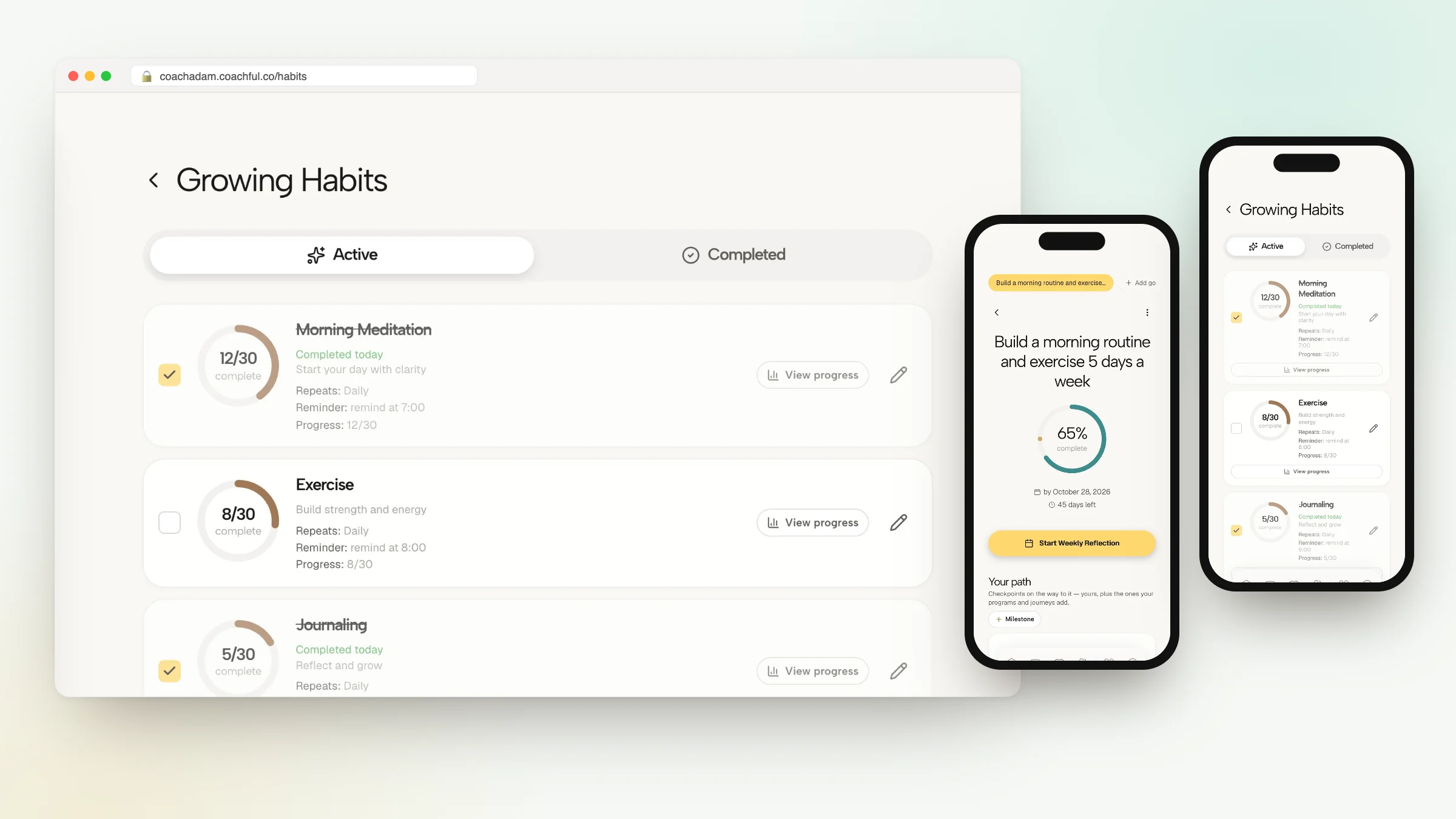
Add one habit per week and keep the earlier ones running. By week five the client has four small habits in play, which is about as many as most people can hold without the whole thing collapsing. Track each one as done or not done each day, and let the client see their streaks.

Then add one weekly check-in, kept short so it gets answered on a phone:
- Afternoon energy this week, on a 1 to 10 slider.
- Which habit felt easiest?
- Which habit fell apart, and on what day?
- Anything your doctor or another practitioner told you that I should know?
That last question keeps you inside your scope and builds trust. For more ways to keep clients engaged between calls, read our guide to weekly check-ins and simple action plans.

Session rhythm for a health coaching program
Behavior change needs frequent, short contact more than long sessions. A rhythm that suits the ten-week sample:
- Week one: a 60-minute intake covering history, goals, current routine and anything medical to work around.
- Weeks two to six: 30-minute sessions each week, focused on the new habit and what got in the way.
- Weeks seven to ten: 30-minute sessions every two weeks, with the check-in carrying the off weeks.
- Optional: a group call every two weeks for all current clients, covering a topic such as eating on busy days.
Short daily check-ins can carry the days between, for example a morning prompt asking what the plan is for lunch and an evening prompt asking how the afternoon went.

Worksheets that suit health coaching
- Energy diary: three energy ratings a day plus meals, for the baseline weeks.
- Hunger and fullness scale: a 1 to 10 check before and after meals, for clients who eat on autopilot.
- Plate check: a simple drawing of a plate split into vegetables, protein and starch, ticked at each meal for a week.
- Sleep diary: bedtime, wake time, screens off, how rested.
- If-then plan: "If I have back-to-back meetings over lunch, then I eat the snack in my bag at 12:30."
Our comparison of health coaching templates covers ready-made options if you would rather adapt than write from scratch.
How to price a health coaching program
Health coaching often sells better as a commitment than as single sessions, because the change happens across weeks. Common structures:
- One program fee for the ten or twelve weeks, with an option to pay in two or three parts.
- A maintenance membership afterwards: a monthly fee for a check-in, the community and one call a month.
- A group version of the same program for clients who want structure and company more than 1:1 time.
Base the fee on the real time involved, including reading check-ins and answering messages, which in health coaching can add up to more than the sessions themselves.
Delivering a health coaching program online
Health coaching clients interact with the program daily, so it has to live on their phone. In Coachful, a program's weeks carry the habits, tasks and worksheets, check-ins arrive at each client's local reminder time, and clients use the branded portal or the client app on iPhone and Android. For nutrition-focused programs, the Fitness & Nutrition power-up adds nutrition targets, meal plans, recipes, food lookup and private progress photos and measurements. A program community gives group members a feed and chat. Coachful's page for health coaches walks through the setup, and ready-to-film templates such as The Energy Reset, Eat Well Without Dieting and The Better Sleep Blueprint can give you a head start.
Mistakes that hurt health coaching retention
- Five habits in week one. Clients feel great for four days and quit on day five. One new habit a week.
- A plan with no bad-day version. The first sick week ends most programs. Teach the fallback plan before it is needed.
- Tracking everything. If clients log every gram, they will stop logging. Track the behavior you are coaching this week.
- Drifting outside scope. When a client asks about medication or a symptom, refer them back to their doctor and note it.
- No ending. Without a maintenance plan, clients slip after week ten and blame themselves. Hand them a plan and an option to stay.
Planning a longer version? The 12-week coaching program template shows how to stretch the same shape across three phases.
We'll build your health coaching program for free
When the behavior cluster and weeks are clear, Coachful's team can turn them into a working program in your account. It is free on every Coachful plan; the app labels it FREE and Complimentary gift.
Open Create and tap the first chip, We'll build it for you · FREE. You can also use the Want us to build your program? card at the bottom of your Programs list, which says you can send an outline, notes or even a voice memo.

In the form, choose Program, then describe it ("a ten-week afternoon energy program with one habit a week, a weekly check-in and a group call every two weeks") and say who it is for. Add up to eight links, any notes or copy, and up to ten files such as your intake form, a habit tracker you use, a handout or an audio recording. Video files are not accepted. A final box takes deadlines and anything to avoid.
The team replies by email with next steps, usually within around 24 hours, which is a typical turnaround and not a guaranteed deadline. The program is built inside your account, so the habits, weeks and worksheets stay editable in the usual program editor.
Health coaches have used the service for the pages around a program, too. For a menopause and midlife health coach starting with no website, logo or prices, the team built a five-page site in sage and cream where every button leads to a free 20-minute consultation booking. For a psychologist-turned-coach working on emotional eating, it was a homepage with three clear paths (book a call, join the free community, enroll in the program) and a free-community funnel that delivers a guide.
What it does not include: the team does not record your videos or audio, give medical or compliance advice, run coaching calls, design logos or manage ads. Nothing gets invented, including credentials, testimonials, results or prices; anything missing is left for you to fill in. The free white-glove service guide lists everything the team builds.
Frequently asked questions
How do I create a health coaching program?
Pick an outcome inside your scope, choose a cluster of three or four behaviors that drive it, add one habit per week, track the behavior you are coaching, check in weekly, and close with a maintenance plan. Ten to twelve weeks gives habits time to settle.
How long should a health coaching program be?
Most run eight to twelve weeks, often followed by an optional maintenance membership. Research from University College London (Lally and colleagues, 2009) found new habits took a median of 66 days to become automatic, with a wide range, which is one reason short programs often feel unfinished.
What should be in a health coaching program?
An intake, a weekly habit focus, simple daily tracking, a short weekly check-in, regular sessions, a few worksheets such as an energy diary or sleep diary, a plan for bad days and a maintenance plan. Group programs add a community and group calls.
Can health coaches give meal plans?
It depends on your training and local rules. Many health coaches support general healthy eating habits and planning but leave therapeutic diets to dietitians and doctors. Check what your certification and jurisdiction allow before offering meal plans for any condition.
Is the Coachful program build really free?
Yes. The build service is free on every Coachful plan. Choose Program in the request form, describe the program and audience, and attach your outline, handouts or a voice memo. The team replies by email, usually within around 24 hours, and builds it in your account. Coachful itself is a paid subscription.
How do I keep health coaching clients engaged?
Keep contact short and frequent: one habit a week, a two-minute weekly check-in, visible streaks and a reply to every check-in. Plan for the bad week before it arrives, and give clients a reason to stay after the program, such as a maintenance membership.