12 Week Coaching Program Template: A Week-by-Week Plan
A 12 week coaching program works best as three four-week phases: foundation, build and integrate. The first phase sets the baseline and the goal, the second is where the client practises and stumbles and adjusts, and the third makes the change hold without you. Each week gets one theme, one session focus, one action and one check-in question, and weeks four, eight and twelve each end with a short milestone review.
Below is the full template as a week-by-week table you can copy, followed by the same template filled in for a dating coach who works with recently divorced clients, the weekly rhythm inside each week, milestone reviews, pricing options and the renewal conversation in week thirteen.
If you would like the template set up in your account without doing it yourself, Coachful's team builds programs for free on any Coachful plan. Send this outline with your own topics filled in, and the twelve weeks, tasks and check-ins are built for you to edit.
Why twelve weeks is such a common length
Twelve weeks lines up with a calendar quarter, which makes it easy to sell ("by the end of March"), easy to schedule and easy for clients to picture. It also gives enough room for a few rounds of trying something, getting it wrong and adjusting, which shorter programs often cut off just as the real learning starts.
It is short enough, too. Week one is still fresh in memory at week twelve, so the before and after are vivid. And the end of a quarter is a natural point to decide whether to continue, which keeps renewals honest. If you are weighing other lengths, our broader guide on how to create a coaching program covers four, six and eight-week formats too.
The three-phase shape
| Phase | Weeks | The client's job | Your job |
|---|---|---|---|
| Foundation | 1 to 4 | Get honest about the starting point and commit to one clear goal | Assess, listen, narrow the goal, set up habits and check-ins |
| Build | 5 to 8 | Practise the new behavior in real situations, report back | Challenge, adjust the plan, handle setbacks without drama |
| Integrate | 9 to 12 | Make the change hold under pressure and plan beyond the program | Step back, hand over tools, review progress, plan what's next |
Expect energy to dip around weeks five and six, when novelty has worn off and results have not fully arrived. Plan the build phase with a quick win in week five for exactly that reason.
The 12 week coaching program template
Copy this table into your own planning doc and replace the themes with your topic. The structure works across niches; the content is yours.
| Week | Phase | Theme | Session focus | Client action | Check-in question |
|---|---|---|---|---|---|
| 1 | Foundation | Starting point | Intake, story, what has been tried before | Baseline assessment | What made you sign up now? |
| 2 | Foundation | The goal | Narrow to one goal the client can describe and measure | Write the goal in their own words | How will you know it worked? |
| 3 | Foundation | Obstacles | Patterns, beliefs and practical barriers | Notice and log one obstacle a day | Which obstacle showed up most? |
| 4 | Foundation | The plan | Choose the first habit and the first experiment | Start the habit | Milestone review 1: what has shifted already? |
| 5 | Build | Quick win | Design one small, likely success | Run the quick win | What happened, and how did it feel? |
| 6 | Build | Stretch | A harder version of the experiment | Run the stretch | Where did you hold back? |
| 7 | Build | Setback | Work through what went wrong, without blame | Adjust the plan | What will you do differently? |
| 8 | Build | Momentum | Review the build phase, add a second habit | Repeat the baseline assessment | Milestone review 2: compare with week one |
| 9 | Integrate | Pressure test | Plan for the hardest week ahead | Write an if-then plan | What would knock you off course? |
| 10 | Integrate | Ownership | Client leads the session; coach asks questions only | Coach themselves through one decision | What did you notice leading it yourself? |
| 11 | Integrate | Support | Who and what keeps this going after the program | Set up one support (a buddy, a routine, a reminder) | Who is on your side? |
| 12 | Integrate | Close | Final review, celebration, the next 90 days | Final assessment and one-page plan | Milestone review 3: what are you proudest of? |
Two weeks in that table do most of the heavy lifting. Week seven normalizes setbacks before they become reasons to quit. Week ten, where the client leads, is the clearest sign of whether the change will survive without you.

Example: the template for a dating coach
Here is the same template filled in for a coach who works with people dating again after divorce. The program is "Ready Again", and the promise is "In twelve weeks you know what you want, you have a dating profile you're proud of, and you have been on dates that felt like you."
| Week | Theme | Client action |
|---|---|---|
| 1 | Where you are after the divorce | Readiness self-assessment |
| 2 | What you want now (and what you no longer want) | Write five must-haves and five deal-breakers |
| 3 | Old patterns | Map the last relationship's turning points |
| 4 | Confidence basics | One social plan that is not a date |
| 5 | Your profile | Draft the profile and choose photos |
| 6 | First messages | Start three conversations |
| 7 | The first date that went badly | Debrief without self-blame |
| 8 | Pacing | Two dates, using a pacing plan |
| 9 | Talking about the past | Practise how to mention the divorce |
| 10 | Kids, exes and logistics | Write boundaries for the second and third date |
| 11 | Your support circle | Choose one friend as a dating debrief buddy |
| 12 | The next season | Final assessment and a 90-day dating plan |
See Coachful's pages for dating coaches and divorce coaches for niche-specific setups.
What happens inside each week
A program feels alive when clients hear from it between sessions. A simple weekly rhythm:
- Start of the week: the week's theme, action and any worksheet arrive.
- Midweek: a short nudge or a daily check-in prompt, depending on how much contact the topic needs.
- End of the week: the check-in question, answered in a two-minute form.
- Session: weekly in the foundation phase, then weekly or every two weeks after, opening with the check-in answer.
Keep worksheets to one per week at most. Our guide to creating coaching worksheets has layouts for assessments, reflections and plans.

Milestone reviews at weeks four, eight and twelve
Run the same short assessment three times: week one (baseline), week eight and week twelve, with a lighter review at week four. Five to eight questions on a 1 to 10 scale is plenty, plus "what has changed that the numbers don't show?". Clients forget how they started; side-by-side scores remind them, and they become the raw material for a testimonial if the client is happy to give one.

Pricing a 12 week coaching program
Three structures are common:
- Pay in full at sign-up, sometimes at a small saving.
- Three monthly payments, which line up neatly with the three phases. Total slightly more than paying in full.
- Deposit plus balance, with the balance due before week five.
Whatever you choose, the price should reflect the result and all the time involved: sessions, prep, check-in replies and messages. A twelve-week program priced as twelve single sessions undersells what you are delivering. If clients tend to drop around month three, our piece on minimum commitments and the three-month dip explains how to set terms fairly.
Week thirteen: the renewal conversation
Don't wait until the last session to talk about what comes next. Raise it in week ten or eleven, framed around the client's plan, not your sales target: "Based on what you wrote in week nine, what support would help in the next quarter?" Offer two options, such as a lighter monthly check-in or a second twelve-week program with a new goal, and make "I'm good, thank you" an easy answer too. Our guide on when to start the renewal conversation covers timing and wording.

Setting up the template in Coachful
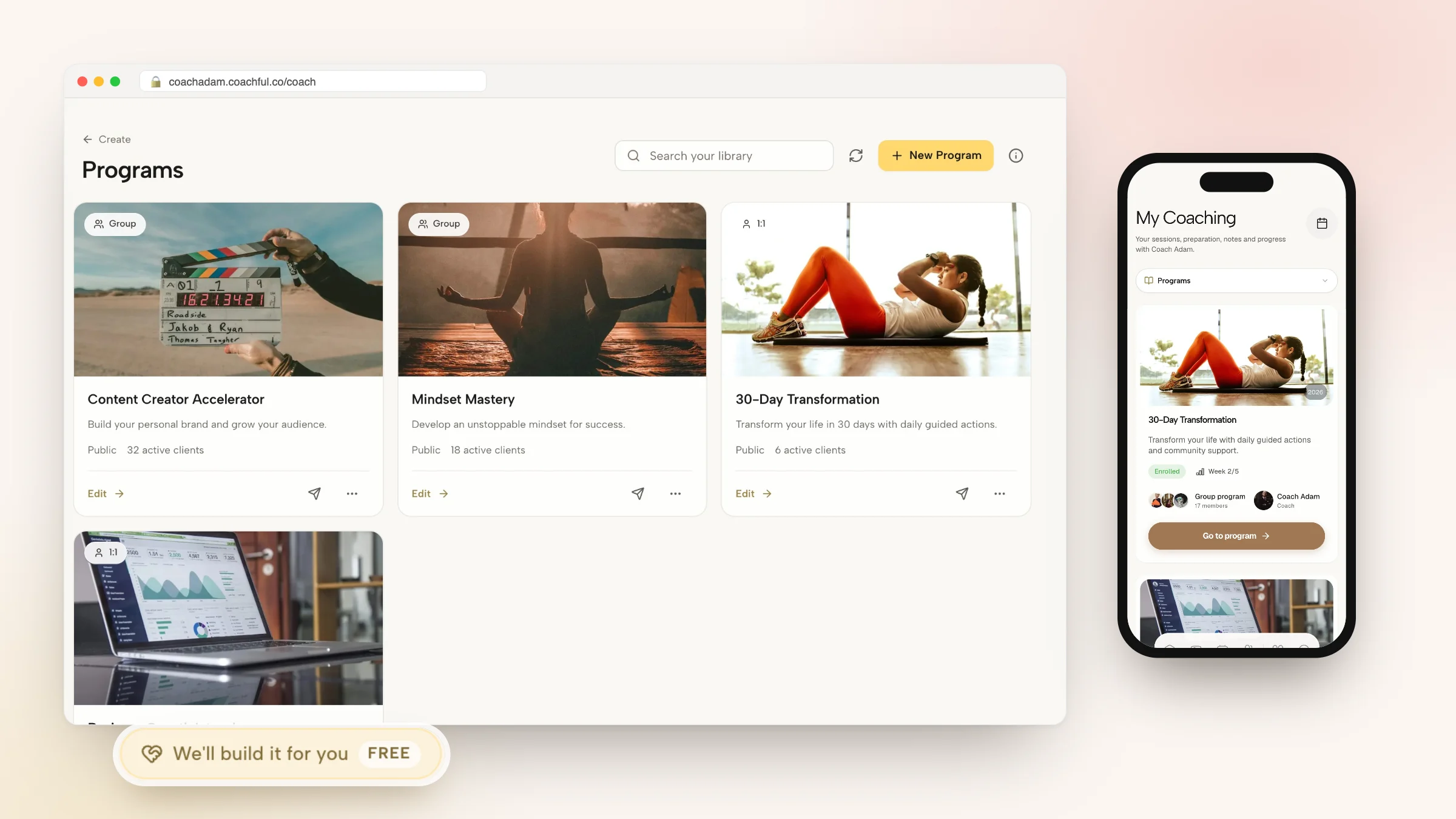
A twelve-week program maps cleanly onto Coachful's structure: three modules (one per phase), each spanning four weeks, with each week holding its tasks, habits, worksheets and resources. Check-ins can run on the days you choose, a journey can welcome new clients and send the week-one assessment, and clients follow along in the portal or the client app on iPhone and Android. The coaching program software page shows the structure in detail, and the program template gallery has more than 40 ready-to-film templates if you would rather adapt one.
Get the 12-week program built for free
Coachful's team will turn this template, with your topics, into a working program in your account. It is free on every Coachful plan and labelled FREE and Complimentary gift in the app.
Use the We'll build it for you · FREE chip at the top of the Create page, or the Want us to build your program? card at the bottom of your Programs list, which opens the form with Program already selected.

Describe what you want ("a 12 week coaching program in three phases for recently divorced clients, with a weekly check-in, a worksheet in weeks 1, 2, 5 and 9, and milestone reviews in weeks 4, 8 and 12"), who it is for and what it should achieve. Then attach your filled-in version of the table above, along with up to eight links and up to ten files in total: worksheets, slides, an assessment you use or a voice memo. Video files are not accepted. Use the last box for deadlines and anything to avoid.
The team replies by email with next steps, usually within around 24 hours. That is the usual turnaround, not a guaranteed deadline. All twelve weeks are built inside your account, so you can rename themes, move tasks between weeks or swap a worksheet later.
Recent requests have included a 12-week mentorship for a business mentor to beauty professionals, where the team built the sales page and checkout and a free start-up-guide funnel leading into it, and a year-long cohort program with an application form for a real-estate and money coach.
The team does not record your videos or audio, run sessions, design logos, manage ads or run ongoing marketing. Nothing is invented: no fake credentials, testimonials or prices, and anything missing is left for you to fill. The guide to the free white-glove service explains the rest.
Frequently asked questions
What should a 12 week coaching program include?
Three phases (foundation, build, integrate), a theme, session focus, client action and check-in question for each week, a baseline assessment repeated in weeks eight and twelve, one worksheet per week at most, a plan for setbacks around week seven, and a renewal conversation before the end.
How many sessions are in a 12 week coaching program?
Usually between six and twelve. Weekly sessions suit intense goals. Weekly in the first four weeks then every two weeks is a common middle ground, with written check-ins carrying the off weeks.
Is 12 weeks long enough for coaching to work?
For a single, well-defined goal, usually yes: it allows a baseline, several rounds of practice and adjustment, and a period of making the change hold. Bigger transitions may need a second program or an ongoing monthly arrangement afterwards.
How do you price a 12 week coaching program?
Price the result and the full time involved, then offer pay in full, three monthly payments aligned with the three phases, or a deposit plus balance. Avoid pricing it as twelve single sessions, which undervalues the structure and support.
Can Coachful build my 12 week coaching program for free?
Yes. On any Coachful plan, choose Program in the request form, describe the program and audience, and attach your outline, worksheets or a voice memo. The team replies by email, usually within around 24 hours, and builds the twelve weeks in your account.
What happens after a 12 week coaching program ends?
Ideally the client leaves with a one-page plan for the next 90 days and a clear choice: continue with a lighter monthly check-in, start a new program with a new goal, or finish. Raise the options in week ten or eleven, not in the final minutes.