How to Create a Coaching Program Clients Finish
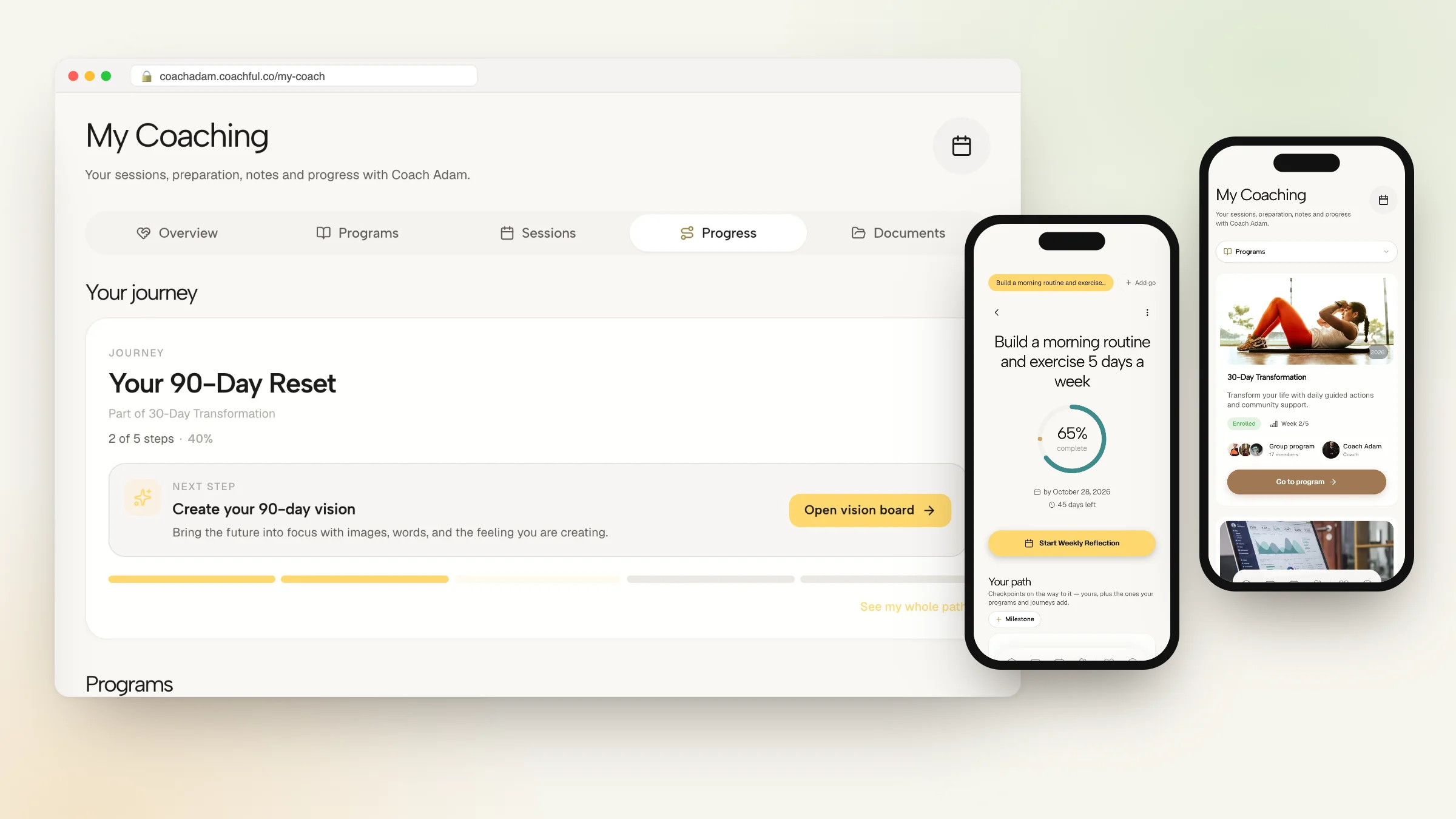
To learn how to create a coaching program, work through eight decisions in order: the outcome, the length, the path from week one to the end, the session rhythm, the work clients do between sessions, the price structure, the delivery setup and a small pilot. Skip one and the program usually breaks in that exact spot, which is why so many first programs turn into "a bundle of six calls" by week three.
This guide walks through each decision with examples you can copy, including a full six-week outline for one specific niche. If you would rather hand the build to someone else, Coachful's team will set the program up for you for free on any Coachful plan: you send an outline, notes or even a voice memo through a short form, and the weeks, tasks and worksheets appear in your account.
Either way, the thinking below is yours to do. Nobody can choose your client's result for you.
What a coaching program is, and what it is not
A coaching program is a fixed path to a named result, with coaching built in. It has a start, a sequence and an end. A package of sessions, by contrast, is time: six calls, use them as you like. Both are fine to sell. The difference shows up in the middle weeks, when a package client asks "what should we talk about today?" and a program client already knows, because week four is about the hard conversation with their manager.
Programs are easier to explain, easier to price above an hourly rate and easier to deliver to more than one person. They are harder to build, because you have to commit to an order of operations. That commitment is the product.
Step 1: Write the outcome as a sentence a client would say
Start with the sentence your ideal client would say at the end, in their words, not yours. "I have a morning routine I actually keep" beats "holistic morning optimization". Test it with three questions:
- Can they tell if it happened? "Feel more confident" is hard to verify. "Asked for the project I wanted" is easy.
- Is it reachable in the time you have? A six-week program can change a routine. It probably cannot change a career.
- Is it yours to deliver? Pick something your coaching influences directly, not a result that depends on the economy, a hiring manager's mood or a medical test.
Write the outcome on a sticky note and put it where you can see it. Every week, task and worksheet you add later has to earn its place against that sentence.
Step 2: Choose the length and the format
Length follows the outcome. A routine or a single skill fits in four to eight weeks. A transition (new role, new city, life after a divorce) usually needs three months or more. Many coaches settle on six, eight or twelve weeks because those lengths are easy to schedule and easy to explain. If you are torn between two formats, our guide on choosing an online coaching program format lays out the trade-offs in detail.
| Format | Works best when | Watch out for |
|---|---|---|
| 1:1 program | The work is personal or sensitive, and you have a few slots to fill | Your calendar caps your income |
| Group cohort | Clients benefit from hearing each other and you can gather people for one start date | Filling the first cohort |
| Hybrid | Group calls for teaching, a few 1:1 calls for the personal part | Two schedules to manage |
| Self-paced with check-ins | Clients mostly need structure and a nudge, less live time | Completion drops without a human touch |
Step 3: Map the path, week by week
Now break the outcome into stages. A useful shape for almost any short program is: understand where you are, decide what you want, practise the new behavior, then lock it in. Each week gets one theme, one session focus, one thing to do between sessions and one check-in question.
Here is a sample for a coach who works with parents going back to work after parental leave. The promise: "Six weeks from now I am back at work with a routine that holds, a clear conversation with my manager behind me, and evenings that are not a scramble."
| Week | Theme | Session focus | Between sessions | Check-in question |
|---|---|---|---|---|
| 1 | Where you are now | Map the week as it really runs, including the 6 a.m. chaos | Time log for three ordinary days | What took more energy than you expected? |
| 2 | What you want back | Name the two or three non-negotiables at work and at home | Values and priorities worksheet | Which one did you protect this week? |
| 3 | The manager conversation | Script and rehearse the return conversation: hours, flexibility, projects | Hold the conversation, note what was agreed | What did you ask for, and what did you get? |
| 4 | The morning and the pickup | Design the two pressure points of the day with your partner or support | Run the new routine for five days | Which day fell apart, and why? |
| 5 | Guilt, boundaries and energy | Work on the inner voice and one boundary that needs holding | One boundary practice, one evening off | Energy from 1 to 10, and what moved it |
| 6 | Lock it in | Review what worked, plan for the first sick-kid week, set a 90-day check | Write a one-page "my return plan" | What will you keep doing without me? |
Notice what is missing: there is no week of theory. Every week asks the client to change something real by the next session. If a week has no "between sessions" action, it is probably a lecture, and it can move into a short video or reading instead. If you want a deeper method for sequencing content, our piece on how to write a curriculum covers learning objectives and order.
Step 4: Set the session rhythm
The rhythm is what clients feel most. Three patterns cover most programs:
- Weekly 45 to 60 minute sessions. Good for short, intense programs like the one above. Clients keep momentum and you see problems early.
- Every two weeks, plus a written check-in in the off week. Good for longer programs where clients need time to practise. The check-in stops the gap from turning into silence.
- A kickoff, a midpoint and a close, with group calls in between. Good for hybrid programs and higher numbers of clients.
Decide session length on purpose. Our breakdown of 30, 45 or 60 minute coaching sessions helps if you are unsure. Put the first and last sessions in the calendar at sign-up, so the end date is real from day one.

Step 5: Add worksheets, check-ins and between-session work
Most of the change in a coaching program happens between calls. Plan three kinds of support:
- Worksheets for thinking that needs structure: a values sort, a time log, a conversation script. Keep each one to a single page or a few short questions. We cover layouts in our guide to coaching worksheets.
- Check-ins for momentum: a two-minute weekly form with a 1 to 10 scale, one win, one obstacle and one question for the next session. Read them before you meet and the session starts in the right place.
- Daily actions or habits where the outcome depends on repetition. Keep it to one or two at a time.
A good test: if a client only did the between-session work and skipped every call, would they still move toward the outcome? If yes, your program has a spine.

Step 6: Price the structure, not the hours
Price the result and the support around it, then sanity-check against your hours. A few structures that work for programs:
- One program fee, paid upfront, with an optional payment plan split into two or three parts that adds up to slightly more.
- A founding price for the first small group, in exchange for feedback and a testimonial if they are happy.
- Two tiers: the group version and a version with added 1:1 calls.
Work out your floor: the hours you will actually spend (sessions, prep, check-in replies, admin) times the hourly figure you need. The program price should clear that comfortably. For more on structuring tiers, read how to structure three coaching packages.

Step 7: Deliver it online in one place
Clients drop out when they have to hunt for things. Put the weeks, the session links, the worksheets and the check-ins in one place they can open on their phone. In Coachful, a program holds modules and weeks with tasks, habits, resources and worksheets, and each enrolled client sees the current week in their portal and in the client app on iPhone and Android. Group programs get a community feed and chat, and payments go to your own Stripe account with a 0% Coachful platform fee. See how the coaching program software fits together, or browse the more than 40 ready-to-film program templates such as The Life Reset or Habits That Stick if you want a starting skeleton.

From the client's side, the program shows where they are and what is next, with the coach and group alongside.

Step 8: Pilot it with three to five people
Run the first round small, at a founding price, and treat it as research. Ask the same three questions at the end of each week: what was useful, what was confusing, what did you skip. Rewrite the week that gets skipped most. Our guide to running a paid beta coaching program covers recruiting and feedback in more depth.

After the pilot you will have real words from real clients for the sales page, and a program that has already survived contact with people's actual weeks.
Mistakes that sink a first coaching program
- Too much content. Coaches cram everything they know into week one. Clients need one idea and one action per week, not twelve.
- No defined end. Without an end date and a closing session, programs drift into an expensive maybe. Put the last session in the calendar at the start.
- Homework nobody checks. If you never mention the worksheet, clients stop doing it by week two. Open each session with what they tried.
- A vague promise. "Transform your life" invites refund conversations. A concrete outcome invites referrals.
- Building the tech before selling. Sell three seats with an outline first. Build the polished version once people have said yes.
Let our team build your coaching program for free
If the steps above make sense but the setup does not appeal, our team will build the program in your Coachful account for free, on any plan. In the app it is labelled FREE and Complimentary gift.
There are two ways in. On the Create page, the first chip under "Unleash your creativity" is We'll build it for you · FREE. At the bottom of your Programs list there is a card called Want us to build your program? with a Fill in a form button. Opened from the Programs list, the form starts with Program already selected.

The form is short. You choose what to build (Program), then answer "What do you want it to be?" and "Who is it for, and what should it achieve?". You can paste up to eight links to examples you like, add notes, copy or offers to include, and upload up to ten files: your outline, an old workbook, slides, photos or a voice memo talking it through. Video files are not accepted. A last box asks about deadlines or anything to avoid.
The request goes to the Coachful team, who reply by email with next steps, usually within around 24 hours. That is a typical turnaround, not a guaranteed deadline. The program is built inside your own account, with weeks, tasks, worksheets and resources set up, so you can edit any of it afterwards in the normal program editor.
Recent requests show the range. For a real-estate and money coach, the team built a year-long cohort program with an application form, plus a free nine-day bootcamp course with its own signup funnel and emails. For a business mentor for beauty professionals, the job was a sales page and checkout for a 12-week mentorship, with a free guide funnel leading into it.
A few limits so nothing surprises you. The team does not record your videos or audio; if a program needs videos, you film them. The service does not include a private coaching call, logo design, ad management or ongoing marketing. And nothing gets invented: no fake credentials, testimonials or prices. Anything missing is left for you to fill in. The full guide to the free white-glove service lists everything the team can build.
If you write your outcome sentence and a rough week list today, you have already done the part that only you can do.
Frequently asked questions
How long should a coaching program be?
Long enough to reach the outcome and short enough to keep momentum. Most single-skill or routine programs fit in six to eight weeks, while transitions often need twelve weeks or more. Choose the outcome first, then count backwards how many weeks of practice it needs.
How many sessions should a coaching program include?
A common pattern is one session a week for short programs, or one every two weeks with written check-ins in between for longer ones. Add a kickoff and a closing session either way, and schedule both at sign-up so the program has a visible start and end.
What should be included in a coaching program?
A clear outcome, a week-by-week path, live sessions, worksheets for structured thinking, weekly check-ins, one or two daily actions where repetition matters, and a closing review. Group programs add a community space and group calls. Leave out anything that does not move the client toward the outcome.
How do I price a coaching program?
Price the result, then check it against the real hours you will spend, including prep and replies. Many coaches sell one program fee with an optional two or three part payment plan, and offer a founding price to the first small group in exchange for feedback.
Can someone build my coaching program for me?
Yes. On any Coachful plan, the team builds programs for free: pick Program in the request form under Create, describe the outcome and audience, and attach your outline, notes or a voice memo. They reply by email, usually within around 24 hours, and the program is built in your account for you to edit.
Do I need videos to run a coaching program?
No. Many programs run on live sessions, worksheets and check-ins alone. Short videos help when you repeat the same explanation to every client, but they are optional. If you do want them, you record them yourself and add them to the program weeks.