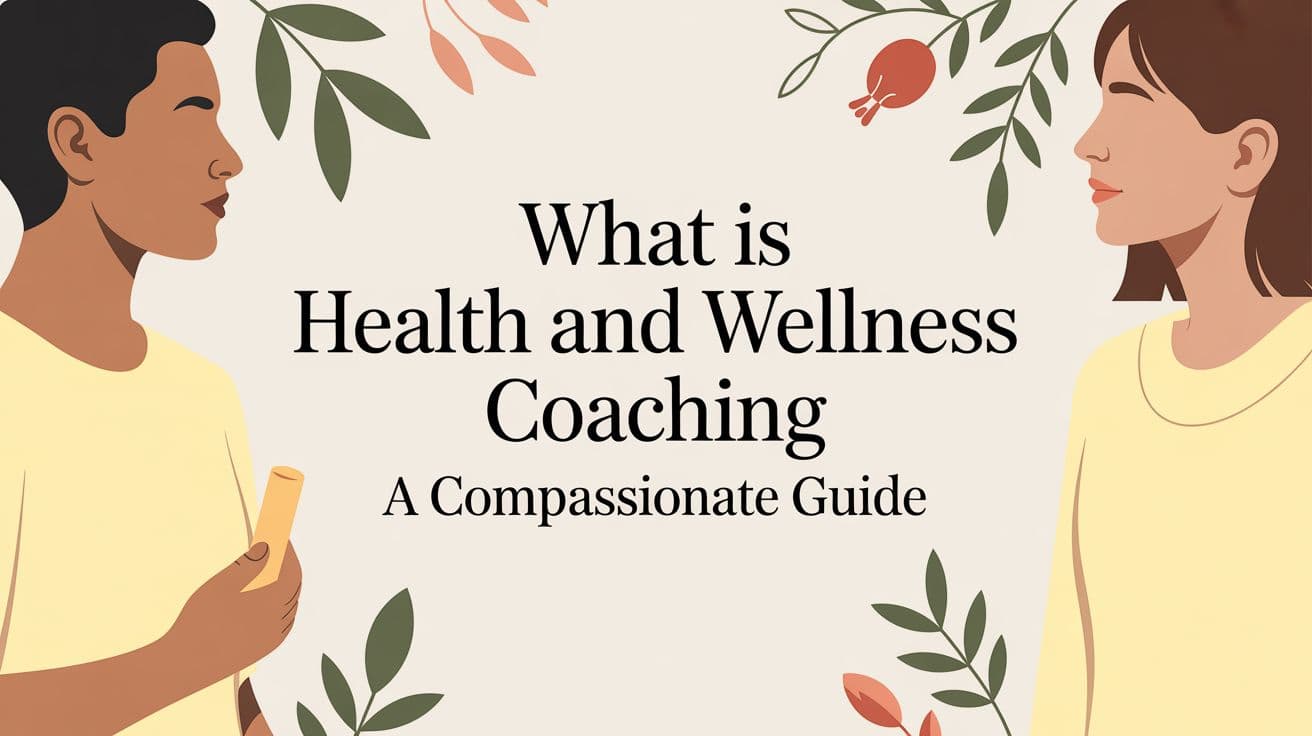
What Is Health and Wellness Coaching? A Compassionate Guide for Coaches and Clients

Coachful
You know that feeling? You’ve read the articles, you have the best intentions, and you know you should eat better, sleep more, or finally start that exercise routine. But there’s a massive, frustrating gap between knowing what to do and actually doing it consistently.
What is health and wellness coaching? It’s the bridge across that gap. It’s a powerful, client-led partnership that empowers you to turn good intentions into real, lasting change—without rigid plans or one-size-fits-all advice.
The True Meaning of Health and Wellness Coaching
Let’s get one thing straight: a health coach isn't there to hand you a meal plan and send you on your way. If you’re a coach yourself, you might be wrestling with that inner voice asking, "Am I just a cheerleader? A less-qualified trainer? What's my real value?" The answer is a resounding no. You are a behavior change specialist.
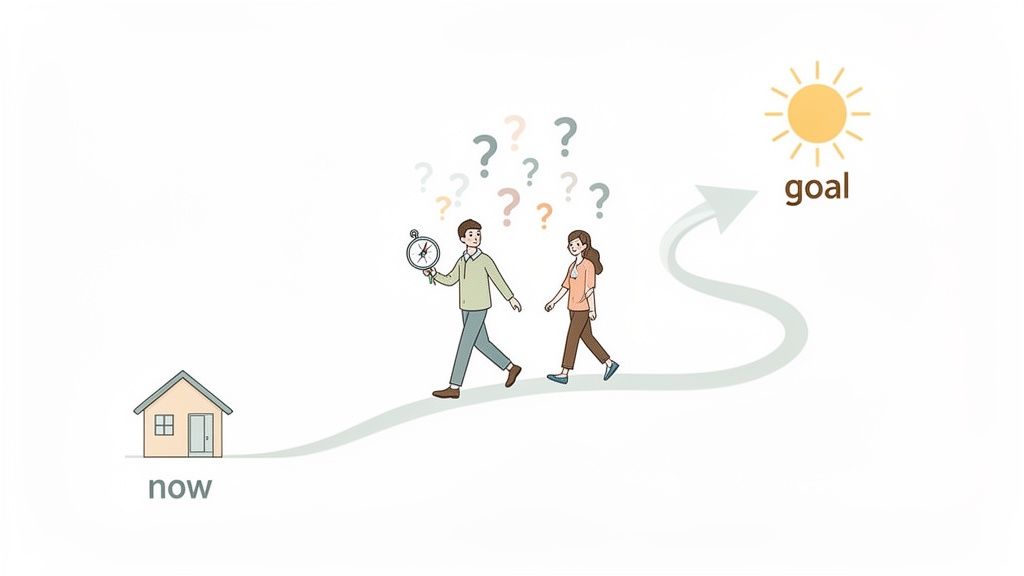
Think of a health coach as a skilled guide on a journey. They meet the client exactly where they are—no judgment—and help them map a clear path to where they truly want to be. The client remains the undisputed expert on their own life; the coach is the expert in the process of change itself.
A health coach operates on a simple but profound belief: you don't provide the answers; you help the client uncover their own. You focus on their "why"—the deep-seated, personal motivation that fuels commitment—not just the "what" and "how."
To get a quick overview of what this looks like in practice, here’s a simple breakdown.
Health Coaching at a Glance
| Component | What It Means for You (The Client) |
|---|---|
| Client-Led Partnership | You're in the driver's seat. Your goals, values, and pace set the agenda. |
| Focus on "Why" | We dig deep to find the personal motivation that makes change meaningful and sustainable. |
| Behavior Change Science | Coaches use proven methods to help you build habits that actually stick. |
| Holistic Perspective | It's not just about diet and exercise. We look at sleep, stress, relationships, and more. |
| Accountability & Support | Your coach is your dedicated partner, providing support without judgment. |
This table captures the essence of the coaching relationship—it's a supportive framework built entirely around the client.
Unlocking Your Client's Inner Wisdom
As a coach, your primary tools are powerful, open-ended questions that unlock a client's own insights. By creating a safe, non-judgmental space, you help people navigate the mental roadblocks that get in the way—things like self-doubt, procrastination, or all-or-nothing thinking.
For example, a client might say, "I failed again. I ate a whole pint of ice cream last night." Your inner critic might want to analyze the 'mistake.' But as a coach, you reframe it. You might ask, "Thank you for sharing that. What was going on in your day right before that moment? What need do you think the ice cream was meeting for you?" This shifts the focus from shame to self-awareness. It's how you might approach something like intuitive eating coaching, which is all about rebuilding trust with your body, not fighting against it.
This personalized approach is exactly why the field is booming. Valued at $18.6 billion in 2025, the global health coaching market is on a trajectory to nearly double by 2035. This incredible growth stems from a collective shift toward proactive and preventive health, and coaches are perfectly positioned to provide that personalized guidance.
Ultimately, great health coaching helps clients build unshakable self-trust and create a life that feels genuinely good from the inside out. For coaches looking to take this process to an even deeper level, our guide on what is transformational coaching explores how to facilitate profound shifts in a client's core beliefs and identity.
A Look Inside a Health Coaching Session
So, what actually happens in a health coaching session? If you're a new coach, you might be wrestling with your own questions. "How do I structure these sessions to get real results? What does a first meeting even look like compared to a fifth? What if I ask the wrong thing?" Let’s pull back the curtain on the entire process, from the initial hello to celebrating those hard-earned wins.
The Initial Discovery Session
The very first meeting is all about connection and exploration. This is not a "weigh-in" or a lecture. Think of it as a discovery session. Your number one goal as a coach is to build a foundation of trust and begin sketching out a picture of your client's desired future.
You'll guide the conversation with open-ended questions, digging into their personal health vision, their core values, and what "feeling well" truly means to them, on their own terms.
- A Client might say: "I just want to lose 20 pounds."
- The Coach asks: "That's a great starting point. Let's imagine you've lost those 20 pounds. What does your day look like? What are you doing? How do you feel in your body? What's possible for you then that isn't possible now?"
This initial chat lays the groundwork for a strong partnership. It’s the moment the client starts to feel like they’re in the driver's seat, with you riding shotgun as a supportive navigator.
Co-Creating Goals and Action Steps
Once you've established that connection, follow-up sessions pivot toward creating a plan together. This isn't about setting huge, overwhelming goals that are destined to fail. As a coach, you know the real magic happens when you focus on identifying small, achievable steps that build momentum and confidence.
A core principle of health and wellness coaching is breaking big dreams into bite-sized actions. If a client’s goal is to "get healthy," a coach helps them pinpoint what that looks like day-to-day. Does it mean a 15-minute walk after dinner? Or maybe just adding one green vegetable to their lunch?
These small victories are the true building blocks of lasting change. They prove to the client that progress isn't just possible—it's already happening. That’s a powerful motivator.
Navigating Obstacles with Empathy
Life is messy, and setbacks are a completely normal part of any journey. A huge part of a coach's job is handling these roadblocks not with judgment, but with curiosity and compassion.
Imagine a client who struggles with stress-eating. A non-coaching conversation might sound critical. But a coaching approach flips the script entirely.
- A Critical Voice: "Why did you eat that bag of chips? You know that's not on your plan."
- A Coaching Voice: "Let's explore that moment. What was going on for you right before you reached for the chips? When you feel that way again, what could support you differently?"
This empathetic, forward-looking method keeps your client engaged instead of feeling ashamed. It reframes a "failure" as a valuable learning opportunity, reinforcing that this is a journey of progress, not perfection. This client-centered focus is absolutely fundamental to effective coaching. For any coach looking to sharpen this skill, mastering the art of coaching goal setting is an essential part of the craft.
From reviewing progress to brainstorming creative solutions for new challenges, every single session is a team effort. The coach holds the space, asks thoughtful questions, and offers accountability. But it’s the client who always leads the way, building the self-reliance and skills they need to manage their own well-being for life.
How Coaching Differs From Therapy and Consulting
If you're a coach, you've probably asked yourself, "So, what exactly do I do? Am I a therapist? A consultant? A cheerleader?" It's one of the most common points of confusion, but getting clear on these lines isn't just about sounding professional—it’s the foundation of practicing ethically and showing clients your true value.
Think of it like this: a person's well-being is a complex project, and it often takes a team of specialists to get the job done right. A therapist, a consultant, and a coach all have critical roles, but you wouldn't hire an electrician to fix your plumbing. They aren't interchangeable.
Coaching Is Future-Focused and Action-Oriented
The biggest difference comes down to the timeline. Therapy often explores the past to heal. It’s essential for working through trauma, understanding how past events shape your present, and diagnosing clinical conditions like anxiety or depression. The goal is often to help someone move from a state of distress to a stable, functional baseline.
Health coaching starts from a different place. It's built for growth and is intensely focused on the future. A coach works with clients who are generally stable but want to move from "good" to "great." We're not asking, “Why are you stuck?” We’re asking, “Where do you want to go, and what’s one small step we can take today to get you there?”
This is all about building momentum toward a new vision for your health.
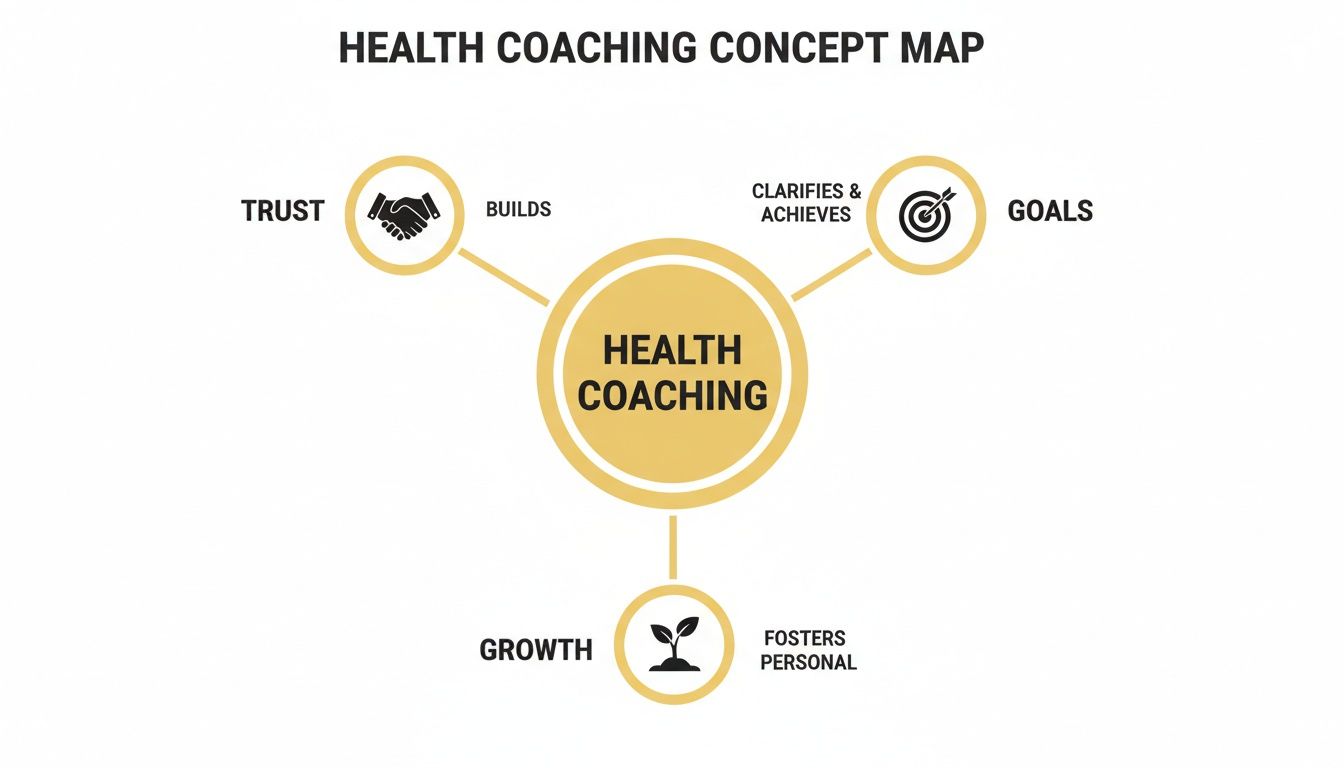
As you can see, it’s a forward-moving journey that starts with a strong partnership and builds toward real, tangible growth.
The 'How' Versus the 'What'
The line between coaching and consulting can also feel blurry. A consultant is an expert you hire for answers—the "what." A registered dietitian, for instance, might give a client a detailed meal plan based on their medical needs. They provide the expert solution.
A health coach, on the other hand, is the expert on the "how." The coach asks, "This is a great plan. What part feels most exciting to you? What part feels a little daunting? How can we make this fit into your real life, right now?" They step in to help that same client build the habits, mindset, and self-awareness to actually follow the meal plan, brainstorming strategies to make it stick this time.
To make these distinctions crystal clear, let's break them down side-by-side.
Coaching vs Other Professions: A Clear Comparison
This table breaks down the key differences between health coaching, therapy, consulting, and mentoring to clarify roles and responsibilities.
| Profession | Primary Focus | Core Question | Goal |
|---|---|---|---|
| Health Coaching | The future and action | "What do you want to achieve, and how will you get there?" | Empowerment and skill-building |
| Therapy | The past and healing | "How do your past experiences affect your present?" | Insight and healing from distress |
| Consulting | The problem and solutions | "What is the answer to this specific problem?" | Providing expert advice and answers |
| Mentoring | The career path and guidance | "How can my experience help you navigate your path?" | Sharing wisdom and guidance |
Seeing it laid out like this really highlights the unique and vital space that coaching occupies.
Here’s one final analogy to tie it all together:
- A Therapist is like a skilled mechanic who diagnoses and repairs a deep engine problem to get your car running safely again.
- A Consultant is the driving instructor who gives you the map and explains the rules of the road.
- A Coach is the trusted partner in the passenger seat, helping you find your own route, build your confidence on tricky highways, and ultimately become a masterful driver in your own right.
Once you truly grasp these boundaries, you can confidently explain what is health and wellness coaching and position yourself as the essential partner your clients need to achieve their goals.
The Core Principles That Drive Lasting Change
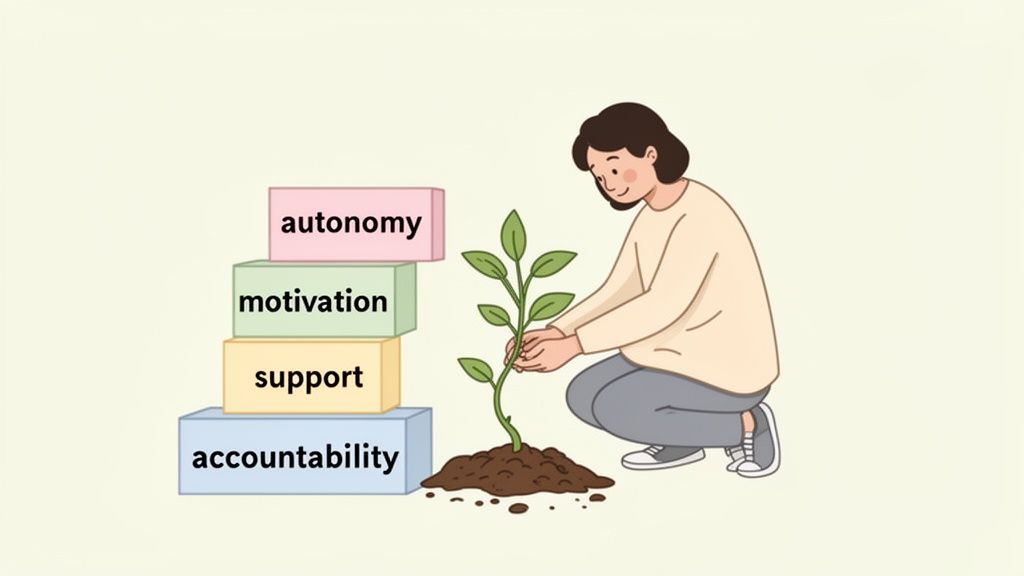
So, what makes health coaching work so well where other approaches fall flat? It’s not a magic formula. Instead, it’s built on a deep understanding of human psychology and a few key principles that completely reframe how we think about change. As a coach, your inner monologue might be, "But how do I make it stick? How do I actually motivate someone?" The secret is to stop trying to motivate them and instead help them find their own motivation.
A great coach doesn't just hand you a to-do list. Their real job is to create an environment where you can discover your own path forward, turning "shoulds" into "wants."
At the heart of health and wellness coaching is the concept of client autonomy. This means the client is always in the driver's seat. A coach's role isn't to push, but to partner—honoring the client's wisdom and right to choose their own goals and methods.
When you feel in control of your journey, something powerful clicks into place: intrinsic motivation. This is that deep, internal drive to change because you want it, not because someone is telling you to. It's the difference between grudgingly going to the gym for a week and building a fitness habit that lasts a lifetime.
Unlocking a Client's Inner Drive
So how does a coach tap into that inner fire? One of the most essential techniques is Motivational Interviewing (MI). Think of it as a conversational style that helps people talk themselves into making a change by exploring their own mixed feelings. It’s grounded in empathy, sidesteps arguments, and reinforces a person's belief that they can actually succeed.
For example, instead of a directive like, "You need to start exercising," a conversation using MI would sound very different:
- Coach: "On a scale of 1-10, how important is it for you to become more active right now?"
- Client: "Mmm, probably a 6."
- Coach: "Great. Why a 6 and not a 3 or 4?" (This invites them to state their own reasons for change).
- Coach: "Imagine you did become more active. What are some of the good things you might experience?"
This back-and-forth isn't about tricking someone; it's a collaborative way to help them resolve their own internal debates and commit to a plan that feels truly theirs.
From Pressure to Partnership
Another core idea is completely flipping the script on accountability. For most of us, accountability feels like pressure or the fear of being judged. A health coach transforms it into a compassionate, supportive partnership.
The focus is always on progress, not perfection. If a client hits a roadblock—and everyone does—a coach doesn't see it as a failure. They see it as a learning opportunity. The goal is to help your client turn their inner critic into their biggest cheerleader, celebrating the small wins that build momentum and resilience for the long journey ahead.
This unique, supportive model is a huge reason why the global coaching industry is now valued at $5.34 billion. With a recent McKinsey study revealing that 82% of consumers now view wellness as a top life priority, the demand for skilled coaches who can guide this kind of meaningful change is soaring. You can dive deeper into the data and see why coaching has become a key part of the modern wellness economy.
The Rise of Digital Health Coaching in 2026
As coaching has moved online, a big question often pops into a coach's mind: "Can I really forge a deep, meaningful connection with someone through a screen? Is online coaching just a less effective version of the real thing?"
The answer we're seeing in the industry is a resounding "no." Not only does digital coaching work, but it also unlocks incredible advantages. It tears down geographical walls, giving you the freedom to scale your practice and connect with clients who need your specific expertise, no matter where they live.
From Chaos to Cohesion
If you're a coach, you know the daily juggle. You’ve got Zoom for your video calls, Calendly for scheduling, PayPal to handle payments, and maybe even WhatsApp for those quick check-in messages. This patchwork of tools gets the job done, but it's clunky, time-consuming, and can feel a bit unprofessional for your clients.
This is exactly the problem that modern coaching platforms were built to solve. They’re designed to pull all those scattered pieces of your business into one cohesive, branded home.
An all-in-one system means you can manage your scheduling, payments, secure video sessions, and client messages from a single dashboard. It automates the tedious back-end work so you can pour your energy into what you do best—delivering a personal, high-impact experience for every client.
This shift toward integrated platforms isn't just a matter of convenience; it’s a response to a huge market trend. The digital health coaching space is exploding, projected to grow from $12.27 billion in 2025 to an incredible $41.18 billion by 2035. This growth is driven by clients who want and expect on-demand support. By automating administrative tasks, a good platform can cut down your back-end work by 30-50%, giving that time back to you for actual coaching. You can dive deeper into the rapid expansion of digital health coaching on Insightace Analytic.
Creating Connection in a Digital Space
But what about that personal touch? It's the heart of coaching, after all. A coach might worry, "Will this feel cold and impersonal?" But the right platform can actually help you build a stronger coach-client relationship. By giving your work a dedicated, private container, you create a focused space for growth.
This kind of structured environment makes it so much easier to:
- Share resources and notes immediately after a call to reinforce a breakthrough moment.
- Track goals and habits visually, letting clients see their own progress in black and white.
- Send secure messages for quick accountability check-ins and support between sessions.
When the technology handles the administrative heavy lifting, you're free to focus on the truly human side of coaching—listening deeply, asking powerful questions, and building the trust that makes real change possible. If you're thinking about streamlining your own practice, our guide to the best online coaching platforms is a great place to start looking for the right fit.
Common Questions About Health and Wellness Coaching
As you start to unpack what health and wellness coaching is all about, questions are bound to pop up. Whether you're thinking about becoming a coach or hiring one, practical concerns are probably on your mind. For a new coach, the inner monologue might be, "Do I have what it takes? How can I possibly explain this value to someone who’s skeptical?" For a potential client, it’s often, "Is this just another wellness fad? Will it actually work for me?" Let's tackle those questions head-on.
What Qualifications Should a Health Coach Have?
This is, without a doubt, one of the most important questions. While the health coaching industry isn't as tightly regulated as medicine or therapy, a coach's credibility is everything. The best coaches have invested in certifications from reputable, independent organizations.
The National Board for Health & Wellness Coaching (NBHWC) is widely seen as the gold standard in the field. A National Board Certified Health & Wellness Coach (NBC-HWC) has gone through an approved, intensive training program, logged a significant number of coaching hours, and passed a challenging board exam.
This certification is your assurance that a coach understands the core principles of behavior change, motivational interviewing, and professional ethics. When you see those credentials, you know you’re working with someone who is deeply committed to their craft.
For coaches themselves, getting certified isn't just about adding letters after your name. It's about confidence. It's the proof that silences the imposter syndrome and confirms you have the skills to practice safely and effectively. It's a powerful signal to clients and other healthcare professionals that you are dedicated to upholding the highest standards.
How Long Does It Take to See Results?
Everyone wants a timeline, but health coaching is a journey, not a sprint. Think of it like planting a garden. You wouldn't sow seeds on Monday and expect a full harvest by Friday. It takes time for roots to deepen and for real growth to happen. The entire point is to create sustainable, lasting change, not a temporary fix.
Most coaching relationships last for a minimum of 3 to 6 months. This timeframe gives you and your coach enough room to:
- Build a solid foundation of trust.
- Dig deep to uncover what truly motivates you.
- Experiment with and establish new habits that actually stick.
- Learn how to navigate setbacks with confidence and resilience.
The results show up gradually. At first, a client might just notice small shifts—a little more energy in the afternoon, sleeping through the night, or a more optimistic mindset. Over time, these small wins build on each other, creating significant, life-altering transformation.
Can a Health Coach Help with Medical Conditions?
Yes, absolutely—but it’s critical to understand their specific role. A health coach does not diagnose, treat, or prescribe for any medical condition. They are not a substitute for your doctor, registered dietitian, or therapist.
Think of your health coach as the implementation specialist on your healthcare team. They bridge the gap between your doctor's advice and your daily life.
- Doctor's Advice: "You need to reduce your stress and eat a more balanced diet."
- Coach's Support: "Let's brainstorm some stress-reduction techniques that you could actually fit into your busy day. What’s one small, easy tweak we can make to your lunch this week that you’d actually enjoy?"
As a coach, your role is to honor the medical plan and empower the client to follow it. You help them build the daily habits—mindful eating, consistent movement, better sleep—that make their doctor’s treatment plan feel achievable and sustainable.
Is Health Coaching a Worthwhile Investment?
When you look at the cost, it’s easy to view it as just another expense. A better way to frame it is as an investment in your long-term health and vitality. By giving you the tools to build healthy habits and manage stress, coaching can help prevent or lessen the impact of costly chronic diseases down the road.
Even more importantly, it gives you back a sense of control over your own life. The self-awareness and confidence you gain are assets you'll carry with you forever. Of course, for aspiring coaches, building a practice goes beyond the coaching itself. Understanding effective Marketing for Coaches is a crucial next step to find clients and share your valuable expertise with the world.
Ready to stop juggling tools and start focusing on your clients? Coachful provides a single, professional platform to manage your entire coaching practice, from scheduling and payments to client progress tracking. Discover how Coachful can help you grow your business.