Best Coaching Communities for Executive Coaches in 2026
The best communities for executive coaches give you three things a general coaching group cannot: supervision for work you can never discuss in detail, peers who understand corporate buyers and procurement, and credentials that survive a sponsor's due diligence. Executive coaching is confidential by contract, often three-way, and frequently bought by people who will never sit in a session. That changes what you need from a community.
We compared nine communities for executive coaches on those needs, from accreditation bodies with strict supervision requirements to a monthly peer advisory group and the private community inside Coachful. Each entry covers who it suits, what stands out, where it falls short, and when to pick it over our first choice.
And when your peers tell you your website reads like a life coach's rather than a senior advisor's, Coachful's team will rebuild it for free inside your account. Details in the first entry.
What executive coaches need from a community
| Executive coaching reality | What the community has to provide |
|---|---|
| Sessions are confidential, sponsors want progress | Supervision or a peer case group where you can think through three-way contracting and what to report, without breaking confidence |
| Buyers are HR, talent and procurement teams | Peers who know how corporate buying works: frameworks, panels, credential checks, rate cards |
| Credentials are screened | An accreditation buyers recognize, often ICF PCC or MCC, EMCC or APECS |
| Work often arrives through associate networks | Relationships with firms and coaches who subcontract engagements |
| Clients are senior and isolated | A place to process heavy material: restructurings, board conflict, burnout at the top |
| Assessments and evidence matter | Access to research and other coaches certified in the tools you use |
If your engagements involve sponsors, our guide to stakeholder alignment meetings is worth reading before you bring a contracting question to any group, and our explainer on coaching supervision sets out what supervision is and is not.
How we chose these communities for executive coaches
Our criteria, in order: specific, confidential help with live practice and business questions, supervision and reflective practice, credibility with corporate buyers, and access to research and senior peers.
We ranked in that order, so a room you will use every week sits above a body you will deal with once a year. Each organization was checked on its own website in October 2026; we quote only figures they publish and no prices.
Communities for executive coaches compared
| Community | Best for | Supervision angle | Buyer credibility |
|---|---|---|---|
| 1. Coach Corner (Coachful) | Weekly business and practice questions | Peer support, not formal supervision | None directly |
| 2. ICF Executive and Leadership community | Specialty learning and PCC or MCC credentials | A Coaching Supervision Community of Practice | High |
| 3. EMCC Global | Accreditation, supervision and team coaching | Supervisor accreditation and a Supervision Centre for Excellence | High, especially in Europe |
| 4. APECS | Executive coach accreditation built on supervision | Requires ongoing supervision | High in the UK |
| 5. Association of Corporate Executive Coaches | A monthly peer advisory group | Confidential peer group | Its own credential ladder |
| 6. Institute of Coaching | Research and leadership coaching evidence | Peer sessions on tricky cases | Research credibility |
| 7. A supervision group | Reflective practice on real cases | Formal | Expected by many buyers |
| 8. Associate networks | Engagements from established firms | Varies by firm | Through the firm's brand |
| 9. GSAEC | Coaches with academic training | Communities of practice for coach educators | Academic standards |
1. Coach Corner: the best community for executive coaches' weekly questions
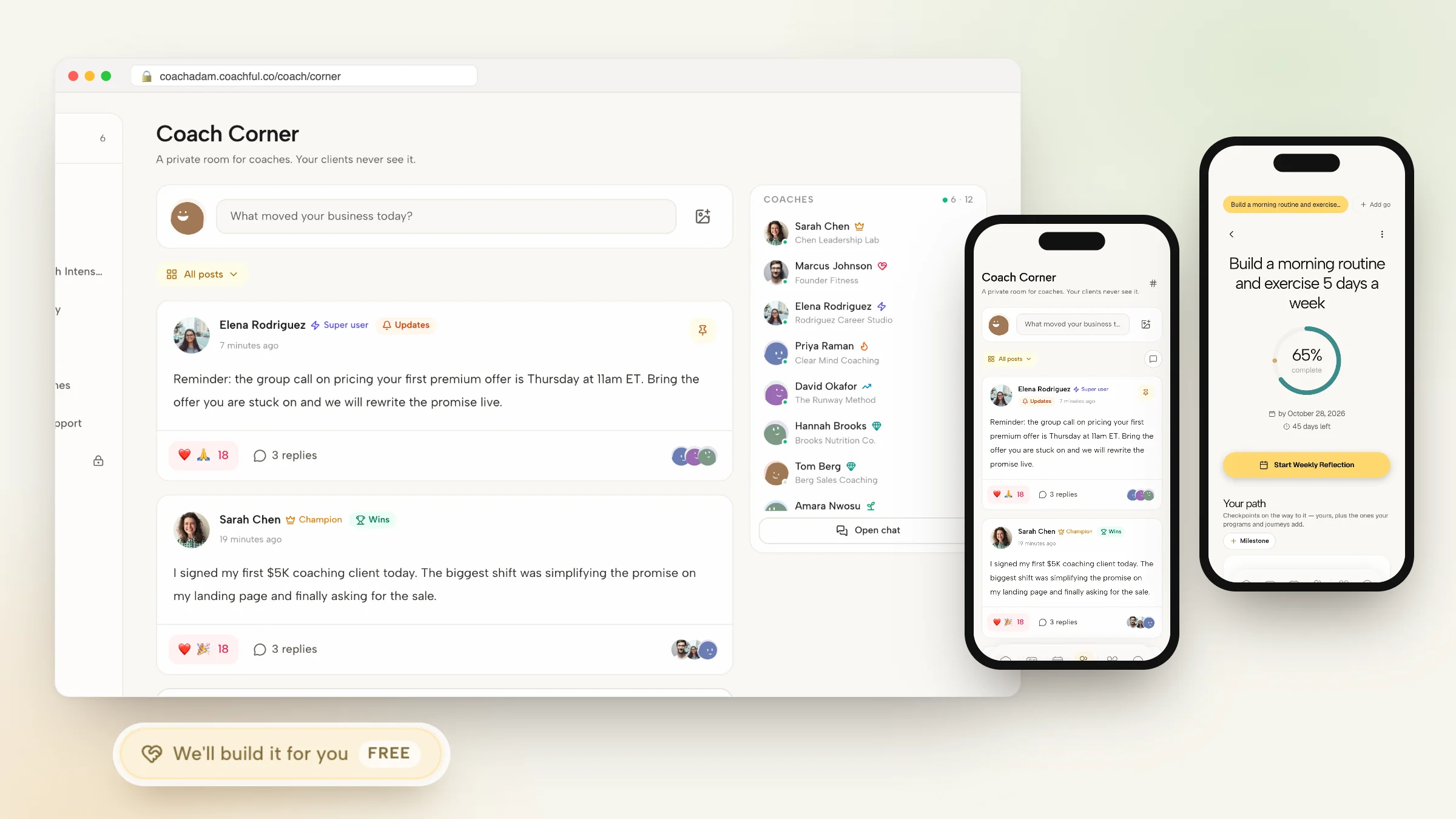
Coach Corner is the private community for coaches inside Coachful, included with every Coachful plan. You open it from Community in the coach menu, and it is coaches only: your clients and their sponsors never see it. For executive coaches, that privacy is the price of entry for any community worth using.

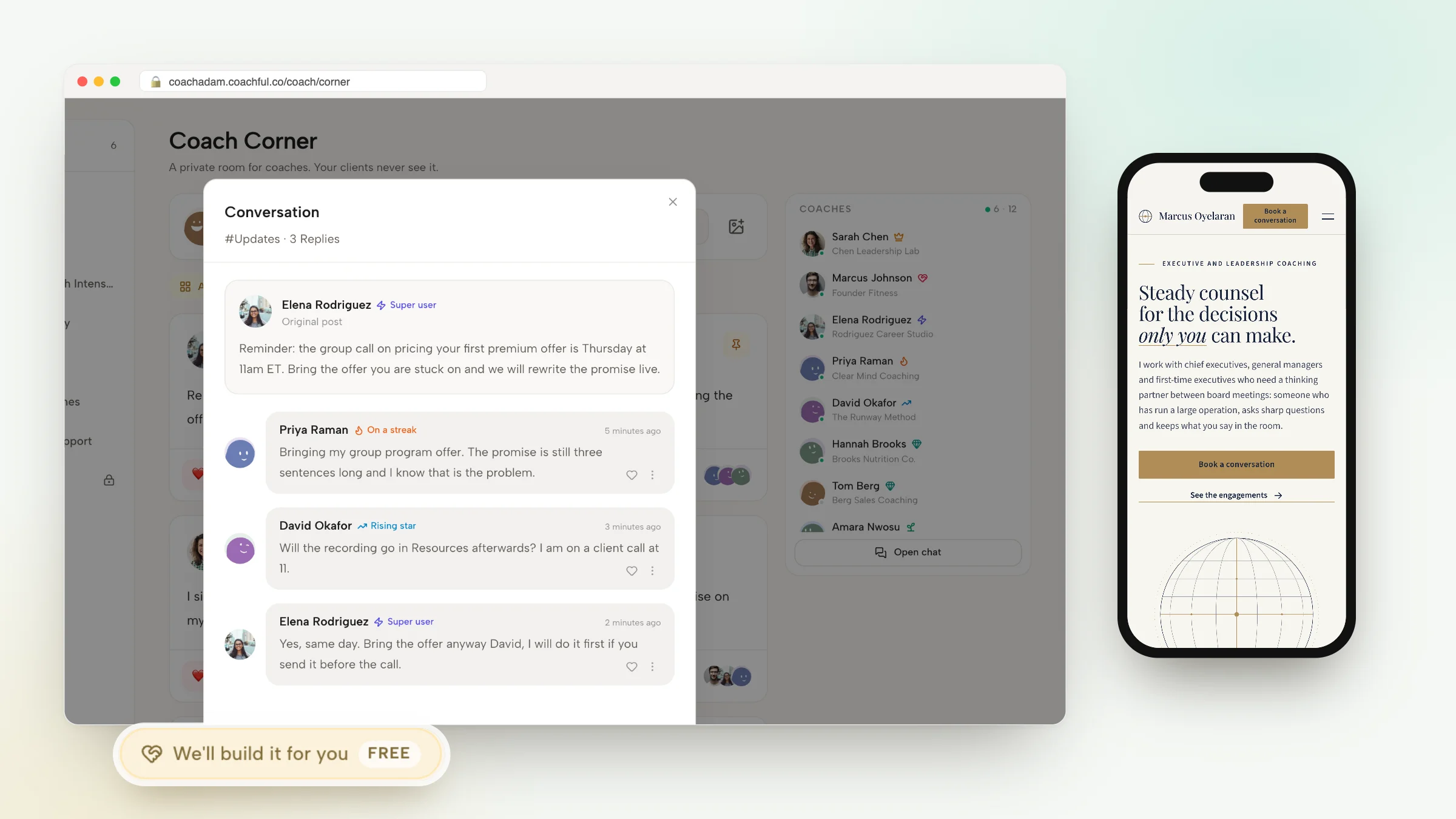
Executive coaches tend to use it for the business questions that do not need a supervisor but do need a peer. How do you price a six-month engagement with a sponsor check-in at the midpoint? What goes in the progress note to HR? How many discovery calls a week before quality drops? In the demo community, a sample coach who runs a leadership coaching business holds the Champion badge. When she shares a win, another coach asks to see her offer before and after, and she posts both: a generic promise to ambitious managers, then a specific promotion outcome with a timeframe. A third coach replies that the second line is the whole lesson.
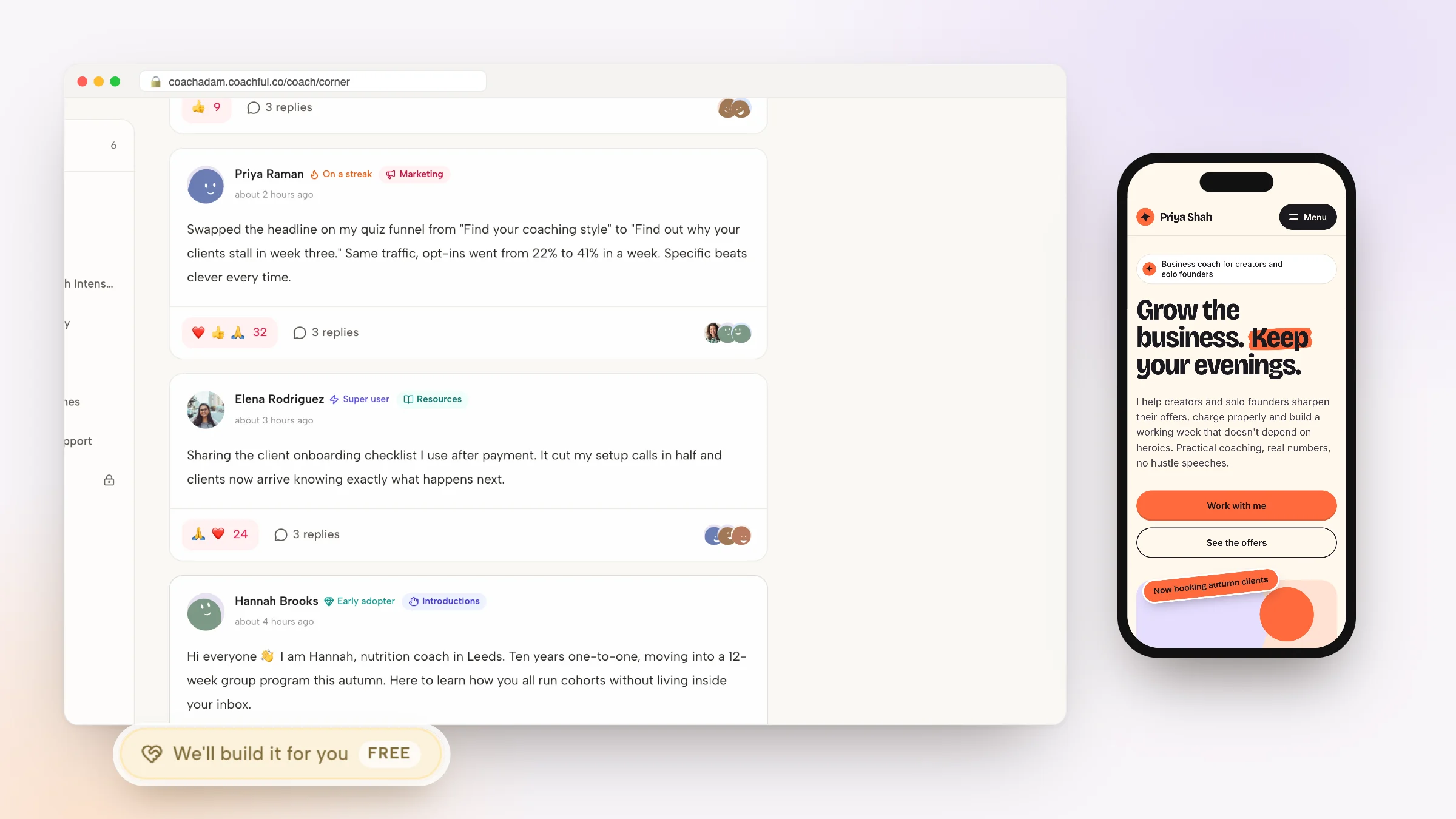
Channels keep it organized (Questions, Marketing, Resources, Wins, Product and more), and the Engage menu adds a Poll, a Q&A with an accepted answer, a Commitment and an anonymous Pulse, which is useful when you want honest numbers on rates or utilization without anyone attaching their name. The coaches list shows each coach's business, and you can message a coach privately when a question is too sensitive for a thread.

Badges are earned automatically, not bought: Champion for the coaches doing the most for the room, Welcomer for those whose replies and welcomes far outweigh their own posts, and others such as Rising star and Super user. Senior coaches who mentor informally tend to end up with them, which makes it easy to see whose advice the room values.
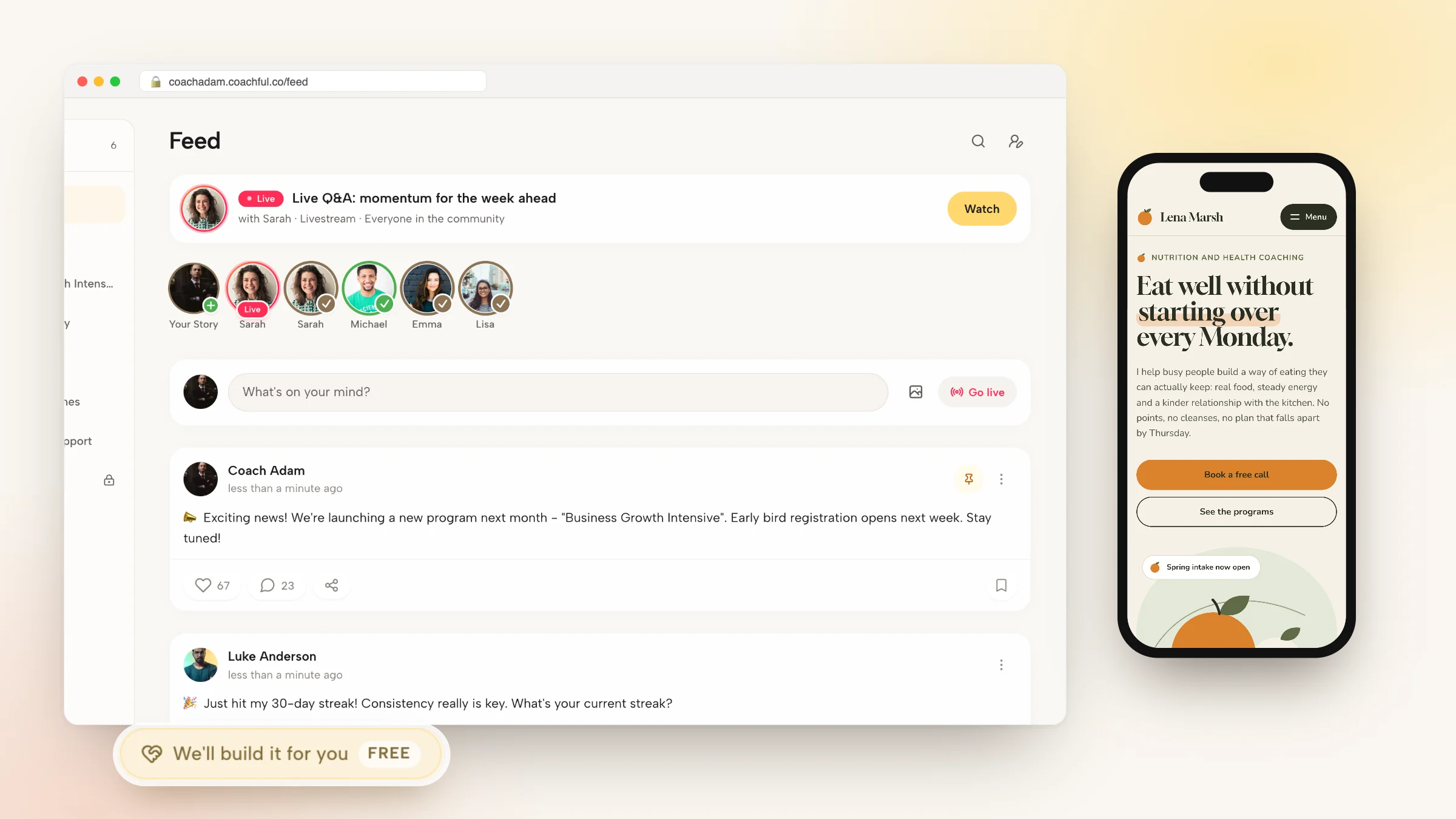
Why Coachful stands out: a free white-glove service. Executive coaches are often judged on their website before anyone reads their bio. On every Coachful plan, Coachful's team builds what you need inside your account, usually within about 24 hours: an understated website for senior buyers with engagements, approach and a "book a conversation" path, an application or enquiry funnel, an engagement program, or an intake questionnaire. You fill in a short form and attach up to eight links and ten files; nothing is invented, so no fake client logos or credentials. See the free white-glove service.

Best for: executive coaches who want a private, practical room for weekly business and practice questions. Where it falls short: it is a cross-niche peer community, not supervision and not an accrediting body. Pick something else if you need formal supervision or an accreditation for a buyer's panel; add one of the next four. Coachful's own features for this niche are on the Coachful for executive coaches page.
2. The ICF's Executive and Leadership community and credentials
The International Coaching Federation organizes Communities of Practice by specialty, including Executive and Leadership, Team and Group, Internal coaching and Coaching Supervision, and anyone can attend their webinars. Members also get a chapter (the ICF lists over 140) and the ICF Engage online community. The bigger reason executive coaches join is the credential. Buyers and delivery partners screen for it; the Center for Creative Leadership's coach application, for example, asks for an active ICF PCC or MCC, or an EMCC credential. See the International Coaching Federation.

Best for: executive coaches selling to organizations. Where it falls short: large and general; peer depth depends on your chapter. Pick it over Coach Corner if your next engagement depends on a credential. Our comparison of ACC, PCC and MCC explains the levels.
3. EMCC Global
EMCC Global is a not-for-profit body for coaching, mentoring and supervision with 29 affiliated countries and regions. Executive coaches value two parts of it. Its supervision work includes a supervisor accreditation (ESIA, which asks for 120 hours of supervising others) and a Supervision Centre for Excellence. Its team coaching accreditation (ITCA) runs from Foundation to Master Practitioner, which matters as more engagements include the leader's team. Members can also join The Conversation Space, its online community.
Best for: executive and team coaches in Europe, and coaches moving into supervision. Where it falls short: it publishes nothing specific to executive coaching as a business. Pick it over Coach Corner if your buyers recognize EMCC accreditation.
4. Association for Professional Executive Coaching and Supervision (APECS)
APECS is a UK not-for-profit and accreditation body for executive coaches, team coaches and supervisors, with an approach that puts "less focus on competencies and hours". Supervision is built in: executive coach applicants need at least twelve months of supervision with the same qualified supervisor, and continuous use of supervision afterwards. Its community events include masterclasses, community gatherings, learning circles and group supervision.
Best for: experienced executive coaches who see supervision as central to the work. Where it falls short: demanding entry requirements, and strongest in the UK. Pick it over Coach Corner if you want an accreditation that signals reflective depth rather than logged hours.
5. Association of Corporate Executive Coaches (ACEC)
ACEC aims to establish corporate executive coaching as a recognized profession and runs a credential ladder of its own, from Associate Executive Coach to Master Corporate Executive Coach, with experience thresholds for each. Its most community-like offer is a monthly Peer Advisory Group, which it describes as "a confidential setting where candor is the norm", alongside monthly masterclasses, weekly professional development classes, mentoring and a member directory.
Best for: executive coaches who want a small, confidential peer group of corporate specialists. Where it falls short: buyers may know its credentials less well than the ICF's. Pick it over Coach Corner if you want a structured monthly peer advisory format.
6. Institute of Coaching (IOC)
The Institute of Coaching, based at McLean Hospital (an affiliate of Harvard Medical School), is where evidence-minded executive coaches go. It runs the annual Coaching in Leadership and Healthcare conference, a Leadership Forum for Fellows and Full Members, "When Coaching Gets Tricky" peer sessions, discussion groups and a large research library. Full membership is for experienced coaches, and the Professional Fellow tier requires an application.
Best for: coaches whose buyers want evidence. Where it falls short: academic in tone. Pick it over Coach Corner if research credibility wins your engagements.
7. A supervision group
Many experienced executive coaches meet a trained supervisor regularly, one-to-one or in a small group, to reflect on live cases: the client who wants you to take sides against their CEO, the sponsor who asks for more than the contract allows, the session that left you uneasy. Some accreditation bodies require it, APECS among them, and some buyers ask about it. Ask your professional body for a supervisor directory, or find a group through peers.
Best for: ethical judgment and resilience. Where it falls short: it is not a business forum. Pick it over Coach Corner if the hard part of your week is the casework, not the marketing.

8. Associate networks and delivery partners
A lot of executive coaching is delivered through firms that subcontract to independent coaches, and their networks are communities in their own right. Entry can be demanding. The Center for Creative Leadership, for example, lists a coach application asking for seven or more years of executive coaching experience, an active ICF PCC or MCC or EMCC credential and a postgraduate degree; you can read its requirements on the Center for Creative Leadership's site. Others, such as 100 Coaches, co-founded by Scott Osman and Marshall Goldsmith, pair a community of coaches and leadership experts with an agency that serves corporate buyers.
Best for: steady engagements without doing all your own selling. Where it falls short: you work under someone else's brand and rates. Pick it over Coach Corner if you want work from established buyers. If you run associates yourself, our guide to associate coach revenue share covers the terms.
9. Graduate School Alliance for Education in Coaching (GSAEC)
GSAEC works to "define, advance and sustain graduate-level research and education in coaching globally". Individual membership is for coach educators and coaches with formal academic training in coaching, and it runs an annual international conference and a monthly Coach Educator Community of Practice.
Best for: executive coaches with a master's in coaching, or those who teach. Where it falls short: narrow membership. Pick it over Coach Corner if academic standards are central to your positioning.
How to use communities without breaking confidentiality
Executive coaches carry information that could move careers and share prices, so the rules are stricter than in most niches. Never name the client, the company or the sponsor. Change the industry and the size of the team if they would identify someone. Ask about the pattern ("a CEO wants a progress report beyond our contract") rather than the person. Keep the deeper casework for supervision. And check your coaching agreement says how you use supervision, so your clients know their material may be discussed anonymously with a supervisor.

If you also run leadership cohorts, a private client community lets participants keep working between sessions. Coachful includes one, separate from Coach Corner; see the community platform for coaches and our guide to creating an online coaching community. For the wider landscape, read the best online coaching communities and our guide to the coaching community.
Frequently asked questions
What is the best community for executive coaches?
Most executive coaches combine three: a private peer community for weekly business questions, such as Coach Corner inside Coachful; a body whose accreditation buyers recognize, such as the ICF, EMCC Global or APECS; and supervision for casework. The mix matters more than any single choice.
Do executive coaches need supervision?
It is not legally required, but it is part of good practice. APECS builds ongoing supervision into its executive coach accreditation, EMCC Global accredits supervisors, and the ICF runs a Coaching Supervision Community of Practice. Supervision protects your clients, your judgment and your own wellbeing.
Which credential do corporate buyers ask executive coaches for?
Commonly an ICF credential at PCC or MCC level, or an EMCC or APECS accreditation. Delivery partners set their own bar: the Center for Creative Leadership's coach application asks for an active ICF PCC or MCC or EMCC credential, years of executive coaching experience and a postgraduate degree.
How do executive coaches find associate work?
Through leadership development firms, coaching providers and other coaches who subcontract engagements. Relationships formed in professional bodies and peer communities lead to many introductions. Expect application processes, credential checks and the firm's own rates and brand.
Can I discuss executive clients in an online coaching community?
Only anonymously and only in a private, coaches-only space. Remove names, companies and identifying details, and keep detailed casework for supervision. Coach Corner is closed to clients, but the confidentiality obligation is still yours.
Will Coachful build an executive coaching website for free?
Yes. The white-glove build is free on every Coachful plan. You describe the pages and the path you want senior buyers to take, attach links and files, and the team builds it in your account, usually within about 24 hours. That is not a guaranteed deadline, and Coachful itself is a paid membership.