
SMART Goals Template: Copy It, Fill It In, Track It Weekly
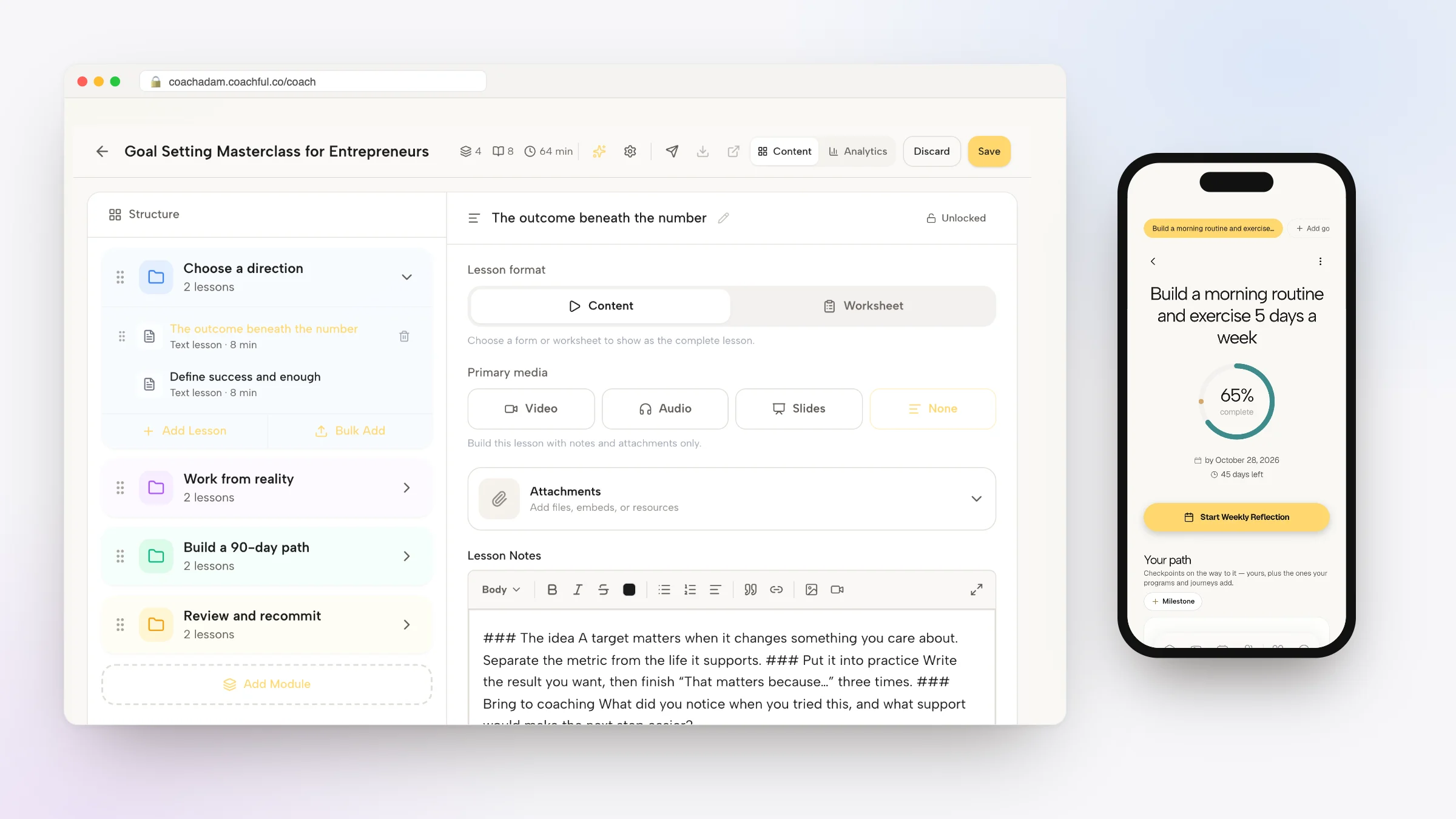
A SMART goals template is a one-page form that walks a vague goal through five tests (Specific, Measurable, Achievable, Relevant and Time-bound) and ends with a single goal statement, a first step and a review date. Below is a SMART goals template you can copy, a fill-in-the-blanks goal formula, three filled-in examples, a 12-week tracker to go with it and the mistakes that make SMART goals fail.
If you'd rather fill it in on screen, our free SMART goal worksheet builder takes you through the same prompts and lets you copy or print the result. Coaches who want this template inside their clients' app can have Coachful's team build it in their account for free.
The SMART goals template
Copy this table into a document, a notebook or a spreadsheet. Fill it in from top to bottom; the order matters, because each line depends on the one before.
| Section | Prompt | Your answer |
|---|---|---|
| Starting goal | Write the goal in one line, however vague. | |
| Specific | What exactly will be different? Who is involved? What does "done" look like? | |
| Measurable | What number, evidence or moment proves it's done? What's the starting number today? | |
| Achievable | What makes this realistic: time per week, skills, money, support? How confident are you, 0 to 10? | |
| Relevant | Why this, and why now? Which bigger goal or value does it serve? | |
| Time-bound | What's the deadline? What are the checkpoints on the way? | |
| SMART goal statement | Rewrite the goal using the formula below. | |
| Weekly actions | What will you do every week that leads to the result? | |
| First step | What's the first action, and when exactly will you do it? | |
| Obstacle and plan | What's most likely to get in the way? If that happens, then I will... | |
| Support | Who will you tell, and how will they know how you're doing? | |
| Review date | When will you check progress and adjust? |
The last five rows aren't part of the original acronym, and they're the reason this template works better than a bare SMART checklist. A goal can be perfectly SMART and still never start.
The SMART goal formula
Once you've filled in the five letters, compress them into one sentence:
By [date], I will [specific result], measured by [number or evidence], by [weekly actions], because [reason it matters].
For example: "By March 31, I will run a 5K without stopping, measured by a timed run on the local park route, by running three times a week following a beginner plan, because I want to keep up with my kids on weekends."
If the sentence feels clunky, that's fine. It's a working document, not a slogan.

How to fill in each part of the template
Specific
Name the result, not the effort. "Get fit" is an intention. "Run 5K without stopping" is a result. A useful test: could a stranger tell, from your sentence alone, whether you'd done it?
Measurable
Write the starting number next to the target: "from 0 to 5 paying clients", "from 2 runs a month to 12". If the outcome isn't a number, define the evidence: "a signed offer letter", "a finished first draft of 40,000 words". Avoid measures you can't see until the deadline. Add a weekly number you can track along the way.
Achievable
This is the letter most people get wrong, in both directions. A goal that needs twenty hours a week from someone who has five will fail. But "achievable" doesn't mean easy. Goal-setting research is clear that harder goals, as long as they're within your ability and you're committed to them, lead to more effort and better results than easy ones (more on that below). Use the 0 to 10 confidence score: if you're below 6, shrink the goal or extend the deadline. If you're at 10, it may be too easy to change anything.
Relevant
Write the real reason, the one you'd say to a close friend. "Because my doctor said so" is weaker than "because I want to be able to hike with my daughter next summer." If you can't find a reason that matters to you, it may be someone else's goal. Our core values assessment helps here.
Time-bound
Pick a date, not a season. Then add checkpoints: a 12-week goal needs at least two, at weeks 4 and 8. Without checkpoints, everyone starts in week 10.
Three filled-in SMART goal templates
Example 1: a personal health goal
| Section | Answer |
|---|---|
| Starting goal | Get fitter |
| Specific | Run 5K without stopping on the park loop. |
| Measurable | Today I can run about 1K before walking. Target: 5K continuous, timed on a phone app. |
| Achievable | Three 30-minute slots a week before work. A friend ran the same plan last year. Confidence: 7/10. |
| Relevant | I want to keep up with my kids and feel less tired by 3pm. |
| Time-bound | 12 weeks, by March 31. Checkpoints: 2K continuous by week 4, 3.5K by week 8. |
| SMART goal | By March 31, I will run 5K without stopping, measured by a timed run on the park loop, by running three mornings a week on a beginner plan, because I want more energy for my family. |
| Weekly actions | Monday, Wednesday and Saturday runs at 6:45am. |
| First step | Lay out running clothes Sunday night; first run Monday 6:45am. |
| Obstacle and plan | If it's raining, then I'll do the session on the treadmill at the gym. |
| Support | Text my sister after every run. |
| Review date | Every Sunday evening, 10 minutes. |
Example 2: a career goal
SMART goal: By June 30, I will move into a product design role, measured by a signed offer, by finishing two portfolio case studies by April 15 and applying to five roles a week from April 16, because I want work that uses my research skills.
Checkpoints: first case study by March 1, second by April 15, ten informational conversations by May 1. If-then plan: if I get no interviews after 30 applications, then I'll ask two designers to review my portfolio before applying further.
Example 3: a coaching business goal
SMART goal: By November 30, I will have five new 1:1 coaching clients, measured by five signed agreements and first payments received, by booking three discovery calls a week from referrals and my email list, because five clients replaces my part-time income.
Weekly actions: email ten past contacts every Monday; one helpful post on LinkedIn every Wednesday; follow up every discovery call within 24 hours. Our SMART goals examples have 40 more, across health, work, money, relationships and study.

A 12-week SMART goal tracker
A goal you don't look at weekly is a wish with a deadline. Copy this tracker under your template and fill one row every week.
| Week | Actions planned | Actions done | Progress number | Confidence (0 to 10) | One change for next week |
|---|---|---|---|---|---|
| 1 | 3 runs | 3 | 1.2K continuous | 7 | Go to bed by 10:30 on run nights |
| 2 | 3 runs | 2 | 1.5K | 6 | Swap Saturday run to Sunday |
| 3 | |||||
| 4 (checkpoint) | |||||
| 5 to 7 | |||||
| 8 (checkpoint) | |||||
| 9 to 11 | |||||
| 12 (deadline) |
Track the actions as well as the result. In weeks where the number doesn't move, the actions column tells you whether the plan is wrong or simply wasn't followed, and those need different fixes.
Where SMART goals came from, and what the research says
The acronym was first proposed by George T. Doran in the November 1981 issue of Management Review, in an article titled "There's a S.M.A.R.T. way to write management's goals and objectives." His original letters were Specific, Measurable, Assignable, Realistic and Time-related, according to Wikipedia's summary; Achievable, Relevant and Time-bound came later.
SMART itself was a management checklist rather than a research finding, and critics point to its lack of empirical support. The research it overlaps with is Edwin Locke and Gary Latham's goal-setting theory. Their 2002 review of 35 years of studies reports that specific, difficult goals consistently led to higher performance than urging people to "do their best", with effect sizes in meta-analyses of .42 to .80. They also found that goals work best with feedback: "people need summary feedback that reveals progress in relation to their goals," and the combination of goals plus feedback beats goals alone. That's the case for the weekly tracker.
Two findings from the same review should change how you use the template:
- "Achievable" shouldn't mean easy. The highest goals produced the most effort and performance, leveling off only at the limits of ability or when commitment lapsed.
- For new, complex goals, set learning goals and near-term checkpoints. When people don't yet know how to do something, a specific learning goal ("learn and test three ways to get referrals") outperformed a pure outcome goal, and adding proximal goals to a distant one helped.
The obstacle row has research behind it too. In a 2025 review, Peter Gollwitzer and Paschal Sheeran describe how if-then plans (also called implementation intentions) help people reach their goals.
Common SMART goal mistakes
- Too many goals at once. Three SMART goals are a plan. Eight are a list of disappointments. Pick one per area of life, at most.
- A measure you can't track weekly. "Lose 10 pounds by June" needs a weekly action measure too, such as meals planned or workouts done.
- A deadline without checkpoints. Add at least one checkpoint per month.
- Confusing a task with a goal. "Update my CV" is a task. "Get three interviews for product roles by May 1" is a goal the task serves.
- Never revising. A SMART goal is a hypothesis. If week 4 shows the deadline is unrealistic, change it on purpose rather than abandoning the goal quietly.

Using a SMART goals template with coaching clients in Coachful
A template on paper helps once. The same template inside a client app keeps working for twelve weeks, because the goal, the weekly actions and the review all sit where the client already is. Here's how coaches run it in Coachful, all included in your membership.
Start from the SMART goal worksheet in Tools
Tools > Explore has a ready SMART goal worksheet you can make your own and edit. Coachful's version asks about Specific, Measure, Resources, Meaning and Time, so it covers what the client already has to work with and why it matters to them. Assign it to a client or attach it to a session as prep.
Turn the answer into a real goal
In any worksheet you build, a question can be set to Use answer in… a goal, task, habit or identity statement. When the client finishes, they review the answer and save it as a goal; nothing is created without them. The goal then appears in their app with a target date, a progress ring and the days left.
Checkpoints and weekly actions
The goal page has a milestone path ("Your path") for checkpoints, and a Daily momentum section where the client links the tasks and habits that drive the goal. The weekly reflection then asks whether they're on track, how far along they are, what went well, the biggest obstacle and what they'll do differently next week, which is the 12-week tracker without the spreadsheet.

Watch every client's goals in one place
The Clients overview shows which goals are nearest to completion and how clients rated their own progress, so you know who to celebrate and who needs a different plan.

Build a whole program around it
For a goal-setting program or course, Coachful has more than 40 ready-to-film program templates and 48 course templates to start from, and journeys that move clients through a sequence of steps over days or weeks.

Or have our team build it for you
Coachful's team will build your SMART goal worksheet, a 12-week goal program or the weekly check-in in your account for free, on every plan. Ask from Create > We'll build it for you; the team usually replies within about 24 hours. Here's what the white-glove service includes. For the coaching side of goal work, read our guide to coaching goal setting and our GROW model questions, or see how it fits Coachful's client progress tracking.

Frequently asked questions
What is a SMART goals template?
It's a form that takes one goal through five checks (Specific, Measurable, Achievable, Relevant, Time-bound) and ends with a single goal statement. A good template also asks for weekly actions, a first step, the likely obstacle and a review date, because those decide whether the goal actually starts.
How do you write a SMART goal?
Use the formula: by [date], I will [specific result], measured by [number or evidence], by [weekly actions], because [reason]. Example: by March 31, I will run 5K without stopping, measured by a timed run, by running three mornings a week, because I want more energy for my family.
What are the 5 parts of a SMART goal?
Specific (exactly what changes), Measurable (the number or evidence that proves it), Achievable (realistic with your time and resources), Relevant (connected to something that matters to you) and Time-bound (a deadline with checkpoints). George Doran's 1981 original used Assignable, Realistic and Time-related for the last three.
Is there a free SMART goals template?
Yes. Copy the template on this page into any document, or use Coachful's free SMART goal worksheet builder at /tools/smart-goal-worksheet, which walks you through each letter and lets you copy or print the finished worksheet.
How many SMART goals should I set at once?
One to three. Goal-setting research treats commitment as one of the conditions that make goals work, and commitment spread across eight goals is thin. One goal per life area, reviewed weekly, is a sensible ceiling.
What's the difference between a SMART goal and a goal-setting worksheet?
A SMART template tests one goal against five criteria. A broader goal-setting worksheet starts earlier, with your vision and values, and ends later, with milestones, obstacles and support. Use the worksheet to choose the goal and the SMART template to sharpen it.
Will Coachful build a SMART goal worksheet for my coaching clients?
Yes. The white-glove service is free on every Coachful plan. Ask from Create > We'll build it for you and the team will build the worksheet, a goal-setting program or weekly check-ins in your account, usually within about 24 hours, ready for you to edit.












