
Goal Setting Worksheet: A 9-Part Template With an Example
A goal setting worksheet is a single page that takes you from "I want things to be different" to one clear goal with milestones, weekly actions, a plan for the obstacles and a date to review it. Below is a nine-part goal setting worksheet you can copy, a filled-in example, a shorter version for students and teens, the research behind each section, and how coaches run the same worksheet with clients between sessions.
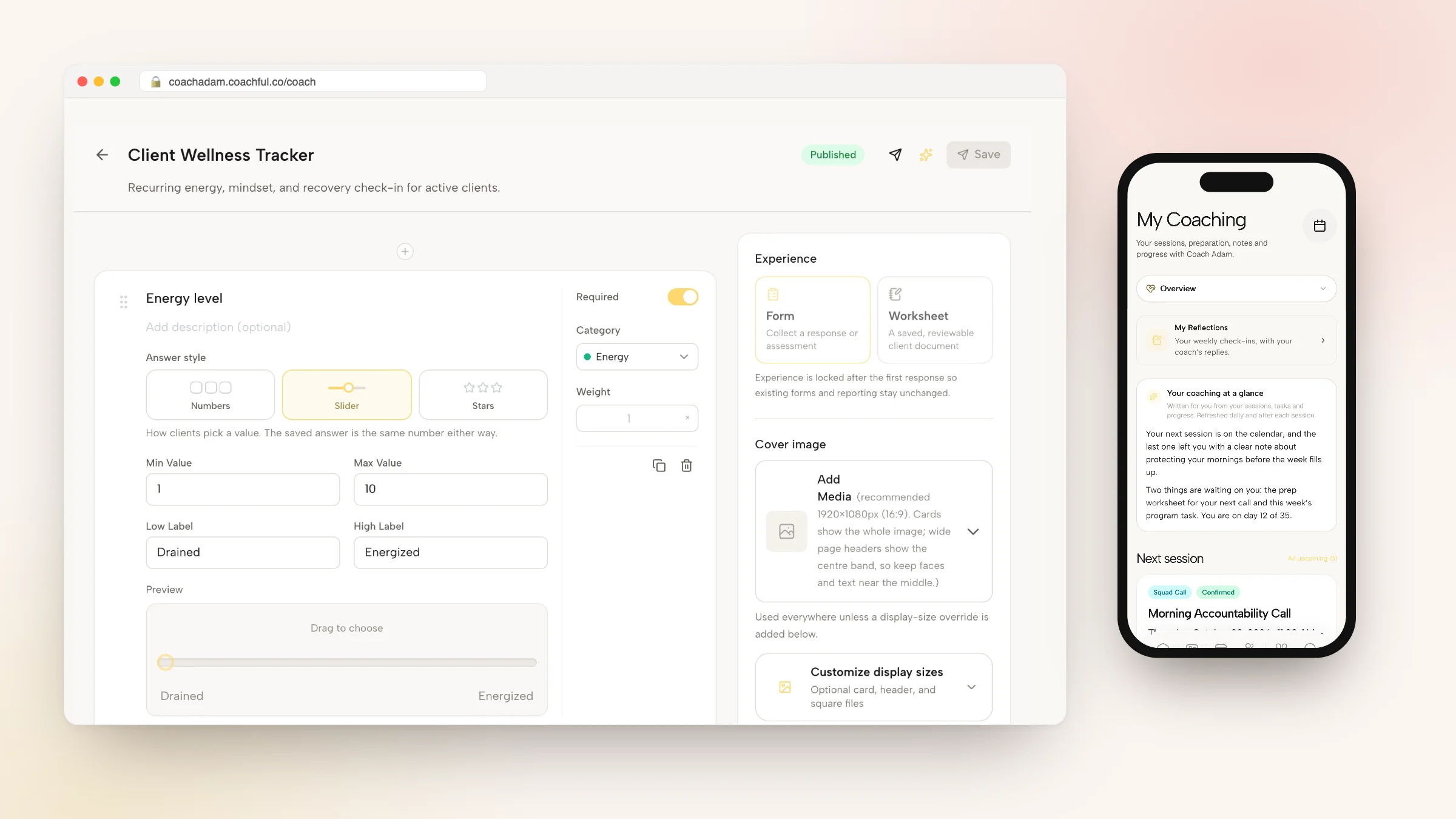
It goes further than a SMART checklist. The worksheet helps you choose the goal; the SMART goals template sharpens it once you have. If you're a coach, Coachful's team will build this worksheet into your clients' app for free.
The goal setting worksheet
Give yourself 30 to 45 minutes and work through it in order. Each part feeds the next.
| Part | Questions to answer | Your answers |
|---|---|---|
| 1. Look back | Score these areas from 1 to 10: health, career, money, relationships, personal growth, fun, environment, purpose. Which one, if it improved, would lift the others? | |
| 2. Picture it | Twelve months from now, if this area went well, what does an ordinary week look like? Be concrete. | |
| 3. Why it matters | Why do you want this? Ask "and why does that matter?" three times. Which value does it serve? | |
| 4. The goal | Write one goal for the next 90 days. By [date], I will [result], measured by [evidence]. | |
| 5. Milestones | What will be true at day 30, day 60 and day 90? | |
| 6. Weekly actions | Which two or three actions, done every week, would make the goal likely? Which can become habits? | |
| 7. Obstacles and if-then plans | What inside you or around you is most likely to get in the way? If [obstacle], then I will [response]. | |
| 8. Support | Who will you tell? What do you need from them? What resources (time, money, tools) do you need? | |
| 9. Review | When will you check progress each week? What will you ask yourself? | |
| Commitment | How committed are you, 0 to 10? If below 7, what would make the goal smaller or more yours? |
How to fill in each part
1. Look back
Scoring eight life areas is the quickest way to choose where to put your energy. Don't pick the lowest score by default: pick the one with the most knock-on effect. Better sleep often lifts health, work and patience with the people you live with. Our free Wheel of Life assessment draws the scores as a wheel, and our guide to the Wheel of Life explains how to read it.
2. Picture it
Describe a normal Tuesday, not a highlight reel. "I leave work by six, cook dinner and go to bed without my phone" is more useful than "I have work-life balance", because you can see the behaviors in it.
3. Why it matters
The first reason is usually the polite one. Ask "and why does that matter?" until you reach something you'd say only to a close friend. That reason is what you'll reread in week six. If it connects to one of your core values, write the value down; our core values assessment will help you name them.
4. The goal
Ninety days is long enough to change something and short enough to stay real. Write one goal, not three, with a specific result and the evidence that will show you've got there.
5. Milestones
Milestones are the goal broken into stages you can check. If you can't say what will be true at day 30, the goal isn't clear enough yet.
6. Weekly actions
Results are what you want; actions are what you control. Choose actions that are small enough to do in a bad week. "Apply to five roles every Monday" survives a busy week. "Network more" doesn't.
7. Obstacles and if-then plans
This is the part most worksheets skip, and the one with the strongest research behind it. Name the obstacle honestly, especially the internal one ("I'll get discouraged after the first rejection"), then write what you'll do when it shows up.
8. Support
Tell one person and agree how they'll hear about your progress. A friend who asks every Sunday, a group, a coach or an accountability partner all work.
9. Review
Put a 15-minute weekly review in your calendar now. Ask: what did I do, what moved, what got in the way, and what will I change next week?

A filled-in goal setting worksheet
Here's the worksheet completed by someone who wants to move from teaching into instructional design.
| Part | Answer |
|---|---|
| 1. Look back | Health 6, career 3, money 5, relationships 8, growth 4, fun 5, environment 7, purpose 4. Career is the lever: it drains my energy and my sense of purpose. |
| 2. Picture it | I design online training for a company, work from home two days a week, and I'm not marking papers at 10pm. |
| 3. Why it matters | I like teaching but not the hours. Why does that matter? I want evenings with my partner. Why? Because I'm missing the years before we have kids. Value: connection. |
| 4. The goal | By March 31, I will have a portfolio of three instructional design samples and five informational conversations with people in the field. |
| 5. Milestones | Day 30: first sample finished, two conversations done. Day 60: second sample, four conversations. Day 90: third sample, portfolio site live. |
| 6. Weekly actions | Saturday 9 to 12 on samples. One LinkedIn message to a designer every Wednesday. One course module a week. |
| 7. Obstacles | Report-card weeks will eat Saturdays. If it's a report-card week, then I'll do two 45-minute sessions on Sunday evening instead. If a designer doesn't reply, then I'll message the next person on my list the same day. |
| 8. Support | My partner knows the plan and protects Saturday mornings. A former colleague who made the switch will review my first sample. |
| 9. Review | Sunday 7pm, 15 minutes, in my notes app. |
| Commitment | 8 out of 10. |
The goal isn't "get a new job by March". That depends on other people. It's the portfolio and the conversations, which are under the writer's control and make the job much more likely. Turning career answers like these into a workplace plan is covered in our individual development plan guide.
A shorter goal setting worksheet for students and teens
For younger people, five questions are plenty. Keep the goal to four to six weeks.
- My goal is: (one thing, in one sentence)
- I'll know I've done it when: (what you'll see, hear or have)
- It matters to me because:
- Every week I will: (one or two actions, with days)
- If ___ gets in the way, then I will:
Example: "My goal is to raise my math grade to a B by the end of term. I'll know when my report says B. It matters because I want to take chemistry next year. Every week I'll do the practice set on Tuesday and Thursday. If I don't understand a problem, then I'll ask in lunchtime help on Wednesday."

What the research says about goal setting worksheets
Each section of the worksheet maps to a finding.
- Specific, challenging goals (part 4). Edwin Locke and Gary Latham's 2002 review of 35 years of goal-setting research reports that specific, difficult goals consistently led to higher performance than being told to "do your best." They also found that commitment matters most when goals are difficult, which is why the worksheet ends with a commitment score.
- Milestones (part 5). The same review describes how adding near-term goals to a distant goal helped people on new, complex tasks.
- Obstacles and if-then plans (part 7). Pairing a picture of the future with an honest look at the obstacles, then making if-then plans, is called mental contrasting with implementation intentions. A 2021 meta-analysis of 21 studies (15,907 participants) found it improved goal attainment with a small to medium effect. Interventions delivered through interaction with another person had stronger effects (g = 0.465) than those delivered through documents alone (g = 0.277), so doing this part with someone helps.
- Weekly review (part 9). A 2016 meta-analysis of 138 studies found that monitoring progress promoted goal attainment, with larger effects when progress was recorded or reported to someone.
The honest summary: a worksheet won't do the work for you, but each of these sections nudges the odds in your favor, and filling it in with another person nudges them a little more.
Common goal setting worksheet mistakes
- Filling it in and filing it. The worksheet is the start of a 90-day process, not the end. Put the review in your calendar before you close the page.
- Choosing a goal that depends on someone else. "Get promoted" depends on your manager. "Lead two projects and ask for monthly feedback" depends on you.
- Skipping the obstacle section. People skip it because it's uncomfortable. It's also the section most linked to follow-through.
- Too many goals. One worksheet, one goal. If you have three, fill in three worksheets and pick the one with the highest commitment score.

Using a goal setting worksheet with coaching clients in Coachful
For coaches, the worksheet usually happens in two parts: the client fills in parts 1 to 3 before the session, and you work through parts 4 to 9 together. That split matches the research above, since the obstacle planning works better done with someone. Here's how it runs in Coachful, all included in your membership.
Build it as a worksheet, not a form
In Create > Resources > Forms & Worksheets, choose the Worksheet experience: a saved, reviewable client document that autosaves and can be edited after it's submitted, rather than a one-off form. Tools > Explore also has ready-made Goal ladder, Action plan, Personal vision and Wheel of life tools you can make your own, so you rarely start from a blank page.

Send parts 1 to 3 as session prep
Attach the worksheet to the session type as prep. The client sees it on their session card under Before your session with a Start worksheet button, and it's marked required if you choose. Required prep never blocks them from joining the call.
Turn answers into a goal, milestones and habits
Set the goal question to Use answer in… a goal, and the weekly actions to tasks or habits. After completing the worksheet, the client reviews each answer and saves it; nothing is created automatically. The goal then sits in their app with a target date, a milestone path for parts 5 and 9, and Daily momentum showing the linked tasks and habits.

A weekly review they don't have to remember
Each goal includes a weekly reflection: on track or not, progress, what went well, the biggest obstacle, what they'll do differently and their focus for next week. It's part 9 of the worksheet, delivered in the app every week.
Picture it with a vision board
For part 2, send a vision board resource. Each client gets their own private copy to fill with images, words and video, and it can appear in their morning visualization.

Or ask our team to build it
Coachful's team will build this goal setting worksheet, a 90-day goal program or a goal-setting journey in your account for free, on every plan. Use Create > We'll build it for you; the team usually replies within about 24 hours. Here's what the white-glove service includes. Our guides to coaching goal setting and creating coaching worksheets go deeper, and Coachful's forms and worksheets page shows every question type.

Frequently asked questions
What should a goal setting worksheet include?
At minimum: the goal written specifically, why it matters, milestones, weekly actions, likely obstacles with if-then plans, who will support you and when you'll review progress. Adding a quick life-area score at the start helps you choose the right goal, and a 0 to 10 commitment score at the end tells you if it's the right size.
How do you fill out a goal setting worksheet?
Work through it in order in one 30 to 45 minute sitting: score your life areas, picture the outcome, find the reason, write one 90-day goal, set three milestones, choose weekly actions, plan for obstacles, name your support and book a weekly review. Then put the review in your calendar before you finish.
Is there a free goal setting worksheet I can print?
Yes. Copy the table on this page into a document and print it, or use Coachful's free SMART goal worksheet builder at /tools/smart-goal-worksheet to sharpen the goal on screen and print the result.
What is a good goal setting worksheet for students?
A short one: my goal, how I'll know I've done it, why it matters, what I'll do every week and what I'll do if something gets in the way. Keep the goal to four to six weeks so a student can see results before motivation fades.
How is a goal setting worksheet different from a SMART goal template?
A SMART goal template tests one goal against five criteria. A goal setting worksheet covers the whole process, from choosing which goal to set through milestones, obstacles, support and weekly review. Many people use the worksheet first and the SMART template for part 4.
How often should I review my goal setting worksheet?
Weekly for 15 minutes, with a bigger review at each milestone (day 30, 60 and 90). Progress monitoring is one of the best-supported parts of goal setting, and it works better when you write it down.
Can Coachful build a goal setting worksheet for my clients?
Yes. The white-glove service is free on every Coachful plan. Ask from Create > We'll build it for you and the team will build the worksheet, a goal program or a goal-setting journey in your account, usually within about 24 hours, ready for you to edit.












