
Accountability Partner: How to Find One and Make It Work
An accountability partner is someone you check in with on a regular schedule about the goals you have each set, so that you both do what you said you would. Most are friends, colleagues or peers working on goals of their own, and the arrangement is mutual: you agree what you will report, how often you will talk, and what happens when one of you slips. It works best with specific weekly commitments, a fixed check-in time and progress written down somewhere you can both see.
The idea is simple; keeping it going is the hard part. Most partnerships fade after three weeks, usually because the goals were vague, the check-ins drifted, or one person did all the asking. This guide covers what the research says, the kinds of partner to look for and where to find them, an agreement for the first conversation, a weekly check-in template, what to do when it stops working, and when a paid coach is the better choice. Coaches will find a section on pairing clients up.
Does having an accountability partner work?
There is good evidence that reporting progress to someone helps, and some evidence that doing a goal alongside people you know helps too.
- Reporting progress improves results. A meta-analysis of 138 randomized studies with 19,951 participants found that prompting people to monitor their goal progress improved goal attainment (d = 0.40). The effect was larger when progress was reported to other people or made public, and when it was physically recorded (Harkin and colleagues, 2016). That is the core of what an accountability partner does.
- Doing it with friends helped in a weight-loss trial. In a study of 166 people, those who signed up with three friends or family members and also received social support training were far more likely to finish the four-month program (95% compared with 76% of those who joined alone without it) and to keep all the weight off at ten months (66% compared with 24%) (Wing and Jeffery, 1999). That is one study in one area, but the gap is large.
You may also have seen a claim that having a scheduled accountability appointment raises your chance of reaching a goal to 95%. It is usually credited to a training industry association, but we could not find a published study behind it, so we would not lean on the number.
Types of accountability partner
| Type | Good for | Watch out for |
|---|---|---|
| A friend | Trust from day one, easy to start | Being too kind to call you out; the friendship can make it awkward to stop |
| A peer with a similar goal | Shared language, swapping tactics (two writers, two job seekers) | Comparing progress until it turns competitive |
| A small group or mastermind | Several perspectives, keeps going if one person drops out | Long meetings; quieter members get skipped |
| Focus or coworking sessions | Getting started on a task with someone present on camera | Great for doing, weak for deciding what to do |
| An online community | Lots of people at your stage, posting wins | Easy to post and still not act |
| A coach | Skilled questions, structure, someone with no stake in your choices | It costs money; see the comparison below |
How to find an accountability partner
- Write down what you want to be held to. One or two goals with a deadline, such as "send ten job applications by the end of the month" or "write 500 words, four mornings a week". If yours is fuzzy, run it through the free SMART goal worksheet or our SMART goals template first.
- Decide the rhythm you need. Daily texts suit habits. A weekly call suits projects. Knowing this filters people fast.
- Look where people with similar goals already gather: a class or course you are taking, a running club, a professional association, a writing group, an online community in your field, or the community inside a coaching program.
- Ask directly and specifically. "I'm trying to write four mornings a week until March. Would you want to swap a two-line text every Friday about how it went, and you do the same for your goal?" A specific ask is easier to say yes to than "want to be accountability buddies?"
- Agree a four-week trial. It gives both of you an easy exit and a natural point to adjust.
The best partners are reliable, honest, roughly as committed as you are, and not someone with power over the goal (your manager, your spouse on a money goal). They do not need the same goal, but a similar check-in rhythm helps.
Your first conversation: an accountability partner agreement
Spend 20 minutes agreeing these points and write the answers in a shared note. Copy this list.
| Question | Example answer |
|---|---|
| What is each of us working on? | Me: four writing mornings a week. Ana: three gym sessions a week. |
| When and how do we check in? | Fridays at 6 p.m., a text; a 15-minute call on the last Friday of the month |
| What do we report? | What I did, what got in the way, next week's plan |
| What counts as done? | 500 words, even if they are bad |
| What happens if one of us misses? | No guilt trips. The other person asks once, the next day. |
| How direct do we want feedback? | Direct, but ask before giving advice |
| What stays between us? | Everything, unless we agree otherwise |
| When do we review this? | In four weeks; either of us can end it then without explanation |
A weekly accountability partner check-in template
Keep it to 15 minutes, about seven each. Use the same four questions every week so nobody has to think about the format.
| Step | Question | Time |
|---|---|---|
| 1. Report | What did you say you would do, and what did you do? | 2 min |
| 2. Learn | What helped, and what got in the way? | 2 min |
| 3. Plan | What will you do this week, when exactly, and what will you do if the usual obstacle shows up? | 2 min |
| 4. Ask | Is there anything you want from me this week? | 1 min |
The planning question uses an if-then plan ("If I get home late, I will do a 20-minute session instead of skipping"), which research on mental contrasting and implementation intentions supports: across 21 studies, picturing the goal, naming the obstacle and planning a response improved goal attainment (Wang, Wang and Gai, 2021). For daily goals, a two-line text works: "Done: 3 of 4 mornings. Tomorrow: 7 a.m. at the kitchen table." Tracking the habit itself on a habit tracker gives you both something concrete to look at.

Good questions to ask your accountability partner
- What is the one thing that would make this week a win?
- What did you avoid, and why do you think that was?
- How would you make next week's plan half as hard?
- What would you tell me if I said what you just said?
- Is this still the right goal?
When an accountability partnership stops working
| Sign | Fix |
|---|---|
| Check-ins keep getting moved | Fix one time slot and put it in both calendars as a recurring event |
| One person does all the asking | Take turns going first; use the same four questions |
| It has turned into venting | Cap stories at two minutes and end on next week's plan |
| It feels like competition | Report against your own plan, never against each other |
| You both keep missing | Shrink the goals until a week is easy, then build up |
| It has simply run its course | End it at the review date, say thank you, find a new partner |
Accountability partner or accountability coach?
A partner is a peer helping you follow through. A coach is a trained professional who also helps you decide what to commit to, asks better questions when you are stuck, and runs the structure for you. Our guide to what accountability coaching is covers it in depth.
| Accountability partner | Accountability coach | |
|---|---|---|
| Cost | Nothing; you return the favor | Paid sessions or a monthly package |
| Relationship | Mutual | All the attention is on you |
| Skill | Varies; usually encouragement | Trained in questions, goal setting and follow-through |
| Best for | Clear goals you mainly need to keep doing | Stuck, unclear or high-stakes goals |
Many people use both: a coach for direction every two weeks, a partner for the Friday text in between.

For coaches: pairing clients as accountability partners
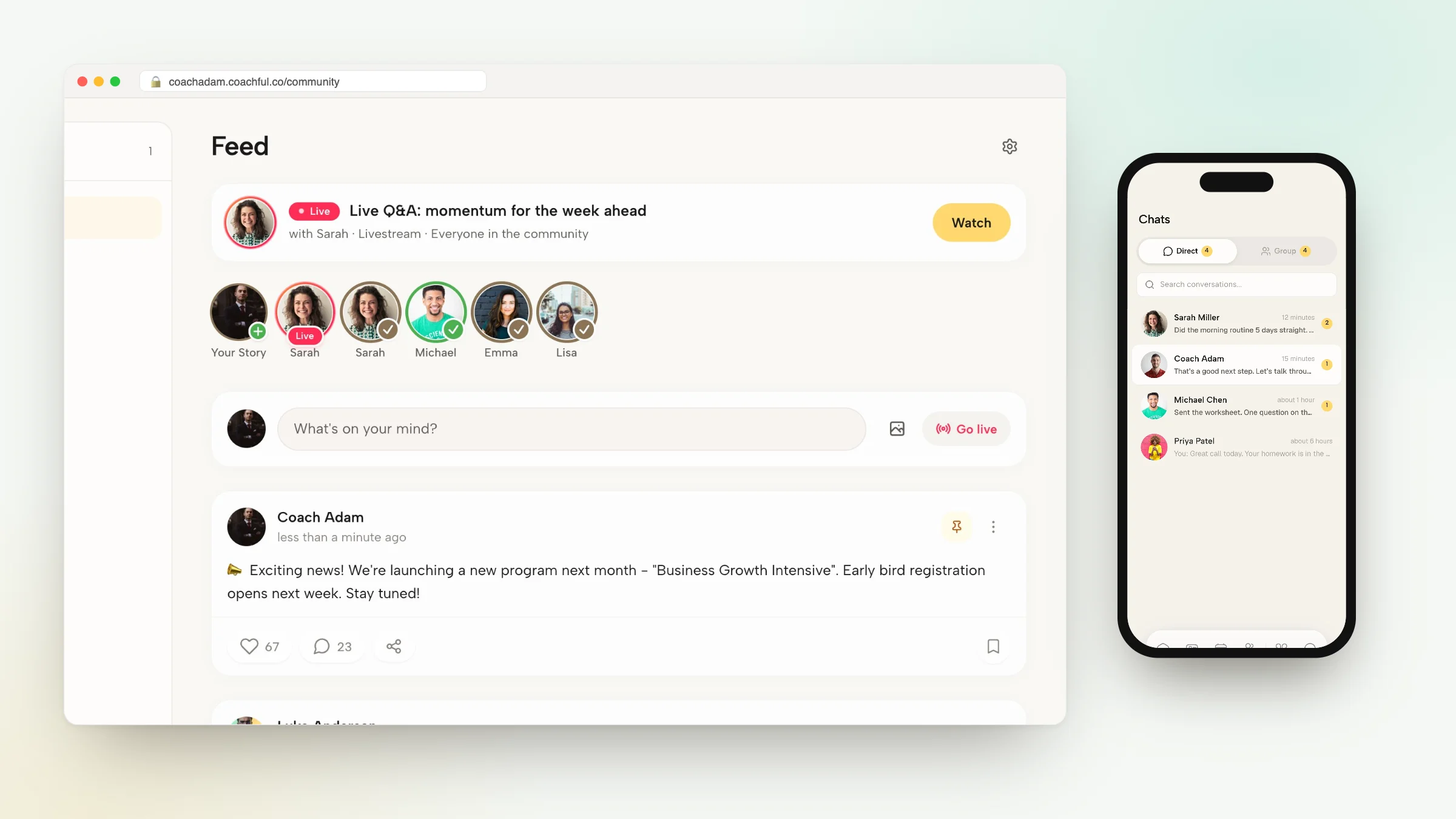
Clients in a group program often stay strangers unless someone introduces them, and a buddy who asks "did you do it?" on a Wednesday is support you do not have to deliver yourself. Coachful has this built in as Connections between clients, inside program communities.
- Introductions. In a program community's Members card, you tap Introduce, pick two people and write a line about why they should meet. Each person gets a private invitation; a chat between them opens only when both say yes. If one says not now, the other never finds out.
- Buddy groups. Turn them on per program and choose pairs, threes or fours, kept the same or shuffled every two or four weeks. Each group gets its own chat, listed under Group in the client's chats.
- A weekly conversation starter posted into the community chat on a weekday you choose.
- Buddy check-ins. For clients who opt in, a buddy is privately asked to say hello when that person goes quieter than their own usual rhythm. The buddy learns nothing except "quieter than usual".
Introductions are on by default; buddy groups, the weekly starter and buddy check-ins start switched off, so you choose what runs on its own. You can also set whether clients can message anyone in your workspace, only people you have introduced them to, or nobody but you.


Around that, the client's daily accountability lives in the same app: habits with reminders, daily tasks, morning and evening check-ins, goals with milestones, and group calls such as a weekly accountability call with prep due beforehand. On your side, each client is marked thriving, active, quiet or at risk from their own activity, so you notice a quiet fortnight before the next session. Our page on client accountability software covers those features, our guide to coaching accountability covers the method, and how to run a peer coaching group has an agenda for coach peers.


Have an accountability program built for you
If you want a ready-made accountability program, with the habits, check-ins, weekly call and community set up, the Coachful team will build it in your account at no extra cost through the free white-glove service. Pick We'll build it for you on the Create page and describe what you want; the team replies by email, usually within about 24 hours, and everything stays editable.

Frequently asked questions
What is an accountability partner?
An accountability partner is a person you check in with regularly about goals you have each set, so both of you follow through. You agree what you will report, how often you will talk and what happens when someone misses. Most are friends, colleagues or peers rather than professionals.
How do I find an accountability partner?
Write down the goal and the check-in rhythm you want, then ask someone specific from a class, club, professional group, online community or coaching program. Make a concrete ask, such as a two-line text every Friday, and agree a four-week trial.
What should I talk about with my accountability partner?
Use the same four questions each time: what you planned and what you did, what helped or got in the way, exactly what you will do this week and what you will do if the usual obstacle appears, and whether you want anything from your partner.
How often should accountability partners check in?
Weekly suits most goals, with a slightly longer monthly review. Daily habits can use a short daily text. Pick one fixed time and keep it; moved check-ins are the most common reason partnerships fade.
Do accountability partners really work?
Research supports the core idea. A meta-analysis of 138 randomized studies found that monitoring progress improves goal attainment, especially when progress is reported to others. The popular "95%" figure, though, does not trace to a published study we could find.
What is the difference between an accountability partner and a coach?
A partner is a peer, the arrangement is mutual and it costs nothing. A coach is trained, focuses entirely on you, helps you choose the right commitments and runs the structure, and is paid. Many people use a coach for direction and a partner in between.
Can Coachful set up an accountability program for my coaching clients?
Yes. Coachful's free white-glove service builds programs with habits, check-ins, group calls and a community inside your own account. You can then switch on introductions and buddy groups for the program. Ask from We'll build it for you on the Create page.












