
Habit Tracker Template: Printable Monthly and Weekly Grids
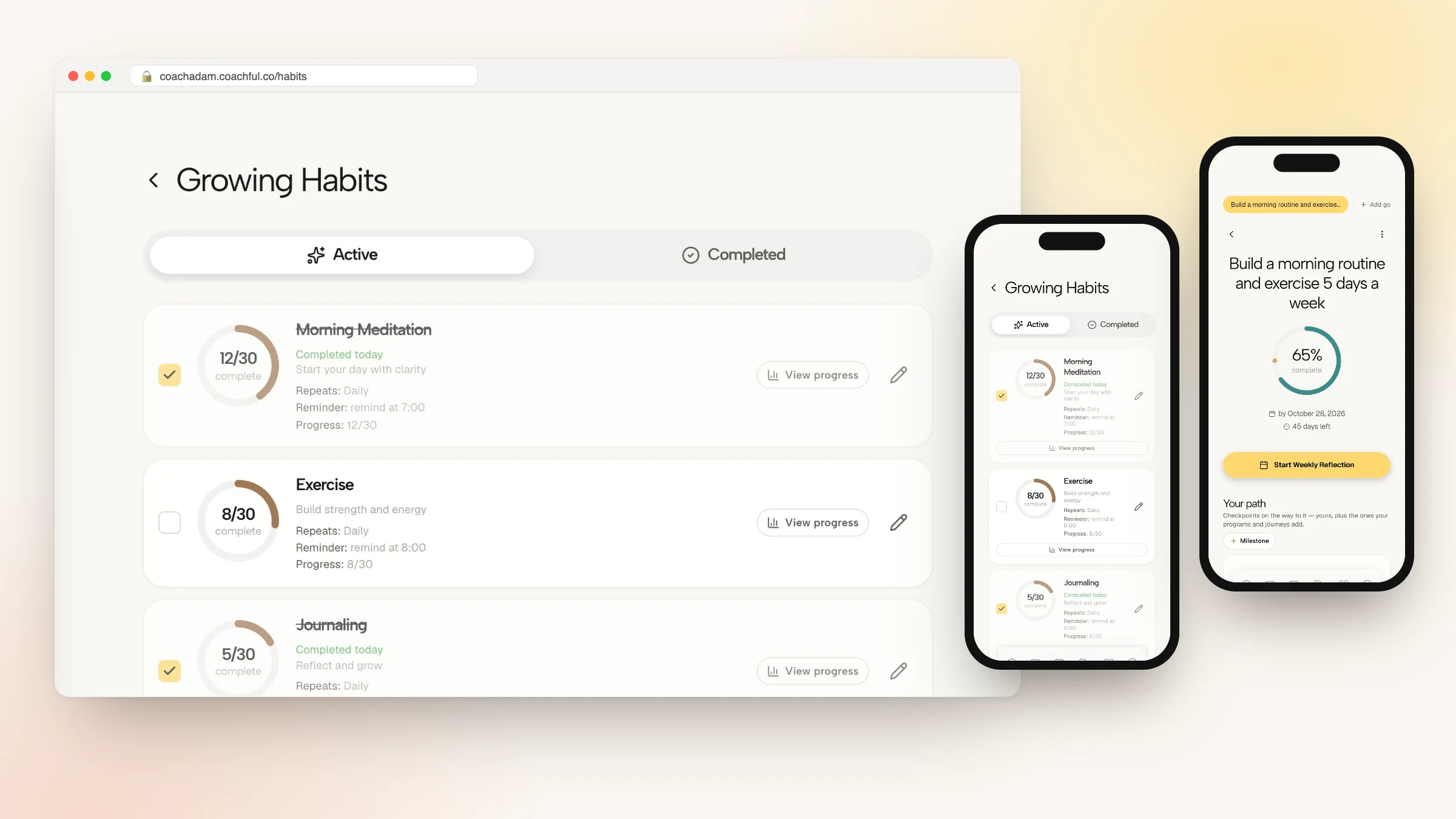
A habit tracker template is a grid with your habits down the side and the days across the top: you mark each day you do the habit, and the gaps show you what to fix. Below is a printable monthly habit tracker template, a weekly version, a habit planning sheet that decides when and how each habit happens, a filled-in example, 30 habit ideas, and what the research says about how long habits take and what to do after a missed day.
The last section is for coaches who want clients tracking habits in an app instead of on paper, including how Coachful's habit tracker works. Coachful's team will set up habits and check-ins for your clients in your account for free.
Monthly habit tracker template
Copy this into a spreadsheet or print it. Write up to five habits in the left column, then mark each day: a tick for done, a dot for a planned rest day, and leave it blank if you missed it. Total the row at the end of the month.
| Habit | 1 | 2 | 3 | 4 | 5 | 6 | 7 | 8 | 9 | 10 | 11 | 12 | 13 | 14 | 15 | 16 | 17 | 18 | 19 | 20 | 21 | 22 | 23 | 24 | 25 | 26 | 27 | 28 | 29 | 30 | 31 | Total |
|---|---|---|---|---|---|---|---|---|---|---|---|---|---|---|---|---|---|---|---|---|---|---|---|---|---|---|---|---|---|---|---|---|
Five rows is deliberate. Most people tracking ten habits are tracking none of them by week three.
Weekly habit tracker template
A weekly grid is easier to keep on the fridge or the first page of a planner, and it fits a weekly review.
| Habit | Mon | Tue | Wed | Thu | Fri | Sat | Sun | Done / target |
|---|---|---|---|---|---|---|---|---|
| / | ||||||||
| / | ||||||||
| / | ||||||||
| / |
Under the grid, write one more line each Sunday: How automatic did each habit feel this week, from 1 to 10? The idea comes from habit researchers at University College London, who suggest rating how automatic a habit feels at the end of each week so you can watch it get easier. A habit is formed when it stops needing a decision, not when you've ticked a certain number of boxes.

The habit planning sheet: fill this in first
A tracker records habits; it doesn't create them. Before you start ticking, decide exactly when and where each habit happens. This sheet is where most of the success is decided.
| Habit | After I... (the cue) | Where | Minimum version for a bad day | Days per week | Why it matters to me |
|---|---|---|---|---|---|
| Walk | After I drop the kids at school | The park loop | Walk to the end of the street and back | 5 | More energy in the afternoon |
| Read | After I get into bed | Bedroom, phone charging in the kitchen | One page | 7 | I miss reading and sleep better without my phone |
| Stretch | After I pour my first coffee | Kitchen floor | One stretch | 7 | My back hurts less |
The cue column matters most. In their guide to habit formation for doctors, Benjamin Gardner, Phillippa Lally and Jane Wardle sum it up as repeating a chosen behavior in the same context until it becomes automatic, and they suggest tying it to a cue inside an existing daily routine, such as "when I go on my lunch break." Their patient handout says to choose a time and place you encounter every day of the week.
A filled-in weekly habit tracker
Here's week two for the plan above. A tick means done, a dot means a planned rest day, and blank means missed.
| Habit | Mon | Tue | Wed | Thu | Fri | Sat | Sun | Done / target |
|---|---|---|---|---|---|---|---|---|
| Walk | ✓ | ✓ | ✓ | ✓ | · | · | 4 / 5 | |
| Read | ✓ | ✓ | ✓ | ✓ | ✓ | 5 / 7 | ||
| Stretch | ✓ | ✓ | ✓ | ✓ | ✓ | ✓ | ✓ | 7 / 7 |
Automatic scores this week: walk 5, read 4, stretch 7. The pattern is easy to read: reading broke on Thursday and Friday, and the weekly note says why ("late dinners out, too tired"). The fix isn't more willpower; it's the minimum version, one page, on late nights. Stretching is nearly automatic after two weeks because the cue (coffee) never changes.
How many habits should you track?
- Start with one to three. Add a new habit only when the earlier ones feel mostly automatic.
- Track behaviors, not outcomes. "Walk 20 minutes" is a habit; "lose weight" is a goal the habit serves. Put the goal on a SMART goals template and the habits here.
- Keep it small. The UCL researchers advise small, manageable changes and choosing the target behavior yourself.
How long does it take to form a habit?
Longer than 21 days, for most people. In Phillippa Lally's study at University College London, participants repeated a chosen behavior daily and rated how automatic it felt. As UCL's summary explains, it took 66 days on average for the habit to form, with wide differences between people and habits: one participant got there in 18 days, while another was forecast to need 254. Simpler actions became automatic faster than more elaborate routines.
Two practical conclusions. Plan for about ten weeks, which is the figure the researchers suggest telling patients to expect. And use a tracker for at least that long, rather than stopping at 30 days.
What to do when you miss a day
Keep going. The same research found that missing the occasional opportunity to do the behavior did not seriously impair habit formation. The damage from a missed day usually comes afterwards, from the "I've broken the streak, so why bother" feeling. A useful rule: never miss twice. If you missed yesterday, today's job is the minimum version.
The tracker itself helps. A 2016 meta-analysis of 138 studies found that monitoring progress promoted goal attainment, and the effect was larger when progress was physically recorded or reported to others. Ticking a box on paper, or in an app your coach can see, counts.
A five-minute weekly habit review
A tracker only helps if you read it. Every Sunday, look at the week's grid and answer four questions in writing:
- Which habit held best, and why? Usually the one with the most stable cue. Protect that cue.
- Where did the gaps cluster? Gaps on the same days point to a schedule problem (late meetings, weekends, travel), not a motivation problem.
- Is any habit too big? If a habit hit less than half its target two weeks running, shrink it to the minimum version for a week.
- Is anything automatic yet? If a habit scores 8 or more for automaticity three weeks running, stop tracking it and give the row to the next habit.
If your gaps keep landing on the same habit, write about it once with a self-reflection journal prompt such as "What does skipping this give me that I'd miss?" The answer is often more useful than another reminder.

30 habit ideas to track
| Health | Mind | Work and learning | Home and money | Relationships |
|---|---|---|---|---|
| Walk 20 minutes | Meditate 10 minutes | Plan tomorrow's top three tasks | Make the bed | Message one friend |
| Drink 2 liters of water | Journal three lines | Read 10 pages | Ten-minute tidy | Phone-free dinner |
| Stretch 5 minutes | Write one thing I'm grateful for | Practise a language 15 minutes | Log every expense | Ask my partner about their day |
| Phone out of the bedroom | No social media before 9am | One focused 50-minute block | No-spend day | Bedtime story with the kids |
| Vegetables at two meals | A short walk without headphones | Inbox to zero by 5pm | Cook dinner at home | Call a parent |
| Strength workout | Five deep breaths before meetings | Write 300 words | Prep tomorrow's lunch | One kind note at work |
Printable or app habit tracker?
- Printable is visible, satisfying to tick and free of notifications. It's easy to forget once it's buried under mail, and it can't remind you.
- A spreadsheet totals everything for you and is easy to copy each month.
- An app can remind you at the right time, track counts and amounts, and show a history. If you work with a coach, an app they can see adds the "reported to someone else" effect from the research above.
The best tracker is the one in the place you'll see at the moment of the habit. A paper grid on the bathroom mirror beats a beautiful app you never open.
Habit tracking for coaches and their clients in Coachful
Coaches lose a lot of client progress between sessions: the client meant to walk every day, did three days, then went quiet for a week, and you find out on the next call. Paper trackers and spreadsheets don't fix that because you can't see them. Here's how habit tracking runs inside Coachful's client app, all included in your membership.
The habit itself
Clients (or you, on their behalf) add a habit by answering What do you want to do?, with an optional Linked routine such as "after breakfast", which is the cue column from the planning sheet. How often? offers every day, specific days, a number of days per week, specific dates or a number of days per month. How do you track this? is done / not done, a count or an amount with a daily target and unit. Add a reminder time, a Target repetitions number and the Goal this supports.

Progress the client can see
Each habit shows progress toward its target (12 of 30, for example) and a history with done, skipped and not done counts, plus a calendar heatmap. Reaching the target moves the habit to Completed.
Assign habits, or put them in a program
You can assign a habit to a client, and program habits sync to everyone enrolled in that week or module. For coach-assigned habits you can turn on Proof check-ins: after completing, the client can add an optional photo or a few words, keep it private or share it with you, and you can acknowledge it.

Streaks you define once
Streaks are set for your whole practice. You choose what counts each day (check-ins, tasks, habits, an active goal), whether that means at least one habit, half or all of them, whether weekends count, and planned streak breaks for holidays.
See who's slipping
The Clients overview shows task completion and check-in rates across your roster and who has gone quiet, so you can message the client on day three instead of finding out on day ten. For a quick public challenge, our free client challenge tracker runs a daily accountability challenge without accounts, and the free progress tracker generator builds a tracking template for your niche.

Or let our team set it up
Coachful's team will build your habit program, check-ins and client templates in your account for free, on every plan. Ask from Create > We'll build it for you; the team usually replies within about 24 hours. Here's what the white-glove service includes. Our guides to coaching accountability and daily check-ins for ADHD clients go further, and Coachful for health coaches shows the full setup.

Frequently asked questions
What should I put on a habit tracker?
One to three behaviors you can do in a few minutes, each with a clear cue: "walk 20 minutes after school drop-off", "read one page in bed", "stretch after my first coffee". Track actions you control, not outcomes like weight or income.
How do I make a printable habit tracker?
Copy the monthly or weekly grid on this page into a spreadsheet or document, write your habits in the first column and print it. Keep it where the habit happens: on the fridge, the bathroom mirror or the first page of your planner.
Does habit tracking actually work?
Monitoring progress helps. A 2016 meta-analysis of 138 studies found that progress monitoring promoted goal attainment, with larger effects when progress was physically recorded or shared with someone. A tracker works best alongside a clear cue for each habit.
How long should I track a habit?
At least ten weeks. UCL research found habits took 66 days on average to become automatic, with a range from 18 days to a forecast of 254 depending on the person and the habit. Stop tracking when it feels automatic, not on a fixed date.
What if I break my habit streak?
Start again the next day with the smallest version of the habit. Research on habit formation found that missing an occasional day didn't seriously harm the process. Missing several days in a row is what lets the habit fade.
What's the best habit tracker app for coaching clients?
One that lives in the same app as their coaching, so you can see progress and they get reminders without a second login. Coachful's client app includes habits with reminders, counts and amounts, targets, a history heatmap, optional proof check-ins and streaks you define for your practice.
Can Coachful set up habit tracking for my coaching clients?
Yes. The white-glove service is free on every Coachful plan. Ask from Create > We'll build it for you and the team will build habit programs, check-ins and templates in your account, usually within about 24 hours.












