Daily Check-Ins for ADHD Coaching Clients Without the Chasing

The session went well. Your client left with three clear commitments and real energy. A week later they open with an apology, because none of it happened, and you can hear how bad they feel. So you start sending a quick text each morning. It helps. Then you do the same for the next client, and the next, and now your phone is a second job nobody is paying you for.
An ADHD and executive function coach asked about exactly this on Reddit: "I’m an ADHD and Executive function coach and curious if and how others use habit tracking accountability tools with clients for building and maintaining routines." One reply described a problem many coaches in this niche will recognise: "So the idea of a 1x per week session where we set goals and come up with strategies and have any expectation that they're going to follow thru is folly without some form of near daily touch point. Even though they get the session summary notes with goals emailed to them, if they aren't poked, reminded, or drawn into some degree of mild awareness of accountability, the next week rolls around and nothing happens."
The short answer: make the daily prompt the system's job and the response yours. The client gets one prompt a day, at a time they chose, that takes under a minute to answer: done, part done or not today, plus an optional line. You read the answers in one batch at a set time and reply by rule, for example one short message after two silent days and a conversation in the session after a silent week. Write the arrangement into your agreement and your price, so daily accountability is something you sell and can sustain.
This article is about designing a coaching service. It is not clinical guidance, and coaching is not treatment for ADHD. Coachful details were checked on 3 October 2026.
Why weekly sessions stall and why chasing breaks the ADHD coach
The commenter's point is the starting place. A plan made on Tuesday and emailed as a summary is invisible by Thursday. Without a cue near the moment of action, the next session arrives and nothing has moved. The client reads that as one more failure, and a client who feels like a failure is unlikely to renew.
Many coaches fix this with their own thumbs, and the sums get ugly fast. Take a hypothetical roster of 12 clients and five minutes a day per client for a reminder and a reply. That is an hour a day, or five hours across a working week, on top of sessions and prep.
There is a second cost that is easy to miss. When you are the reminder, your client's progress depends on your memory. The week you are ill or on holiday, their routine goes with you.
- No touch point: nothing happens between sessions, and the client leaves feeling coaching did not work.
- Heroic chasing: it works for a while, then you resent it, miss days and cap your roster lower than you can afford.
What a lightweight daily accountability check-in looks like
- One prompt a day. At a time the client picked, in a place they already look.
- Under a minute to answer. Three options (done, part done, not today) and an optional line: "What got in the way?"
- One to three commitments. The ones chosen in the last session, and never the whole plan.
- Sent by the system. A scheduled reminder or check-in, so it arrives whether or not you remember.
- A missed day is information. The check-in records what happened. It does not grade the person.

"Part done" matters more than it looks. A choice between done and failed pushes people to stop answering on bad days, which are the days you most need to hear about.
Design the check-in with each ADHD coaching client
Spend ten minutes of a session on it. The questions are simple, and the answers differ a lot from client to client.
- Which one to three commitments get tracked this week?
- What time should the prompt arrive, and where: the app, a text, an email?
- What counts as part done?
- Which kinds of nudge help, and which feel like nagging?
- What should I do if I hear nothing for two days?
That last question is the important one. A client who has agreed in advance to a two-day message experiences it as the plan working. A client who has not may experience it as being caught.

Review the setup after two weeks. Some clients want a morning prompt to plan the day and others an evening one to close it. Expect to adjust it. Changing the time is a normal part of the setup.
Keep ADHD accountability free of shame
The word accountability can arrive with baggage. In the episode below from Understood, a nonprofit that supports people with learning and thinking differences, Dr. J explains why accountability can feel loaded with guilt for women with ADHD, especially after years of being told they are making excuses, and how an explanation differs from an excuse. Watch it before you write your check-in wording.
A 12-minute episode on ADHD, accountability and shame. Source: Understood on YouTube.
In practice that means a few wording choices:
- Ask "What got in the way?" and leave out "Why didn't you?"
- Agree before it happens how to read a broken streak. A streak motivates some clients, and for others one missed day ends the whole routine.
- Treat restarting as the skill being practised. A client who comes back after three silent days has done the hard part.
The coach's response rule: review in one batch and reply by rule
This is the half that protects you. Decide when you look and what earns a reply, then tell the client.

| What you see in the batch | What you do |
|---|---|
| Done or part done | Nothing, or a one-tap acknowledgement |
| Not today, with a note | Reply only if they asked something. Otherwise bring it to the session |
| Two days with no answer | One short message: "No check-in for two days. No explanation needed. Want to shrink the task or move the time?" |
| A week with no answer | Raise it in the session and redesign the check-in together |
Pick a review window, such as 15 minutes at the same time each working day, and keep to it. Avoid a second nudge on the same day, replies late at night, and carrying a client's task list in your own head. If a message ever worries you about someone's safety, that is a different matter from accountability and needs its own plan.
The window also gives you a capacity number. A fixed 15-minute window is 75 minutes over five days, compared with the five hours in the earlier example. If the answers no longer fit in the window, the roster or the rules need to change. For the wider sum, see our guide to defining a full coaching roster.
Put the daily check-in in your coaching agreement and price
Daily accountability is a service. If it is not written down, it grows until it is all you do.
- What is included: a daily prompt, the days you review answers, and how quickly you reply when a rule is triggered.
- What is not: on-demand texting, replies outside your hours, crisis support.
- What it costs: build the review time into the package price. A client who wants daily personal contact from you is buying a higher-touch package, and it should be priced as one.
- When you review it: after two to four weeks, decide together whether to keep, change or reduce the check-in.

Our guides to between-session support boundaries and structuring coaching packages cover the wording and the tiers. If the arrangement has already drifted, see resetting a coaching agreement.
When the daily check-in stops working
Watch for four signs: answers stop, every answer is "done" and nothing changes, the client says the prompt fills them with dread, or you catch yourself chasing again.
- Shrink the commitment until it is almost too easy.
- Move the prompt to a different time or channel.
- Change the question.
- Pause the check-in for a week and talk about what it was like without it.
A check-in that has gone quiet can be an early sign that a client is drifting. Our guide to spotting at-risk coaching clients covers what to do next, and the wider picture is in keeping clients engaged between sessions.
Objections ADHD coaches raise about daily check-ins
"My clients ignore app notifications." Many do. Put the prompt where that client already looks, attach it to something they do every day, and review the choice after two weeks. No tool removes the need for that conversation.
"If I stop chasing, they will stop doing the work and quit." Some may wobble at first. A client whose progress depends on your daily texts is borrowing your executive function, which can be a fair service when it is scheduled and paid for, and is a slow route to burnout when it is neither.
"An automated prompt feels impersonal." The prompt is automated. Your reply is still written by you, and there are fewer of them, so each one can be better.
"Would a group do this better?" For some clients, yes. A small group with a daily check-in thread spreads the accountability across peers and takes you out of the middle.
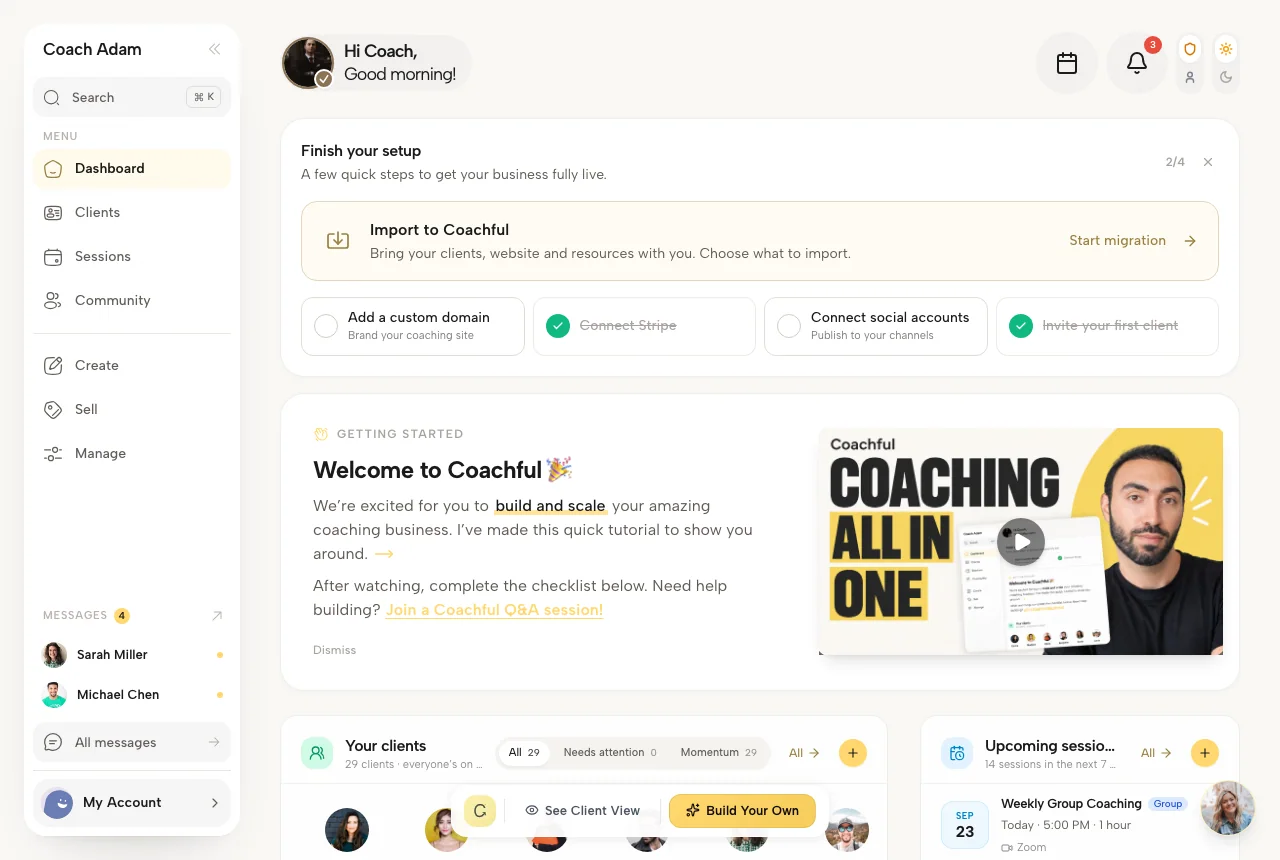
Running a daily check-in in Coachful
We make Coachful, so weigh this section accordingly. A reminder does not make anyone act, and Coachful is not a clinical tool and is not HIPAA-certified. What it can do is send the prompt so you do not have to.
- Daily habits: each habit repeats daily, can have a reminder time and is ticked off with one tap, with progress the client can see.
- Morning and evening check-ins: check-in flows the client completes in the app.
- Streaks: habits show streaks, so agree with each client how to read a broken one.
- On their phone: an iOS and Android client app showing your branding.
- Your batch review: client activity and engagement analytics, and a briefing on each client before sessions.
- Groups: a community feed and group chat for peer accountability.
- Sessions: calls run on built-in video that is part of the subscription, so there is no separate video tool to pay for.

If a shared spreadsheet and a recurring phone alarm work for a client, keep them. The design matters more than the tool. If you are comparing software for habits and check-ins, our review of health coaching software covers the options. Coachful has a 7-day free trial: card required, no charge during the trial, cancel in one click.
Frequently asked questions
How often should an ADHD coach check in with clients between sessions?
Often daily, as the coach quoted above describes, and the prompt does not have to come from you. Let a scheduled reminder or check-in send it, and review the answers yourself in one batch on the days named in your agreement.
What should a daily accountability check-in ask?
One question per commitment with three answers (done, part done, not today) and an optional line for what got in the way. Keep it to one to three commitments so it takes under a minute.
How do I stop chasing coaching clients who do not respond?
Agree a rule in advance. For example: after two days with no check-in you send one short message, and after a week you raise it in the session and redesign the check-in. Anything beyond the rule waits for the session.
Should daily accountability check-ins cost extra?
They should be priced, either inside the package or as a higher-touch tier. Work out the review time per week, include it in the price, and state what is and is not included so the support does not expand unpaid.
Do habit trackers work for coaching clients with ADHD?
It depends on the client and the setup. A tracker helps when the prompt arrives at a useful time and answering takes almost no effort. Agree the details together, review after two weeks and change what is not working.
Is daily accountability coaching a treatment for ADHD?
No. Coaching supports routines and follow-through. It does not diagnose or treat ADHD, and clinical questions belong with a licensed professional. Say so in your agreement.
Do I need a separate video tool for sessions on Coachful?
No. Sessions run on built-in video included in the subscription. Zoom, Google Meet or Teams links can be created automatically if you prefer them.