
60 Journal Prompts for Self-Reflection, With a 4-Week Plan
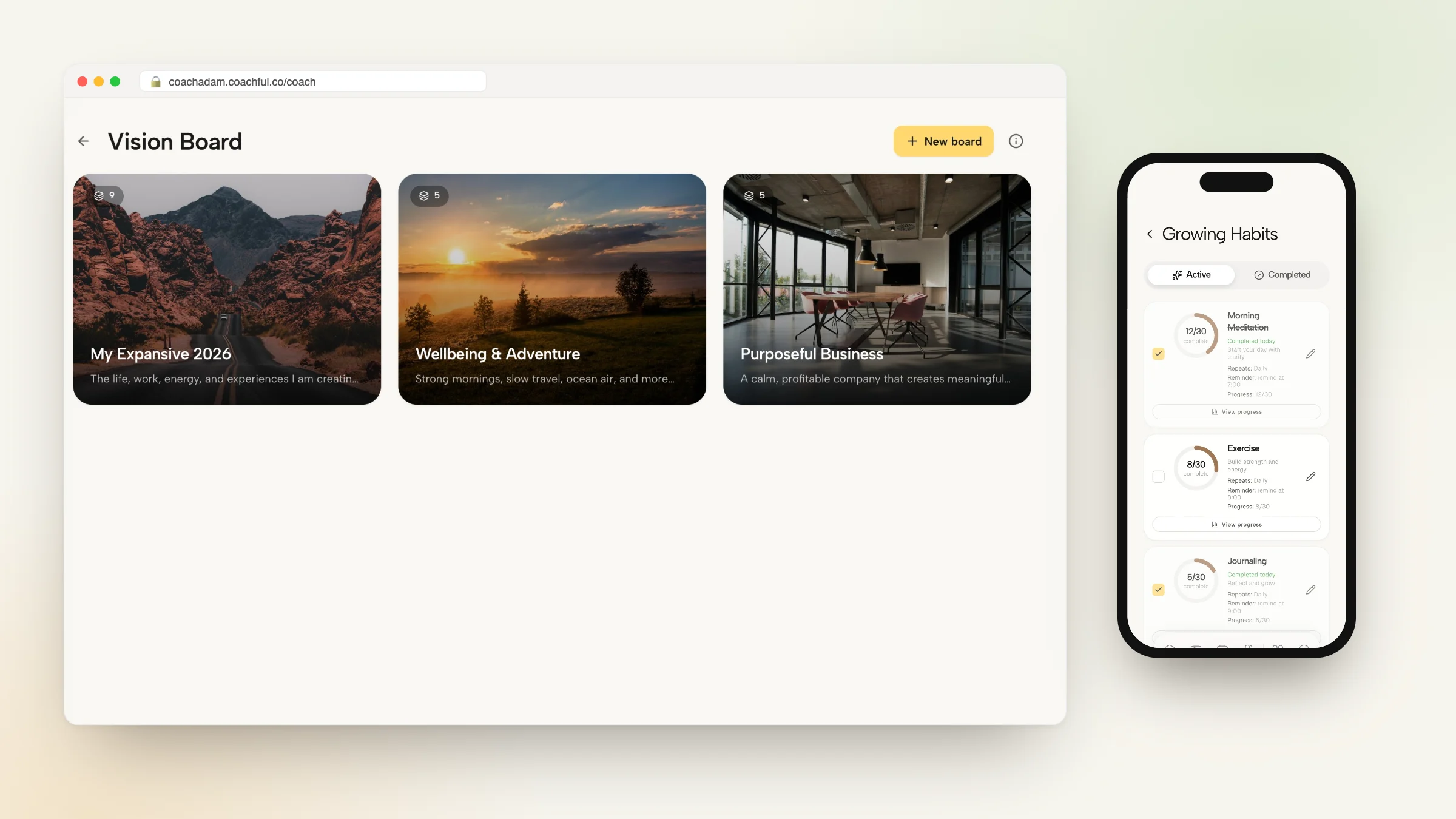
Journal prompts for self-reflection are open-ended writing starters that help you look at your feelings, choices and patterns on paper instead of in circles in your head. The best ones are specific enough to start writing straight away and open enough that the answer surprises you. Below are 60 journal prompts for self-reflection in nine themes, a four-week plan to start a habit, what the research on expressive writing and gratitude journaling actually found, and how to journal so it helps rather than spirals.
If you want quick questions for a daily or weekly check-in rather than longer writing, our self-reflection questions are built for that. And if you're a coach who wants to give clients prompts inside a private journal, the last section shows how it works in Coachful, where our team will set it up in your account for free.
What makes a good self-reflection journal prompt
A prompt has one job: get the pen moving. Prompts that start with "Is" or "Do" invite a one-word answer and stall. Prompts that say "Describe", "Write about" or "What" ask for a scene or a list, and the writing keeps going.
| Weak prompt | Why it stalls | Stronger version |
|---|---|---|
| Am I happy? | Yes, no or "sort of" | Describe the last moment you felt genuinely content. What made it possible? |
| What are my goals? | Too broad to start | Describe an ordinary Tuesday five years from now, if things go well. |
| Why am I like this? | Invites self-criticism | What pattern did I notice in myself this week, and when did it start? |
| Write about your feelings. | No entry point | What emotion did I feel most this week, and what was it trying to tell me? |
How to journal for self-reflection
- Pick one prompt. Not three. One prompt, written about properly, beats a page of half-answers.
- Set a timer for 10 to 15 minutes and keep writing until it goes off, even if you write "I don't know what to say" for a line.
- Don't edit. Spelling, grammar and handwriting don't matter. Nobody else needs to read it.
- Close with one sentence using a closing prompt from the last list below. It turns a vent into something you can use.
- Reread once a month. Patterns show up across entries that you can't see in any single one.
Prompts for getting to know yourself
- Describe a day last month when you felt completely like yourself. What were you doing, and who were you with?
- Write about three things people often misunderstand about you.
- What do you do when nobody is asking anything of you? What does that say about what you enjoy?
- List the roles you play (parent, manager, friend, partner). Which feels most like you, and which feels like a costume?
- What are you better at than you give yourself credit for? Give real examples.
- Write about a belief you held five years ago that you've since changed. What changed it?
- If your closest friend described you to a stranger, what would they say? What would they leave out?
- What do you need more of right now: rest, challenge, connection or quiet? Why that one?
Prompts for emotions and what sits under them
- What emotion did I feel most this week? When did it show up, and what was it trying to tell me?
- Write about something that irritated you recently. Which of your values was being stepped on?
- What am I anxious about right now? Write the worst case, the best case and the most likely case.
- When did I last cry, or come close? What was it really about?
- What do I do with anger: swallow it, show it or something else? Where did I learn that?
- Write a letter to a feeling you've been avoiding.
- Where in my body do I feel stress first? What usually comes just before it?
- What lifted my mood this week, even a little?

Prompts about the past: lessons and turning points
- Write about a turning point in your life. What did you decide then that still shapes you?
- What did your 16-year-old self want for you? What would they think of your life now?
- Describe a mistake you're glad you made.
- Write about a time you were braver than you expected to be.
- What did your family teach you about money, work or love without ever saying it out loud?
- Which period of your life would you call "the hard year"? What got you through it?
- Write a thank-you note to someone who changed your direction, whether or not you send it.
Prompts about your future self
- Describe an ordinary Tuesday five years from now, if things go well. Where do you wake up, what do you do, who do you see?
- Write a letter from yourself a year from now, explaining what you did this year that made the difference.
- What do you want to be true about your health, work and relationships in twelve months?
- What would you attempt if you knew it would work? What's the smallest version you could try this month?
- What do you want to stop carrying into next year?
- What kind of person do you want to be at 80, and what would that person do differently now?
- What would "enough" look like for you: enough money, enough work, enough success?
Future-self prompts pair well with a vision board. Our guide on how to make a vision board turns prompt 24 into something you see every day.

Prompts about relationships
- Who do I feel most myself around, and when did I last see them?
- Write about a relationship that drains you. Which part of the pattern is yours?
- What do I need from the people closest to me that I haven't clearly asked for?
- Where am I saying yes when I mean no?
- Who have I been meaning to reconnect with? What's actually stopping me?
- Describe how you show love. Is that how the people closest to you like to receive it?
- What conversation am I avoiding? Write the first two sentences of it.
Prompts about work, purpose and ambition
- Which part of my work would I do even if nobody paid me?
- When did I last lose track of time at work? What was I doing?
- What does success mean to me, separate from what my parents, boss or social media say it is?
- What am I tolerating at work because I'm afraid of the alternative?
- Write about the skill you most want to build this year, and why it matters to you.
- If I had to change careers tomorrow, what would I try first?
- What would I like to be known for in my field?
When work prompts turn into plans, a personal development plan gives them a structure with deadlines.
Prompts for gratitude and what's going well
- Write about three good things that happened today, and why each one happened.
- Who made my week easier, and do they know?
- What's something ordinary I'd miss if it were gone?
- What hard thing from my past am I now grateful for?
- What did my body let me do today?
- What went right this week that I haven't noticed yet?
Prompts for hard days
- What happened today, in plain facts? Then: what story am I telling myself about it?
- What would I say to a friend who had my day?
- What's one thing I can control right now, and one thing I can't?
- What do I need tonight to feel ten percent better?
- What has helped me get through days like this before?
Journaling is a good companion to support, not a replacement for it. If writing brings up thoughts of harming yourself, or feelings that don't ease over weeks, talk to a licensed mental health professional. In the US you can call or text 988 at any time.
Closing prompts to end any entry
- What's one thing I learned from writing this?
- What do I want to remember a month from now?
- What's one small thing I'll do differently tomorrow?
- What surprised me in what I wrote?
- Finish the sentence: "Right now, I'm ready to..."

A four-week plan to start a self-reflection journal
Use one prompt a day, five days a week, with a weekly review on the weekend. Keep the time and place the same every day; a fixed cue does more for a new habit than motivation does.
| Week | Theme | Weekday prompts | Weekend review prompt |
|---|---|---|---|
| 1 | Know yourself | 1, 3, 5, 8, 16 | What did I learn about myself this week that I didn't expect? |
| 2 | Feelings and relationships | 9, 10, 31, 33, 34 | Which feeling or person came up most, and what do I want to do about it? |
| 3 | Past and lessons | 17, 19, 20, 21, 48 | What thread runs through the stories I wrote this week? |
| 4 | Future and purpose | 24, 26, 30, 39, 40 | What's one change I'll make in the next month because of this journal? |
On day 28, reread all four weeks and write one page answering prompt 59: what surprised you?
What the research says about journaling
The best-studied form is expressive writing, which grew out of psychologist James Pennebaker's research in the 1980s on writing about difficult experiences. Joshua Smyth's 1998 meta-analysis found that the writing task led to improved outcomes in healthy participants across reported physical health, psychological well-being, physiological functioning and general functioning, though it didn't change health behaviors. It also found that writing increased distress immediately afterwards, which was unrelated to the later benefits. In plain terms: feeling worse right after a hard entry is normal and isn't a sign it's failing.
Gratitude writing has its own evidence. In Robert Emmons and Michael McCullough's 2003 experiments, people randomly assigned to list things they were grateful for showed higher well-being on several, though not all, of the measures, with the clearest effect on positive mood.
Two honest caveats. These studies used specific instructions over set periods, so a random prompt on a random day isn't the same intervention. And the effects are real but modest. Journaling helps most people a bit, and helps most when it's regular.
Paper or app?
- Paper is slower, which helps reflection, and nothing gets synced anywhere. It's harder to search and easy to lose.
- A notes app is always with you and searchable, but sits next to every notification you're trying to escape.
- A journal inside a coaching app makes sense if you work with a coach: prompts arrive when you need them, and you decide what, if anything, your coach sees.
Whichever you pick, privacy matters more than features. You'll only write honestly where you're sure nobody is reading over your shoulder.
Journal prompts for coaches to use with clients
Coaches give journal prompts as between-session work because the insight often arrives on a Wednesday night, not during the call. The trouble with prompts sent by email is that they're answered once in a hurry, or not at all. Our guide to keeping clients engaged between sessions covers the wider weekly rhythm; here's how journaling runs in Coachful, included in your membership.
A private journal clients trust
Every client has a private journal. The page says it plainly: "Only you can read these pages. Not your coach, not anyone." That line is the reason clients write honestly. When you add a journal step to a coaching flow, the client sees "Only you can read this page. Your coach sees that you wrote one, never what."
Prompts, sharing and mood tags with the Life & Mindset power-up
Turn on the Life & Mindset power-up's journal for a client and you can assign prompt sets. The client sees Today's prompt with Write from this prompt and Another prompt, can tag a page with mood and energy, and can choose Share with coach on any single page. Shared pages let you reply; the client can take a page back at any time.
Takeaways from your courses land in the journal
On every course lesson, signed-in clients get a private Your takeaway box above Complete & Next. Each takeaway saves as a page of their journal, so the reflection prompt "What will you keep from this lesson?" sits right where the learning happens.

Journaling as a habit, with a reminder
Add journaling to a client's habits with a reminder time, or include it in a program so every client gets it. Progress shows as a count toward a target, and you can choose whether habits count toward the client's streak.
Flows that ask the question for you
An evening check-in can end with "Anything you'd like to reflect on?", answered by typing or voice. You can add a journal step to any flow, and the Coaching flows template gallery includes mindset and wellbeing templates to start from.

Let our team build it
Coachful's team will build a prompt-based reflection flow, a journaling program or a worksheet in your account for free on every plan. Ask from Create > We'll build it for you; the team usually replies within about 24 hours, and you edit everything afterwards. See what the white-glove service includes, our pages for mindset coaches and life coaches, and our guide to reflective practice for coaches if you want a journal routine of your own.

Frequently asked questions
What are good journal prompts for self-reflection?
Good prompts ask for a scene or a list rather than a yes or no. Try "Describe a day when you felt completely like yourself", "What emotion did I feel most this week, and what was it telling me?" or "Write a letter from yourself a year from now." End each entry with "What's one thing I learned from writing this?"
How do I start journaling for self-reflection?
Pick a fixed time and place, choose one prompt, set a timer for 10 to 15 minutes and write without editing. Do it five days a week for four weeks using the plan above, then reread everything. A fixed time helps the habit stick more than motivation does.
How long should I journal each day?
Ten to fifteen minutes is enough for most people, and a timer stops it turning into an hour of going round in circles. Regular short sessions you actually do are better than long ones you skip.
Is journaling good for mental health?
Research on expressive writing found modest benefits for well-being and reported health in healthy adults, and gratitude writing improved mood in some studies. It isn't treatment. If you're struggling with depression, anxiety or trauma, use journaling alongside support from a licensed mental health professional.
What should I write in a self-reflection journal when I don't know what to say?
Write the facts of your day in three sentences, then answer "What story am I telling myself about it?" Or simply write "I don't know what to write because..." and keep going. The block usually breaks within a minute.
Can my coach read my journal?
It depends on the tool. In Coachful, the client journal is private by default: coaches can't read it. With the Life & Mindset journal on, a client can choose to share a single page with their coach and can take it back later.
Will Coachful set up journal prompts for my coaching clients?
Yes. The white-glove service is free on every Coachful plan. Ask from Create > We'll build it for you and the team will build a reflection flow, a journaling program or prompt worksheets in your account, usually within about 24 hours.












