
Personal Development Plan: Template, Example and 7 Steps
A personal development plan is a written plan for growing in the areas of life you choose: it starts with where you are and what you value, sets a few goals, and lists the skills, habits, support and review dates that will get you there. Unlike a workplace development plan, nobody signs it but you. Below is a personal development plan template you can copy, a seven-step process, a filled-in example, a 90-day version, and how coaches run a PDP with clients so it survives past the first week.
If your plan is mainly about your job and you'll agree it with a manager, our individual development plan guide is the better fit. Coaches can have Coachful's team build this template into their clients' app for free.
What a personal development plan covers
A good PDP answers six questions on a page or two:
- Where am I now, across the main areas of my life?
- What matters most to me?
- Where do I want to be in 12 months?
- Which two or three goals will get me there?
- What will I do every week, and what will I learn?
- Who will help, what might get in the way, and when will I review it?
The common failure is jumping straight to question 4. Goals chosen without questions 1 to 3 tend to be the ones you think you should want, and they're the first to go when life gets busy.
Personal development plan template
Copy this into a document. Plan on an hour for the first draft.
| Section | Prompt | Your answer |
|---|---|---|
| 1. Life review | Score each area 1 to 10: health, career, money, relationships, personal growth, fun, home and environment, purpose. One line on why for each. | |
| 2. Values | My top five values, each with one sentence on what it means to me. | |
| 3. Twelve-month vision | A year from now, what does an ordinary week look like? Write it in the present tense. | |
| 4. Goals (two or three) | For each: by [date], I will [result], measured by [evidence], because [value it serves]. | |
| 5. Skills to learn | Which skills or knowledge does each goal need? How will I learn them? | |
| 6. Habits | Which weekly or daily habits support each goal? After what cue will I do them? | |
| 7. Resources | Time per week, money, tools, courses, people. | |
| 8. Obstacles and if-then plans | What's most likely to get in the way? If [obstacle], then I will [response]. | |
| 9. Support | Who knows about this plan, and how will they hear about progress? | |
| 10. Milestones | What will be true at 3, 6 and 9 months? | |
| 11. Review schedule | Weekly check (15 minutes), monthly review (30 minutes), quarterly reset (1 hour). Put the dates in your calendar. |
How to write a personal development plan in seven steps
Step 1: Review your life as it is
Score each area from 1 to 10 and write one honest line about each. Our free Wheel of Life assessment draws the scores as a wheel, which makes the lopsided spots obvious. Don't automatically pick the lowest score. Pick the area that, if it improved, would lift others; sleep and health often do.
Step 2: Name your values
Your values decide which goals you'll keep working on when motivation drops. If you haven't done it before, our core values assessment takes about 45 minutes and ends with your top five, defined in your own words.
Step 3: Write a twelve-month vision
Describe an ordinary week a year from now, as if it's already true: "I'm in bed by 10:30 most nights, I run twice a week, and I'm spending Saturday mornings on the pottery business." Concrete beats inspiring. You should be able to see the behaviors in it.
Step 4: Choose two or three goals
Pick goals that close the biggest gaps between step 1 and step 3, and that serve your top values. Write each one specifically, with a measure and a date. Our SMART goals template and SMART goals examples help here.
Step 5: Plan the skills and habits
For each goal, list what you need to learn and what you'll do repeatedly. Skills get a learning activity ("an evening pottery course on Tuesdays"); habits get a cue ("after the school run"). Track the habits on a habit tracker.
Step 6: Plan for obstacles and support
Write the two most likely obstacles for each goal and what you'll do when they show up. Then tell one person about the plan and agree how they'll hear about your progress.
Step 7: Set milestones and reviews
Set a checkpoint every three months and book your reviews now. A plan without a review date is a wish list.

A filled-in personal development plan
Here's a plan written by a 34-year-old nurse who felt stuck: tired, short on time, and with a side interest she'd never given room.
| Section | Answer |
|---|---|
| 1. Life review | Health 4 (night shifts, little exercise), career 6, money 6, relationships 7, growth 3 (haven't learned anything new in years), fun 4, home 7, purpose 5. |
| 2. Values | Health (energy to enjoy my days off), creativity (making things with my hands), connection, security, learning. |
| 3. Vision | I sleep properly after night shifts, walk or swim three times a week, and spend one morning a week at the pottery studio. I've sold my first pieces at the local market. |
| 4. Goals | (1) By March 31, exercise three times a week for 12 weeks in a row, logged in my habit tracker. (2) By June 30, finish a beginner pottery course and make a set of 12 pieces. (3) By November, sell work at one local market. |
| 5. Skills | Wheel-throwing and glazing (Tuesday evening course). Basic pricing and selling (talk to two stallholders at the market). |
| 6. Habits | Swim after the last night shift of each block. Walk 30 minutes on day-off mornings. One hour of practice after each class, while the studio is open. |
| 7. Resources | Course fee saved from two months of skipped takeout. Four hours a week. A friend's spare shelf for drying pieces. |
| 8. Obstacles | If a shift change wipes out a class, then I'll book the open studio session that week. If I'm too tired to swim, then I'll walk for 10 minutes instead. |
| 9. Support | My partner covers dinner on Tuesdays. A colleague who also wants to exercise is my swim buddy. |
| 10. Milestones | 3 months: 12 weeks of exercise done, course started. 6 months: course finished, 12 pieces made. 9 months: market stall booked. |
| 11. Reviews | Sunday evening check, first Sunday of the month review, quarterly reset on the first day off of each quarter. |
Three goals, and each one maps to a value and a low score. The obstacle plans are written for a shift worker's real week, which is why they might hold.
A 90-day personal development plan
If a year feels too far away, use a 90-day version. It's long enough to see change and short enough to stay real.
| Weeks | Focus | What to do |
|---|---|---|
| Week 1 | Set up | Life review, values, one goal, two habits, first review booked |
| Weeks 2 to 4 | Start small | Minimum versions of each habit; one learning activity a week |
| Week 4 | First checkpoint | What's working? Shrink anything below half its target |
| Weeks 5 to 8 | Build | Increase one habit; add the harder parts of the goal |
| Week 8 | Second checkpoint | Is the goal still the right one? Adjust the date or the measure on purpose |
| Weeks 9 to 12 | Finish | Push for the result; note what you learned |
| Week 13 | Review | Score the life areas again; write the next 90 days |

Personal development plan review questions
Weekly (15 minutes): What did I do this week toward each goal? Which habits held? What got in the way? What's my focus next week?
Monthly (30 minutes): Am I closer to my vision than a month ago? Is each goal still mine? Which obstacle keeps coming back, and what's my new plan for it?
Quarterly (1 hour): Re-score the life areas. Which goals are done, which need a new date, and which should I drop? What did I learn about how I work best?
For more review prompts, see our self-reflection questions.
What makes a personal development plan work
A PDP brings together several well-studied techniques. Edwin Locke and Gary Latham's review of 35 years of goal research found that specific, challenging goals beat "do your best", that goals work best with feedback on progress, and that commitment matters most when goals are hard. Peter Gollwitzer and Paschal Sheeran's 2025 review describes how if-then plans help people reach their goals. And a 2021 meta-analysis of combining a picture of the goal with an honest look at the obstacles and if-then plans found a small to medium benefit for goal attainment, stronger when it was delivered through interaction with another person than through documents alone.
That last finding is the practical one: a plan you make with someone (a coach, a mentor, a friend who asks every Sunday) tends to work better than the same plan made alone.
Common personal development plan mistakes
- Too many goals. A goal in all eight life areas is eight half-efforts. Two or three is the working limit.
- Goals with no habits under them. A goal tells you where to go; habits are how you get there on an ordinary Tuesday.
- No obstacles section. It's the least pleasant part to write and one of the most useful.
- Writing it once. The plan is a living document. If you're not editing it at the monthly review, you're probably not using it.
- Measuring only outcomes. Track the habits too, so a slow month on results doesn't hide good effort, or vice versa.

Running personal development plans with coaching clients in Coachful
For coaches, a PDP is often the backbone of a 3 to 12 month engagement: you build it together in the first sessions, then each session works on one part of it. The hard part is keeping it alive between calls. Here's how the pieces sit in Coachful's client app, all included in your membership.
Every section has a home
- Life review: the Wheel of life tool in Tools > Explore, which you can make your own and assign.
- Values and vision: values tools such as Values ranking and alignment, a Personal vision worksheet, and vision board resources where each client gets a private copy to edit.
- Goals: several active goals at once, each with a target date, progress ring, milestone path and weekly reflection; the client can feature one on their home screen.
- Habits: with cues ("Linked routine"), reminders, targets and the goal each one supports.
- Reviews: the weekly reflection on each goal, plus morning and evening check-ins you can edit.

A journey for the whole plan
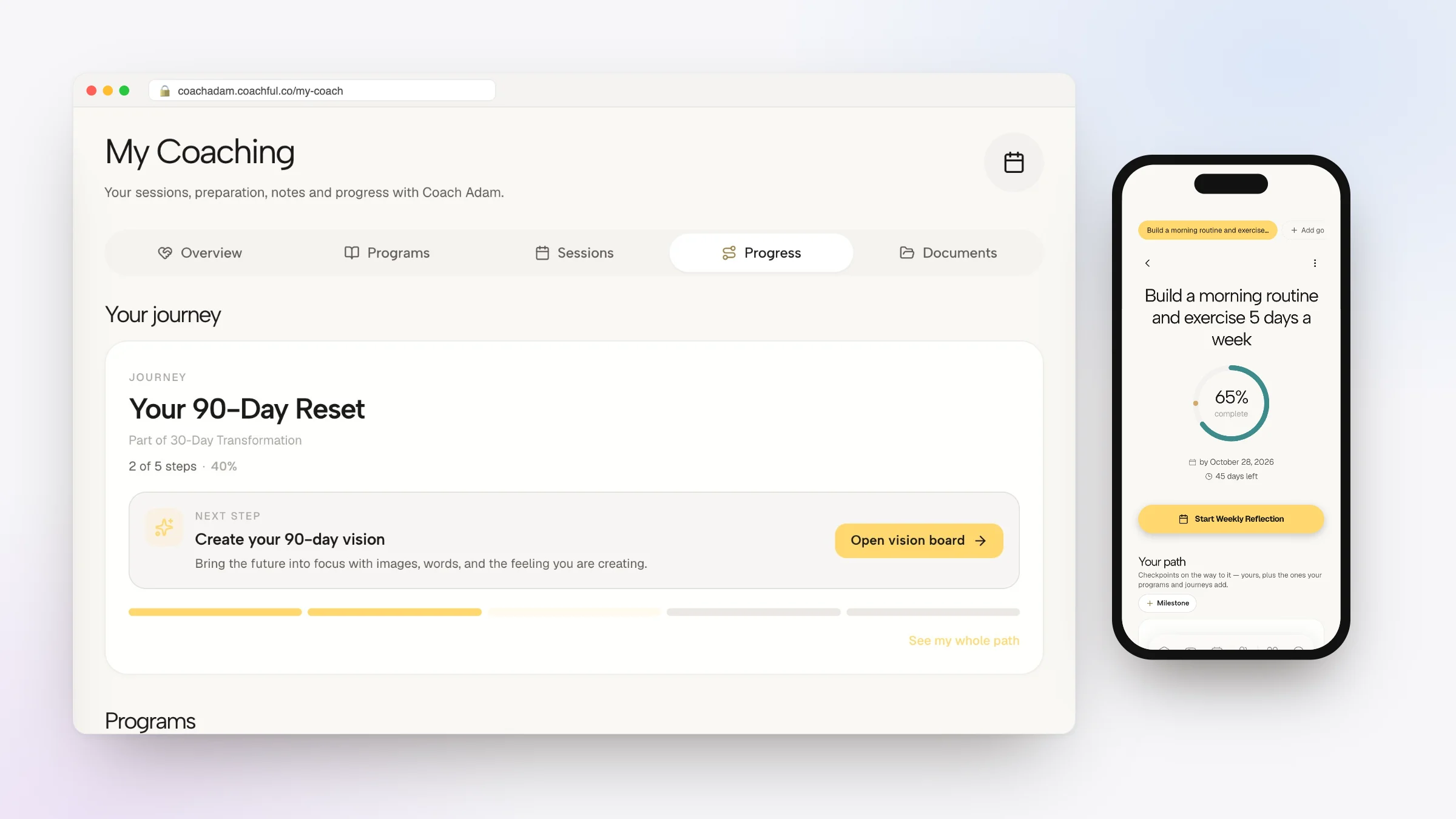
Journeys move a client through a sequence of steps over weeks, such as "Create your 90-day vision" followed by a goal-setting worksheet and a check-in. The client sees their progress and next step on their My Coaching page.

Turn worksheet answers into the plan
When you build the PDP as a worksheet, set the goal, habit and identity questions to Use answer in…. After finishing, the client reviews and saves each answer as a goal, task, habit or identity statement, so the plan appears in their app instead of a document they'll never reopen.
Close the engagement with their story
At the end of an engagement, a closing flow builds the client's coaching story from their goals and milestones, sessions, habit days and check-ins, then asks what they'll keep, begin and release. It's the quarterly review, done once more, with everything they've done in front of them.

Or let our team build it
Coachful's team will build the PDP worksheet, a 90-day development journey or a full program in your account for free, on every plan. Ask from Create > We'll build it for you; the team usually replies within about 24 hours. Here's what the white-glove service includes. Our guides to coaching goal setting and the 12-week coaching program template show how to structure the sessions, and Coachful for life coaches shows the full setup.

Frequently asked questions
What is a personal development plan?
A written plan for growing in the areas of life you choose. It usually includes a review of where you are now, your values, a vision for the next year, two or three goals, the skills and habits behind each goal, likely obstacles with plans for them, support and review dates.
How do I write a personal development plan?
Score your life areas, name your top five values, write a 12-month vision, choose two or three goals, list the skills and habits each needs, plan for obstacles and support, then set milestones and book weekly, monthly and quarterly reviews. The template on this page follows those steps.
What are examples of personal development goals?
"Exercise three times a week for 12 weeks in a row," "Finish a beginner pottery course and make 12 pieces by June 30," "Read 12 books this year," "Hold a 10-minute conversation in Spanish by December." Good ones are specific, measured and tied to something you value.
What are the 5 areas of personal development?
There's no single official list. A common split is mental, physical, emotional, social and spiritual development. The template here uses eight life areas (health, career, money, relationships, personal growth, fun, home and purpose) so nothing important is missed.
How long should a personal development plan be?
One or two pages. If it's longer, you've probably written too many goals. A 12-month plan with quarterly milestones, or a 90-day version, is easier to keep than a five-year plan.
What is the difference between a personal development plan and an individual development plan?
An individual development plan is usually a workplace document agreed with a manager, focused on skills for your current and next role. A personal development plan covers any part of your life and belongs only to you. Many people keep both.
Can Coachful build a personal development plan template for my clients?
Yes. The white-glove service is free on every Coachful plan. Ask from Create > We'll build it for you and the team will build the PDP worksheet, a development journey or a full program in your account, usually within about 24 hours.












