
70 Self-Reflection Questions, From Daily to Yearly
Self-reflection questions are short questions you ask yourself to understand what happened, why it mattered and what you'll do next. The useful ones are specific, answerable in a few minutes and end in a choice rather than a verdict on yourself. Below are 70 self-reflection questions organized by when to use them (daily, weekly, monthly and yearly) and by life area, plus how to reflect without spiralling, a filled-in weekly example and a simple routine to keep it going.
If you're a coach looking for questions to give clients, the last section shows how these run inside a client app, and Coachful's team will set up a weekly reflection for your clients in your account for free. If you want writing prompts for longer journaling sessions instead, see our journal prompts for self-reflection.
Reflection versus rumination: why some questions help and some hurt
Turning inward isn't automatically good for you. In a 1999 study, psychologists Paul Trapnell and Jennifer Campbell separated two kinds of self-attention that earlier research had lumped together: reflection, driven by curiosity, and rumination, driven by threat and worry. Their work helped explain a puzzle: people who pay close attention to themselves tend to know themselves better, yet they also report more distress. The difference was in how they paid attention.
So the shape of the question matters. Compare:
| Ruminating version | Reflective version |
|---|---|
| Why do I always mess this up? | What happened just before it went wrong? |
| What's wrong with me? | What was I needing in that moment? |
| Why can't I be more disciplined? | When have I been consistent, and what was different then? |
| Why did they treat me like that? | What do I want to do about it now? |
| Will I ever figure this out? | What's one thing I understand now that I didn't a month ago? |
Three habits keep reflection on the useful side. Time-box it (five minutes daily, twenty minutes weekly). Write the answers down rather than turning them over in your head. And end every session with one small next step, even if it's "rest tonight".
Daily self-reflection questions (five minutes)
Pick two or three at the end of the day. You don't need to answer all of them.
- What went well today, and what part did I play in it?
- What drained my energy today?
- What did I avoid, and what was I avoiding feeling?
- When did I feel most like myself?
- What did I learn today?
- If I could replay one moment, what would I do differently?
- Who do I want to thank?
- What's the one thing that matters most tomorrow?
Weekly self-reflection questions (twenty minutes)
A weekly review is where reflection pays off most, because a week is long enough to see a pattern and short enough to change course.
- What did I do this week that I'm proud of?
- What did I say yes to that I wish I'd said no to?
- Where did my time actually go?
- What progress did I make on the goal that matters most?
- What got in the way?
- What did I keep putting off?
- Which relationship did I invest in, and which did I neglect?
- How did I look after my body?
- What will I do differently next week?
- What's my one focus for next week?
Writing it down does more than it seems. A 2016 meta-analysis of 138 studies found that monitoring progress toward a goal helped people reach it, and the effect was larger when the progress was physically recorded or reported to someone else.

A filled-in weekly reflection
Here's what a real-feeling weekly review looks like for someone working on a career change. Notice how short the answers are.
| Question | Answer |
|---|---|
| What am I proud of? | Sent two messages to people in UX roles. One replied and offered a call. |
| What did I say yes to that I regret? | Covering a colleague's Friday shift. Lost my portfolio afternoon. |
| Where did my time go? | Work, the gym three times, far too much scrolling after 10pm. |
| Progress on my main goal? | Portfolio case study is about 40% done. Behind where I wanted. |
| What got in the way? | I wait until I have a free afternoon. I never have one. |
| What will I do differently? | Forty-five minutes before work on Tuesday and Thursday, laptop open the night before. |
| One focus for next week? | Finish the research section of the case study. |
The insight is in row five. "I wait for a free afternoon" is a pattern, and row six is a specific fix for it. If your reflection produces a goal, our SMART goals template will help you write it so you can measure it.
Monthly self-reflection questions
- What changed for me this month?
- Which habits held, and which slipped?
- What am I tolerating that I could change?
- What did I learn about myself?
- Is my money going to the things I say I value?
- What do I want more of next month, and less of?
- Who influenced me most this month, for better or worse?
- What will I start, stop and continue?
Yearly self-reflection questions
Give these an hour, ideally somewhere other than your desk. The Wheel of Life is a good warm-up: our free Wheel of Life assessment scores eight areas so you can see where to look first, and our guide to the Wheel of Life explains how to read the result.
- What were the three best moments of this year?
- What was the hardest thing, and what did it teach me?
- What did I outgrow?
- Which goals did I reach, and which no longer matter to me?
- Where did I grow the most?
- What am I most grateful for?
- What do I want to be true a year from now?
- What am I leaving behind with this year?
- Who do I want to spend more time with?
- If I chose one word for next year, what would it be?

Self-reflection questions by life area
Work and career
- Which parts of my work give me energy, and which drain it?
- Am I learning, or coasting?
- What would people I work with say I'm best at?
- What does success at work mean to me, in my own words?
- What would I try if I weren't worried about looking foolish?
- If I left tomorrow, what would I miss?
- What skill do I want to be known for in three years?
For a structured version at work, an individual development plan turns these answers into objectives your manager can support.
Relationships
- Who do I feel most myself around?
- What do I need from the people closest to me that I haven't asked for?
- Where am I keeping score?
- How do I act when I feel hurt?
- Who have I lost touch with that I miss?
- What kind of friend have I been lately?
Health and energy
- What does my body need that I keep ignoring?
- When do I feel most rested?
- What do I reach for when I'm stressed?
- What one small change would help my sleep?
- How do I talk to myself when I'm tired?
Values and purpose
- What matters most to me, and does my calendar show it?
- When did I last act against my values, and what pushed me there?
- What would I like to be remembered for?
- What do I believe that I've never questioned?
- What am I doing out of habit rather than choice?
- What would make this year feel meaningful?
If these are hard to answer, start with our core values assessment and come back.
Patterns, fears and beliefs
- What story do I keep telling about myself?
- What am I afraid would happen if I changed?
- What pattern keeps repeating in different places?
- What would I tell a friend in my situation?
- What am I pretending not to know?
- What would I do if I trusted myself a little more?
The deep end
- Who am I when nobody is watching?
- What do I want, if no one else's opinion counted?
- What am I ready to forgive, in myself or someone else?
- What would my future self thank me for doing now?
A simple self-reflection routine you'll actually keep
- Attach it to something you already do. After brushing your teeth at night, or with Sunday morning coffee. A fixed cue beats willpower.
- Use the same three questions daily. Variety is fun, but the same questions make patterns visible. Try 1, 2 and 8.
- Do the weekly review on paper or in an app, never in your head. Writing slows you down enough to notice things.
- Stop when it turns into rumination. If you're on your third "why" about the same thing, switch to "What's one thing I can do?" and close the notebook.
- Review the reviews monthly. Reading four weeks of answers together is where the real insight sits.
If something you uncover is heavy (grief, trauma, thoughts of harming yourself), reflection questions aren't the right tool on their own. Talk to a licensed mental health professional, or in the US call or text 988.

Self-reflection questions for coaches to use with clients
Coaches use self-reflection questions in two places: inside the session, and between sessions so the client arrives having already noticed something. The between-session part is where most of the value is lost, because a question sent by email gets answered once and forgotten. Here's how it runs inside Coachful, all included in your membership.
A weekly reflection built into every goal
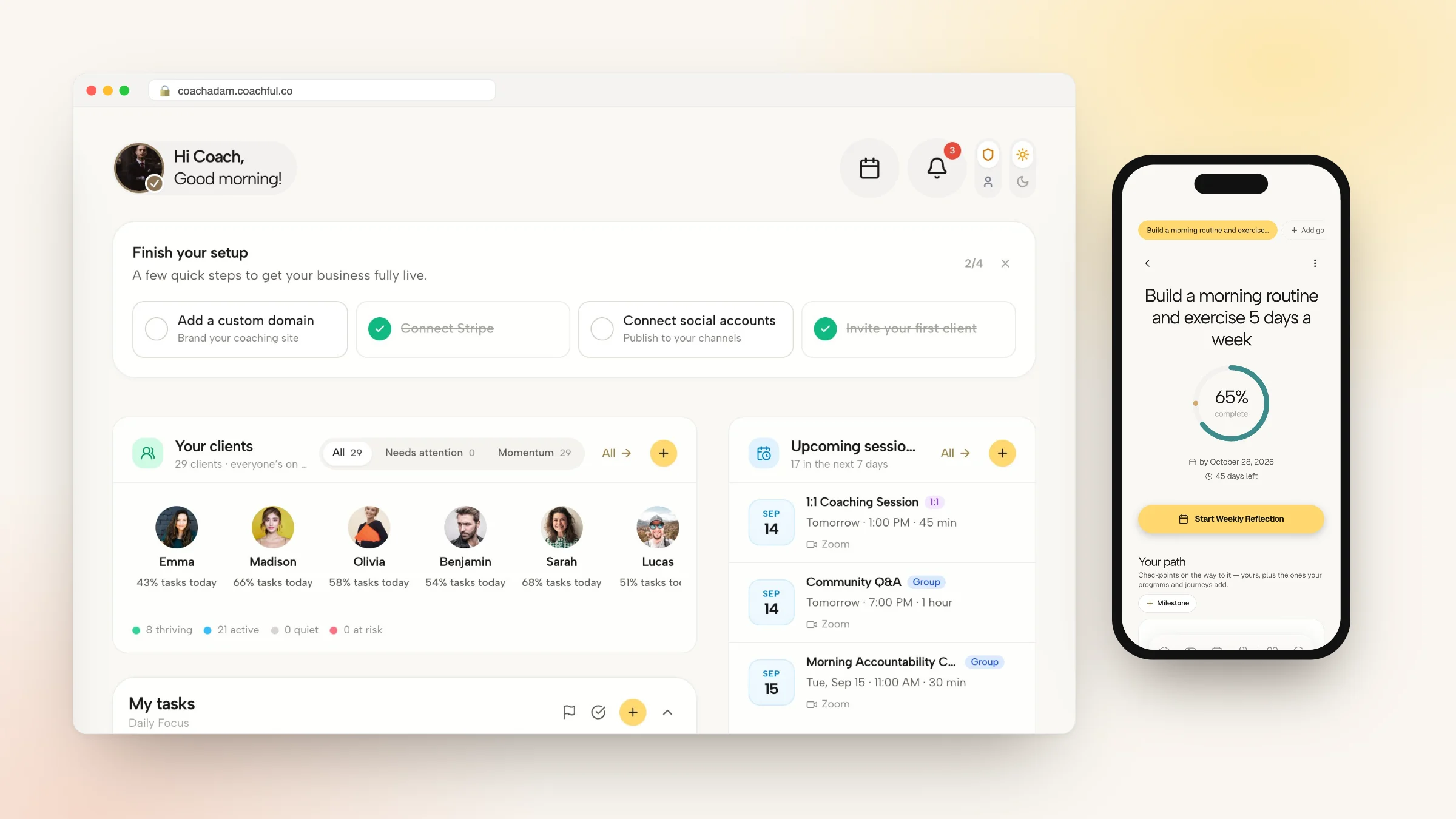
Each client goal has a Start Weekly Reflection button that opens in a window you control (Friday to Monday by default). It asks whether they're on track, how far along they are, what went well, their biggest obstacle, what they'll do differently next week and their focus for next week, which is most of the weekly list above. The answers land on their client record, and you can reply to a reflection from there.
An evening check-in for the daily questions
The default evening check-in asks how the day went against the tasks they planned, how the day was overall (from Tough day to Great day!), and "Anything you'd like to reflect on?", typed or spoken. You can edit any step or build your own flow with the questions you prefer from this list.
See the pattern across your roster
The Clients overview shows reflections and mood across all your clients, including how many said they were on track, not sure or off track, and who to check in on.

Make reflection a habit, not a homework task
A daily journaling or reflection habit with a reminder sits in the client's Growing Habits list and can count toward the streak you configure. Clients see their own progress, which is part of what keeps them going.

Have our team set it up
Coachful's team will build your reflection check-ins, a reflection worksheet or a whole program in your account for free, on every plan. Ask from Create > We'll build it for you; the team usually replies within about 24 hours, and you can edit everything afterwards. Here's what the white-glove service includes. Our guide to keeping clients engaged between sessions covers the rest of the weekly rhythm, and Coachful for life coaches shows the full setup.

Frequently asked questions
What are good self-reflection questions to ask yourself?
Good ones are specific and lead to a choice: "What drained my energy today?", "What did I say yes to that I wish I'd said no to?", "What pattern keeps repeating?" and "What's my one focus for next week?" Avoid questions that only invite self-criticism, such as "What's wrong with me?"
What is the difference between self-reflection questions and journal prompts?
Self-reflection questions are short and quick to answer, often in a line or two, and work well on a daily or weekly rhythm. Journal prompts invite longer writing about one theme. Many people use both: three reflection questions every evening, and a longer prompt once or twice a week.
How often should I do self-reflection?
Five minutes daily and twenty minutes weekly is a sustainable rhythm for most people, with a longer monthly and yearly review. The weekly review matters most: it's long enough to show a pattern and short enough to change course quickly.
How do I self-reflect without overthinking?
Time-box it, write the answers down, and use "what" questions instead of "why" questions about your flaws. If you notice yourself asking the same painful question for the third time, switch to "What's one thing I can do about this?" and stop for the day.
What are self-reflection questions for work?
Try: Which parts of my work give me energy? Am I learning or coasting? What would colleagues say I'm best at? What does success at work mean to me? What skill do I want to be known for in three years? They make good preparation for a performance review or a development plan.
Can a coach help with self-reflection?
Yes. A coach asks the follow-up question you wouldn't ask yourself and notices patterns across weeks. Coaching isn't therapy, though: if reflection brings up trauma, depression or anything that feels unsafe, a licensed mental health professional is the right person to talk to.
Will Coachful set up a weekly reflection for my coaching clients?
Yes. Coachful's white-glove service is free on every plan. Ask from Create > We'll build it for you, describe the reflection questions and schedule you want, and the team builds it in your account, usually within about 24 hours.












