
Individual Development Plan: Template, Examples and Steps
An individual development plan (IDP) is a written plan, usually agreed between an employee and their manager, that sets out career goals, the skills to build next, and the specific learning activities, support and deadlines to get there. The U.S. Office of Personnel Management describes it as a tool to help employees reach personal and professional development goals, and as a partnership between employee and supervisor rather than a performance evaluation. Below is a copyable individual development plan template, two filled-in examples, a six-step process, questions for the IDP conversation and common mistakes.
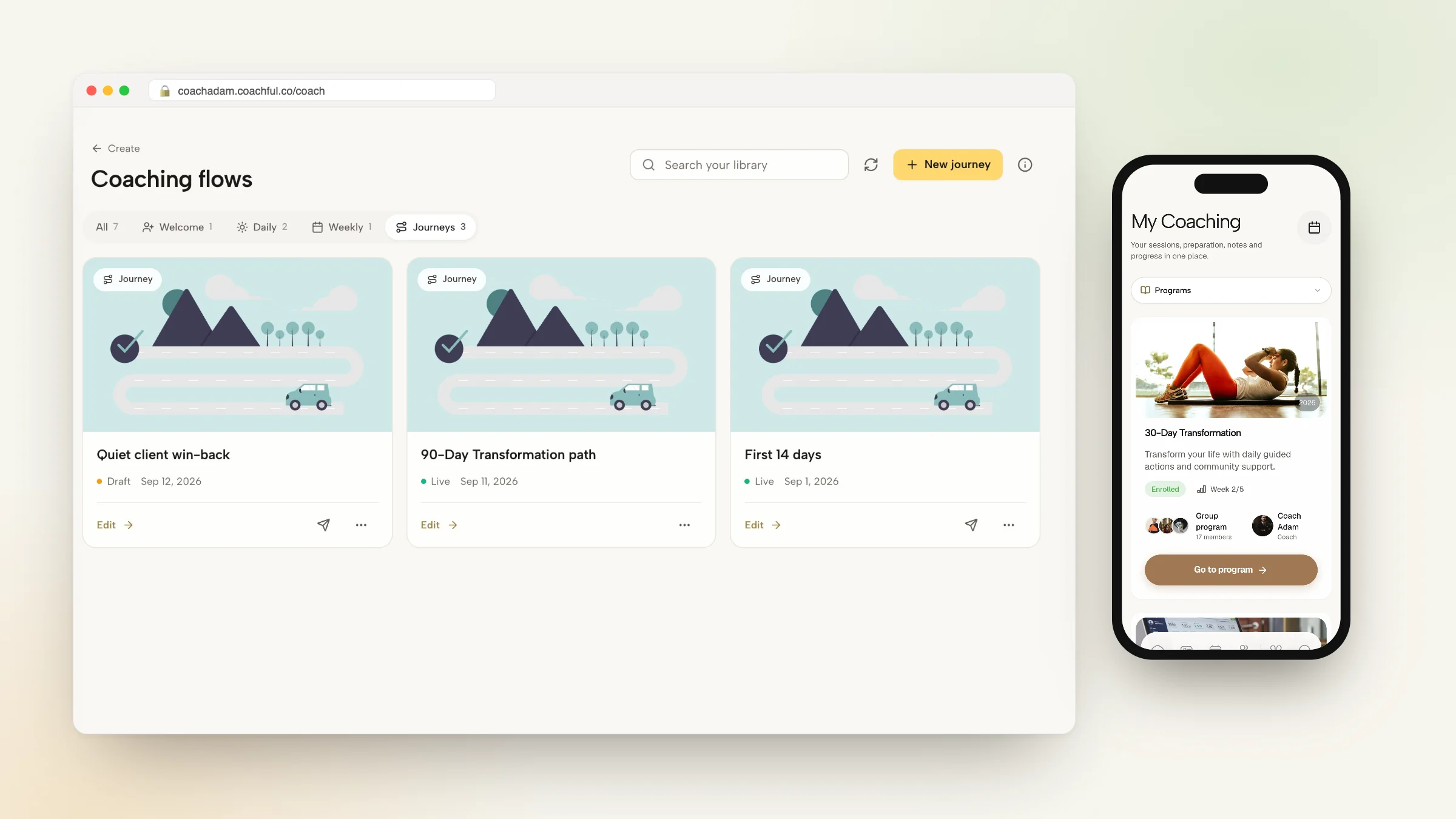
If the plan is for your life outside work as well, a personal development plan is the broader version. Coaches who run IDPs with clients will find a section at the end on doing it in Coachful, where our team will build the template in your account for free.
What an individual development plan includes
OPM's career development guidance lists the key elements an effective IDP should include at minimum:
- Employee profile: name, position title, office and grade or pay band.
- Career goals: short-term and long-term goals with estimated and actual completion dates.
- Development objectives: linked to the work unit's goals and the employee's development needs.
- Training and development opportunities: the activities the employee will pursue.
- Signatures: employee and supervisor, with the date.
The same guidance notes that many agencies require IDPs and encourage employees to update them annually. University templates follow a similar shape. The University of California, Irvine's staff IDP template asks for each objective's expected outcomes, planned actions, the person responsible and the time frame, and marks each objective as development for the current role (performance) or for a future one (career).
IDP vs personal development plan vs performance review
| Compared on | Individual development plan | Personal development plan | Performance review |
|---|---|---|---|
| Purpose | Grow skills for the current role and the next one | Grow in any area of life you choose | Assess past performance |
| Who owns it | Employee, agreed with manager | You | Manager and organization |
| Time frame | Usually 6 to 12 months, reviewed quarterly | Often 3 to 12 months | Looks back over the review period |
| Typical contents | Career goals, development objectives, activities, support, dates | Vision, values, goals across life areas, habits | Ratings, achievements, feedback |
| Linked to pay? | Usually not | No | Often |
Keep the IDP separate from the performance review if you can. Employees write more honest development needs when the document isn't also deciding their raise.
Individual development plan template
Copy this into a document. Fill in parts 1 to 3 yourself before meeting your manager, then complete part 4 together.
Part 1: Profile
| Field | Your answer |
|---|---|
| Name, role, team | |
| Manager or mentor | |
| Plan period (start and end dates) |
Part 2: Career goals
| Goal | Your answer | Target date |
|---|---|---|
| Short-term (next 12 months) | ||
| Long-term (3 to 5 years) |
Part 3: Self-assessment
| Question | Your answer |
|---|---|
| Strengths I want to use more | |
| Skills or knowledge gaps for my current role | |
| Skills I'll need for my long-term goal | |
| Work that gives me energy, and work that drains me | |
| Feedback I've received more than once |
Part 4: Development objectives and actions
| # | Performance (P) or career (C) | Objective: what will I develop? | Expected result | Planned actions and activities | Support and who's responsible | Time frame | Status |
|---|---|---|---|---|---|---|---|
| 1 | |||||||
| 2 | |||||||
| 3 |
Part 5: Review and sign-off
| Field | Answer |
|---|---|
| Review dates (at least quarterly) | |
| Employee signature and date | |
| Manager signature and date |

How to create an individual development plan in six steps
- Do the self-assessment honestly. Fill in part 3 alone. Look at past reviews, project feedback and what colleagues ask you for. If you've never named your strengths, our strengths-based coaching questions are a good prompt list, and our self-reflection questions for work help with the rest.
- Write career goals you actually want. "Become a team lead" is fine. So is "stay a senior engineer and become the person others ask about architecture." The IDP is for your direction, not the org chart's default.
- Talk it through with your manager. Bring parts 1 to 3. Ask what they see as your strengths and gaps, what the team will need in a year, and which opportunities are realistic.
- Pick two or three development objectives. Each objective names a skill and a visible result: "Learn to run stakeholder meetings, so that I can lead the Q3 planning meeting without my manager in the room."
- Choose activities from three kinds of learning. Mix on-the-job experience (a stretch project, leading a meeting), learning from people (mentoring, shadowing, feedback) and formal learning (a course, a book, a certification). Make sure every objective has at least one real assignment attached, so you practise the skill on actual work rather than only learning about it.
- Set dates, measures and reviews. Give each objective a time frame and agree to review progress at least quarterly, with a full update once a year.
Individual development plan examples
Example 1: a new people manager
Short-term goal: become a confident manager of a team of five within 12 months. Long-term goal: lead a department of 20 to 30 people within five years.
| Objective | Expected result | Actions | Support | Time frame |
|---|---|---|---|---|
| (P) Run effective one-to-ones | Fortnightly one-to-ones with all five reports; each report can name one thing they're working on | Use a standard five-question agenda; ask for feedback on the meetings in month 3 | Manager reviews agenda; HR's new manager course | Start now, review in 3 months |
| (P) Give difficult feedback early | Two difficult conversations held within a week of the issue | Practise with a mentor using real scenarios; prepare notes before each | Mentor from another department | By end of Q2 |
| (C) Understand budgets | Build and present next year's team budget | Shadow the finance partner during planning; draft the budget with manager review | Finance partner, manager | Budget cycle, Q4 |
Example 2: a data analyst aiming for a senior role
Short-term goal: promotion to senior analyst at the next review. Long-term goal: lead analytics for a product line.
| Objective | Expected result | Actions | Support | Time frame |
|---|---|---|---|---|
| (P) Own an analysis end to end | Deliver one analysis from question to recommendation, presented to the product team | Pick a live question with the product manager; weekly check-ins with lead | Analytics lead | By end of Q2 |
| (P) Write for non-technical readers | Two one-page summaries that stakeholders act on without a meeting | Rewrite two past reports; get feedback from one stakeholder each | Product manager | Q2 and Q3 |
| (C) Experimentation skills | Design and analyze one A/B test | Complete an internal or online course; pair with a senior analyst on a test | Senior analyst, training budget | By end of Q3 |
Notice that every objective ends in something other people can see. That's what makes the plan easy to review and hard to quietly drop.

Development activity ideas for your IDP
| Doing the work | Learning from people | Formal learning |
|---|---|---|
| Lead a project or a meeting series | Monthly mentoring sessions | A course with an assessment |
| Cover for your manager during leave | Shadow someone in the role you want | A professional certification |
| Join a cross-functional team | Ask three colleagues for feedback on one skill | Two books on the skill, with notes |
| Present to senior leaders | Work with a coach | A conference or workshop |
| Train a new hire | Join a peer learning group | An internal training program |
Questions for the IDP conversation
For employees to ask, and for managers to ask in return:
- What do you see as my strongest contribution to the team?
- What's one skill that would make the biggest difference in my current role?
- Where do you see the team's needs in a year, and where could I fit?
- What would someone in the role I want be doing that I'm not doing yet?
- Which projects coming up could stretch me?
- Who should I learn from, inside or outside the team?
- What support or budget is realistic for training this year?
- How will we both know this plan is working?
- How often should we review it?
- What's one thing I should stop doing?
For leaders, our leadership coaching topics map common development objectives to practice ideas.
Why individual development plans work, when they work
An IDP is a goal-setting tool, and it benefits from the same research. Edwin Locke and Gary Latham's review of 35 years of goal-setting studies found that specific, challenging goals led to higher performance than "do your best", and that goals combined with feedback on progress beat goals alone. For new, complex skills, they found that specific learning goals and near-term checkpoints helped more than a distant outcome goal. That's the case for objectives that name a skill, a visible result and a quarterly review. A 2016 meta-analysis of 138 studies adds that monitoring progress promotes goal attainment, especially when progress is recorded or reported to someone.
The plans that fail usually fail in the same places: no time set aside, no review, and objectives written to please the manager rather than the employee.
Common IDP mistakes
- A list of courses instead of a plan. Training is one activity, not the objective. Tie every course to a result you'll show at work.
- Too many objectives. Two or three per year is plenty alongside a full-time job.
- No time in the calendar. If the plan needs two hours a week, block them before you sign it.
- Filed after the meeting. Book the quarterly reviews when you write the plan.
- Only the manager's goals. If the long-term goal isn't yours, the plan will feel like homework.

Running individual development plans with coaching clients in Coachful
Executive, leadership and career coaches often build an IDP with a client in the first sessions, sometimes alongside the client's manager or HR sponsor, then use coaching to work on the objectives. Our guide to stakeholder alignment meetings in executive coaching covers the sponsor side. Here's how the plan runs in Coachful, all included in your membership.
The template as a worksheet
Build the IDP template as a worksheet (Create > Resources > Forms & Worksheets), with a fillable table for the objectives. A worksheet is a saved, reviewable document the client can return to and edit, and, if you allow it, download as a PDF to share with their manager. Tools > Explore also includes a Professional development plan tool built for coaches' own development, which you can make your own and adapt for clients.

Objectives become goals with milestones
Each development objective can become a goal in the client's app, with a target date, progress and a milestone path for the quarterly checkpoints. Set worksheet questions to Use answer in… a goal or task and the client reviews and saves each one after completing the plan.
Sessions, notes and a weekly reflection
Your session notes build into a running summary the client can read, and each goal's weekly reflection asks whether they're on track, what went well, the biggest obstacle and what they'll do differently next week. Before a call, Brain's Prepare for a client brings together their context, progress and what to discuss next.

Power-ups for career and executive coaching
The Career Coaching power-up adds connections, applications, CV and LinkedIn planning; the Executive Coaching power-up adds its own specialist workspace and templates. See Coachful for executive coaches and for career coaches.
Your own development plan, too
Coaches have IDPs as well. Coachful's Coach development panel tracks your hours and clients from completed sessions against the ICF credential thresholds, visible only to you, as a head start on your log.
Or let our team build it
Coachful's team will build the IDP worksheet, a leadership development program or the review check-ins in your account for free, on every plan. Ask from Create > We'll build it for you; the team usually replies within about 24 hours. Here's what the white-glove service includes.

Frequently asked questions
What is an individual development plan?
A written plan, usually agreed between an employee and their manager, that sets out short- and long-term career goals, the skills to develop, the activities and support to develop them, and dates. OPM describes it as a partnership between employee and supervisor and notes it isn't a performance evaluation tool.
What should be included in an individual development plan?
At minimum: a profile, short-term and long-term career goals with dates, development objectives linked to the team's needs, the training and development activities you'll do, and signatures. Good plans also include expected results, who's responsible for support and quarterly review dates.
What is an example of an IDP goal?
"Learn to run stakeholder meetings so that I can lead the Q3 planning meeting without my manager in the room, by shadowing two meetings in Q2 and leading one with feedback." It names the skill, the visible result, the activities and the time frame.
How often should an IDP be updated?
Review progress at least quarterly and update the plan once a year. OPM notes that many federal agencies encourage employees to update their IDPs annually. Update it sooner if your role, team or goals change.
Who writes the individual development plan, the employee or the manager?
The employee drafts it and owns it; the manager reviews, adds context and commits to support. Writing the self-assessment alone first, then meeting, gives the most honest plan.
Is an IDP the same as a performance improvement plan?
No. A performance improvement plan addresses specific performance problems, usually with consequences if they aren't fixed. An IDP is developmental: it builds skills for the current role and future ones, and works best kept separate from performance ratings.
Can Coachful build an IDP template for my coaching clients?
Yes. The white-glove service is free on every Coachful plan. Ask from Create > We'll build it for you and the team will build the IDP worksheet, a development program or quarterly review check-ins in your account, usually within about 24 hours.












