Coaching Accountability: Strategies That Work

Coachful
The most popular advice about coaching accountability is also the least useful: tell clients to try harder, stay motivated, and remember what they committed to. That advice leaves the coach carrying the emotional burden when the client stalls, while ignoring the practical conditions that make follow-through possible.
Clients usually don't abandon a goal because they suddenly stop caring. More often, the action was vague, ownership was assumed rather than recorded, and nothing brought the commitment back into view after the session. Effective coaching accountability is less about policing motivation and more about designing a system where the next action is visible, measurable, and easy to review.
Redefining Coaching Accountability for Real Change
A client says they want to change. They agree enthusiastically during the session. Then the call ends, daily demands return, and the commitment disappears into a notebook, an email thread, or memory. The coach starts wondering, “Did I fail to motivate them?” That question points in the wrong direction.
A more useful question is, “What structure would help this person act when motivation is no longer present?”
A 2026 coaching-programme guide argues that the gap in client follow-through is rarely a lack of care and is instead a lack of structure, particularly when reviews reopen decisions rather than measure movement. That distinction changes the coach's role. You're not trying to manufacture desire inside another adult. You're creating a reliable path from intention to action, then helping the client learn how to use it.
Motivation is not a complete operating system
Motivation can start a conversation, but it can't reliably manage reminders, clarify ownership, identify obstacles, or show whether a commitment was completed. A client may be fully committed to improving their business and still fail to send the proposal because the task wasn't defined, scheduled, or connected to a visible review point.
A weak accountability arrangement sounds like this:
“I'll work on my business development before our next session.”
A stronger arrangement identifies the action, owner, context, and review point:
“I'll draft the proposal after my Tuesday client call and mark it complete in our shared workspace before our next session.”
The second version gives both people something observable. If the action doesn't happen, you can examine the design rather than make a judgment about character.
Build the bridge between sessions
A useful accountability system answers four questions:
- What belongs to the client: The client owns the action, not the coach.
- What counts as completion: The behavior has a clear finish line.
- Where the action lives: Both people know where to find the commitment.
- When it will be reviewed: The next conversation measures movement instead of recreating the plan.
This is why a guide for leaders on accountability coaching can be useful alongside coaching psychology resources. It reinforces a practical principle that applies to individual coaching too, expectations work better when responsibility, support, and follow-up are explicit.
The coach's inner dialogue often says, “If I make the system too structured, I'll become a taskmaster.” In practice, the opposite can happen. A clear system reduces chasing because the client can see what they agreed to, and the coach can spend more time interpreting patterns, removing barriers, and developing judgment.
The Psychology Behind Client Follow-Through
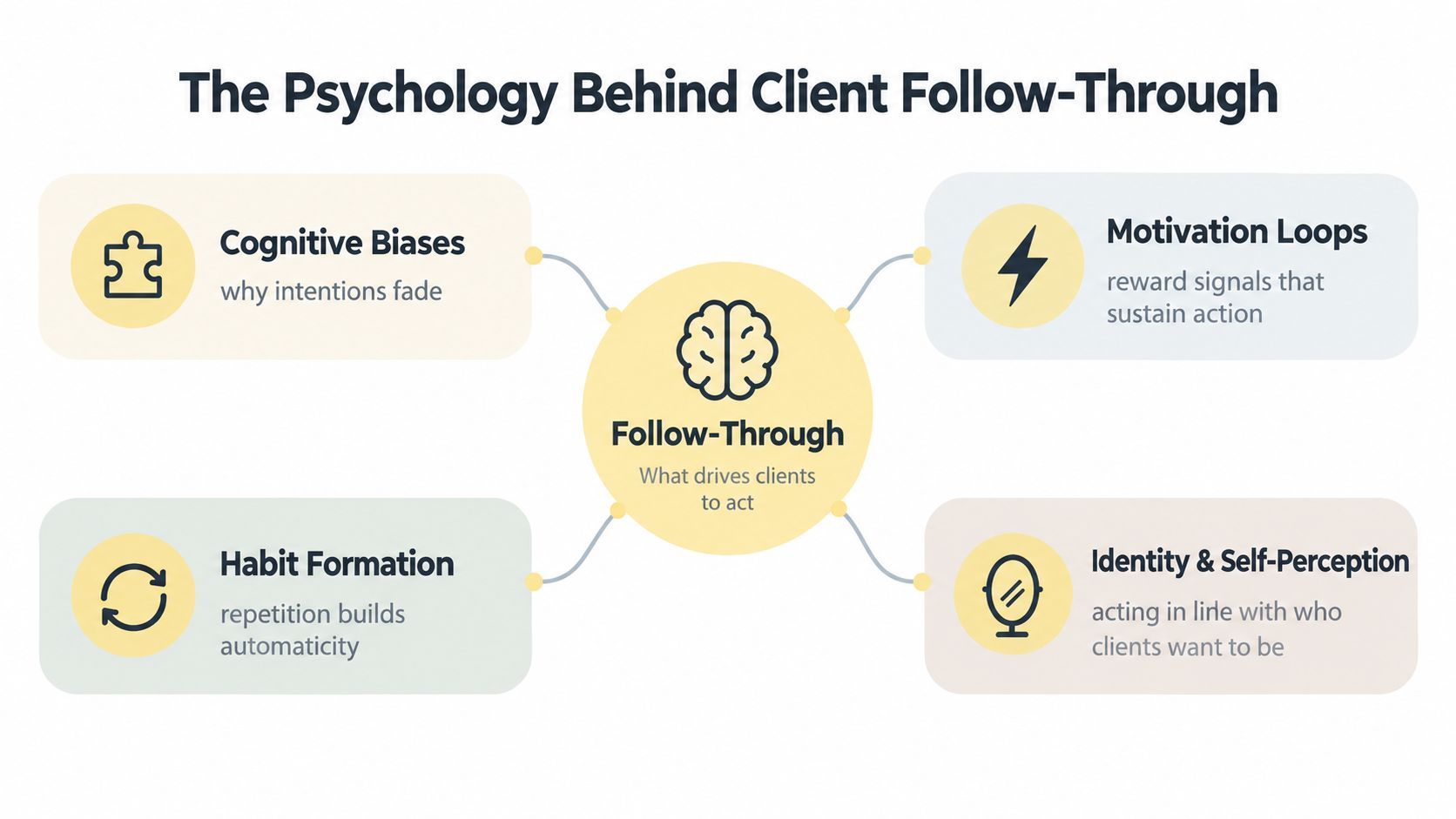
“My client has excellent intentions, so why aren't they acting?” The answer often lies in the gap between wanting an outcome and specifying the behavior that starts it.
An intention such as “I'll prospect more” requires the client to make several decisions in the moment. When will they prospect? Where will they do it? What exactly will they send? What will happen if an urgent message arrives first? Each unanswered question creates another opportunity for avoidance, distraction, or decision fatigue.
Implementation intentions close that gap by defining when, where, and how the behavior will occur. Research pooled from 94 studies covering more than 8,000 people found a medium-to-large effect on follow-through when implementation intentions specified those conditions in the research summary on accountability partner strategies.
Turn intention into a trigger-action script
A coach can ask, “What will remind you to begin?” rather than accepting a general promise. For example:
- Trigger: After opening email at 9:00 a.m.
- Context: At the client's desk, before checking social media.
- Action: Send two outreach messages.
- Evidence: Mark the task complete and note any response.
The trigger transfers some control from abstract motivation to a situation the client already encounters. If the plan still fails, the coach has useful information. Perhaps the trigger is unrealistic, the task is too large, or the client doesn't have the required resource. You can redesign the plan without labelling the client uncommitted.
Self-monitoring adds another layer. Content from the ACE behavior-change accountability guidance emphasizes tracking behavior, helping clients problem-solve, and observing how actions affect progress. The point isn't to collect data for its own sake. Tracking lets the client see patterns that memory tends to blur.
A business client might record outreach attempts, the time of day, and whether the action was completed. At review, the conversation becomes concrete: “What made the morning block easier to protect?” That is more productive than, “Why weren't you disciplined?”
Add a social reporting loop
Written commitments and regular progress reports create a social expectation that private intentions don't. The Dominican University goal-achievement study found that participants who wrote down goals, committed to action, and sent weekly progress reports to a friend achieved significantly more than participants who only thought about their goals the study presentation.
That doesn't mean every client needs public exposure. A short check-in to a coach can provide enough structure:
“This week I completed the proposal draft, missed the Tuesday outreach block, and will move it to Thursday morning because Tuesday meetings ran over.”
The coach can support this loop with follow-up reminders, but the reminder shouldn't carry the entire system. It should point to a commitment the client already defined and agreed to review.
Shifting From Outcome Tracking to Process Accountability
Outcome goals matter. Clients need a meaningful direction, whether that's improved health, stronger leadership, or a more stable business. The problem starts when the coach treats the outcome as the only measure of accountability.
A client may do the agreed work and still not see the desired result immediately. Market conditions can change. A prospect can decline. Energy, illness, timing, or other constraints can affect an outcome. If the review asks only, “Did you get the result?”, the client may conclude that effort was pointless even when the process was sound.
Research on coaching-style behavior change supports a process-oriented approach. Tracking specific target behaviors can increase completion, while outcome-only tracking can lower adherence because the client experiences less control over the process the 2011 model of supportive accountability.
Measure what the client can actually control
Suppose a client wants to improve fitness. “Lose 10 pounds” describes an outcome, while “walk 20 minutes after lunch four days this week and log it before Friday” defines a process. The process example comes from the accountability model and gives the coach a behavior to review, a routine to connect it to, and a clear opportunity to adjust the plan.
The same translation works in business coaching. “Grow revenue” is directionally useful but operationally thin. A process metric might be completing a defined prospecting block, reviewing a qualified pipeline, or sending a prepared proposal after a discovery call. The exact behavior should come from the client's strategy, capacity, and values.
Practical rule: Keep the outcome visible for meaning, but hold the client accountable for the next controllable behavior.
Compare the two approaches
| Outcome Goal | Process Accountability Metric | Tracking Method |
|---|---|---|
| Improve fitness | Complete the agreed movement routine and record it after each planned session | A simple habit log reviewed during coaching |
| Build a stronger sales pipeline | Complete the prospecting activity selected with the coach | A shared action list with completion status |
| Improve leadership communication | Prepare for and conduct a defined conversation using the agreed approach | A brief reflection submitted before review |
| Finish a strategic project | Complete the next documented deliverable by the agreed review point | A milestone tracker with notes on blockers |
The coach still needs to ask whether the outcome is moving. That question belongs in the review, but it shouldn't replace process evidence. If the client completed the agreed actions and the result lagged, you can examine strategy, timing, or assumptions. If the client didn't complete the actions, you can examine friction, clarity, and fit.
Co-define the standard
Don't impose process measures from above. Ask, “Which behavior would make the biggest difference?” and “What can you realistically control before we meet again?” Co-definition matters because the client must recognize the action as theirs, not as homework assigned by an authority figure.
A process metric also needs a reason. Explain how it connects to the larger goal, then ask for agreement. The client should know what they're doing, why it matters, how completion will be recorded, and when the two of you will review it. That structure turns accountability from an evaluation into a feedback loop.
Building a Supportive Accountability Framework
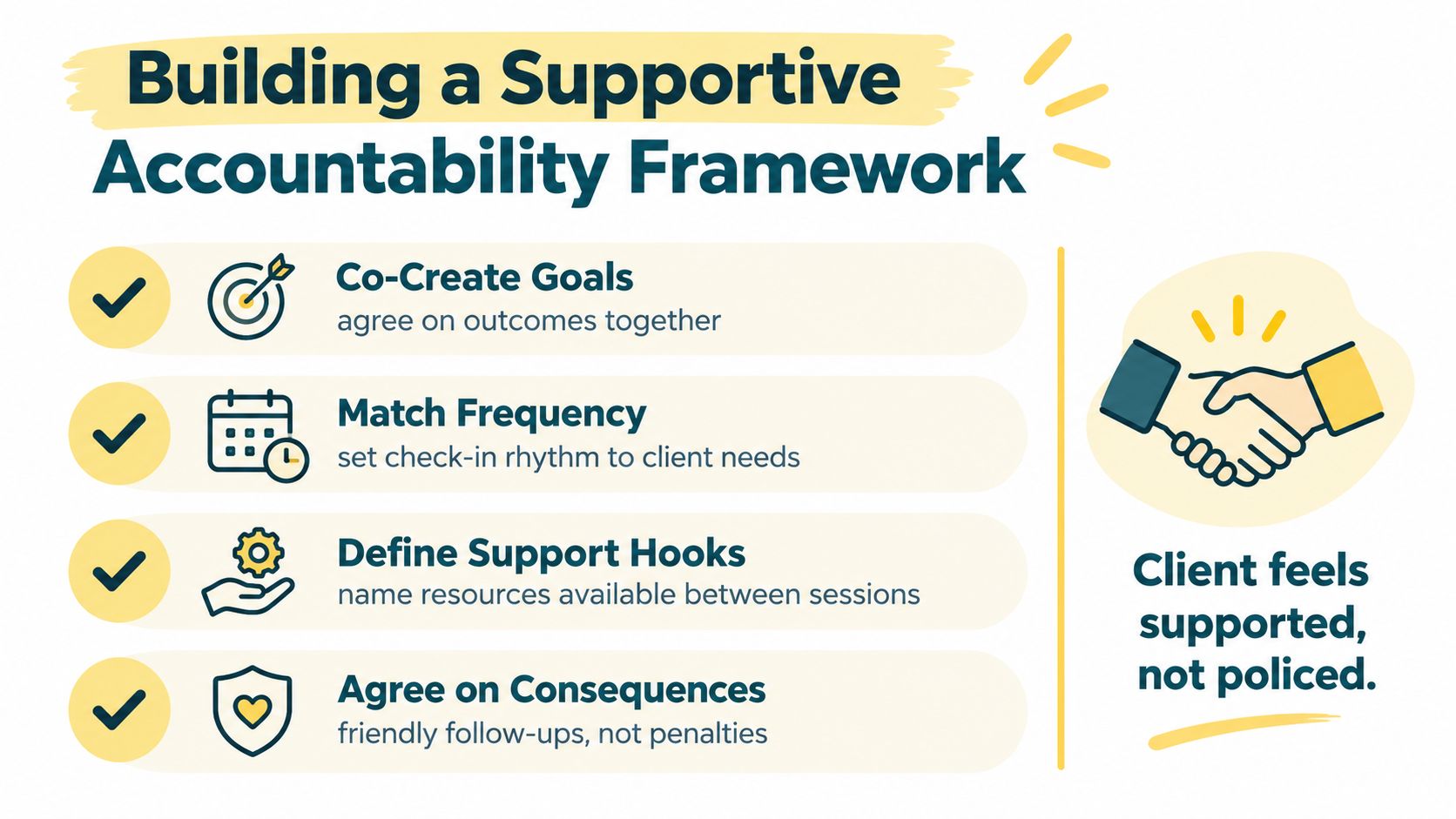
Clients often fear accountability because they've experienced it as criticism disguised as support. A coach may intend to be encouraging while the client hears, “You failed again.” The remedy isn't to remove standards. It's to agree in advance on how standards will be discussed.
A useful framework begins during onboarding or goal setting, before anyone misses a commitment.
Start with a co-created agreement
Ask questions such as:
- “What kind of follow-up helps you act without feeling pressured?”
- “If you miss an action, would you prefer a message, a question in our next session, or both?”
- “How quickly should we address a missed commitment?”
- “What support can I provide between sessions?”
- “What should I avoid because it makes you defensive or withdrawn?”
Deeper accountability includes asking how the coach should hold the client accountable in a way that sounds supportive rather than negative, and how to raise missed commitments without creating defensiveness coaching session guidance. This conversation is not a soft extra. It establishes the communication conditions under which the client can stay honest.
Use a practical agreement template
You can record the agreement in plain language:
My commitment: I will complete [observable action] by [date or review point].
My trigger: I will do it after [existing routine or cue].
My evidence: I will record [completion evidence] in [shared location].
Coach support: My coach will [specific support].
If I miss it: We will review what happened, identify the barrier, and revise the plan without pretending the commitment didn't matter.
A step-by-step accountability plan can help coaches turn this kind of agreement into a repeatable operating practice rather than an improvised conversation.
Match the rhythm to the work
The right check-in rhythm depends on the client's commitment, the complexity of the action, and the amount of support required. A small behavior may need a lightweight written check-in. A strategic project may need a milestone review with space to discuss decisions and blockers.
The important point is to decide the rhythm before the work begins. Don't wait for silence to become a problem. Define how the client will report, where you will respond, and what happens when circumstances change. A program accountability check-in workflow can support coaches who want this process embedded in a structured program.
Keep support distinct from rescue
Support might mean clarifying a task, sharing a resource, helping the client rehearse a conversation, or reviewing a barrier. It doesn't mean completing the work, repeatedly renegotiating every uncomfortable action, or sending endless reminders without examining the design.
The psychological contract should leave the client with ownership and the coach with a clear role. Both people know what they agreed to, how they will communicate, and how they will repair the process if it stops working.
Navigating Missed Commitments Without Breaking Trust
A client misses the action. The coach sees the blank check-in and feels the familiar pull toward one of two extremes: avoid the subject to protect rapport, or confront the client sharply to prove accountability matters. Neither response repairs the system.
Consider a client who agreed to prepare a difficult conversation with a senior colleague. At the next session, the preparation hasn't happened. The coach's first task is to separate the facts from the story. The fact is that the preparation wasn't completed. The story might be that the client is resistant, careless, or not serious.
Replace judgment with diagnosis
A useful opening could be:
“We agreed that you would draft the opening points before today. I don't see that draft. What got in the way?”
The question is direct, but it doesn't smuggle in a verdict. The client might explain that the conversation became emotionally charged, that the draft felt too vague, or that the planned time was consumed by an urgent issue. Each answer suggests a different intervention.
- If the task felt emotionally unsafe: Rehearse the first sentence together.
- If the task was vague: Define the required draft as three points and one request.
- If the timing failed: Attach the action to a more reliable routine.
- If the client avoided the decision: Explore the fear while preserving the commitment.
The coach can then say, “Given what we know now, is the original action still the right next step?” That question allows adaptation without lowering the standard.
Repair the loop in the same conversation
Don't end with a general promise to try again. Create a revised commitment with a visible completion signal. For example, the client might write the opening sentence during the session, schedule a rehearsal after an existing meeting, and submit a short reflection before the next check-in.
The client needs to experience two truths at once: the missed commitment matters, and the miss doesn't make them a bad or incapable person. A communication resource such as Documind's client communication guide can help coaches refine language for clear, respectful conversations.
“We aren't deciding whether you're accountable as a person. We're identifying why this action didn't happen and designing a plan that gives it a better chance.”
That distinction protects trust without making accountability optional. If misses continue, the pattern itself becomes material for coaching. The coach may need to revisit the goal, the client's capacity, the relationship agreement, or whether the work is aligned with what the client wants.

Operationalizing Accountability Inside Coachful
A sound accountability method can still fail when its records are scattered across email, spreadsheets, calendar notes, and memory. The coach then becomes the system. Every reminder depends on personal effort, every missed update requires manual chasing, and every session begins with a search for what happened last time.
A dedicated coaching workspace lets the structure carry more of the administrative load. Coachful brings programs, goals, milestones, session notes, resources, progress tracking, reminders, and client communication into a shared environment. A coach can use those capabilities to make commitments visible without turning the relationship into a stream of surveillance messages.
Design the workflow around behavior
A practical setup might look like this:
- Create the outcome and process milestone: Record the broader goal, then add the behavior the client owns before the next review.
- Attach the action to a program or milestone: Keep the commitment in the same place as relevant resources and session context.
- Set the check-in: Ask the client to report completion, obstacles, or evidence through a recurring check-in.
- Review the signal: Use notes and progress views to identify whether the barrier is clarity, capacity, timing, or strategy.
- Adjust deliberately: Change the action when the evidence supports a change, not because the client feels uncomfortable.

For a one-to-one client, the workflow might contain a weekly goal, a habit or action step, a reflection, and a milestone review. For a group program, the coach can structure shared assignments and cohort touchpoints while preserving individual progress information. The tool should reflect the coaching method, not replace it.
Meta-analytic evidence indicates that accountability systems work best when they shorten the feedback cycle between intention and review, supporting small commitments, recurring review, and immediate feedback dashboards the coaching accountability synthesis. The practical implication is simple: don't wait until the next major outcome to discover that execution stopped weeks earlier.
A platform such as Coachful's client accountability software can centralize these interactions so the coach doesn't have to reconstruct progress manually. Automation should handle reminders and visibility. The coach should handle interpretation, empathy, challenge, and judgment.
Turning Accountability Into Your Coaching Superpower
Accountability becomes a coaching superpower when it stops asking, “How do I make this client comply?” and starts asking, “What environment will help this client act with ownership?”
That shift changes the work in practical ways. You define process behaviors instead of relying on distant outcomes. You agree on how follow-up should feel before a difficult conversation occurs. You record commitments where both people can see them. You treat missed actions as information, then revise the system without erasing responsibility.
Audit your current practice by looking for three warning signs: commitments that live only in memory, outcomes that clients can't directly control, and reviews that reopen decisions instead of examining movement. Replace each one with a visible action, a clear evidence point, and a mutually agreed review.
The coach's job isn't to remove every obstacle. It's to build enough scaffolding that the client can see the next step, recognize what happened, and learn how to adjust. When the structure carries the reminders and records, you have more mental space for the work only a coach can do, helping clients think clearly, choose with integrity, and act with increasing independence.
Coachful gives coaches a structured workspace for programs, goals, milestones, session notes, resources, reminders, and client progress tracking, so accountability can continue between sessions without scattered administration. Visit Coachful to explore how it can support a more visible, supportive follow-through system in your practice.