
What Is Accountability Coaching? How It Works and Costs
What is accountability coaching? It is coaching built around follow-through. You and a coach agree specific commitments, you report progress on a fixed schedule (a short daily message, a weekly call, or both), and when something slips, the coach helps you work out why and adjusts the plan with you. The value is less about big insights and more about doing what you said you would, week after week, with someone paying attention.
Most people who look for an accountability coach already know what they should do. The gap is doing it on a wet Tuesday with nobody watching. This guide covers who accountability coaching suits, how it works, what a check-in looks like, how it compares with an accountability partner, a life coach or therapy, what the research supports, costs, and how to choose a coach. If you are a coach, the section near the end is for you.
Who accountability coaching is for
- Solo business owners and freelancers with no manager, who keep pushing the important-but-not-urgent work back.
- Writers, researchers and creatives finishing a long project: a book, a thesis, a portfolio.
- Job seekers who need to send applications and outreach every week, through the rejections.
- People building health habits such as exercise, sleep or cooking, alongside any medical advice they have.
- People with ADHD who find external structure helpful. ADHD coaching is a specialty of its own; see our guide to ADHD coaching.
- Anyone restarting a goal they have tried and dropped before.
It suits people less well when the goal itself is unclear (start with a life or career coach), when they want to be punished into action (that rarely lasts), or when low mood or anxiety is the real obstacle, which is a job for a licensed professional. Our guide to life coach vs therapist helps you tell the difference.
How accountability coaching works
- A setup session. You agree the goal, why it matters, and what has gone wrong in past attempts.
- Specific commitments. Small, scheduled and checkable: "write 500 words before 9 a.m., Monday to Thursday", not "write more".
- A check-in rhythm. How often you report, where, and how fast the coach replies.
- Tracking. A habit tracker, a goal with milestones, a shared document, or the coach's client app.
- Misses handled as information. When you skip, the coach asks what got in the way and helps you change the plan, the trigger or the size of the step.
- Regular reviews. Every four to six weeks, look at the record and decide what to keep, drop or raise.
| Check-in rhythm | What it looks like | Suits |
|---|---|---|
| Daily message | A one-line report each day, often with a short reply | Daily habits, starting a new routine |
| Mid-week nudge | One message on a fixed day: "How's the plan holding up?" | Weekly targets that drift by Thursday |
| Weekly call | 15 to 30 minutes: review, learn, plan | Projects, job searches, business goals |
| Group call | A short call with others reporting their week | People who like a bit of peer pressure |
| Monthly review | A longer session looking at the whole month's record | Everyone, on top of the above |

What makes a commitment worth being held to
Most accountability fails at the commitment, not the check-in. Before you agree one with a coach, run it past five tests:
- Specific: someone else could tell whether you did it.
- Small: you could do it on a bad day, even if not well.
- Scheduled: it has a day and a time, ideally attached to something you already do ("after the school run").
- Visible: it lives somewhere you will see it, such as a habit tracker or a calendar block.
- Reported: you know when and how you will tell the coach.
If a commitment fails two of these, shrink it until it passes. The free SMART goal worksheet helps with the first three, and our habit tracker template covers the fourth.
What an accountability check-in looks like
A daily message thread is usually short. For example:
Client (Tuesday, 9:14 a.m.): 500 words done. Hated all of them.
Coach: Done is the target. Same time tomorrow?
Client (Thursday, 6:40 p.m.): Missed today. Meeting ran into my writing slot.
Coach: Thanks for flagging it. On meeting days, what would a 15-minute version look like?
A weekly call follows the same four steps every time, so nobody wastes energy on the format:
| Step | Question |
|---|---|
| Review | What did you commit to, and what happened? |
| Learn | What helped? What got in the way? |
| Plan | What exactly will you do this week, and when? What will you do if the usual obstacle shows up? |
| Support | What do you need, from the coach or anyone else? |
The International Coaching Federation's guide for clients describes a coach supporting accountability by keeping you focused on your goals without guilt or punishment (ICF guide for individuals). That tone matters: people hide misses from a coach who scolds, and hidden misses cannot be fixed.

Accountability coaching vs an accountability partner, life coaching and therapy
| Accountability coaching | Accountability partner | Life coaching | Therapy | |
|---|---|---|---|---|
| Main job | Follow-through on goals you have chosen | Mutual check-ins between peers | Clarifying goals and making changes across your life | Treating mental health conditions |
| Who | A paid coach | A friend or peer | A paid coach | A licensed clinician |
| Contact | Frequent, short | As agreed | Sessions every week or two | Scheduled sessions |
| Skill | Trained in goals, habits and questions | Varies | Trained in coaching | Clinical training and license |
If a free arrangement with a peer might be enough, our guide to finding an accountability partner includes an agreement and a check-in script. Many people start there and hire a coach when the goal matters more or keeps slipping.
Does accountability coaching work? What the research says
There is little research on "accountability coaching" by name, but its two main ingredients are well studied.
- Reporting progress improves goal attainment. A meta-analysis of 138 randomized studies with 19,951 people found that interventions prompting people to monitor their progress improved goal attainment (d = 0.40), and that the effect was larger when progress was reported to others or physically recorded (Harkin and colleagues, 2016). That is an accountability check-in in research terms.
- If-then plans help. Across 21 studies and nearly 16,000 participants, picturing a goal, naming the obstacle and making an if-then plan improved goal attainment, with stronger effects when guided by a person rather than a document (Wang, Wang and Gai, 2021).
- Coaching improves goal-directed self-regulation. A meta-analysis of workplace coaching found its largest effect on goal-directed self-regulation (g = 0.74), the skill of setting, pursuing and adjusting goals (Theeboom, Beersma and van Vianen, 2014).
The evidence supports what a good accountability coach does: regular, recorded progress reports and concrete plans for obstacles. It does not support shaming or punishment, which the studies do not test.

Red flags in an accountability coach
- Shame as a method. Public call-outs or guilt trips you did not agree to.
- Penalties you did not choose. Some people like a self-set stake; it should be your idea and easy to stop.
- Doing the work for you. Writing your applications or posts is a service, not coaching.
- Unlimited availability promises. "Message me any time" sounds generous and usually becomes slow replies. Agree response times up front.
- Guaranteed results. Nobody can guarantee your follow-through but you.
How much does accountability coaching cost?
Coachful's 2026 Coaching Business Report has no figure specific to accountability coaching. Some coaches sell it per session and some as a monthly package with check-ins between calls. For comparison, these are the report's life coaching and group benchmarks, in US dollars:
| Format | Typical price | Source |
|---|---|---|
| One-to-one session, typical life coach | $75 to $200 | PayScale and practitioner reports |
| Four sessions over four weeks with email support | $400 to $600 | Practitioner reports |
| Six months, 12 to 16 sessions with chat and accountability | $2,500 to $5,000 | Practitioner reports |
| Group coaching | $100 to $300 a month | Practitioner reports |
| Membership or community | $47 to $197 a month | Practitioner reports |
Q2 2026. More detail on coachingrates.com.
When comparing prices, ask what is included between sessions: daily messages, a weekly call, a group call, tracking in an app. Those are what you are really paying for.
How to choose an accountability coach
- What is the check-in rhythm, and how fast do you reply?
- What happens when I miss? Listen for curiosity, not scolding.
- How do you track progress, and can I see it?
- Do you specialize? Business owners, writers, ADHD, job search and health habits each have their own patterns.
- Can I pause or change the rhythm during a busy month?
- What training do you have? Coaching is unregulated; ICF credentials and specialist training are voluntary signs of investment in the craft.
Find an accountability coach on Coachful
Coachful's Find a Coach directory is public, so you can browse without creating an account. Search "accountability" to find coaches whose headline or bio mentions it, or browse the Mindset and Lifestyle categories. The Find My Coach quiz asks what you want to improve, where you are now, your preferred style and your monthly budget, then suggests coaches. Profiles show each coach's background, programs and either a calendar for a discovery call or a way to send a message.


For coaches who offer accountability coaching
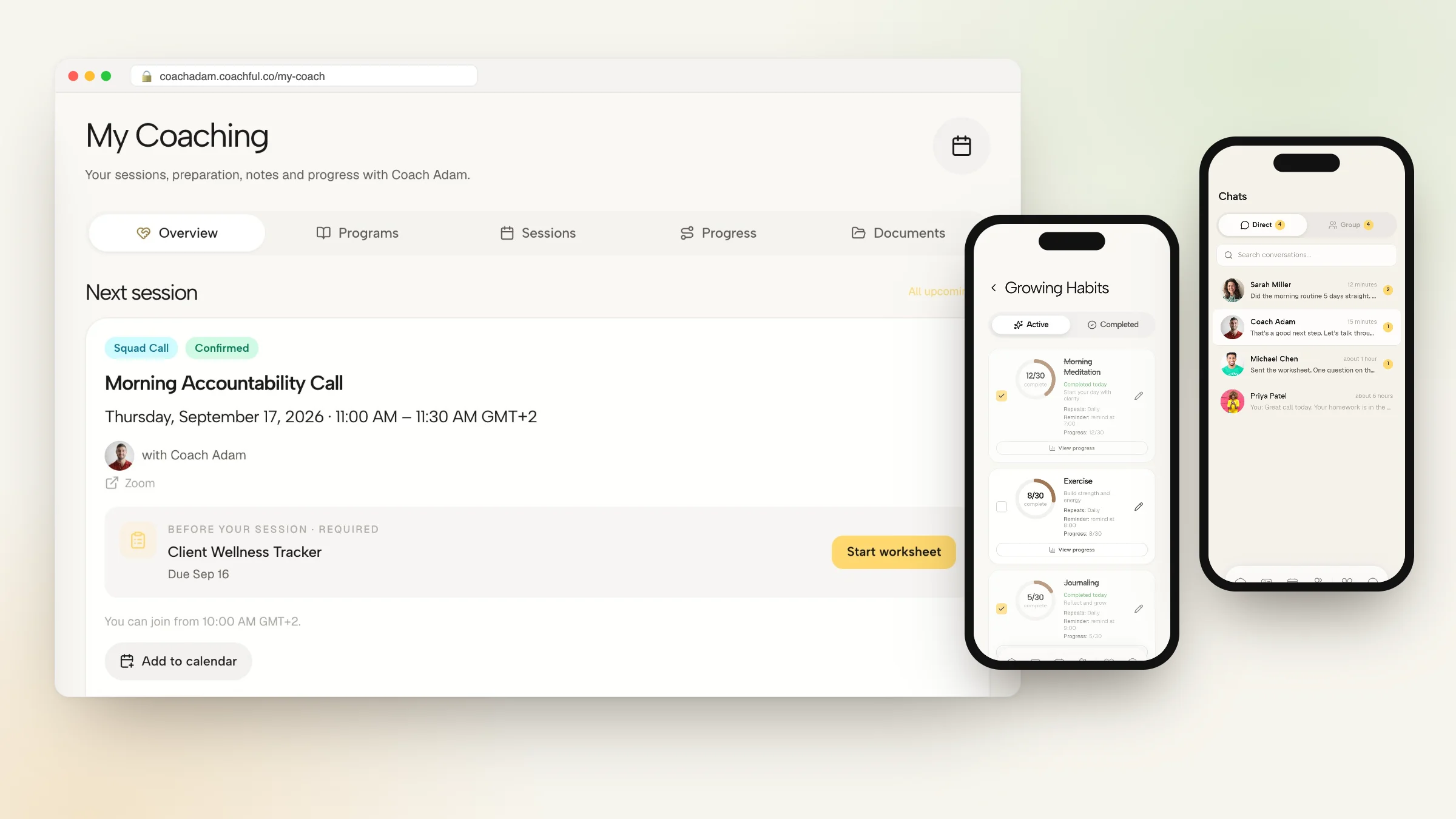
Accountability coaching lives or dies between sessions, so the tools matter more than in most niches. In Coachful, clients get habits with their own frequency, reminder and target, daily tasks from a program or set directly on the client, morning, evening and weekly check-ins you design, goals with milestones and weekly reflections, and direct messages, all in one client app. On your side, each client is marked thriving, active, quiet or at risk from their own activity, so a silent week shows up before the next call. In group programs, you can introduce clients to each other or pair them into buddy groups, and buddy check-ins can nudge a buddy when an opted-in client goes quieter than usual.


Our page on client accountability software covers these features, our guide to coaching accountability covers method, and between-session support boundaries helps you set reply times you can keep. If you would rather not build the program yourself, the Coachful team will set up the habits, check-ins and group call in your account at no extra cost through the free white-glove service.
Frequently asked questions
What is accountability coaching in simple terms?
It is coaching focused on follow-through. You agree specific commitments with a coach, report progress on a fixed schedule, and the coach helps you understand misses and adjust the plan, so you keep doing what you said you would over weeks and months.
What does an accountability coach actually do?
An accountability coach helps you turn goals into small scheduled commitments, checks in daily or weekly, reviews your progress record, asks what got in the way when you miss, and helps you change the plan. They do not do the work for you.
Is an accountability coach the same as a life coach?
Not quite. A life coach helps you decide what you want across your life and how to get there. An accountability coach usually starts from a goal you already have and focuses on consistent follow-through. Many life coaches offer accountability as part of their work.
How much does an accountability coach cost?
Coachful's 2026 Coaching Business Report has no accountability-specific figure. For comparison, life coaching sessions typically cost $75 to $200, group coaching $100 to $300 a month and memberships $47 to $197 a month.
Does accountability coaching really work?
Its main ingredients are well supported. A meta-analysis of 138 randomized studies found that monitoring progress improves goal attainment, especially when progress is reported to someone else, and if-then plans for obstacles also improve results.
How often should I check in with an accountability coach?
Match the rhythm to the goal: a daily message for new habits, a weekly call for projects and job searches, and a longer monthly review for everyone. A fixed time matters more than frequency.
Is accountability coaching good for ADHD?
Regular check-ins and external structure are a common part of ADHD coaching, which is a specialty that adds strategies for planning, time and focus; it complements, and does not replace, medical care. See our guide to ADHD coaching.












