
ADHD Coaching: How It Works, Costs and How to Choose
ADHD coaching is a practical, structured partnership that helps people with ADHD turn good intentions into working routines: planning the week, starting the task, keeping track of time and following through. A coach works on daily life and the goals you choose, usually in a video session every week or two with short check-ins in between. It does not treat ADHD and it does not replace medication or therapy. Small studies, mostly with college students, link it to better study skills, self-regulation and well-being.
If you have ADHD, you have probably been told to "just use a planner" more times than you can count. Coaching starts from the opposite end: the planner you abandoned in February is information, and the job is to build a system that fits how your attention actually works. Below is what ADHD coaching involves, who it suits, where it stops and a clinician takes over, what the research found, what it costs and how to pick a coach worth paying.
What ADHD coaching is, and what it is not
An ADHD coach helps you with the gap between knowing what to do and doing it. The work is concrete. A typical engagement covers some mix of these:
- Time: estimating how long things take, building a weekly plan you will look at, protecting the hours that matter.
- Starting: breaking a dreaded task into a first step small enough to begin today.
- Remembering: getting appointments, bills and promises out of your head and into one trusted place.
- Space and paper: a launch pad by the door, a mail routine, a desk that does not eat documents.
- Follow-through: someone who asks next week how it went, without judgment, and helps you adjust.
It sits next to several other kinds of help, and the differences matter when you are deciding where to spend your money.
| Who | What they do for ADHD | Licensed? |
|---|---|---|
| ADHD coach | Routines, planning, accountability and goals in daily life | No. The title is unregulated; ADHD-specific credentials exist |
| Psychiatrist, physician or nurse practitioner | Diagnosis, medication and medical follow-up | Yes |
| Psychologist or therapist | Assessment, therapy for ADHD and what often comes with it, such as anxiety, low mood or shame | Yes |
| Professional organizer | Hands-on decluttering and storage systems for your home or office | No |
| Tutor or academic coach | Course content and study skills for a specific class or exam | Usually no |
Many people use two or three of these at once. A common and sensible pattern is treatment from a prescriber or therapist, plus a coach for the week-to-week work of putting it into practice.
Who ADHD coaching helps, and who should start elsewhere
Adult ADHD is common. The CDC estimates that 15.5 million US adults had an ADHD diagnosis in 2023, about 6 percent, and that more than half of them were diagnosed at 18 or older (CDC, MMWR 2024).
ADHD coaching tends to suit people who already know, or strongly suspect, that ADHD is part of the picture and who want structure more than insight. Some common starting points:
- A college student who coped in high school because parents and teachers built the scaffolding, and is now drowning in unstructured time.
- An adult diagnosed in their 30s or 40s who finally understands the past and now wants the next ten years to go differently.
- A professional newly promoted into a job that is all email, meetings and deadlines.
- A self-employed person whose business depends on invoices, follow-ups and admin they keep postponing.
- A parent with ADHD running a household of other people's schedules.
It is the wrong first step if you are struggling badly and have never been evaluated, if anxiety, depression or substance use is running the show, or if the person who needs help is a young child. For children, the first-line help usually runs through the parents and a pediatrician, which our guide to parenting coaching covers.
See a licensed professional when...
- You have never been evaluated and attention problems are causing real trouble at work, school or home. A psychiatrist, psychologist or other qualified clinician can assess ADHD and look for conditions that resemble it or come with it.
- You have questions about medication: starting, stopping, doses or side effects. Those belong to your prescriber, never to a coach.
- Low mood, anxiety, panic, substance use or disordered eating is taking up a lot of room. Get those treated first, or alongside coaching.
- The person who needs help is a child under 6. The CDC's treatment guidance describes parent training in behavior management as the first line of treatment at that age, before medication is tried.
- You are having thoughts of harming yourself. In the US, call or text 988 to reach the 988 Suicide and Crisis Lifeline, any time. Elsewhere, call your local emergency number.
What happens in ADHD coaching sessions
The first session is usually longer and mostly questions. Expect to talk about what a normal week looks like, where things fall apart, what you have tried, what has worked even briefly, your diagnosis and treatment if you have one, and what you want to be different in three months. Some coaches send a short intake form first so the hour goes on the hard part.
After that, sessions settle into a rhythm. A typical 45 to 60 minute session:
- Review the week. What happened with last week's experiments. A missed plan is data, not a failure.
- Pick one focus. The overdue tax return, the morning routine, the thesis chapter.
- Design the system. Where the reminder lives, what the first five minutes look like, what happens when you get interrupted.
- Plan for the predictable problem. "What will you do on Thursday when you don't feel like it?"
- Agree the between-session contact. A check-in message, a reminder or a quick reflection.
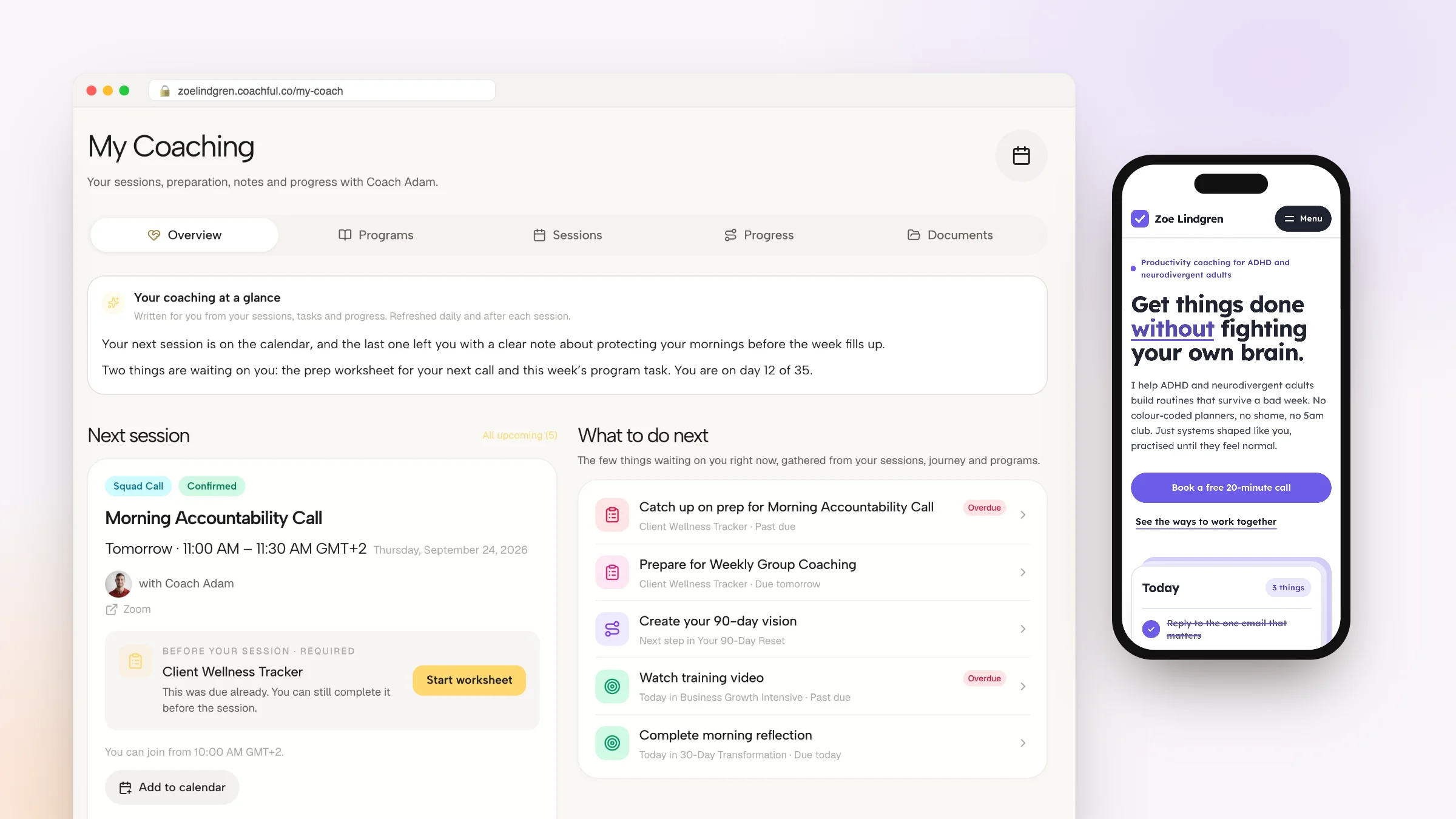
The between-session part matters more with ADHD than with most coaching, because the hard moment is rarely during the call. Many coaches now give clients an app for it. In Coachful's client app, for example, the My Coaching page gathers the next session, the prep that is due and a short "What to do next" list pulled from your sessions and programs.

Habits with daily reminders are another common tool. They make the routine visible and the streak a little satisfying, which for a lot of ADHD brains is half the battle.

Some coaches add short daily check-ins, a morning question about the one thing that matters today and an evening one about how it went. They take a minute and give the coach something real to work with next session. Our piece on daily check-ins for ADHD coaching explains how coaches set them up without turning them into nagging.

And there is messaging. A good coach agrees up front how fast they reply and what the messages are for, so you know a "stuck again" message on a Wednesday will get a useful answer rather than a lecture.

What the research says about ADHD coaching
ADHD coaching has a small research base. The studies point in a hopeful direction, and nearly all of them have design limits worth knowing before you read a coach's sales page.
- The largest randomized study is in college students. Field, Parker, Sawilowsky and Rolands (2013) assigned 160 students at 10 colleges to about six months of weekly 30-minute phone coaching or to a comparison group. Coached students scored higher on study and learning strategies and on self-regulation, and reported higher well-being. Only 88 of the 121 students assigned to coaching actually started it, and the coaching provider helped fund the study (ERIC record).
- A five-year program evaluation found gains in every study skill it measured. Prevatt and Yelland (2015) followed 148 college students through an eight-week coaching program and found improvements across all ten areas of a study-skills inventory, the largest in time management and concentration, along with better self-esteem and less distress. There was no control group, the coaches were trainees, and the authors called the results preliminary (PubMed).
- Research on adults is thinner. An early study of 45 adults reported a positive effect on self-rated concerns (Kubik, 2010). A 2026 study of a 12-session coaching program for adults found medium to large improvements in symptoms, executive function and day-to-day impairment, but it too had no control group (Ahmann, Saviet and Otto, 2026).
- Reviews agree on the promise and on the limits. A 2018 review of 19 outcome studies found that all of them reported improvements, but only two were randomized trials and 15 had no control group at all. Three of its four authors were ADHD coaches, which they disclosed (ERIC record).
The US National Institute of Mental Health lists medication and psychotherapy as the most common treatments for adults, then adds that some adults find it helpful to get support from a life coach or ADHD coach who can teach executive function skills (NIMH, ADHD in adults). That is a fair summary of where coaching sits: a useful support beside treatment.
One more study is worth knowing about. A 2026 survey of 481 US ADHD coaches found that 85 percent held no health care license and about nine in ten had no mental health background, and its authors wrote that ADHD coaching should not be viewed as equivalent to evidence-based psychotherapy (Sibley and colleagues, 2026). Read that as a reason to choose carefully, not as a reason to avoid coaching.
How much ADHD coaching costs
There is no reliable published rate for ADHD coaching on its own. Coachful's 2026 Coaching Business Report, which compiles published research and practitioner reports for the second quarter of 2026, has no ADHD-specific figure, so the closest benchmark is general life coaching.
| What you buy | Typical price | Where the number comes from |
|---|---|---|
| One hour of life coaching | $75 to $200 | PayScale and practitioner reports |
| A newer coach | $50 to $100 an hour | Practitioner estimate |
| An experienced coach | $100 to $200 an hour | Practitioner estimate |
| Three months, eight sessions | $1,200 to $2,500 | Practitioner reports and a verified sample of life coaches' published rates |
| Group coaching | $100 to $300 a month | Practitioner reports |
US dollars, Q2 2026, from Coachful's 2026 Coaching Business Report as published on coachingrates.com. Practitioner figures are estimates, not measured study results.
The same report rates ADHD and neurodivergent coaching as a niche with medium to high income potential and low saturation, also a practitioner estimate. That suggests specialists often price toward the upper half of the life coaching band. Treat it as a direction, not a quote.
A few practical points on cost:
- Ask what is included between sessions. With ADHD, check-ins and messaging are often where most of the value sits, so two coaches with the same session price can offer very different amounts of support.
- Expect to pay yourself. In the 2026 survey above, about nine in ten clients paid out of pocket. Coaching is not a medical treatment, so check with your insurer before assuming anything.
- Look at group programs. A small group with weekly calls costs less and adds peers who understand.
- Start with a fixed block. Eight to twelve weeks with a review point is a reasonable first commitment. For more on whether the money is well spent, see is a life coach worth it.
How to choose an ADHD coach
Because anyone can call themselves an ADHD coach, choosing well is mostly about asking good questions and noticing the answers.
Credentials that mean something
No license is required to work as an ADHD coach, so credentials are voluntary. These are the ones worth recognizing:
- PAAC credentials. The Professional Association of ADHD Coaches credentials ADHD coaches. Its published requirements list a CACP credential at 60 hours of ADHD coaching and the Professional Certified ADHD Coach (PCAC) credential at 250 hours, both with knowledge modules and coaching sessions reviewed as part of the process.
- ICF credentials. The International Coaching Federation's ACC requires 60 or more hours of coach training and 100 or more hours of coaching experience, the PCC 125 and 500, and the MCC 200 and 2,500 (ICF credentialing). They are not ADHD-specific, but they show general coaching training. You can check a coach's status through the ICF's coach finder.
- ADHD-specific training. The ADHD Coaches Organization, a membership body that does not issue credentials itself, keeps a list of accepted training programs: ICF-accredited, with at least 35 hours of ADHD-specific training. Ask which program a coach completed and how many hours of it covered ADHD.
- Lived experience. Many ADHD coaches have ADHD themselves. That brings real empathy and some hard-won tricks. It is a plus beside training, not a replacement for it.
If a coach is also a licensed clinician, such as a psychologist or clinical social worker, ask which role they are playing with you. Coaching and therapy have different rules on records, scope and confidentiality.
Questions to ask on a discovery call
- How many of your clients have ADHD, and what kinds of goals do they usually bring?
- What happens between sessions? How do check-ins work, and how quickly do you reply?
- What do you do when a client comes back having done none of the plan?
- How do you work alongside a therapist or prescriber, if I have one?
- What is your policy on missed or late sessions? (An honest question with ADHD, and a good coach will have a humane answer.)
- How will we both know, by week six, whether this is working?
Red flags
- Claims to cure ADHD, or to replace medication or therapy.
- Advice on starting, stopping or changing medication. That is your prescriber's decision.
- Diagnosing you, or telling you that you definitely do or do not have ADHD.
- Shame dressed as accountability: sighs, lectures, "you just need more discipline". Supportive accountability coaching treats a miss as information instead.
- Pressure to prepay a long package on the first call, or no written agreement on sessions, cancellations and refunds.
- Guaranteed results. Coaching can help; nobody can promise how much.
Before you book anyone, it helps to write down the two or three things you most want to change. Our SMART goal worksheet turns a vague wish ("be more organized") into something a coach can work with ("bills paid by the 5th, three months running").

Find an ADHD coach on Coachful
Coachful runs a public coach directory at Find a Coach. You can browse it without an account. Type "ADHD" into the search bar and it matches coaches whose headline or bio mentions it, or start from the Mindset and Lifestyle categories. You can switch between browsing coaches and browsing their programs.
If you would rather not scroll, the Find My Coach button opens a short matching quiz: the area you want to improve, where you are right now (exploring, stuck, scaling or transforming), your email, the coaching style you prefer and your monthly budget. It returns a shortlist.

Each profile shows what the coach has filled in: their background, credentials and method, programs with prices, and either a calendar to book a discovery call or a form to send a message. Read the credentials line closely, and use the questions above on the call.

Are you an ADHD coach?
If you coach people with ADHD, or want to, our guide on how to become an ADHD coach covers training and first clients, and ADHD coach certification compares the credentials. Coachful's page for ADHD coaches covers its Focus and ADHD power-up, with one next action, a focus timer, micro-steps with an "I'm stuck" button and a morning check-in, and the team will build your website, program or funnel for you at no extra cost through the free white-glove service.

Frequently asked questions
What does an ADHD coach actually do?
An ADHD coach helps you build routines and systems for the parts of life ADHD makes hard: planning, starting tasks, time, paperwork and follow-through. Sessions are usually weekly or every other week by video, with short check-ins between them. The coach does not diagnose, treat or advise on medication.
Is ADHD coaching worth it?
It can be, for someone who wants practical structure and will try things between sessions. Studies, mostly with college students, link coaching to better study skills, self-regulation and well-being, though most had no control group. It works best beside treatment, and the coach's training and fit matter a great deal.
How much does an ADHD coach cost?
There is no reliable ADHD-specific figure. The nearest benchmark, life coaching, typically runs $75 to $200 an hour and $1,200 to $2,500 for a three-month, eight-session package, according to Coachful's 2026 Coaching Business Report. Specialist ADHD coaches often price toward the upper half of that range.
Do I need an ADHD coach or a therapist?
If anxiety, low mood, trauma or shame is the main problem, start with a therapist. If you are reasonably steady and the problem is turning plans into action, a coach fits. Many people use both: a therapist for the inner work and a coach for weekly structure, with your permission to coordinate.
Can an ADHD coach diagnose ADHD or prescribe medication?
No. Diagnosis needs a qualified clinician, such as a psychiatrist, psychologist or physician, and only a prescriber can start or change medication. A coach who offers either is working outside their scope, which is a good reason to look elsewhere.
Does insurance cover ADHD coaching?
Usually you should plan to pay yourself. Coaching is not a medical treatment, and in a 2026 survey of US ADHD coaches about nine in ten clients paid out of pocket. Ask your insurer, and check whether an employer learning budget or a college support office can help.
How long does ADHD coaching take?
The studies used programs from eight weeks to about six months. Many coaches sell three-month blocks, which is long enough to build and test a few routines. Agree at the start what progress should look like by week six, and review it then.












