
Parenting Coaching: What It Is, Costs and When It Helps
Parenting coaching is one-to-one or small-group support for parents who want to handle a specific part of family life differently: mornings, bedtimes, tantrums, screens, a teenager who has stopped talking, or co-parenting across two homes. The coach works with the parent, not the child, on a practical plan, then helps you try it and adjust. It is not therapy and it does not diagnose or treat children, and a good parenting coach knows when to send you to a pediatrician or therapist.
Most parents who look up parenting coaching are not in crisis. They are tired of having the same fight at 7:40 every morning and suspect there is a better way. This guide covers what parenting coaches work on, how coaching compares with family therapy and structured parent training programs, the signs that a child needs a professional evaluation, what the research supports, what it costs (including excellent help that costs nothing) and how to choose a coach.
What parenting coaches help with
The most common reasons parents book a parenting coach:
- Daily flashpoints: getting out the door, homework, dinner, bedtime, screen time.
- Big feelings: tantrums in toddlers and meltdowns in older kids, and how you respond when you are frazzled too.
- Teenagers: rebuilding conversation, setting limits without a standoff, handling phones and independence.
- Sibling conflict and keeping it from taking over the household.
- Two homes: consistent routines and calm handovers after a separation. Our guide to divorce coaching covers the co-parenting side in more depth.
- A child with extra needs: parenting day to day alongside a diagnosis such as ADHD or anxiety, with the clinical care coming from clinicians.
- The parent's own load: burnout, guilt, working-parent logistics, aligning with a partner on the rules. When the strain sits mainly between partners, relationship coaching may be the closer fit.
Some coaches specialize by age, such as toddlers or teens, and some by situation, such as blended families or parenting a neurodivergent child. A specialist is usually worth the search.
Parenting coach, family therapist or parent training program?
These three get confused, and they are not interchangeable.
| Parenting coach | Family therapist or child psychologist | Structured parent training program | |
|---|---|---|---|
| Main focus | Practical plans for the issues a parent chooses | Assessment and treatment of a child's or family's mental health | A set curriculum for teaching specific parenting skills |
| Who delivers it | A coach; the title is unregulated | A licensed clinician | Usually trained therapists or certified facilitators |
| Best for | Everyday friction in a family that is basically okay | Persistent problems, a suspected condition, trauma or crisis | Defiance and behavior problems, especially in young children |
| Evidence base | Thin for coaching itself | Strong for many specific treatments | Strong, across dozens of trials |
For children under 6 with ADHD, the CDC describes parent training in behavior management, typically 8 to 16 sessions with a therapist, as the recommended first choice of treatment (CDC, parent training in behavior management). If that describes your family, start there. A coach can help afterward with the routines and consistency that make it stick.
See a licensed professional when...
- A change in your child's behavior or emotions has lasted for weeks, or is getting in the way of school, home or friendships. The National Institute of Mental Health suggests talking with your child's pediatrician and asking for a referral, and getting help immediately if behavior is unsafe (NIMH, children and mental health).
- You are worried about development, learning, speech or a possible condition such as ADHD or autism. Ask the pediatrician about a comprehensive evaluation (CDC).
- You think a child is being harmed, or someone in the home is unsafe. Call 911 in an emergency.
- You are pregnant or have a new baby and feel overwhelmed, numb or hopeless. The National Maternal Mental Health Hotline, 1-833-TLC-MAMA (1-833-852-6262), offers free, confidential support by call or text, 24 hours a day (HRSA).
- You or your child have thoughts of self-harm. In the US, call or text 988 to reach the 988 Suicide and Crisis Lifeline.
What happens in parenting coaching
A first session is mostly listening. The coach asks about your children's ages and temperaments, what a typical day looks like, the moments that go wrong, what you have tried, what you and any co-parent agree and disagree on, and what you would like home to feel like in three months.
From there, good coaches narrow it down. One flashpoint at a time. Take the 7:40am problem:
- Map the morning. What happens from the alarm to the door, minute by minute, and where it derails.
- Change the setup before the behavior. Clothes laid out the night before, a picture checklist for a young child, breakfast that does not involve choices.
- Decide your response in advance. What you will say, once, when the shoes are not on, and what you will do next.
- Try it for a week. Notice what improved and what did not.
- Review and adjust in the next session.
Parents usually meet the coach weekly or every other week by video. Many coaches give you a few small routines to track between sessions, because consistency is most of the work.

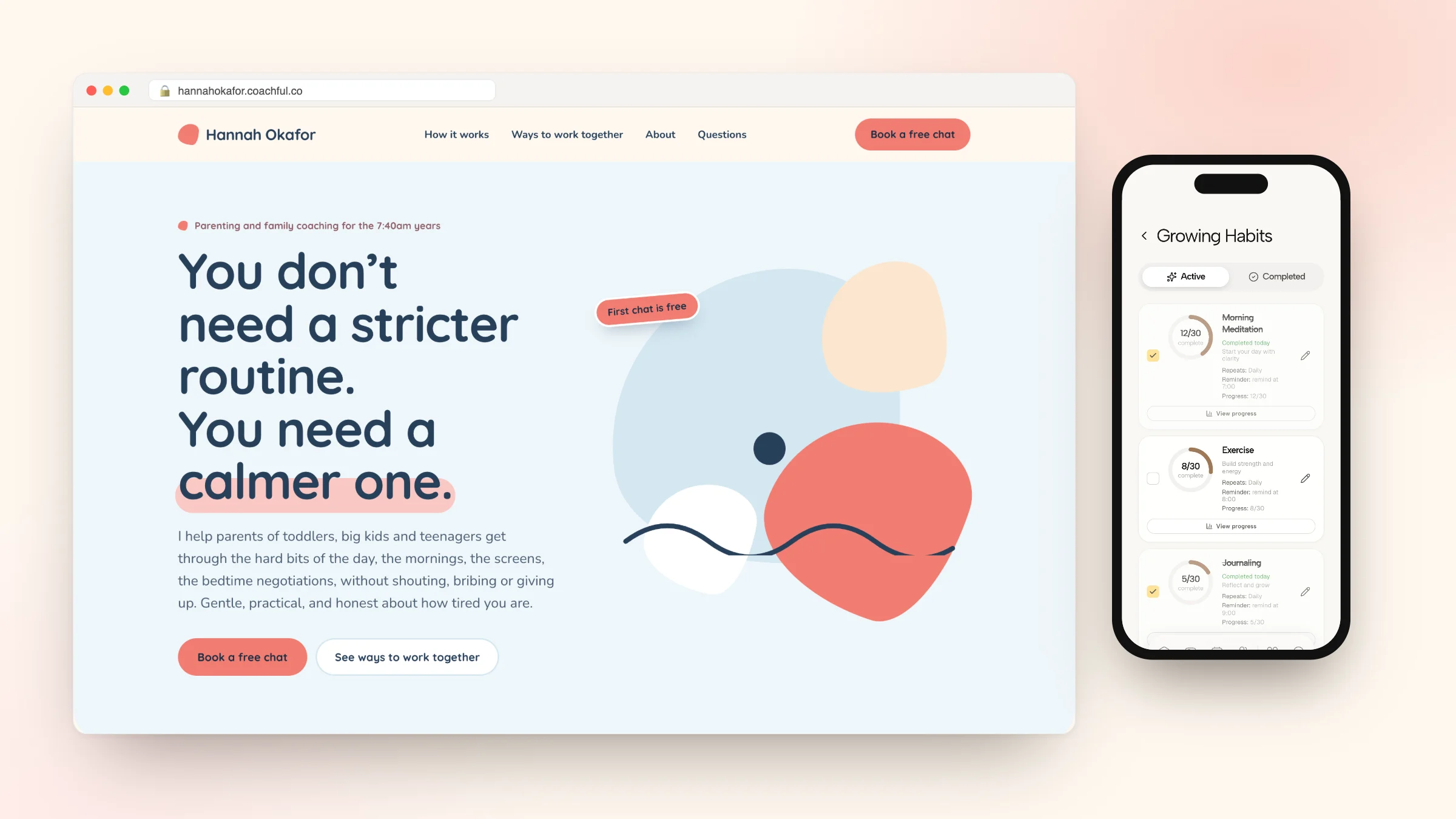
In Coachful's client app, those routines can sit beside the next session and a short "What to do next" list, so the plan is on your phone when the morning starts going sideways.

Messaging between sessions is common too. A two-line note after a rough bedtime ("tried the warning, he still threw the book") gives the coach far better material than a vague recap a week later.

Some parenting coaches run group programs, which cost less and come with something parents rarely get enough of: other adults saying "same here".

What the research says
The evidence for teaching parents specific skills is strong. The evidence for parenting coaching as an independent service is much thinner, because most studies test structured programs delivered by trained clinicians. Here is what the research supports:
- Behavioral parent training works, on average. A meta-analysis of 63 studies found small-to-moderate improvements in child behavior right after training and smaller ones at follow-up. Families facing economic hardship benefited less, and did better with individual than group delivery (Lundahl, Risser and Lovejoy, 2006).
- Some ingredients matter more than others. A review of 77 program evaluations for children up to age 7 found larger effects when programs built positive parent-child interaction and emotional communication, taught consistency and time-out, and had parents practice with their own child during sessions (Kaminski and colleagues, 2008).
- Live coaching of parents is one of the best-supported approaches. In Parent-Child Interaction Therapy, a therapist coaches the parent in real time through an earpiece while the parent plays with their child. The federal Prevention Services Clearinghouse rates it well-supported for ages 2 to 7 (ACF clearinghouse), and a meta-analysis of 23 studies found large reductions in children's behavior problems and lower parent stress (Thomas and colleagues, 2017).
Two practical lessons for choosing a parenting coach follow from this. Look for someone whose approach resembles the well-tested ingredients: warmth plus clear, consistent limits, and practice rather than only talk. And be cautious with anyone who presents a personal method as proven, because the proof in this field belongs to specific programs, delivered with training and supervision.
Help that costs nothing, and what coaching costs
Before paying anyone, look at the CDC's Essentials for Parenting Toddlers and Preschoolers, a free online resource for parents of 2 to 4 year olds. It covers emotion coaching, routines and rules, and responding to behavior with positive attention and consequences, and the CDC says it is based on decades of research. Your pediatrician is another underused starting point, and it is worth asking them, your child's school or a local community center about parenting classes nearby.
For paid coaching, there is no reliable published figure for parenting coaches specifically. Coachful's 2026 Coaching Business Report, which compiles published research and practitioner reports for the second quarter of 2026, has rates for life coaching, the nearest category:
| Life coaching format | Typical price |
|---|---|
| One session | $75 to $200 |
| Four-week starter, four sessions | $400 to $600 |
| Three months, eight sessions | $1,200 to $2,500 |
| Group coaching | $100 to $300 a month |
US dollars, Q2 2026. Hourly band from PayScale and practitioner reports; packages from practitioner reports and a verified sample of life coaches' published rates. Details on coachingrates.com. Practitioner figures are estimates.
Family therapy and clinical parent training programs are priced differently and may be covered by health insurance when a child has a diagnosis; ask your insurer. For a sense of when paid coaching is worth it, see is a life coach worth it.
How to choose a parenting coach
Backgrounds and credentials
- Certified Family Life Educator (CFLE). The National Council on Family Relations runs this certification for family life educators, which requires post-secondary education, work experience and an exam, with renewal every five years.
- Related professions. Teachers, early childhood educators, social workers and nurses bring real knowledge of child development. Licensed clinicians who also coach should tell you which role they are playing.
- Program training. Some coaches are trained facilitators of established parent training programs. Ask which program and whether they are certified in it.
- ICF credentials. The ACC, PCC and MCC show general coaching training and supervised experience (ICF credentialing).
Questions to ask
- Which ages and situations do you mostly work with?
- What is your approach based on? Can you name the ideas or programs behind it?
- What will I practice between sessions, and how do we check whether it is working?
- How do you involve a co-parent or partner?
- When would you suggest we see a pediatrician or therapist instead?
Red flags
- Diagnosing your child, or telling you an evaluation is unnecessary.
- One method for every child and every age.
- Shaming you, or encouraging you to shame your child.
- Guaranteed results in a set number of days.
- Pressure to buy a long package on the first call, or no written agreement.

A coach's website should tell you plainly who they help and what they offer first. The sample template above, with a fictional coach, names the age range, the hard parts of the day and a credential, and starts with a free first chat. Look for the same clarity on any real coach's site.
Find a parenting coach on Coachful
Coachful's Find a Coach directory is public, so you can browse without signing up. Search "parenting", "toddler" or "teen" to find coaches whose headline or bio mentions them, or browse the Relationships and Lifestyle categories. You can view coaches or their programs, which helps if you would prefer a group.
The Find My Coach quiz asks what you want to improve, where you are right now, your email, your preferred style (structured, flexible, intensive or gentle) and your monthly budget, then shows a shortlist. Profiles include each coach's background, credentials and method where they have added them, plus a calendar to book a discovery call or a form to send a message.


Are you a parenting coach?
Our guide on how to become a parenting coach covers training and first clients, and the best software for parenting coaches compares the tools. Coachful's team will build your website, program or funnel for you at no extra cost through the free white-glove service.
Frequently asked questions
What does a parenting coach do?
A parenting coach helps a parent work out a practical plan for a specific part of family life, such as mornings, tantrums, screens or a teenager who has stopped talking, then supports them while they try it. The coach works with the parent rather than the child and does not diagnose or treat anyone.
Is parenting coaching worth it?
It can be for an everyday problem in a family that is basically okay, especially if you will practice between sessions. The strongest evidence is for structured parent training programs delivered by trained therapists, so for serious behavior problems or a young child with ADHD, start with those.
How much does a parenting coach cost?
There is no reliable figure for parenting coaching specifically. The nearest benchmark, life coaching, typically runs $75 to $200 a session and $1,200 to $2,500 for three months, according to Coachful's 2026 Coaching Business Report. Free options such as the CDC's online parenting resources are worth trying first.
What is the difference between a parenting coach and a family therapist?
A family therapist is a licensed clinician who assesses and treats mental health problems in a child or family. A parenting coach helps parents with practical strategies for everyday challenges. If problems last for weeks, affect school or friendships, or involve safety, see a clinician.
Do parenting coaches work with teenagers?
Many do, usually by coaching the parent on communication, limits and independence. Some also meet the teen. Ask how they handle confidentiality with a teenager and what they share with you.
Can a parenting coach help with a child who has ADHD?
A coach can help with routines, consistency and the parent's own stress, alongside the child's clinical care. For children under 6 with ADHD, the CDC describes parent training in behavior management with a therapist as the first choice of treatment.
Is online parenting coaching as good as in person?
For most parent coaching, which is conversation and planning, video works well and fits around naps and school runs. Some well-tested programs need a special setup: in Parent-Child Interaction Therapy, for example, a therapist coaches the parent from behind a one-way mirror.












