
Divorce Coaching: What a Divorce Coach Does and Costs
Divorce coaching is practical, forward-looking support for someone deciding about, going through or rebuilding after a divorce. A divorce coach helps you get organized, make clearer decisions, prepare for meetings with lawyers or mediators, communicate with your ex and plan the life that comes next. A divorce coach is not your lawyer, your therapist or your financial adviser, and a good one will tell you early which of those you also need.
Divorce comes with a strange workload: it arrives at the moment you have the least energy and asks for dozens of decisions, many with long consequences. A coach's value is mostly in that gap. This guide covers what divorce coaches do at each stage, how they fit beside the legal and financial professionals, when you need a clinician or a safety plan instead, what the evidence shows, what it costs and how to choose one.
What a divorce coach does at each stage
Divorce coaching is not one service. Most coaches specialize in one or two of these stages.
| Stage | The questions on your mind | What a coach helps with |
|---|---|---|
| Deciding | Should I stay or go? What would leaving actually involve? | Getting clear on what you want, what you fear and what information you are missing, without pushing either way |
| Preparing | What do I need before I talk to a lawyer? How do I tell the kids? | Gathering documents, a list of questions for professionals, a plan for difficult conversations |
| During the process | How do I stay calm in mediation? What do I ask for? | Clarifying priorities, rehearsing negotiations, keeping emotion from driving expensive decisions |
| Co-parenting | How do we hand over the kids without a fight every Friday? | Communication scripts, boundaries, routines that work across two homes |
| Afterward | Who am I now? How do I rebuild money, home, friendships and confidence? | Goals, routines and the practical steps of a new life |
One more role uses the same name. In collaborative divorce, where both spouses and their lawyers agree to settle without going to court, the team often includes a "divorce coach" who helps the couple communicate and manage conflict.
In that model the coach is usually a licensed mental health professional. A California court brochure describes a collaborative team as an attorney for each spouse, a coach for each spouse who is a mental health professional and, in some cases, a neutral financial professional (Contra Costa Superior Court). If the collaborative process breaks down, both spouses must hire new lawyers to go to court (Marquette Law School faculty blog). When someone offers you "divorce coaching", ask which kind they mean.
Divorce coach, lawyer, mediator, therapist: who does what
The single most useful thing to understand before hiring anyone is the division of labor. Divorce coaches save people money mostly by making the expensive professionals' time more efficient, not by replacing them.
| Professional | Their job in your divorce | Can they give legal advice? |
|---|---|---|
| Family lawyer | Your rights, the law in your state, negotiation and court | Yes |
| Mediator | A neutral who helps both spouses reach an agreement | No, a mediator stays neutral, even if trained as a lawyer |
| Divorce coach | Your organization, decisions, communication and next steps | No |
| Therapist or counselor | Grief, anxiety, depression, trauma and family patterns | No |
| Divorce financial specialist | Dividing assets, pensions, the home and what a settlement means for your future budget | No |
The legal line is a real one. States define the practice of law, and the definitions vary, but they generally include advising someone about their legal rights and obligations and preparing legal documents for them. Iowa's courts, for example, spell this out on their unauthorized practice of law page. A divorce coach can help you work out your priorities and prepare your questions. What you are entitled to is a question for your lawyer.
See a licensed professional, or get safety help, when...
- You are afraid of your spouse, or there has been violence, threats, stalking or control over your money or movements. Safety planning comes before coaching. In the US, the National Domestic Violence Hotline is 800-799-7233, or text START to 88788 (listed by the US Office for Victims of Crime). In immediate danger, call 911.
- You need to know your rights to property, support, custody or the house. That is a family lawyer's job.
- Grief, anxiety or low mood is making it hard to sleep, eat, work or look after your children. A therapist or doctor can help, and coaching can continue alongside.
- Your children are struggling. The National Institute of Mental Health suggests talking with your child's pediatrician when changes in behavior or emotions last for weeks or get in the way of school, home or friendships (NIMH).
- You are having thoughts of harming yourself. In the US, call or text 988 to reach the 988 Suicide and Crisis Lifeline.
What divorce coaching sessions look like
Most divorce coaching happens by video, in sessions of about an hour, weekly or every other week. The first session is about orientation: where you are in the process, who else is involved, what the next decision is and what is making it hard.
After that, the sessions follow the calendar of your divorce. A week before mediation might be spent ranking your priorities, deciding where you can bend and rehearsing the sentence you keep getting stuck on. A week after the kids' first weekend at the other house might be about the handover routine. Some of the most useful work is unglamorous: a document checklist, a one-page budget, a list of questions so the next hour with your lawyer covers what matters.
Session notes do more work in divorce than in most coaching, because stress makes everyone forget. Coachful's client app, for example, keeps a running "notes so far" summary written for the client from the coach's notes, so you can find what you agreed before the next difficult call.

Between sessions, a coach may ask you to fill in a short prep form, track a goal or message them after a hard conversation. Agree up front how quickly they reply and what messages are for. A coach is not an emergency line.


What the evidence says about divorce coaching
The honest answer is that there is almost no research on divorce coaching itself. A PubMed search turns up one descriptive article about collaborative divorce (Alba-Fisch, 2016) and no outcome studies. Anyone promising a proven divorce coaching method is ahead of the evidence.
There is useful evidence next door, in programs for divorcing parents:
- A six-year randomized trial. In the New Beginnings Program study, 218 divorced families were assigned to a program for mothers, a program for mothers and children, or a books-only control. Six years later, 11 percent of teens in the mother-plus-child group had a diagnosed mental disorder in the past year, against 23.5 percent of controls (Wolchik and colleagues, 2002).
- A larger real-world trial with more modest results. When the program was tested with 830 parents through family courts, it had small effects on parenting and child problems, seen only among non-Hispanic White families, and about a quarter of parents never attended (Sandler and colleagues, 2019).
- A meta-analysis of court parenting classes. Nineteen controlled studies of court-affiliated parenting education for divorcing parents found a moderate positive effect, with methodological limits the authors flag clearly (Fackrell, Hawkins and Kay, 2011).
The broader coaching research also offers some support. A meta-analysis by Theeboom, Beersma and van Vianen found coaching improved well-being, coping and goal-directed self-regulation, which is close to the work of the "afterward" stage, although none of the studies involved divorce. Read all of this as a reason to choose a coach who is clear about what they do, not as proof that divorce coaching works.
How much divorce coaching costs
We know of no published data set with a rate for divorce coaching specifically. The closest category in Coachful's 2026 Coaching Business Report, which compiles published research and practitioner reports for the second quarter of 2026, is relationship coaching.
| Relationship coaching | Typical hourly rate | Source |
|---|---|---|
| Typical range | $100 to $200 | PayScale and practitioner reports |
| Newer coach | $75 to $125 | Practitioner estimate |
| Experienced coach | $125 to $250 | Practitioner estimate |
| Top of the niche | $250 to $500 | Practitioner estimate |
US dollars, Q2 2026, from Coachful's 2026 Coaching Business Report as published on coachingrates.com. Practitioner figures are estimates.
The report notes that relationship sessions tend to run longer and heavier than average, so the hourly number can understate what a session costs. In a collaborative divorce, where the coach is often a licensed mental health professional, pricing may follow that profession instead, and we have no figure for it.
The useful comparison is with your lawyer's rate. Ask your lawyer what they charge per hour, then ask the coach what kinds of work they would take off the lawyer's desk: document gathering, a list of questions, preparing you emotionally for a negotiation. For a wider view of what coaching is worth, see is a life coach worth it.
How to choose a divorce coach
Backgrounds and credentials
Divorce coaching is unregulated, so look at background and training together.
- A relevant past career. Family mediation, social work, counseling, family law support roles and financial planning each bring something real. Ask what the coach did before coaching and how it shapes their work.
- Divorce coach training. Several programs train divorce coaches. The Certified Divorce Coach (CDC) program, for example, describes a six-part live training overseen by its own board of standards. No divorce coaching certificate is a license, so treat any of them as evidence of training rather than proof of skill.
- Certified Divorce Financial Analyst (CDFA). This credential from the Institute for Divorce Financial Analysts requires a degree plus three years of relevant experience, or five years without a degree, and an exam. CDFAs are financial specialists rather than coaches; if there is a pension, a business or a house to divide, you may want one as well.
- ICF credentials. The ACC, PCC and MCC show general coaching training and supervised experience (ICF credentialing).
- A clinical license, in collaborative divorce. If your collaborative coach is a therapist or counselor, you can check their license with your state licensing board.
Questions to ask on the first call
- Which stage do you mostly work with: deciding, the process itself, co-parenting or rebuilding?
- What is your background, and what do you not do? Listen for a clear line around legal and therapy work.
- How do you work alongside my lawyer or mediator?
- Have you worked with clients in a high-conflict divorce, or where there are safety concerns? What do you do in that case?
- Will you coach me and my spouse together? (Many coaches will not, unless they are working in a collaborative process with both lawyers.)
- How are fees structured, and what happens if the divorce ends sooner or later than planned?
Red flags
- Telling you what the law "will" give you, or drafting legal documents.
- Pushing you toward or away from divorce.
- Bad-mouthing your spouse or encouraging you to "win".
- Discouraging you from hiring a lawyer to save money.
- No written agreement on fees, confidentiality and cancellations.

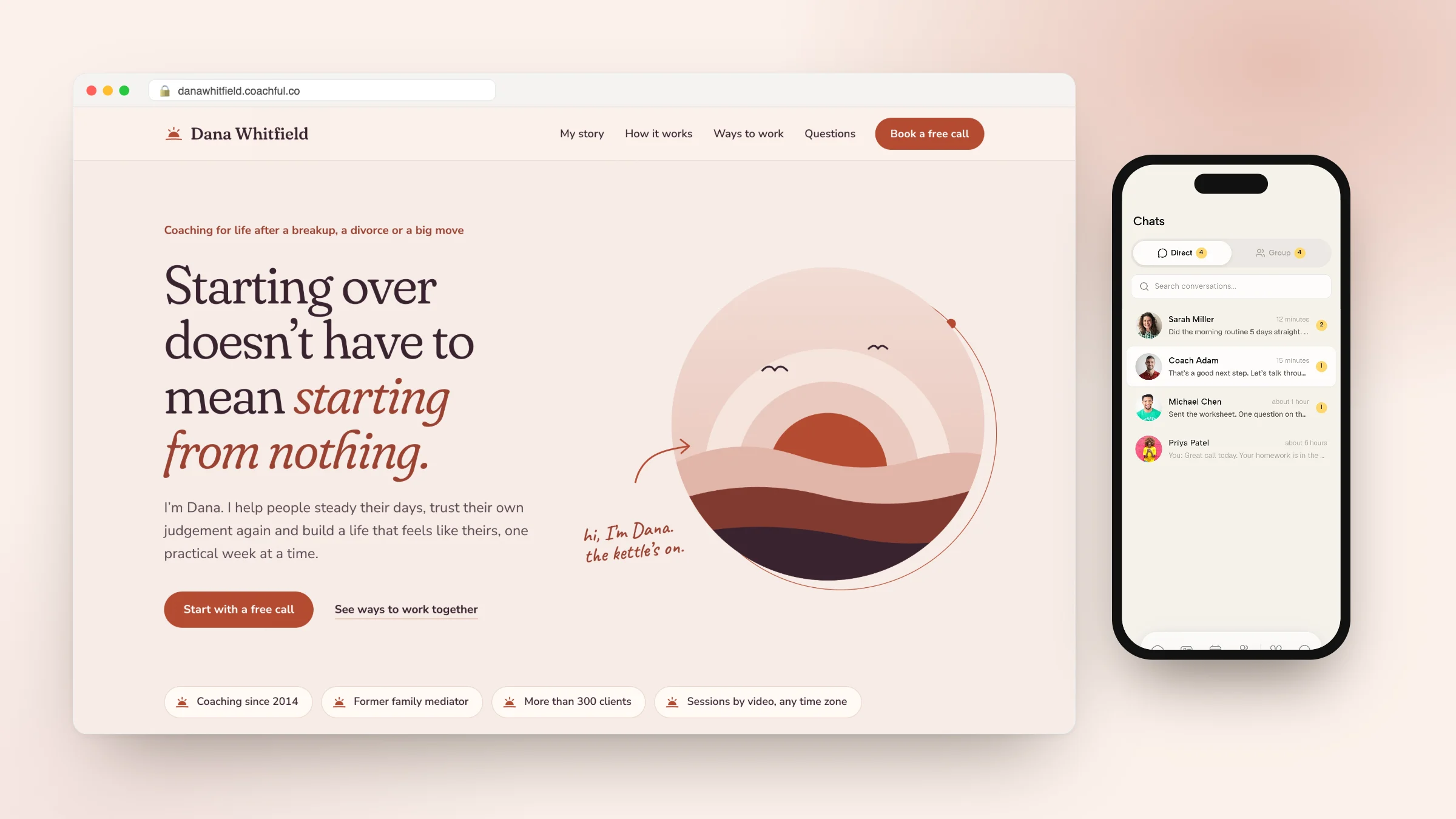
When you look at a coach's website, check that it says plainly who they help and what background they bring. The sample template above, with a fictional coach, names the situation (a breakup, a divorce or a big move), a relevant past career and a low-pressure first call, which are three things worth looking for on any real coach's site.
Life after divorce: where coaching often helps most
Many people find a coach most useful once the paperwork is done. The questions change from "what do I sign?" to "what now?": where to live, how to rebuild savings, how to date again or whether to, how to parent alone half the week, what to do with Saturday evenings. This is classic goal-setting work, and the tools look like those in any good coaching relationship.

Some coaches use vision boards at this stage. It can sound soft, but for someone whose picture of the future was just erased, making a new one on purpose is a real step.

Find a divorce coach on Coachful
Coachful's Find a Coach directory is public and needs no account to browse. Start in Relationships, or search "divorce" or "co-parenting" to find coaches whose headline or bio mentions them. You can browse coaches or their programs, or take the short matching quiz, which asks what you want to improve, where you are now, your preferred coaching style and your monthly budget.
Profiles show what each coach has added: background, credentials and method, programs with prices, and a calendar to book a discovery call or a form to send a message. Ask the questions above on that call.

Are you a divorce coach?
Coachful's page for divorce coaches covers its Separation edition: a client plan with dated milestones and decisions, a weekly pulse, calm co-parenting agreements and a private log for hard moments. Our guide to becoming a relationship coach covers training routes, and the best software for divorce coaches compares the tools. If your website needs work, Coachful's team will build it for you at no extra cost through the free white-glove service.
Frequently asked questions
What does a divorce coach do?
A divorce coach helps you get organized, make clearer decisions, prepare for meetings with your lawyer or mediator, communicate with your ex and plan life afterward. They do not give legal advice, provide therapy or value assets. Most work by video, in sessions of about an hour, weekly or every other week.
Is a divorce coach worth the money?
It can be, mainly when it makes the rest of the process calmer and more efficient: fewer expensive lawyer hours spent on non-legal questions, better-prepared negotiations, steadier co-parenting. There is no outcome research on divorce coaching itself, so judge a coach on clear scope, relevant experience and how well the first sessions go.
How much does a divorce coach cost?
We have no divorce-specific figure. The nearest benchmark, relationship coaching, typically costs $100 to $200 an hour, with experienced coaches at $125 to $250, according to Coachful's 2026 Coaching Business Report. Collaborative divorce coaches who are licensed clinicians may price differently.
Can a divorce coach give legal advice?
No. Advising someone about their legal rights and preparing legal documents is generally the practice of law, which states reserve for lawyers. A coach can help you understand your priorities and prepare questions, then your lawyer answers them.
What is the difference between a divorce coach and a therapist?
A therapist is licensed to treat grief, depression, anxiety and trauma, and often explores how the past shapes the present. A divorce coach focuses on decisions, organization and next steps. Many people use both, especially in the first months.
What is a divorce coach in a collaborative divorce?
In a collaborative divorce, where both spouses and their lawyers agree to settle out of court, each spouse may have a coach who is a licensed mental health professional. The coach helps manage emotions and communication so negotiations stay productive.
Can my spouse and I use the same divorce coach?
Some coaches work with both spouses, especially on co-parenting, but many will only coach one person to avoid a conflict of interest. Ask directly before you start, and make sure the arrangement is in writing.












