
How to Become a Relationship Coach: Training, Scope and Pay
Relationship coaching is one of the few niches where the client is often two people at once, and most of learning how to become a relationship coach is learning to work with both. The training path is simple to describe: coaching skills (ideally from an ICF-accredited program), one relationship framework such as Gottman's Seven Principles Leader Training or a relationship coaching certification, practice with couples and singles, and clear rules for when a case belongs with a licensed couples therapist. Relationship coaching isn't licensed in the US; marriage and family therapy is licensed in every state, and that difference shapes who you can safely take on.
The sections below cover who hires a relationship coach, the line next to therapy, training options and what each really gives you, how long it takes, the research, how couples sessions run, what the work pays and how to fill your first calendar. When you're ready to go live, Coachful's team will build your relationship coaching website for free on every plan.
Who hires a relationship coach
| Client | What they usually want | Typical engagement |
|---|---|---|
| Couples stuck in the same argument | A way to disagree without it turning into a week of silence | 8 to 12 joint sessions over three months |
| Couples before marriage or a big move | To talk through money, family and roles before they become problems | A short structured program |
| One partner whose partner won't come | To change their half of the pattern | Individual sessions |
| People after a breakup or divorce | To understand what happened and choose differently next time | Individual coaching, often 6 to 12 sessions |
| Co-parents | Calmer handovers and fewer flashpoints | Individual or joint sessions with tight agendas |
Pick one or two of these rather than all five. A coach for "couples who keep having the same fight" is easier to recommend than a coach for "relationships". Our guide to a relationship coach website shows how that choice changes the homepage.

Where relationship coaching ends and couples therapy begins
Marriage and family therapists are licensed in every US state. The Bureau of Labor Statistics lists a master's degree, supervised clinical hours after graduation and a state exam as the standard requirements. They treat relationship distress alongside mental health conditions. A coach works with functioning couples on skills, decisions and follow-through.
Refer, or pause coaching, when you see:
- Fear. If one partner is afraid of the other, joint sessions can make things more dangerous. Stop couples work and point to domestic violence services.
- Active addiction that drives the conflict.
- Depression, anxiety or trauma that is the main thing in the room.
- A crisis such as a just-discovered affair, where both partners need clinical support before skills work.
- Talk of self-harm by either partner. Have a crisis line in your intake materials.
Put this list in your agreement, so the referral is a process both partners signed up for rather than a surprise. Our coaching agreement template has a scope clause to adapt.
Relationship coach training and certification options
Relationship coaching has no single credentialing board. The strongest profiles combine general coaching skill with one relationship framework. These are the options we checked in October 2026:
| Option | What it is | What it adds |
|---|---|---|
| ICF-accredited coach training | General coach education; ICF credentials start at 60 hours of training and 100 hours of coaching | Coaching skill and a recognized credential |
| Relationship Coaching Institute | Relationship coach training with paths for helping professionals, coaches, faith leaders and matchmakers; it says its 60+ hours of coach-specific education can be applied toward an ICF credential through the Portfolio Path, and it moves to a self-paced format from January 2027 | A relationship-specific coaching model |
| Gottman Seven Principles Leader Training | A live virtual training from The Gottman Institute, open to coaches, clergy, educators, therapists and laypeople; leaders pass a training exam and agree to a Leader Agreement | A research-based couples workshop you can run |
| PREPARE/ENRICH facilitator certification | Training to use a customized couples assessment covering communication, conflict, finances, intimacy, family and more; the online version is self-paced and takes about three hours or less | A structured assessment, useful for premarital work |
The Gottman Institute titles its therapy track "Clinical Training in Gottman Method Couples Therapy". Whatever you take, describe it accurately: a coach who completed the leader training is a Seven Principles Leader, not a Gottman therapist. Our sibling guide to relationship coach certification compares programs in more depth.
How long it takes to become a relationship coach
| Stage | Typical timing | What to do in it |
|---|---|---|
| Coach training | Several months part time | Choose a program with observed practice, not only video lessons |
| A relationship framework | A few days to a few weeks | One framework done properly beats four done halfway |
| Practice clients | Two to four months | Coach five or six individuals and two or three couples at a pilot price, with feedback |
| ICF ACC hours | Often about a year | 100 coaching hours with at least eight clients, 75 of them paid |
| A full practice | Depends on referrals more than credentials | Build two or three referral relationships with therapists early |
These are typical patterns, not measured figures, and you can take paying clients long before the credential arrives. If you're still deciding whether this is the work for you, our sibling explainer on what relationship coaching is describes it from the client's side, which is a useful test of whether you'd enjoy the sessions.
What the research supports
Most of the evidence in this field is about relationship education rather than coaching itself, and it's reasonably solid. A meta-analysis of marriage and relationship education by Hawkins and colleagues in the Journal of Consulting and Clinical Psychology covered 117 studies and found moderate effects: d of 0.30 to 0.36 on relationship quality and 0.43 to 0.45 on communication skills in experimental studies, with moderate-dose programs doing better than low-dose ones. The authors flagged a gap: too little diversity in the samples to draw conclusions for disadvantaged couples. A skills program with enough sessions is the evidence-backed core; talk about it that way, and don't promise to save marriages.
How couples sessions work
Coaching two people is a triangle, and the coach's job is to stay neutral while both partners feel taken seriously. Settle these before the first joint session:
- Who is the client. Usually the relationship. Say so in writing.
- A secrets policy. Many couples coaches use a no-secrets policy for what's said in individual calls. Decide yours and state it at intake.
- Individual intakes. A short separate call with each partner surfaces fear, affairs and goals that won't come out together.
- A session shape. Check-in from each partner, one topic, a skill practiced live, one agreement to try this week.
- Between sessions. A weekly pulse from each partner, an exercise each answers separately, and the agreement they're testing.

Allow 75 to 90 minutes for joint sessions. Two people need more air time, and Coachful's rates data makes the same point: relationship sessions are longer and emotionally heavier, so the per-hour figure understates the real cost of delivery.
What relationship coaches charge
Coachful's 2026 Coaching Business Report puts relationship coaching at $100 to $200 an hour (PayScale and practitioner reports). By practitioner estimates, newer coaches charge $75 to $125, experienced coaches $125 to $250 and the top of the field $250 to $500. Annual figures run $45,000 to $65,000 (PayScale and Glassdoor). For comparison, the BLS reports a median of $66,940 in May 2025 for licensed marriage and family therapists, an adjacent occupation that bills differently.
| Offer | Structure | Worked example |
|---|---|---|
| Couples reset | Eight 90-minute joint sessions over three months, weekly pulse, two individual calls | At $175 an hour, the 12 joint hours alone come to $2,100 |
| After the breakup | Six individual sessions over two months | At $125 an hour, $750 |
| Premarital program | Assessment, four joint sessions and a written plan | Priced as one package |
Sell packages, not single sessions; couples who book one session at a time tend to come only when things are bad. More on rates at coachingrates.com/relationship, and on structuring offers in our guide to package tiers.
The tools a relationship coaching practice runs on
The hard part of coaching two people is privacy: each partner needs to be honest with you without feeling watched by the other. In Coachful, the Relationships power-up is built for that and is included in your membership:
- A couples edition that links two partners as a pair, each with a private space. What they share with each other, they share on purpose.
- A weekly pulse: four quick ratings from each partner. You read both; they see a shared average only when both agree.
- Agreements: "we will" commitments both accept and tick, with a renegotiation history.
- Exercises from your worksheet library, answered separately. Neither partner sees the other's answers until both are done.
- A private repair log and a plan with milestones and decisions, plus dating and separation editions for individual clients.
Booking, video sessions, agreements for e-signature and payments through your own Stripe account sit in the same account. More on the Coachful page for relationship coaches and in our roundup of tools for relationship coaches.

Your relationship coaching website, built for free
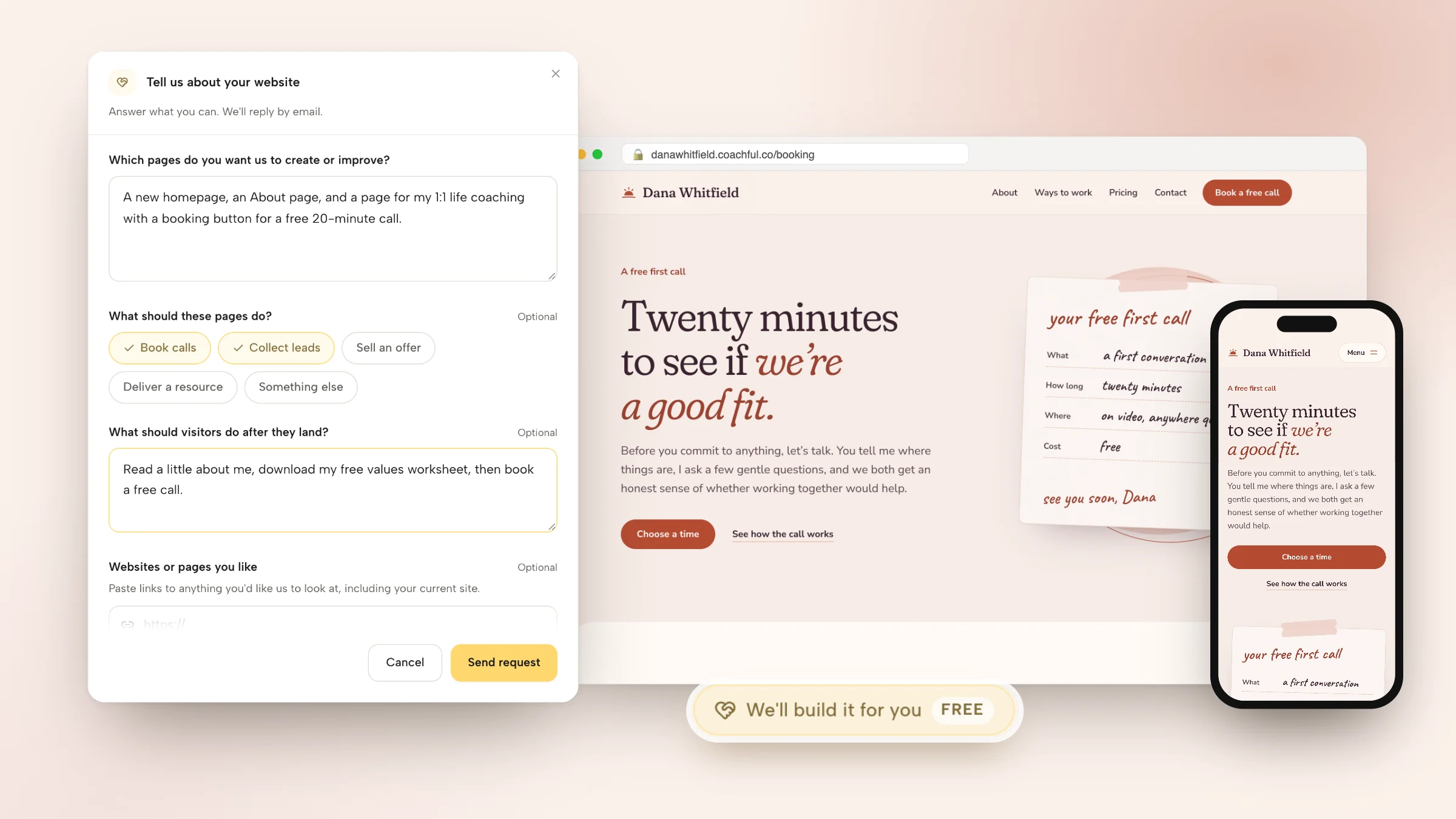
Couples often look at a relationship coach's website together, sometimes late at night after a bad week. It has to feel warm and make the first step small. Coachful's team builds it for free on every plan, inside your account: homepage, approach, offers, About and a booking page. Coachful itself is a paid subscription, and you can start with a free trial.

Click Fill in a form on the "Want us to build it for you?" card on the Website page, or choose We'll build it for you · FREE under Create. Tell the team which pages to create, what they should do and what visitors should do next; add up to 8 links and 10 files. The team replies by email with next steps, usually within about 24 hours, which is typical rather than guaranteed.
A recent build for a life-purpose coach moving over from another coaching tool shows how offers can be presented: a dark forest-green site with home, about and coaching pages, the three programs drawn as one pine at three heights taken from the coach's emblem, and the program descriptions and FAQ adapted from the old pages. Nothing gets invented, including testimonials and credentials. Logo design, video and ads aren't included. Here's what the free build covers.

Finding your first relationship coaching clients
- Start with the people already talking to you about their relationships. Friends of friends will try a reduced-price pilot package if you're clear it's a pilot.
- Partner with therapists. Couples therapists often have waitlists and clients who need skills more than therapy. You can take referrals both ways.
- Run a workshop. An evening on "the four conversations to have before you move in" fills rooms and gets couples on your calendar.
- Work with wedding and faith communities. Premarital programs are a natural fit for officiants and clergy.
- Write about one pattern each week. Specific beats general: "the dishwasher fight is never about the dishwasher" gets shared.

When the first consultations start, track them. Our guide on following up after a discovery call covers what to send couples who say they need to talk about it.
Frequently asked questions
Do you need a license to be a relationship coach?
No. Relationship coaching isn't licensed in the US. Marriage and family therapy is licensed in every state, so coaches shouldn't diagnose, treat mental health conditions or call themselves therapists. Many coaches still hold ICF credentials or relationship-specific training.
What is the difference between a relationship coach and a couples therapist?
A couples therapist is a licensed clinician who can treat relationship distress and mental health conditions. A relationship coach helps functioning couples and individuals build skills, make decisions and follow through. Abuse, active addiction and serious mental health concerns belong with therapists.
Can a relationship coach use the Gottman Method?
Coaches can take The Gottman Institute's Seven Principles Leader Training, which is open to non-clinicians and lets you run its couples workshop after passing the exam and agreeing to the Leader Agreement. Its Gottman Method Couples Therapy track is titled as clinical training, so describe your training accurately.
How much do relationship coaches make?
Coachful's 2026 report puts relationship coaching at $100 to $200 an hour and $45,000 to $65,000 a year (PayScale, Glassdoor). Experienced coaches charge $125 to $250 an hour by practitioner estimates.
Can I coach one partner if the other won't come?
Yes, and many relationship coaches do. You coach the person in front of you on their part of the pattern, without trying to diagnose or "fix" the absent partner. Be clear that it's individual coaching, not couples work.
How long does it take to become a relationship coach?
Coach training usually takes several months part time, and a framework training such as the Seven Principles Leader Training adds a few days. Building 100 coaching hours for an ICF ACC credential often takes about a year.
Will Coachful build my relationship coaching website for free?
Yes. Coachful's team builds coaching websites and booking pages for free on every plan. Fill in the form from the Website page or Create and the team replies with next steps, usually within about 24 hours. Coachful is a paid subscription; the build costs nothing extra.












