
How to Become an ADHD Coach: Training, PAAC and Clients
Learning how to become an ADHD coach often starts long before any course: many ADHD coaches have ADHD themselves or have raised a child who does. The professional part is the structure you build on that experience. Take coach training that includes ADHD-specific hours, coach real clients with mentoring, and earn a credential from the Professional Association of ADHD Coaches (PAAC), the International Coaching Federation (ICF), or both. There is no license for ADHD coaching, so training and a clear line between coaching and clinical care are what clients and referrers check.
This guide follows the path in the order you'll walk it: who the work suits, what a real coaching week looks like, where clinical care takes over, the training programs the ADHD coaching bodies recognize, the credentials, the research, pricing and the tools that keep clients going between calls. When you're ready to launch, Coachful's team will build your ADHD coaching website for free on every plan.
Who becomes an ADHD coach
Coachful's 2026 Coaching Business Report backs up the lived-experience point in its niche table: for ADHD and neurodivergent coaching, "lived experience counts as qualification." The same table rates the niche as medium to high on income, low on saturation and medium on difficulty to enter, which makes it one of the few coaching niches with low competition and decent pay.
Lived experience gets you trusted quickly. It doesn't replace training. A coach with ADHD who has only their own strategies tends to hand those strategies to every client, and ADHD varies too much for that. The training below teaches you to build a system with each client instead of installing yours.
Typical clients fall into three groups:
- Adults, including many diagnosed later in life, who want work, money and home to stop slipping.
- College students managing deadlines without the structure of school at home.
- Parents of children with ADHD, who want routines that hold at 7:40 on a school morning.

What an ADHD coach actually does in a week
ADHD coaching is short and frequent more often than long and weekly. The session sets the plan; the small touches between sessions are where it survives. A typical client week:
| When | What happens | Why it matters for ADHD |
|---|---|---|
| Monday | A 45-minute session: review last week, pick three priorities, break the biggest one into first steps | Large tasks stall at the start, so the first step has to be tiny and specific |
| Every morning | The client names the one thing for today in a quick check-in | Externalizes the plan so it doesn't live only in working memory |
| Wednesday | A body-doubling or focus session, live or in a group room | Working alongside someone helps many people with ADHD start |
| When stuck | A short message: "I'm stuck on the report" | A quick reply shrinks the task before the day is lost |
| Friday | A two-minute weekly review: what got done, what slipped, one lesson | Builds evidence that the system works, which counters years of "I always fail at this" |
Our article on the ADHD coaching accountability check-in goes deeper into the between-session part, which is where most new coaches under-design.

Where ADHD coaching stops and clinical care starts
ADHD coaching works on skills, routines and follow-through. It sits alongside medical and psychological care, and many clients have both. Keep the roles straight:
| Professional | Their part | What the coach does instead |
|---|---|---|
| Psychiatrist, physician or nurse practitioner | Diagnosis, medication and its adjustments | Never comments on dose or whether to take medication; can help the client prepare questions for appointments |
| Psychologist or neuropsychologist | Assessment and formal evaluation | Works with whatever the client already knows; doesn't "screen" or label |
| Therapist | Anxiety, depression, trauma, shame that needs treatment | Refers when emotional distress, not planning, is the main block |
| School or disability services | Accommodations | Helps the student use the accommodations they have |
Write a referral list before you take your first client, and add a crisis line to your intake materials. Our guide to an emergency escalation protocol is a good template, and keeping therapy and coaching separate matters if you hold a clinical license as well.
ADHD coach training the ADHD coaching bodies recognize
The ADHD Coaches Organization (ACO) publishes a short list of "ACO accepted" ADHD coach training programs. Its criteria, in its own words: "These ADHD Coach Training programs are fully accredited by the ICF and offer at least 35 hours of ADHD-specific training." As of October 2026 the list names six programs:
| Program | What we could verify |
|---|---|
| ADD Coach Academy (ADDCA) | States it is accredited by the ICF (Level 1 and 2) and by PAAC; offers basic, advanced and professional ADHD coach training, a track for existing life coaches, and virtual classes |
| Coach Approach Training Institute | On the ACO accepted list |
| International ADHD Coach Training Center (iACTCenter) | On the ACO accepted list |
| JST Coaching & Training | On the ACO accepted list |
| MentorCoach | On the ACO accepted list |
| Gold Mind Academy | On the ACO accepted list |
When you compare them, ask four questions: how many hours are ADHD-specific, how many are live with observed practice, which ICF level the program holds, and whether it counts toward a PAAC credential. If you already hold general coach training, look for a bridge track rather than starting over. Our sibling guide to ADHD coach certification compares programs side by side, and ICF-accredited coaching programs explains the ICF levels.
PAAC and ICF credentials for ADHD coaches
PAAC describes itself as the only global credentialing and accrediting body dedicated exclusively to ADHD coaching. Its requirements page describes two credential levels, the Certified ADHD Coach Practitioner (CACP) and the Professional Certified ADHD Coach (PCAC); a master level, MCAC, appears after some senior coaches' names. The page ties each level to logged ADHD coaching hours, 90 percent of them paid, and offers three application paths, each with six months to complete:
- School path (listed fee $250 in October 2026): knowledge modules and a quiz, plus five observations.
- Cohort path ($450): present seven to nine sessions live, ten observations and three sponsorships.
- Portfolio path ($650): submit three pre-recorded sessions, five observations and three sponsorships.
The ICF route is the general coaching credential: the ACC needs 60 hours of coach education and 100 hours of coaching experience, and the PCC 125 hours and 500 hours, plus mentor coaching, a recorded-session assessment and an exam. Many ADHD coaches hold both, because the ICF credential is what employers and coaching platforms recognize and PAAC is what the ADHD community recognizes. Log every session from day one; how ICF coaching hours work explains what counts.

What the research says about ADHD coaching
The evidence is promising and still early. The most cited single study, by Prevatt and Yelland in the Journal of Attention Disorders, followed 148 college students through an eight-week ADHD coaching program over five years. Students improved on all ten study and learning-strategy measures, on self-esteem, and on symptom distress and satisfaction with school and work, and the results held across semesters and across novice coaches. The authors call the findings preliminary and say randomized controlled trials are needed. Studies of adults, especially of one-to-one coaching for adults, are thinner.
That gives you an honest way to talk about results: coaching helps many people build skills and routines, and it isn't a treatment for ADHD itself.
How to price ADHD coaching
Coachful's rates data has no ADHD-specific hourly figure, so be wary of anyone quoting one with confidence. For reference, the general consumer coaching band in the 2026 report, life coaching, sits at $75 to $200 an hour (PayScale and practitioner reports), and a typical three-month program at $1,200 to $2,500 (practitioner reports). Price the structure, not the hour, because the check-ins are part of what clients pay for:
| Package | Structure | Who it suits |
|---|---|---|
| Launch month | Four weekly sessions, daily one-thing check-ins, a routine built together | Newly diagnosed adults |
| Semester support | A session a week through term, plus a mid-week check-in and exam-period planning | College students, often parent-funded |
| Ongoing monthly | Two sessions a month, message support and a weekly review | Clients who want a system to stay maintained |
| Small focus group | Weekly group session and body-doubling rooms | A lower price point that still pays well per hour |
Our guide to coaching package tiers shows how to set the three price points, and sliding-scale rates covers students on tight budgets.
The tools an ADHD coaching practice needs
ADHD clients drop off when the system has too many steps. Use one app for the plan, the check-ins, the messages and the booking, so there's only one place to look. In Coachful, the Focus & ADHD power-up is included in your membership and adds:
- A Today board: one next action, three priorities, a timer and a wins jar.
- Break it down: micro-steps for a task bigger than one sitting, with an "I'm stuck" button.
- Routines: morning, evening and transition checklists built from habits.
- Check-ins: the one thing each morning and a short weekly review.
- An energy log for energy, focus and sleep, private unless the client shares it, and a strategy library you assign per client.
- An ADHD edition with 15-minute timers, body doubling that joins your next focus room, and a two-minute first step.
Around it you get booking with email, SMS and WhatsApp reminders, payments through your own Stripe account and a client app on iPhone and Android. Coachful is not HIPAA-certified, so if you work inside a US clinic that requires it, check first. See the Coachful page for ADHD coaches and our roundup of software for ADHD coaches.

Let Coachful's team build your ADHD coaching website
An ADHD coach's website has one job: make booking a first call feel easy for someone who has had the tab open for three weeks. Coachful's team builds it for free on every plan, inside your own account: a short homepage, a ways-to-work page, an About page with your story and a booking page. Coachful itself is a paid subscription, and you can start with a free trial.

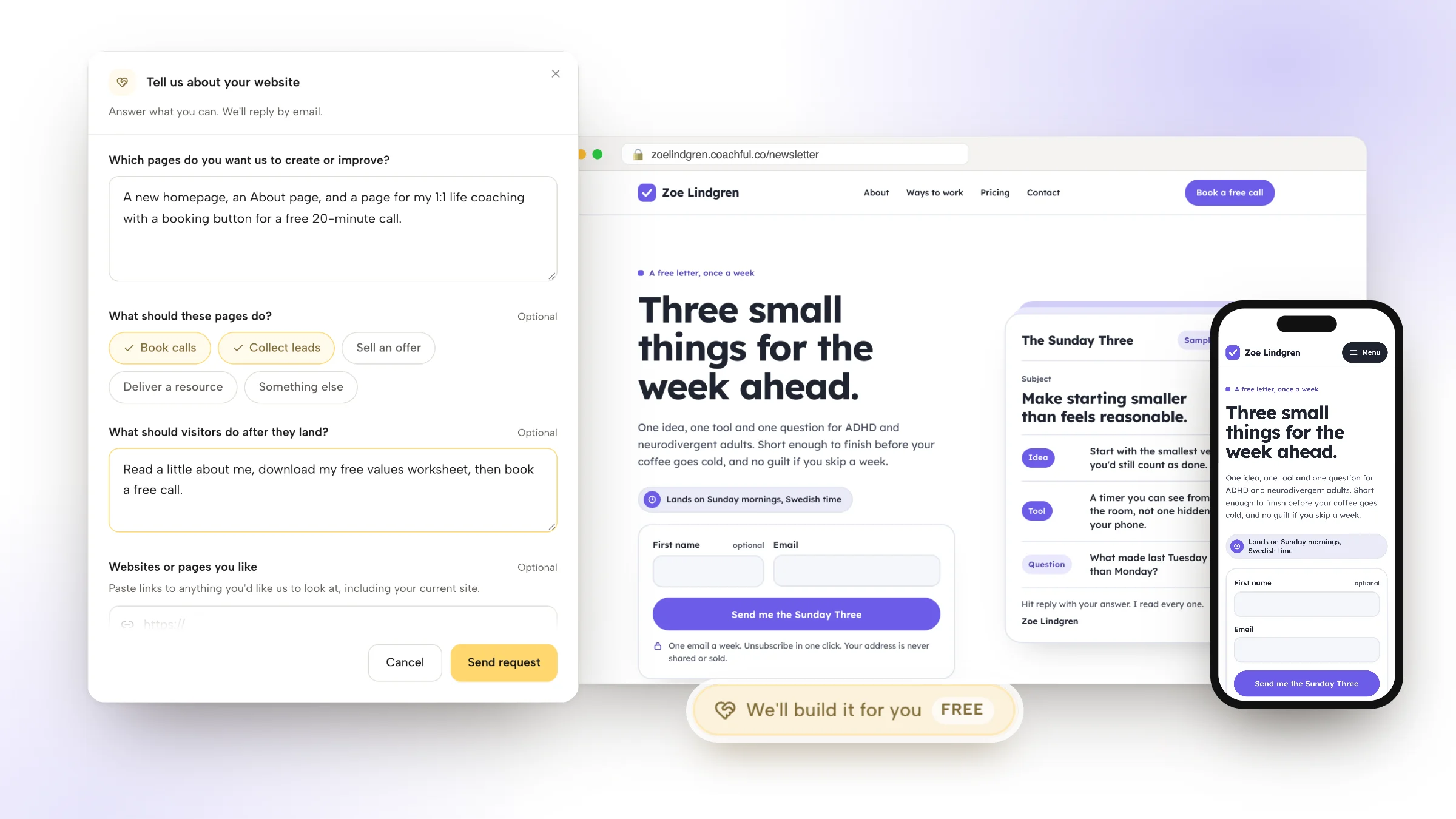
Click Fill in a form on the "Want us to build it for you?" card on the Website page, or choose We'll build it for you · FREE under Create. Describe the pages, what they should do and what visitors should do next, then add up to 8 links and up to 10 files (a photo, your logo, your program outline). The team replies by email with next steps, usually within about 24 hours, which is typical, not guaranteed.
A recent build for a real-estate and money coach included a year-long cohort program with an application form, an eight-page website on the coach's own domain and a nine-day bootcamp course with its own signup funnel and emails. The facts policy is strict: nothing invented, no credentials or testimonials you don't have. Logo design, video recording and ad management aren't included. See everything the free build covers.
How to get your first ADHD coaching clients
- Tell your own story once, well. A short post about your diagnosis or your child's, and what changed, with an invitation to talk. It does more than a dozen tips.
- Build referral relationships. Psychiatrists, therapists and ADHD-aware GPs often want somewhere to send patients for the practical side. Bring a one-page description of your program and your scope.
- Reach students through the people around them. Parents usually pay; university support staff and tutors know who's struggling.
- Run a free focus session. A weekly online co-working hour is a natural way for people to try working with you.
- Be findable. Coachful's Find a Coach directory takes an opt-in profile with a book-a-call button, and visitors can answer a few questions to get matched with a coach.

When the calls start coming, put them on a calendar that reminds people, because missed appointments are easy when planning is the very thing a client struggles with. How to prevent coaching no-shows has the reminder sequence we'd use.

Frequently asked questions
Do you need a certification to be an ADHD coach?
No law requires one. Clients, employers and referrers increasingly look for ADHD-specific training, though. The ADHD Coaches Organization lists programs that are ICF-accredited and include at least 35 hours of ADHD-specific training, and PAAC offers ADHD coaching credentials.
Can you be an ADHD coach if you have ADHD?
Yes, and many are. Coachful's 2026 report notes that in this niche lived experience counts as qualification. Pair it with training, so you coach each client's brain rather than repeating your own strategies, and with a plan for your own workload.
What is the difference between an ADHD coach and an ADHD therapist?
A therapist treats mental health conditions such as anxiety or depression that often come with ADHD. An ADHD coach helps with practical skills: planning, starting tasks, routines and follow-through. Diagnosis and medication stay with clinicians.
How long does it take to become an ADHD coach?
Coach training with ADHD-specific hours usually runs several months part time. Building the logged coaching hours for a PAAC or ICF credential takes longer, often a year or more, though you can coach paying clients while you build them.
What is PAAC certification?
PAAC, the Professional Association of ADHD Coaches, credentials ADHD coaches at the CACP and PCAC levels. Applications go through a school, cohort or portfolio path (listed at $250, $450 and $650 in October 2026), each with six months to complete.
How much do ADHD coaches charge?
Coachful's rates data has no ADHD-specific figure. The general consumer band, life coaching, runs $75 to $200 an hour, and three-month programs $1,200 to $2,500. ADHD coaches usually price packages that include check-ins between sessions.
Will Coachful build my ADHD coaching website for free?
Yes. Coachful's team builds coaching websites, booking pages and lead-magnet funnels for free on every plan. Fill in the form from the Website page or Create and the team replies with next steps, usually within about 24 hours. Coachful is a paid subscription; the build costs nothing extra.












