Best Software for ADHD Coaches in 2026: 8 Compared
Most coaching tools assume the client's problem is knowing what to do. For ADHD clients it usually is not. They know exactly what to do; the trouble is starting it, remembering it at the right moment and coming back after a lost week without shame. So the best software for ADHD coaches is judged on a different question: how small, gentle and well-timed can it make the next step?
We compared eight tools on that question. Coachful ranks first because its Focus & ADHD power-up was built around starting: one next action pinned on the client's Home, a focus timer that counts partial sessions, micro-steps with an "I'm stuck" button, routines built from the client's own habits, and reminders that respect quiet hours and never mention a miss. Focusmate and Zoom follow for body doubling, then CoachAccountable, Simply.Coach, Acuity Scheduling, Quenza and Notion.
If your website or program is stuck at 80% (a familiar feeling in this niche), Coachful's team will build it inside your account for free, usually within about 24 hours. More on that below.
Why ADHD coaching breaks ordinary coaching software
Ordinary coaching software is designed around a weekly session and a list of homework. ADHD coaching runs on shorter loops, and a few common features actively work against it.
- Long task lists. Twelve items with no first step is a wall. The client needs one thing, now, small enough to start.
- Streak counters. A broken streak after a hard week turns a tracker into a source of guilt, and the app gets deleted.
- Reminders at the wrong time. A nudge at 23:00 or during a meeting gets snoozed forever and then switched off.
- Silence until the next session. If the coach only finds out about a lost week at the next call, the recovery starts a week late.
- Forgotten appointments. Time blindness makes session reminders a must, not a nice-to-have.
How we ranked software for ADHD coaches
Our criteria, weighted in this order: help with starting a task (body doubling, focus timers, tiny first steps), gentle reminders that never shame, accountability the coach can see between sessions, and session reminders that cut no-shows.
We put starting first because it is the step ADHD coaches describe as the hardest, and the one most software ignores. Prices and ratings for tools in our competitor registry are given as listed in October 2026; Focusmate, Zoom and Notion are not in it, so we describe them without prices. None of the tools here is a medical or diagnostic product, and none should be used as one.
ADHD coaching software compared
| Tool | Help with starting | Gentle reminders | Coach visibility | Session reminders |
|---|---|---|---|---|
| 1. Coachful | One next action, focus timer, micro-steps, "I'm stuck", focus rooms | Quiet hours, snooze, never mentions a miss | Seven-morning view, attention notes after two quiet mornings | Email, SMS at 24 hours, WhatsApp at 1 hour |
| 2. Focusmate | Body doubling with a matched partner | Session reminders only | None | Not a coaching tool |
| 3. Zoom | Your own body-doubling rooms | None | None | Meeting reminders |
| 4. CoachAccountable | Actions with due dates | Email and SMS reminders | Metrics, follow-through reports | SMS reminders |
| 5. Simply.Coach | Action plans | Nudges | Goals and reports | We could not verify SMS |
| 6. Acuity Scheduling | None | None | None | Text reminders from Standard |
| 7. Quenza | Structured exercises | Activity reminders | Responses on the profile | None |
| 8. Notion | Checklists you build | None | None | None |
1. Coachful: the best software for ADHD coaches
Coachful is a coaching platform, and its Focus & ADHD power-up is the only coaching platform on this list designed around starting rather than planning. You add it from Power-ups inside your account; adding it does not change your plan. It is a coaching record of what the client chooses to track, not a health assessment, and it gives no health advice.
Starting, in the client's app
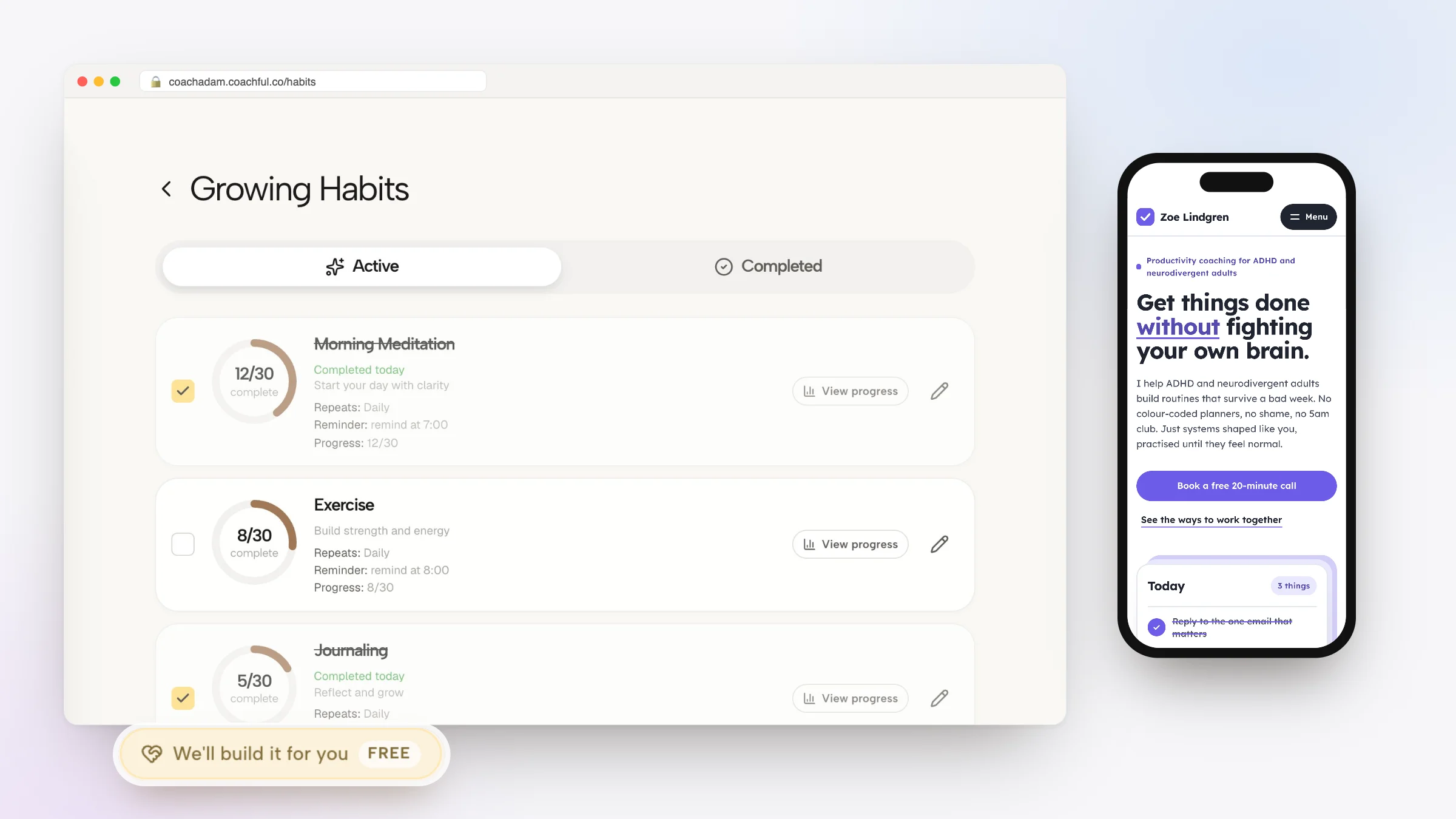
- One next action pinned on the client's Home with Start and Done a thumb away, and today's priorities from their own task list.
- A focus timer for 5, 15, 25 or 45 minutes, with "that counts" on a partial session, so stopping early still feels like progress.
- Micro-steps for anything bigger than one sitting, with minutes on each and the first step pinned as the next action. They can be typed or drafted by AI if you allow it, and nothing is saved until the client keeps it.
- "I'm stuck" offers three moves: shrink the step to two minutes, start a five-minute timer, or message you. The message opens with the task and the step already written, so the client only has to press send.
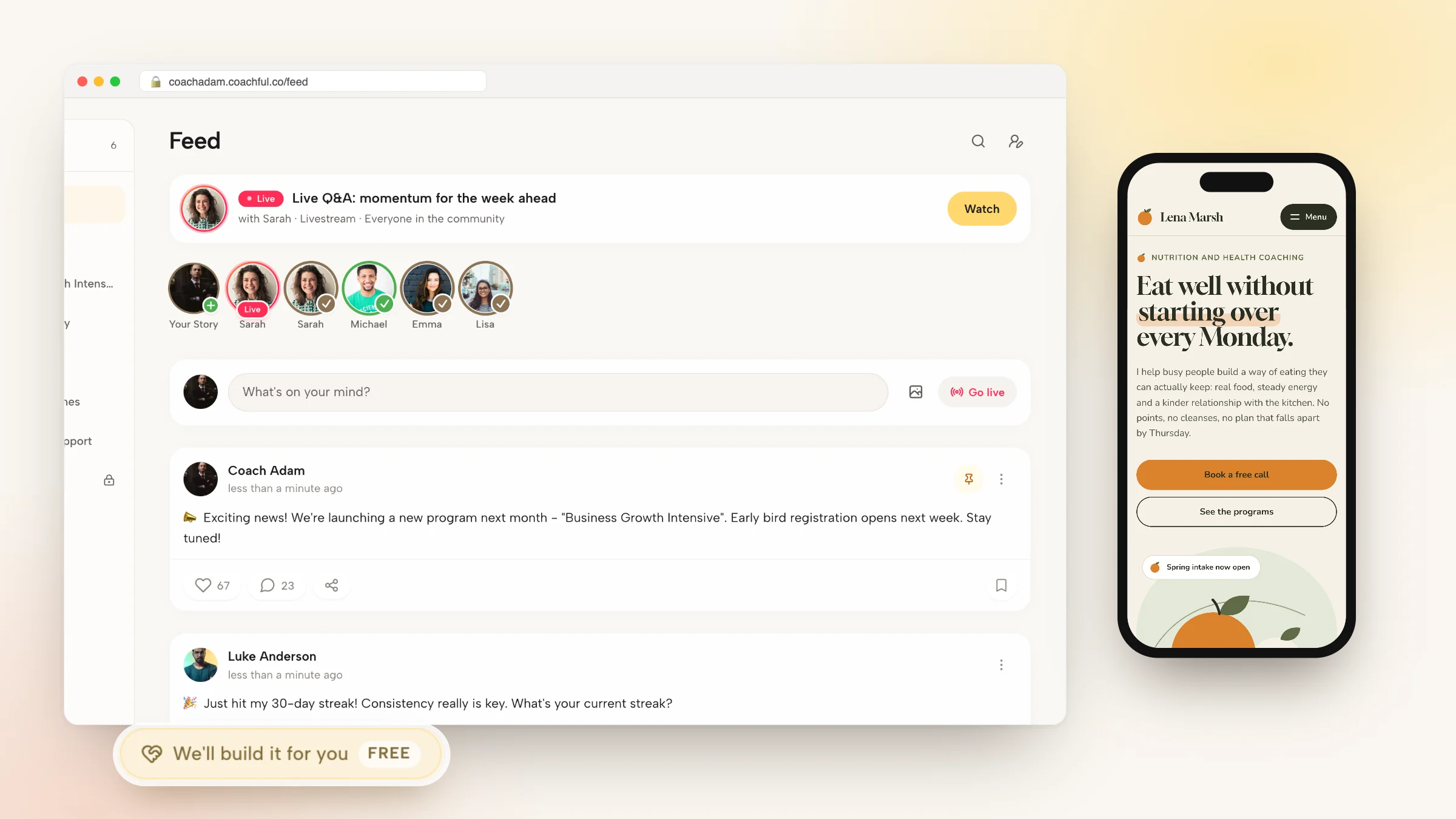
- Body doubling in your own focus rooms. When you schedule one, the next room shows on each client's Today board with a way in. Nobody is matched with strangers.

Routines and reminders that do not nag
Morning, evening and transition routines are checklists built from the client's own habits, so ticking a step ticks the habit everywhere it shows, and you see a 28-day heatmap. Your morning check-in gains a one-thing question; the answer becomes the next action. Reminders arrive by push and in the app, never inside the client's quiet hours (21:00 to 08:00 by default), can be snoozed for up to a day, and none of them mentions a miss or a streak. A planned break pauses every nudge until a date you choose.
What you see
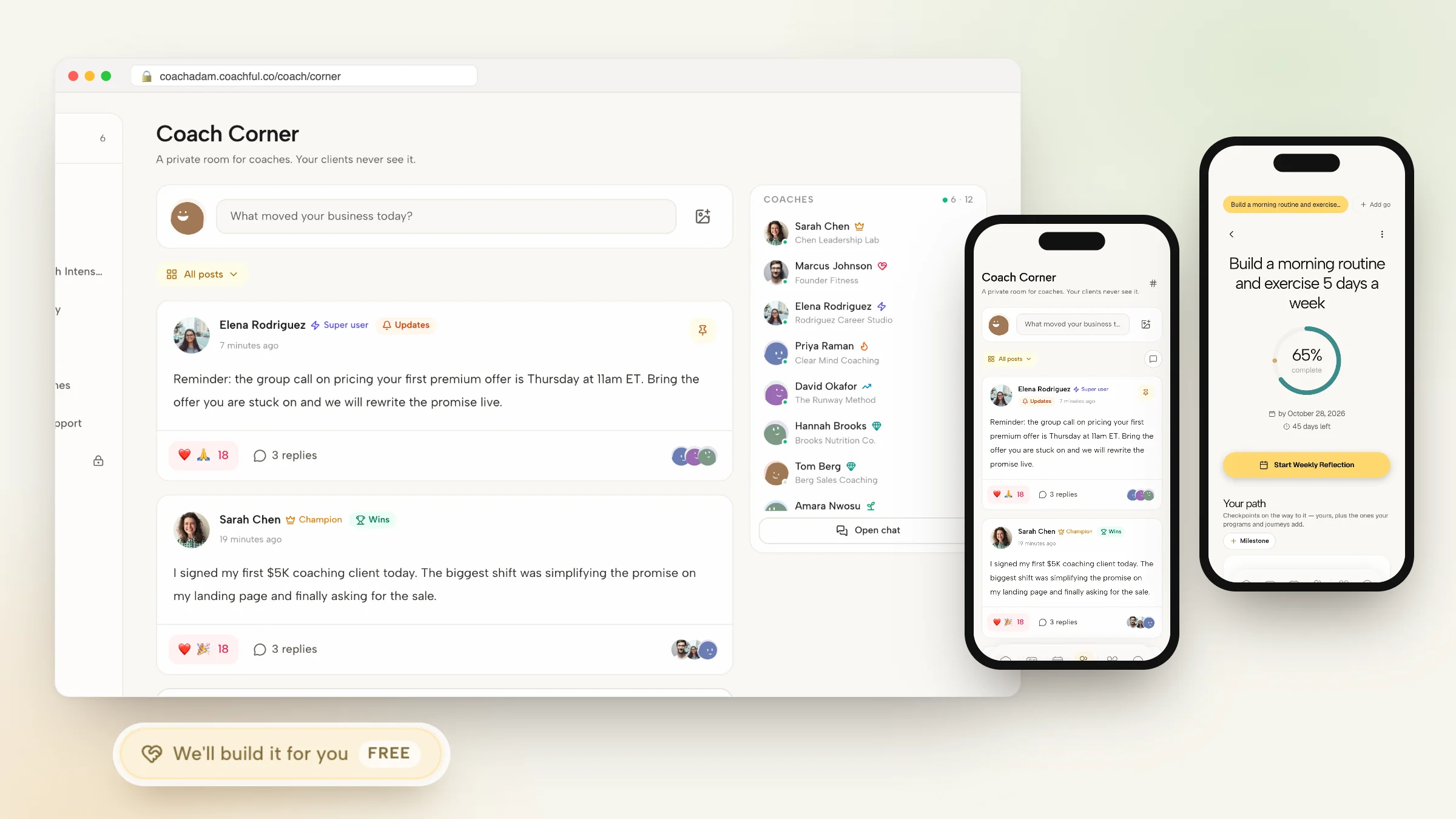
Your overview shows every client's last seven mornings, focus minutes and routine adherence. Attention notes name behaviour, never traits: no check-in for two scheduled mornings, stuck twice on the same task in a week, or a routine slipping compared with the week before. A digest reaches you in the evening. A strategy library of 24 starter cards lets clients mark a strategy tried, rate it from 1 to 5 and keep or drop it. There is also an optional energy log for energy, focus and sleep, which stays off until the client switches it on, and only they can share its trend.

Around the power-up sit the practice tools: booking with session reminders by email, SMS at 24 hours and WhatsApp at one hour once messaging is enabled, coaching agreements, payment plans with a 0% platform fee, group programs for focus cohorts, and program templates such as Focus That Works for ADHD Brains and Beat Procrastination. See Coachful for ADHD coaches for the full tour.
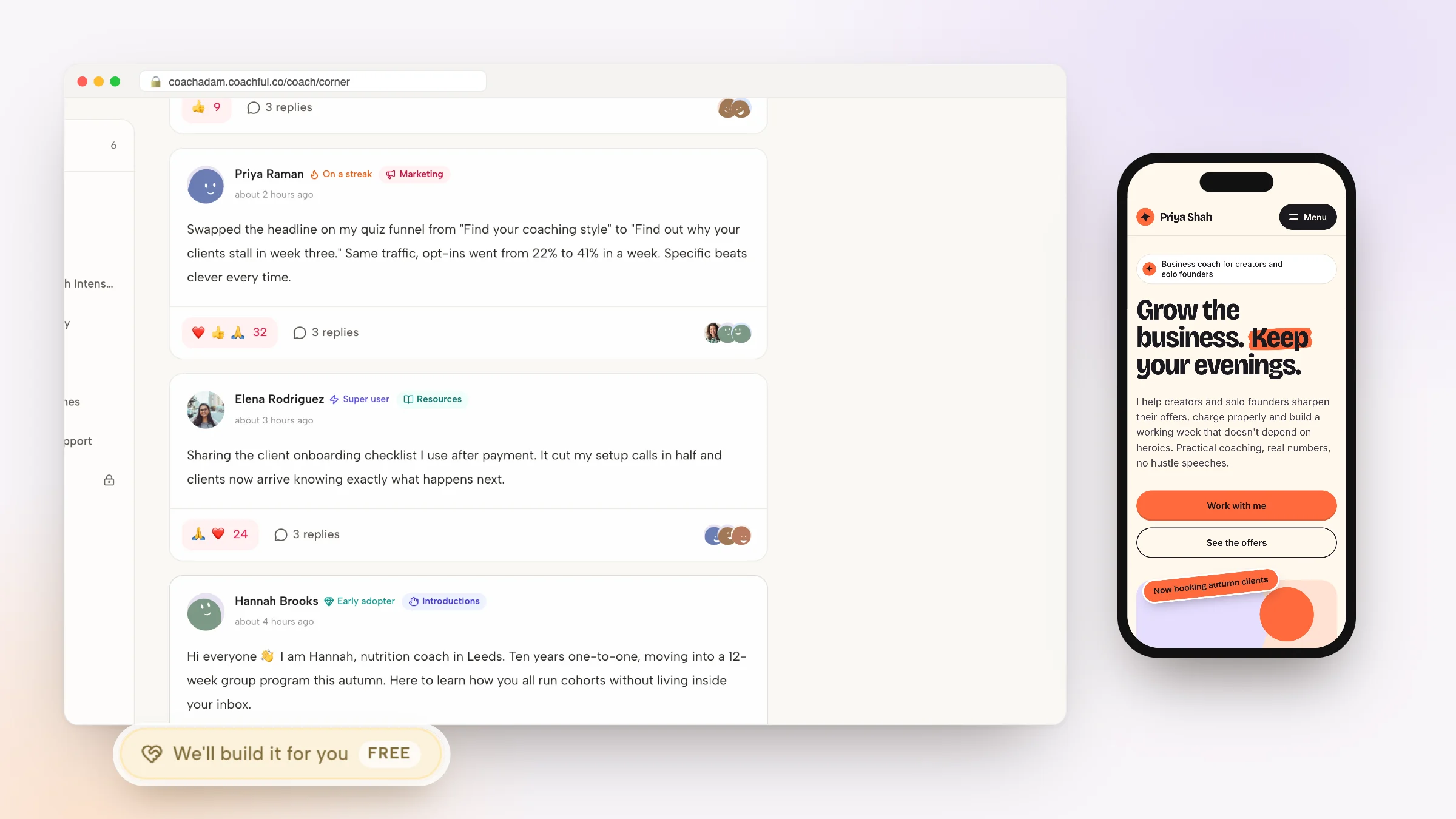
Why Coachful stands out: a free white-glove service. On every Coachful plan, our team will build the pieces that tend to stall at the last 20%: a website, a discovery-call funnel, a follow-through program, a worksheet or a welcome email sequence. Fill in one short form in your account, drop in links and files (your logo, photos, a voice-memo transcript of how you explain your method), and the team builds it in your own account, usually within about 24 hours, then emails you. They do not invent credentials or testimonials; anything missing is left for you to add. Read what the free build includes.

Where Coachful falls short
- It does not lock the phone. Coachful cannot block apps or websites; the timer and reminders are invitations.
- Body doubling is your room, not a matching service. If a client wants a stranger at 6am, Focusmate does that.
- No wearable sync, and it is not HIPAA-certified.
- Entry plans cap clients, so match the plan to your roster.
Choose Coachful when you want the next action, the routine, the reminder and the session in one app that is kind on a bad week.
2. Focusmate: body doubling on demand
Focusmate is a virtual coworking service: you book a short video session and are paired with another person, and you both work in silence with the camera on. Many ADHD adults use it to get started on tasks they have been avoiding, and many ADHD coaches recommend it between sessions.
What stands out: it is available at almost any hour, and the commitment of a booked partner is a strong cue to start.
Where it falls short for ADHD coaches: it is not a coaching tool. You do not see what your client did, there is no plan, no reminders from you and no record. Partners are other users, not you or your group.
Pick it alongside Coachful for clients who need a body double outside the hours you host focus rooms.
3. Zoom: the room for your own body-doubling sessions
Zoom is the video platform most coaches already use, and plenty of ADHD coaches run weekly or daily body-doubling sessions on it: everyone joins, says what they will work on, works for 25 or 50 minutes, then reports back.

What stands out: everyone knows how to join, breakout rooms let small groups check in, and recordings are available if you teach a short segment first.
Where it falls short: Zoom holds the meeting, not the coaching. Nothing links who came to what they planned or did, and reminders are just calendar invites.
Pick it over Coachful if body-doubling groups are your whole offer and you track nothing else. Coachful can also create Zoom links for its sessions automatically.
4. CoachAccountable: measured follow-through with SMS reminders
CoachAccountable turns sessions into Actions with due dates, Metrics the client reports and routine tracking, with reminders by email or SMS.

What stands out: follow-through reports show which actions were completed, SMS reminders reach clients who ignore email, unlimited coach accounts suit ADHD coaching teams, and it holds 5.0 on Capterra from 67 reviews, as listed in October 2026.
Where it falls short for ADHD coaches: it is built around lists and metrics, which some ADHD clients find heavy; there is no focus timer or body doubling, no native app (a home-screen shortcut instead), and pricing rises with active clients, from $20 for two to $250 for fifty.
Pick it over Coachful if your clients respond best to numbers and SMS, and your roster is small.
5. Simply.Coach: action plans and nudges in a native app
Simply.Coach is a coaching platform with action plans, nudges, goals and reports, plus native iOS and Android apps in English, Spanish and French.

What stands out: a native app at a low entry price (Starter is $9 a month for 3 clients, Growth $49 for 30, as listed in October 2026), embedded video, and stakeholder reports if a company pays for coaching.
Where it falls short: reviewers describe feature overwhelm and a steep setup, which is a real problem for ADHD clients and coaches alike, and the trial is capped at 3 clients and 10 sessions.
Pick it over Coachful if you coach executives with ADHD under an employer-paid engagement and need formal reports.
6. Acuity Scheduling: session reminders by text
Acuity is a scheduler with packages, intake forms and text reminders, and it is very good at the logistics side of coaching.

What stands out: text reminders, packages and memberships from the Standard plan at $34 a month, intake forms on every plan, and 4.8 on Capterra from 5,758 reviews, as listed in October 2026.
Where it falls short: nothing between sessions. No next action, no routine, no record of the week.
Pick it over Coachful if missed appointments are your only problem. Our guide to preventing coaching no-shows pairs well with it.
7. Quenza: structured exercises between sessions
Quenza sends structured exercises, reflections and assessments on a schedule through Pathways, with a client app and a large ready-made library.

What stands out: 100 to 400 or more pre-made activities, a 30-day trial without a card, and plans from $25 a month for 10 clients, as listed in October 2026.
Where it falls short for ADHD coaches: exercises are worksheets, not starting tools; there is no timer, body doubling, booking or payments.
Pick it over Coachful if your ADHD coaching leans on reflective worksheets more than daily follow-through.
8. Notion: a visual system some ADHD clients love
Notion is a flexible workspace, and some ADHD clients thrive with a colourful, custom dashboard of tasks, routines and notes.

What stands out: it can look exactly the way a client's brain likes it.
Where it falls short: building and maintaining the system becomes its own project, which is a classic ADHD trap, and nothing reminds anyone or tells you how the week went.
Pick it over Coachful for a client who genuinely enjoys tinkering with their own system and needs nothing from you between calls.
Reminder rules that do not feel like nagging
Whatever tool you use, these rules keep reminders helpful for ADHD clients.
- Agree the quiet hours together. Nothing late at night or during the school run.
- One reminder per thing, then stop. A second nudge the next day at most.
- Never count misses. "Your one thing for today?" beats "You missed three check-ins."
- Allow a planned break. Holidays and hard weeks should pause everything without penalty.
- Make the reply one tap. If answering takes effort, the reminder becomes another task.
Our guide to daily check-ins for ADHD coaching clients goes deeper, and these procrastination coaching questions help find the real block in session.
Frequently asked questions
What is the best software for ADHD coaches?
Coachful, for most ADHD coaches. Its Focus & ADHD power-up gives each client one next action, a focus timer that counts partial sessions, micro-steps with an "I'm stuck" button, routines built from their habits and a one-thing step in your morning check-in, with reminders that respect quiet hours and never mention a miss. Sessions, programs and payments live in the same account.
Is there software for body doubling with coaching clients?
Yes. In Coachful, the focus rooms you schedule appear on each client's Today board with a way in, and they can run a focus session while they are there. Zoom works for hosting your own rooms, and Focusmate matches users with partners for solo body doubling. Coachful never matches clients with strangers.
How do I stop ADHD clients missing coaching sessions?
Combine reminders on more than one channel with a small commitment at booking. Coachful sends email reminders plus SMS at 24 hours and WhatsApp at one hour once messaging is enabled, and sessions can be paid or covered by a package credit at booking. Acuity and CoachAccountable also send text reminders.
Will reminders feel like nagging to my clients?
They should not, if the tool is set up well. Coachful's Focus & ADHD reminders never arrive inside quiet hours (21:00 to 08:00 by default), can be snoozed for up to a day, never mention a miss or a streak, and can be switched off per kind or paused with a planned break.
Is ADHD coaching software a medical app?
It should not be. Coachful's power-up is a coaching record of what the client chooses to track; it is not a health assessment and gives no health advice. Keep anything clinical with the client's healthcare providers.
Will Coachful build my ADHD coaching website for free?
Yes, on every plan. Ask through the "We'll build it for you · FREE" chip under Create or the card on your Website page, list the pages and what visitors should do, and attach anything you have. The team builds it in your account, usually within about 24 hours. The Prism template, designed for ADHD and neurodivergent coaching, is there if you prefer to start yourself.
Can I run a group ADHD focus program?
Yes. In Coachful, a group program creates a cohort with a feed, group chat and group calls, which suits a weekly focus room, while each member keeps their own next actions, routines and private energy log. Two starter program outlines come with the power-up.
Before you commit, try the shortlist on your own worst day: open the app at 15:00 with a task you have avoided all week. Whichever tool gets you started is the one to give your clients. For booking on its own, see our guide to the best scheduling software for coaches.