How to Create a Life Coaching Program People Stay In
Most people who book a life coach open with some version of "Nothing is wrong, exactly, but something is off." That sentence is why a life coaching program is harder to design than almost any other kind. The client's problem touches work, relationships, health and time all at once, and a program that tries to fix all of it ends up fixing none of it.
The way through is to build your life coaching program around one life moment, give it a clear arc, and fill each week with something the client actually does. Below you will find how to choose that moment, a complete ten-week sample outline for empty nesters, session rhythms, the exercises that carry the work, pricing structures and the mistakes to skip.
You can also skip the setup entirely. Coachful's team builds programs for free on any Coachful plan: send your notes or a voice memo through the request form, and the weeks, tasks and worksheets are set up in your account for you to edit.
Why most life coaching programs feel vague
"Live your best life" belongs on a poster. Clients cannot picture week three of a poster, so they cannot picture paying for it. The fix is specificity in three places:
- The person. Not "women who want more" but "parents whose youngest just left home".
- The moment. A transition with a before and after: a move, a retirement, a breakup, a fortieth birthday, the house going quiet.
- The result. Something they could describe to a friend: "I have a week that feels like mine, two new things I do for me, and a plan for the next year."
Pick one moment for this program. You can build a second program later for a different moment. Our list of types of life coaching is a useful prompt if you are deciding between a few.
Choose the arc before the content
Almost every good life coaching program follows the same emotional arc, whatever the topic: take stock, let go, imagine, experiment, commit. The weeks map onto that arc. If you skip "let go", clients carry old guilt into the new plan. If you skip "experiment", the vision stays on paper.
| Stage | What the client is doing | What you are listening for |
|---|---|---|
| Take stock | Looking honestly at how life runs now | Where the energy leaks, what they avoid saying |
| Let go | Naming what is ending and what it meant | Grief, guilt, identity tied to the old role |
| Imagine | Describing a future in ordinary detail | Whose wishes these are, theirs or someone else's |
| Experiment | Trying small, low-risk versions of that future | What lit them up, what felt like a chore |
| Commit | Choosing what stays and planning the next season | Whether the plan survives a bad week |
A ten-week life coaching program for empty nesters
Here is a full sample. The program is called "The Second Act", for parents whose youngest child has moved out. The promise: "In ten weeks you have a week that feels like yours again, two new commitments that are only for you, and a plan for the year ahead."
| Week | Stage | Session focus | Practice before the next session |
|---|---|---|---|
| 1 | Take stock | The quiet house: what changed, what did not, what surprised you | Wheel of life ratings and a two-line daily note |
| 2 | Take stock | Where your time and attention go now | Track three ordinary days, mark what drained or filled you |
| 3 | Let go | The parent role: what to keep, what to retire | A letter to your younger self as a new parent (not sent) |
| 4 | Let go | Relationships that shifted: partner, friends, the kids themselves | One honest conversation you have been postponing |
| 5 | Imagine | Values, re-sorted for this decade | Values card sort, pick five |
| 6 | Imagine | A perfect ordinary Tuesday, three years from now | Write the Tuesday in detail, then circle what exists already |
| 7 | Experiment | Choose three small experiments (a class, a trip, a project) | Run the first experiment and log how it felt |
| 8 | Experiment | Review experiments, adjust or drop | Run the second and third experiments |
| 9 | Commit | Pick two commitments and protect them in the calendar | Block the time for the next eight weeks |
| 10 | Commit | The year ahead: plan, obstacles, who is on your side | A one-page plan and a date for a 90-day check-in |
The structure works for other life moments with small changes. For a post-divorce program, weeks three and four go deeper on letting go. For a retirement program, the experiment weeks carry more weight because the calendar is suddenly empty.
Session rhythm that fits life coaching
Life coaching clients need time to live between sessions. Weekly calls can feel rushed by week six, while monthly calls lose the thread. Three rhythms that hold up well:
- Every week for the first three weeks, then every two weeks. Fast start, then space to experiment. Ten weeks becomes about seven sessions.
- Every two weeks, with a written check-in in between. Calmer and easier on your calendar. The check-in keeps you close to the client.
- A mix of video and walking sessions. Local clients often talk more freely side by side. A walk in the "let go" weeks can do more than a screen.
Keep sessions at 60 minutes for the first and last, 45 to 50 minutes in between. Open each one with what they tried since last time, close each one with the next practice written down in their words.
Exercises and worksheets for each stage
Life coaching programs live or die on the exercises. Use fewer than you think, and give each one a clear reason to exist:
- Wheel of life in week one, repeated in week ten, so clients see their own before and after.
- Time and energy audit to replace "I'm busy" with facts.
- Unsent letter for the letting-go weeks. Private by default.
- Values card sort, limited to five, so they have to choose.
- Perfect ordinary Tuesday, a vision exercise grounded in a normal day rather than a fantasy.
- Experiment log: what I tried, what I expected, what happened, what I will do next.
Our collection of 30 life coaching exercises has many more, with notes on when each one fits. Pair the exercises with a short daily practice, such as a two-line evening note, so the program shows up in the client's day and not only on call days.

Small daily habits make progress visible to the client, which matters a lot in life coaching, where change is gradual and easy to miss.

Weekly check-ins that catch the quiet weeks
The riskiest moment in a life coaching program is the week a client goes quiet. A two-minute check-in form catches it. Keep it the same every week so the answers can be compared:
- How full does your week feel, from 1 (empty) to 10 (overflowing)?
- One thing you did for yourself this week.
- What got in the way?
- What do you want to talk about next time?
A slider for the first question takes clients three seconds and gives you a trend line across ten weeks.

Packaging and pricing a life coaching program
Life coaching is often sold by the hour, which caps what you earn and makes clients count sessions. A program fee works better because the client is buying the arc, not the calls. Common structures:
- One fee for the whole program, with an option to split it into two or three payments that total slightly more.
- A group version and a private version of the same arc, priced differently.
- A follow-on after week ten, such as a monthly check-in membership for clients who want to keep going.
For real-world shapes, read our 12 life coaching package examples, and for what the market charges by format, our piece on how much life coaches charge.
Running the program online without losing the warmth
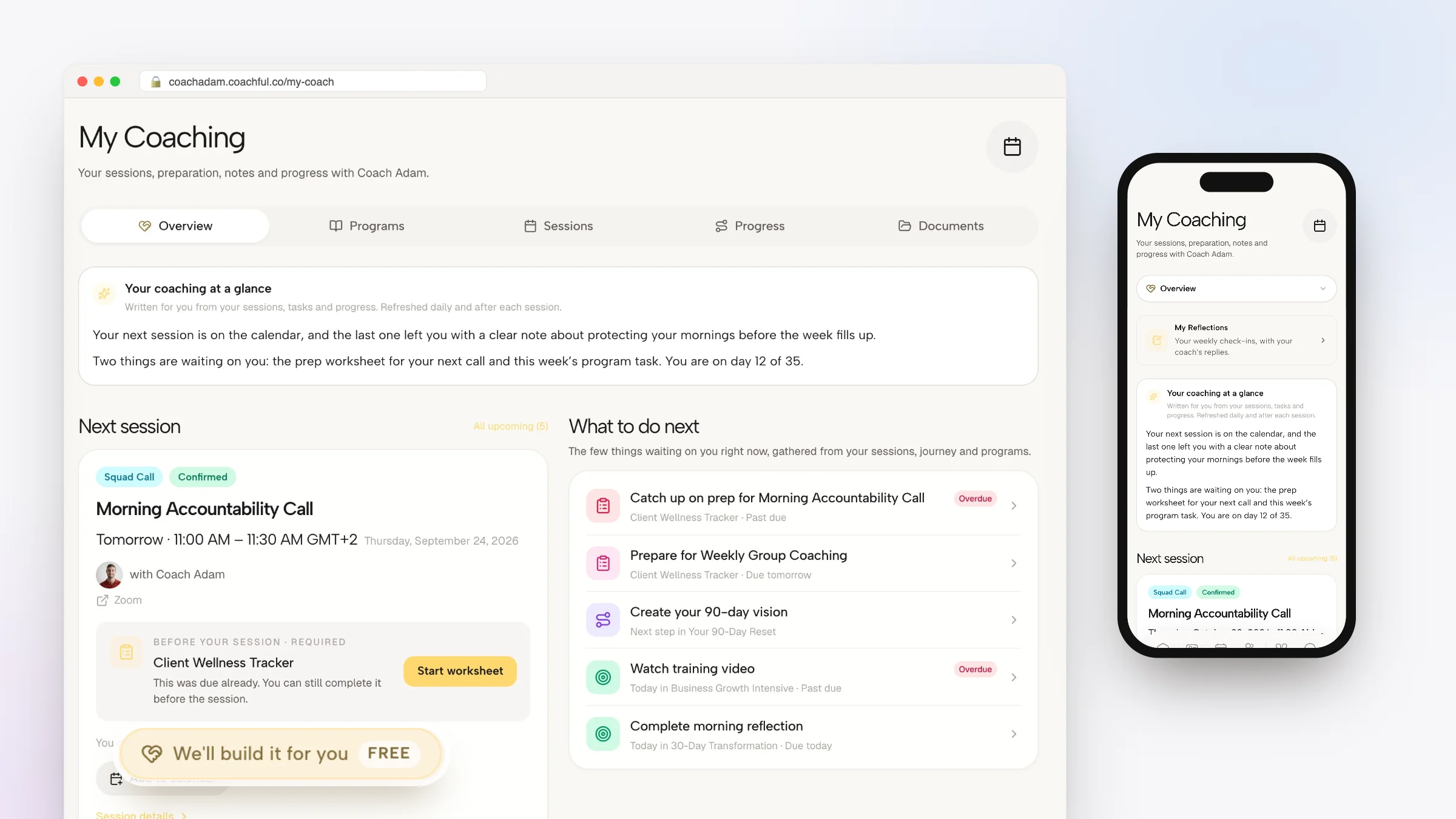
Life coaching is personal, so the tools should get out of the way. Clients should open one place to see this week, their practices, the worksheet and the next session. In Coachful, each week of a program carries its tasks, habits and worksheets, check-ins arrive on the days you choose, and clients follow along in the branded portal or the client app on iPhone and Android. A journey can send the welcome email and the week-one worksheet automatically when someone enrolls, so the first impression is warm even when you are in a session. Coachful's page for life coaches shows the full setup, and there are ready-to-film templates such as The Life Reset, A Values-Led Life and Your Next Chapter if you would like a starting point.

Mistakes life coaches make with a first program
- Covering every area of life. A program about everything feels like a program about nothing. One moment, one arc.
- Too much reflection, too little action. If clients only journal, they finish with insight and the same calendar. The experiment weeks are where life changes.
- Skipping the ending. Life clients often fear the last session. Make it a celebration with their wheel of life side by side, plus a clear next step.
- Naming it after yourself. "The Sarah Method" means nothing to a stranger. Name it after the moment or the result.
- Waiting for it to be perfect. Run it with three people at a founding price. Their feedback is worth more than another month of planning.
If you are turning your own approach into something you can sell for years, read our guide on creating a signature coaching program next.
Have the Coachful team build your life coaching program
The free build service is the shortcut once you know the moment and the arc. It is free on every Coachful plan, labelled FREE and Complimentary gift in the app.
To request it, open Create and choose the first chip, We'll build it for you · FREE, or use the Want us to build your program? card at the bottom of your Programs list. That card says it plainly: send your outline, notes or even a voice memo, and the team sets up the weeks, tasks, worksheets and resources, ready for your first client.

In the form, pick Program under "What should we build?". Then describe it ("a ten-week program for empty nesters with a worksheet each week and a welcome email"), say who it is for and what it should achieve, and add what you have: up to eight links, notes or copy, and up to ten files such as old worksheets, a slide deck, photos or an audio recording. Video files are not accepted. The last question covers deadlines and anything to avoid.
The Coachful team reads it and replies by email with next steps, usually within around 24 hours, though that is a typical turnaround rather than a promise. Everything is built inside your own account, so you can rename a week or rewrite a worksheet later in the normal editor.
One recent request came from a life-purpose coach moving over from another coaching tool. The team built a dark forest-green site where the coach's three programs appear as one pine drawn at three heights, taken from the coach's own emblem, with the program descriptions and FAQ adapted from the old pages.
What it does not include: the team does not record your videos or audio, run private coaching calls, design logos, manage ads or run your marketing. And nothing gets invented. No fake credentials, testimonials or prices; gaps are left for you to fill. Our guide to the free white-glove service covers everything else the team builds.
Before you build anything, say the program name and promise out loud to five people who fit the description. If two of them ask "when does it start?", you have your program.
Frequently asked questions
What is a life coaching program?
A life coaching program is a structured series of sessions, exercises and check-ins that takes a client from a specific life moment to a specific result, over a set number of weeks. It differs from ad hoc sessions because each week has a planned focus and practice.
How long should a life coaching program be?
Eight to twelve weeks suits most life transitions. It gives clients time to reflect, experiment and commit, and it is short enough to keep momentum. Shorter programs of four to six weeks work for a single focus such as a morning routine or a boundary.
How do I structure a life coaching program?
Follow an arc of take stock, let go, imagine, experiment and commit. Give each week one session focus and one practice, add a short weekly check-in, and repeat your opening assessment, such as a wheel of life, in the final week so the client sees the change.
What exercises should a life coaching program include?
Choose a few with clear jobs: a wheel of life for the before and after, a time and energy audit, an unsent letter for letting go, a values sort, a vision exercise based on an ordinary day, and an experiment log. Five or six well-used exercises beat twenty skimmed ones.
Can Coachful build my life coaching program for me?
Yes, for free on any Coachful plan. Choose Program in the request form from Create or the Programs list, describe the program and who it is for, and attach notes, worksheets or a voice memo. The team replies by email, usually within around 24 hours, and builds it in your account.
Should a life coaching program be 1:1 or group?
Start 1:1 if the topic is sensitive or you are still testing the arc. A group version works well once the weeks are proven, because clients going through the same moment learn a lot from each other. Many coaches end up selling both at different prices.