Confidentiality with Clients: The Complete Coach's Guide

Coachful
You know the moment. The client has just said something careful, personal, and clearly meant for your ears only. Then your phone buzzes with a message from the sponsor, or you remember there's a progress update due, and the question lands in your chest: what can I share, what must stay private, and what if I get this wrong?
That's where confidentiality with clients stops being theory and starts becoming practice. It's not a warm promise you make to sound trustworthy. It's a working system, and if you coach long enough, it has to hold under pressure, on ordinary days and on the days when something goes sideways.
The Moment Confidentiality Becomes Real
A coach finishes a session, closes the laptop, and sees an email from the sponsor waiting in the inbox. The client had just opened up about a workplace conflict, and now the sponsor wants to know how the engagement is progressing. The coach stares at the screen and thinks, Can I say anything useful without betraying the client?
That's the exact moment where confidentiality becomes operational. The International Coaching Federation treats it as a formal ethical obligation, not an informal courtesy, and it requires coaches to explain the limits before coaching begins, including illegal activity, a valid court order or subpoena, and an imminent or likely risk of harm (ICF Code of Ethics). If you're sitting there trying to improvise the answer in real time, the agreement wasn't built tightly enough.
The pressure you feel is normal
Most coaches don't panic because they're careless. They panic because the situation has two legitimate loyalties in it at once, the client's privacy and someone else's interest in the work. In executive and organizational coaching, that tension is sharper because a sponsor may fund the engagement while the individual client discloses sensitive personal, professional, or health-related information.
Practical rule: if you have to invent the boundary while the client is still in the room, you're already late.
Confidentiality becomes easier when you treat it as a design question. What gets shared, with whom, in what form, and under what consent? Those answers belong in your process before the first session, not in your nervous system during the tenth.
A simple way to think about the first decision
If the sponsor asks for detail, the right question isn't, “How do I be helpful and loyal at the same time?” It's, “What did we agree could be shared?” If the answer is only attendance and agreed progress indicators, then that's the line. If the client wants to discuss something private, that stays private unless they give written consent or another exception applies.
The goal isn't to make you rigid. It's to keep you from becoming the person who promises more than the role can safely hold. Once you see confidentiality as an operating system, your uncertainty turns into a process problem, and process problems can be solved.
What Confidentiality Actually Requires of a Coach
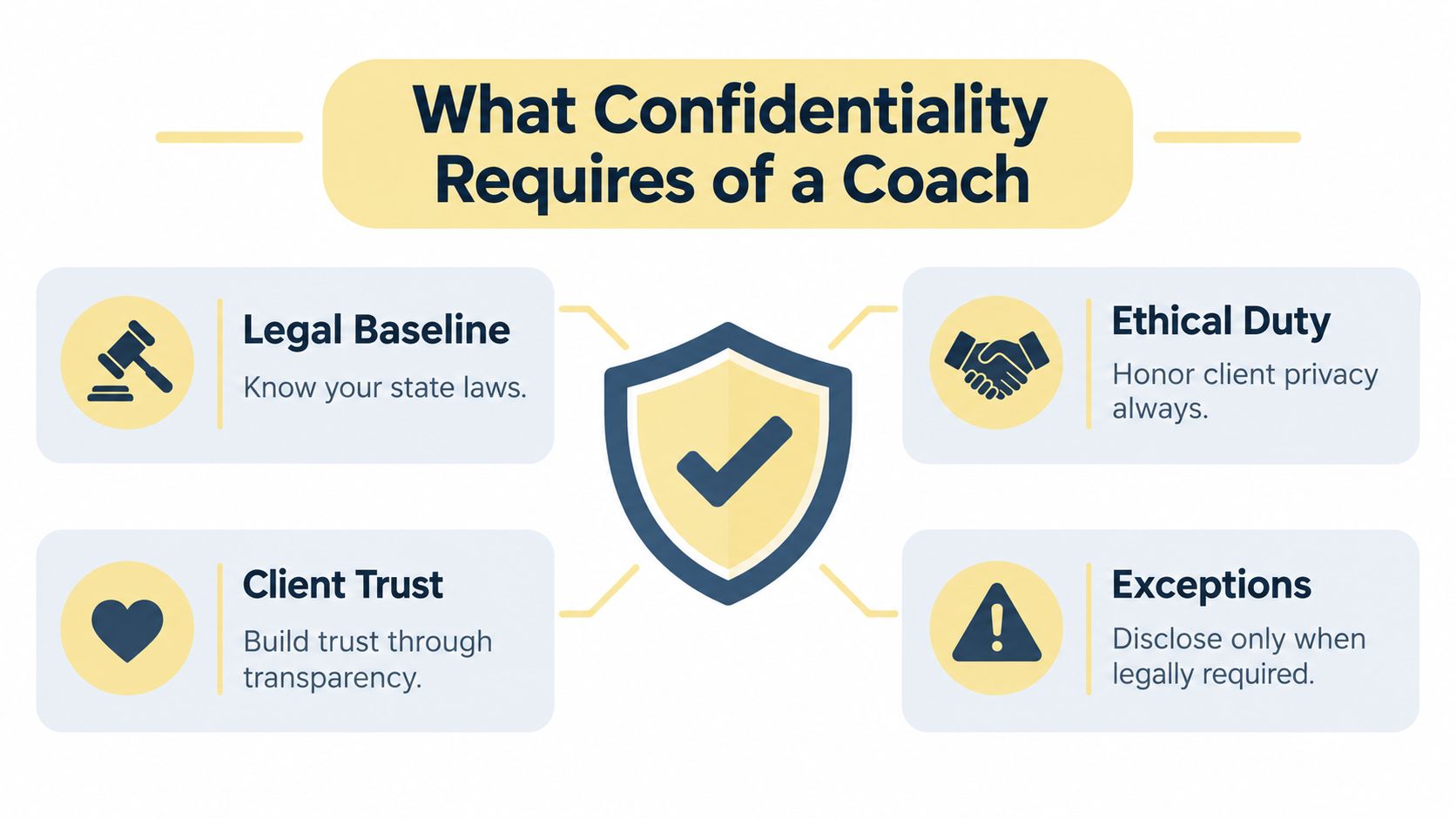
A coach does not need a law degree to handle confidentiality well, but the baseline has to be clear. The ICF defines it as protecting information gathered in or around the coaching relationship unless the client gives written consent, a legal requirement applies, or there is a threat of harm (ICF Code of Ethics). That makes the promise real, and it also makes the limits part of the promise.
Start with the exceptions, not the fantasy version
A clean agreement names the exceptions before anyone needs them. Illegal activity, a court order or subpoena, and imminent danger to the client or others are the boundaries that keep confidentiality honest. If you wait until something goes wrong, the client may already assume the promise had no limits.
The same exceptions the ICF names should also shape your day-to-day practice. A sponsor may ask for more detail than your role allows. A client may want you to keep something private while also sharing it with a manager. If the client says, “Can you confirm whether I'm attending?” that is a simple disclosure decision. If a court order arrives, the question changes completely.
A legal demand also needs a calm response, not a scramble. Check exactly what is being requested, disclose only what the demand requires, and document what you did. If the scope is unclear, get legal advice before you release anything. That is how a solo coach protects the client without pretending every request has the same meaning.
Privacy law turns this into business discipline
The GDPR matters because confidentiality failures are not abstract. In its 2024 report on GDPR implementation, the European Commission said data-protection authorities had imposed more than 6,680 fines totaling approximately EUR 4.2 billion, which shows that privacy failures are enforced, not merely discussed (European Commission report). For a coaching practice, that matters even when the practice is small, because sensitive client data can include identity details, contact data, payment records, session notes, goals, workplace concerns, and messages.
The practical floor is straightforward. Do not promise total secrecy. Explain the limits. Protect the data. Keep only what you need. If a client shares something vulnerable, your system should be able to hold it without relying on luck.
Drafting the Confidentiality Agreement and Consent Form
The clearest agreement is usually written before the client feels exposed and before you have to answer a hard question on the spot. Good drafting sounds calm. It is specific enough to guide practice, and plain enough that a client can read it without guessing what you meant.
The clauses that actually matter
Start with a definition of confidential information. A useful version might say, “Confidential information includes session content, notes, messages, goals, assessments, recordings, and any other identifying material connected to the coaching relationship.” That gives both sides a shared map, instead of leaving the coach to improvise later.
The exceptions you named in the previous section are exactly what your agreement must translate into plain language. The point is not to repeat ethical language word for word. The point is to make the limits legible before anyone is under pressure.
If you work with sponsors, put that boundary in writing too. Spell out what the sponsor may receive, such as attendance, agreed milestones, or summary progress updates, and keep the client's private disclosures separate unless the client gives written consent. That separation matters because a sponsor relationship can expand unless the document holds the line.
If you want a drafting starting point, this coaching contract templates resource can help you organize the clauses. For a legal perspective on confidentiality and nondisclosure wording, Coto & Waddington NDA legal guidance is a useful outside reference to compare against your own language.
Practical rule: the agreement should let a sponsor see the shape of progress, not the client's inner life.
What to ask for in writing
A consent form does not need to be long. It needs to answer the questions a cautious client is already asking: Who sees this, how is it used, and when does it go away?
Include consent for recordings, consent for any AI-assisted tools, consent for sponsor reporting boundaries, the retention period, and the deletion promise. If you cannot explain where the data lives and when it is deleted, the form is not finished yet.
Use your form to make the process concrete. A client should be able to tell, in a few lines, what they are agreeing to and what they are not. That is especially important when a solo coach is handling everything without a separate operations team to clean up ambiguity later.
Here is a simple checklist to test a draft:
- Defined scope: say what counts as confidential information in your practice.
- Named exceptions: state the legal and safety exceptions in straightforward language.
- Sponsor boundary: specify what can and cannot be shared with sponsors.
- Written consent: separate consent for recording, transcription, and AI-assisted processing.
- Retention and deletion: explain how long records are kept and how they are deleted.
- Access control: state who can see notes, recordings, and messages.
If the client can read the form and understand the lines, you have done them a favor. If the form tries to cover every scenario by staying vague, it does not really protect anyone when a real question arrives.
Data Handling, Record-Keeping, and Platform Security
Confidentiality lives or dies in the ordinary places. Session notes, texts, shared folders, recordings, exports, and old drafts are where coaches accidentally leak what they meant to protect. The EU's Article 32 says technical safeguards should include pseudonymization and encryption, ongoing confidentiality, integrity, availability, resilience, timely restoration after incidents, and regular testing, with the exact level depending on risk and context (GDPR Article 32).
What “secure enough” looks like in practice
A coach doesn't need enterprise theatrics. A coach does need a baseline that can be explained and verified. That means encryption in transit and at rest, least-privilege access, strong admin authentication, separate access for teams and cohorts, immutable logs showing who opened or exported records, tested backups, and periodic access reviews.
The logic is straightforward. Broad shared permissions create more disclosure paths. Narrow permissions reduce exposure and make investigations possible if something goes wrong. If someone leaves your practice, access should be revoked promptly, not “when you get around to it.”
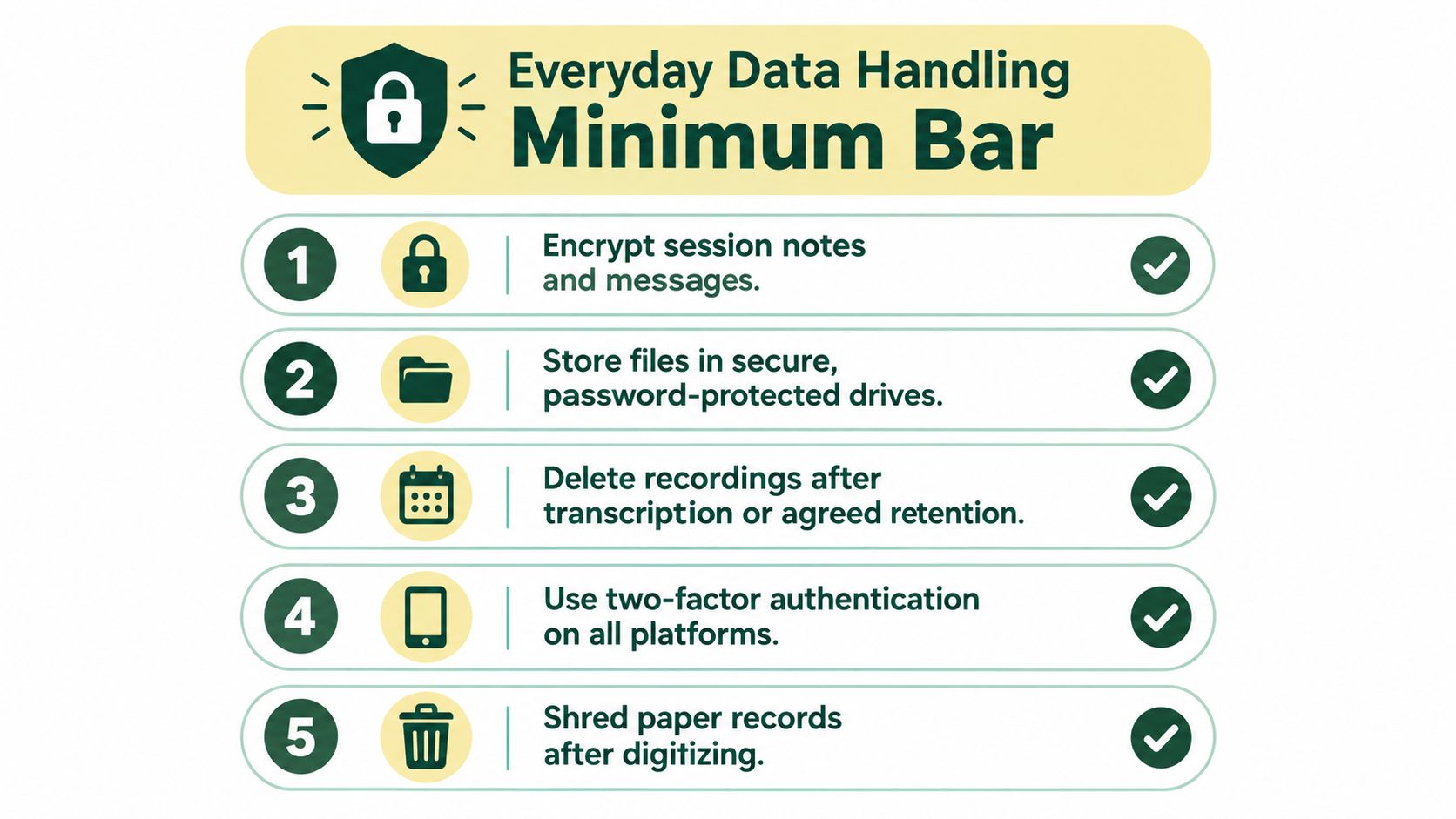
A few everyday habits matter more than people think:
- Encrypt session notes and messages: Treat notes as sensitive records, not casual drafts.
- Use password-protected storage: Keep files in secure drives, not on a scattered desktop.
- Delete recordings on schedule: Don't keep audio “just in case” if retention has expired.
- Review access regularly: Check who can open client data before old permissions become invisible.
- Destroy paper securely: Shred paper notes after digitizing or when retention ends.
Platform choice is part of confidentiality
A coaching workspace that separates factual administration, like dates and attendance, from sensitive narrative notes is more defensible than a shared inbox plus a notes app. The difference shows up the moment someone needs to revoke access to one client without exposing everyone else's data. That's the practical test.
If you want a concrete example of how a platform can help structure this kind of control, how protects data is worth reading alongside your own vendor checklist. The questions you ask should be blunt: Where is the data stored? Who can access it? Can you delete it? What happens if a contractor leaves? Does the platform support role-based permissions and separate client-level access?
Coachful is one platform that offers role-based access and client-data deletion, so it fits into this conversation as one operational option among others. If you're comparing systems, use the data retention policies guide to pressure-test how long your records should stay live and how they should come out of the system at the end.
If a platform can't explain its access model in plain English, it's not ready for sensitive coaching work.
Using AI Tools Without Breaking Confidentiality
The dangerous myth is that removing a name makes a transcript safe. It doesn't. A client's occupation, goals, dates, unusual circumstances, and personal history can still make them identifiable even if you strip out obvious labels. A 2025 study of coaches who actively use generative AI treated confidentiality, transparency, client opt-out rights, bias, and accountability as distinct ethical concerns, which is exactly the right way to think about it (study on generative AI and coaching ethics).
Use a tiered decision rule
Don't ask, “Can I use AI for this?” Ask, “What kind of data is this?” The practical answer is a three-tier rule.
- Prohibited data: Anything you would never want stored, repurposed, or exposed outside the coaching relationship. This includes sensitive session details and anything that could readily identify the client.
- Consent-required data: Material that could be used only if the client has clearly agreed to that use, in writing, with a full understanding of where it goes.
- Low-risk administrative data: Scheduling language, generic task reminders, or non-sensitive internal drafting that doesn't reveal the client's private material.
That framework is more useful than blanket advice to “be careful.” It forces a choice.
Before you paste anything into an AI tool, ask the vendor questions that matter. Where is the data stored? How long is it retained? Is it used to train models? Can you delete it on request? Those questions matter because guidance for professional services warns that organizations need to know what the vendor collects, where the data lives, how long it remains there, and whether it feeds model training.
The coach's inner objections, answered plainly
Can you summarize a session with AI and share the summary? Only if the material is in the right tier and the client has consented to that use. Is a recorded session ever safe to upload? Not by default. If the recording contains identifiable client material, treat it as sensitive and assume the risk until your process says otherwise. Does onboarding consent cover future model training? Not unless it says so explicitly.
If AI is used at all, the sequence should be disclosure first, consent second, narrow data third. The client should know what kind of tool is being used, what it might store, and what part of the interaction is going into it. That's why a disclosure line like this works better than vague reassurance: I may use approved AI tools only for low-risk administrative tasks, and I won't input identifying or sensitive client content without your written consent.
For a practical drafting reference on client-facing consent language around notes and AI use, this AI coaching session notes and client consent resource is useful. Keep it simple enough that you'd be comfortable reading it aloud to a client without speeding up.
Your First 72 Hours After a Confidentiality Incident
A confidentiality incident is not only a legal problem, it's a trust event. Maybe you sent a progress update to the wrong person. Maybe a laptop was lost. Maybe a shared folder was exposed or an account was compromised. The Information Commissioner's Office says a notifiable personal-data breach under UK GDPR must be reported without undue delay and, where feasible, no later than 72 hours after awareness, unless the breach is unlikely to create a risk to rights and freedoms (ICO breach guidance).
What to do first
Start with containment. Stop further access, change credentials if needed, and lock down whatever system was exposed. Then preserve evidence, because you'll need to know what happened before you can explain it to anyone else.
After that, identify whose data was exposed. Was it one client or several? Was the content administrative, narrative, or both? Contact the platform or processor if the incident involved a third-party system, and document the timing as carefully as you can. The clock matters, but so does clarity.
A clean incident log should record:
- Discovery time: When you first became aware of the issue.
- Exposure scope: What data was visible, sent, lost, or accessed.
- Affected people: Whose information may have been involved.
- Containment steps: What you did to stop further exposure.
- Notification decision: Whether you're reporting, escalating, or both.
Don't outsource responsibility
A coach is often the data controller, while a software provider is the processor, but that doesn't mean the provider owns the problem. It just means you may need their help to contain it and understand what happened. Legal deadlines vary by jurisdiction, so if the situation is serious, get jurisdiction-specific advice quickly instead of guessing.
The client communication should be honest and short. Say what you know, what you don't know yet, what you've done to contain it, and when you'll update them again. Don't speculate, don't minimize, and don't hide behind the word “technical.”
Practical rule: contain first, document second, explain third.
The coach who keeps a ready incident template sleeps better. The coach who assumes they'll “figure it out if it ever happens” usually loses the first hour to panic, and that's the hour that matters most.
Making Confidentiality a Sustainable Daily Habit
Confidentiality gets easier when it becomes repetitive. Once a quarter, check the agreement template, the platform access list, the retention clock, the AI settings, and the incident log. Those five reviews catch most of the avoidable drift.
The quiet habits matter just as much. Don't take notes on a personal device if you can avoid it. Don't discuss a hard case with a peer unless you've de-identified it properly. Don't keep recordings because you might want them later if the client has already expected deletion.
Confidentiality doesn't make you invulnerable. It gives your practice a structure that can survive the inevitable close call, which is what clients are really buying when they trust you with their story.
If you want a coaching workspace that helps you manage onboarding, permissions, session notes, and client data in one place, take a look at Coachful. It's built to support the practical side of confidentiality with clients, especially when you need clearer boundaries, cleaner records, and less admin drift.