
Coaching Contract Templates That Protect Your Business

Coachful

You've probably had this moment already.
A new client says yes. You're excited, a little relieved, and already thinking about the work ahead. Then a quieter thought shows up. What if they assume text access means unlimited support? What if they miss sessions and expect makeups forever? What if they stop paying, ask for a refund halfway through, or start treating coaching like therapy?
That tension is usually the point where newer coaches realize a warm email thread and a verbal agreement aren't enough. Not because clients are bad. Most aren't. It's because unclear expectations create friction even in good relationships, and coaching asks people to step into vulnerable territory. When the container is fuzzy, people fill in the blanks with their own assumptions.
A strong contract fixes that. It doesn't make the relationship colder. It makes it safer.
The best coaching contract templates do two jobs at once. They protect your business, and they calm the client's nervous system. They tell your client, “Here's how this works. Here's what I'll do. Here's what I won't do. Here's how we'll handle money, boundaries, privacy, and endings.” That kind of clarity builds trust faster than charm ever will.
If you're still thinking, “I don't want to scare people off with a legal document,” I'd challenge that gently. Serious clients usually feel more confident when they see that you run a real practice. A contract isn't a sign of mistrust. It's a sign that you care enough to be clear.
More Than a Handshake The Power of a Professional Contract
A coach I know started with what many coaches start with. A discovery call, a yes, an invoice, and a friendly message saying, “I'm so excited to work together.” It felt human. It felt easy. It also left a lot unsaid.
By the third session, the client was sending long voice notes late at night and expecting detailed feedback the next morning. When the coach tried to reset the boundary, the client felt blindsided. From the client's perspective, they had bought support. From the coach's perspective, they had sold sessions. Neither person was malicious. The problem was the gap between what was said and what was assumed.
That's what a contract closes.

Why clarity creates trust
Clients don't just buy your insight. They buy your process. They want to know what happens next, how long the engagement lasts, what support is included, and what happens if life gets messy. A professional contract answers those questions before confusion has a chance to grow.
That matters psychologically. Coaching works best when the client isn't wondering whether they're asking for too much, whether they can cancel, or whether what they share will stay private. Clear agreements reduce that background noise.
A contract is the first boundary you set together. Done well, it feels less like a warning and more like a steady hand on the doorframe.
There's also a maturity shift that happens when you start using proper coaching contract templates. You stop selling “time with me” and start leading a professional engagement. That changes how clients show up. They tend to take the work more seriously when the structure is visible from the start.
The contract as a relational tool
A lot of coaches treat the contract like paperwork to rush through. That's a mistake. The conversation around the contract is often the first real moment of alignment.
Use it to talk through things like:
- Communication boundaries: Are clients emailing between sessions for scheduling, brief updates, or full coaching support?
- Ownership of the work: Is the client responsible for action, reflection, and follow-through?
- How progress is judged: Are you measuring by completed actions, self-reported shifts, milestone reviews, or sponsor feedback in organizational work?
- What coaching is not: Are you clearly distinguishing coaching from therapy, consulting, or medical care?
When you explain these points calmly, clients usually relax. They can feel the structure holding them.
A handshake says, “We trust each other.” A professional contract says, “We trust each other enough to be clear.”
The Anatomy of a Bulletproof Coaching Contract
Most coaches don't need a monster legal document. They need a clean, readable agreement addressing the relationship properly. A standard coaching contract template for independent coaches typically includes 14 essential clauses and, for most 1:1 and small-group engagements, the ideal agreement length is two to four pages, according to the verified industry-standard framework summarized above. Those clauses cover parties and effective date, services description and program duration, fees and payment terms, cancellation and rescheduling, confidentiality, intellectual property, limitation of liability, non-medical scope disclaimer, termination, pause or break policy, media consent and testimonial rights, governing law, dispute resolution, and entire-agreement clauses with signature blocks.
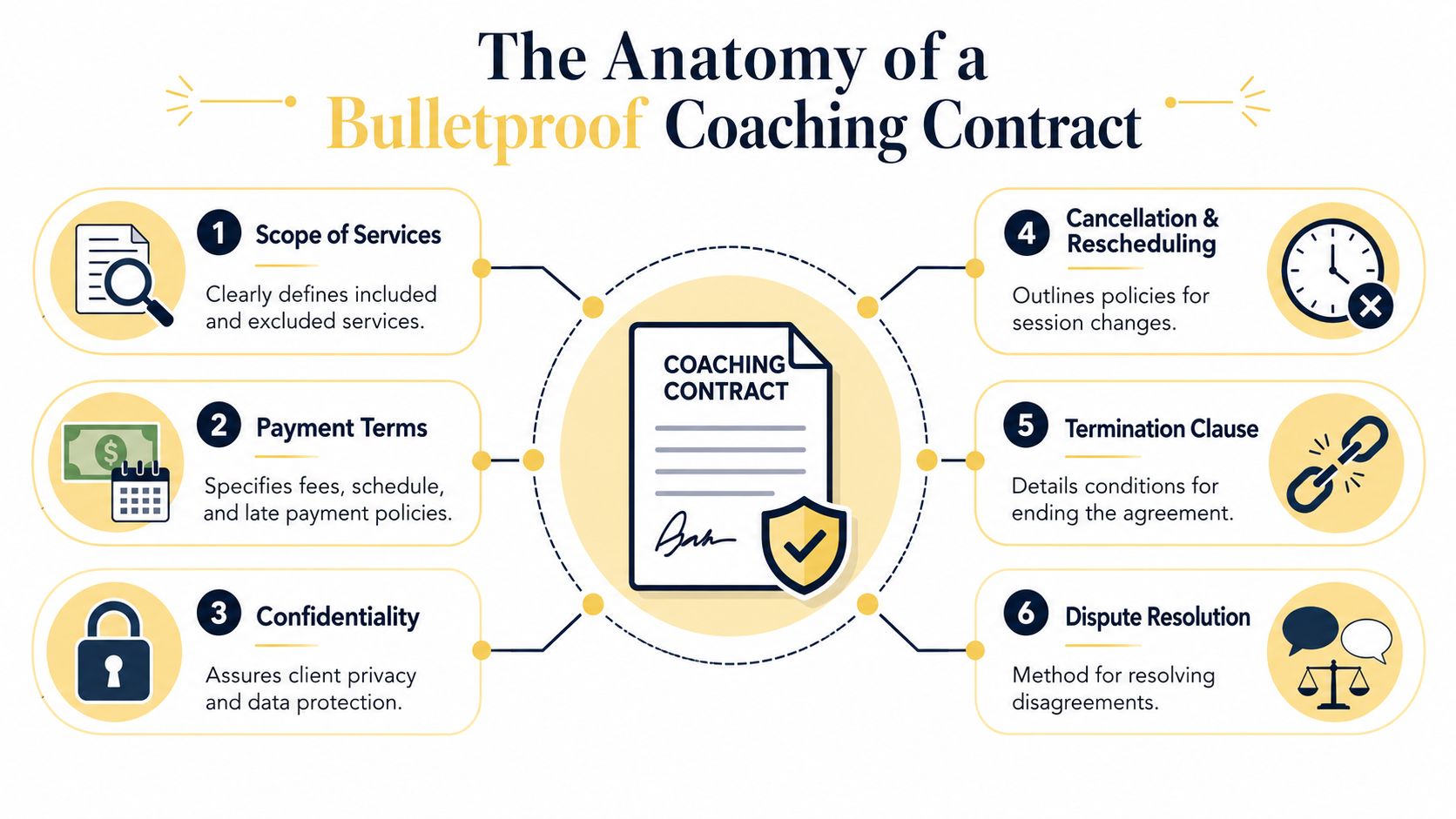
The foundation clauses
These are the clauses that tell both parties what the engagement is.
- Parties and effective date: This identifies who is entering the agreement and when it starts. That sounds basic until you work with a sponsored client inside a company and need to distinguish the coachee from the paying organization.
- Services description and program duration: Here, you define the number of sessions, session length, format such as Zoom, in-person, or async, and the program end date. If this section is vague, the whole contract wobbles.
- Roles and responsibilities: The client owns the agenda, choices, and actions. The coach holds the process. That distinction keeps you out of over-functioning and keeps the client in responsibility.
- Measures of progress: If success is never defined, disappointment becomes subjective and hard to resolve.
Practical rule: If a client can read your services section and still ask, “Wait, what exactly do I get?”, your scope language isn't finished.
If you want a starting point instead of drafting from scratch, a coaching contract generator can help you build the structure faster. The key is not just generating a document, but editing it so it reflects how you work.
The rules of engagement
This category handles the operational friction points that derail otherwise good relationships.
| Clause | What it prevents |
|---|---|
| Fees and payment terms | Awkward money disputes, delayed payments, confusion about installment timing |
| Cancellation and rescheduling | Endless makeups, last-minute no-shows, resentment on both sides |
| Pause or break policy | Unclear expectations when a client wants to stop and restart later |
| Termination | Messy endings and uncertainty about how either side can exit |
Payment language needs to be specific. Include payment schedules, accepted methods, and refund policies. Don't leave “we'll sort it out if needed” hanging in the air. That's exactly where conflict starts.
This is also where business reality matters. If your coaching income is meaningful, contracts and finances need to work together. Coaches who are growing quickly often benefit from a broader business view, including resources like this tax guide for high-earning professionals, because messy admin rarely stays confined to one area.
The protection clauses
These are the clauses many coaches skim past, then later wish they had taken seriously.
Most underestimated clause: Intellectual property matters the moment you share proprietary worksheets, frameworks, assessments, recordings, or program materials. Without that clause, clients can assume broad usage rights you never intended to grant.
- Confidentiality: Explain what stays private and where limits apply.
- Intellectual property: Clarify what you own and what the client may use.
- Limitation of liability: This is part of your legal defense structure.
- Non-medical scope disclaimer: This must be explicit, not buried.
- Media consent and testimonial rights: If you want to use client results, testimonials, or before-and-after stories in marketing, you need permission in writing.
- Governing law and dispute resolution: Decide in advance how disagreements are handled.
- Entire agreement and signature blocks: This closes the loophole of “but I thought your email promised something else.”
The coaches who feel most confident with contracts usually aren't the most legalistic. They're the most precise.
Tailoring Your Contract for Any Coaching Niche
A template should save you time, not flatten your work. The mistake is thinking the document is either generic or custom, as if those are opposites. In practice, the smartest coaching contract templates have a stable core and a niche-specific middle.
The core stays mostly the same. The customization happens in scope, disclaimers, confidentiality, and deliverables.
Business coaching needs operational precision
Business coaches often work around sensitive information. Revenue plans, hiring issues, internal team conflict, pricing strategy, and IP all show up in conversation. That means your confidentiality language should reflect the fact that you may hear proprietary company information.
Your services section also needs to describe deliverables precisely. A verified example of strong specificity is this kind of wording: “12 biweekly 60-minute sessions, access to a proprietary assessment toolkit, and one 2-hour in-person intensive workshop” as noted in this guidance on must-have coaching contract clauses.
That level of detail prevents the quiet client thought of, “I assumed Slack support was included,” or “I thought the workshop covered my whole team.”
Health and wellness coaching needs sharper boundaries
If you're a health coach, wellness coach, or anyone adjacent to behavior change around stress, sleep, nutrition, or habits, your wording has to work harder. Clients may arrive with medical expectations even if you never intended to create them.
Add language that clearly states coaching does not replace medical care, therapy, diagnosis, or treatment. Also define what clients should do if health concerns arise. In practice, this protects both sides. It prevents the client from leaning on coaching for something it can't responsibly provide.
A similar pattern shows up in other service businesses where role boundaries matter. This essential guide for gym owners is a useful reminder that service agreements work best when they define who is responsible for what, instead of assuming everyone interprets the relationship the same way.
Life coaching needs relational boundaries
Life coaching contracts often get too airy. The coach writes beautiful language about transformation and forgets to define mechanics.
Use plain wording like this in the services section:
- Session structure: State frequency, duration, and format.
- Between-session contact: Clarify whether messages are for logistics only or brief coaching support.
- Client responsibility: State that the client remains responsible for decisions, actions, and results.
- Excluded services: Name what isn't included.
If you want examples of niche positioning and service packaging before you revise your agreement, this collection of templates for coaches can help you think through how your offer is framed.
A good niche adaptation doesn't make the contract longer for the sake of it. It makes the right sections more precise.
Common Contract Mistakes That Can Derail Your Business
Some contract mistakes are annoying. One creates real legal exposure. It's the non-medical, non-therapeutic scope disclaimer, and too many coaches either skip it, bury it, or write it so vaguely that it won't help when they need it.
That's not a minor drafting issue. The verified guidance is blunt: the most critically underserved angle in coaching contract content is the handling of this clause, and 2026 legal analyses indicate that without a precise, jurisdiction-specific disclaimer, coaches lose liability protection, as described in this analysis of coaching contract risks.
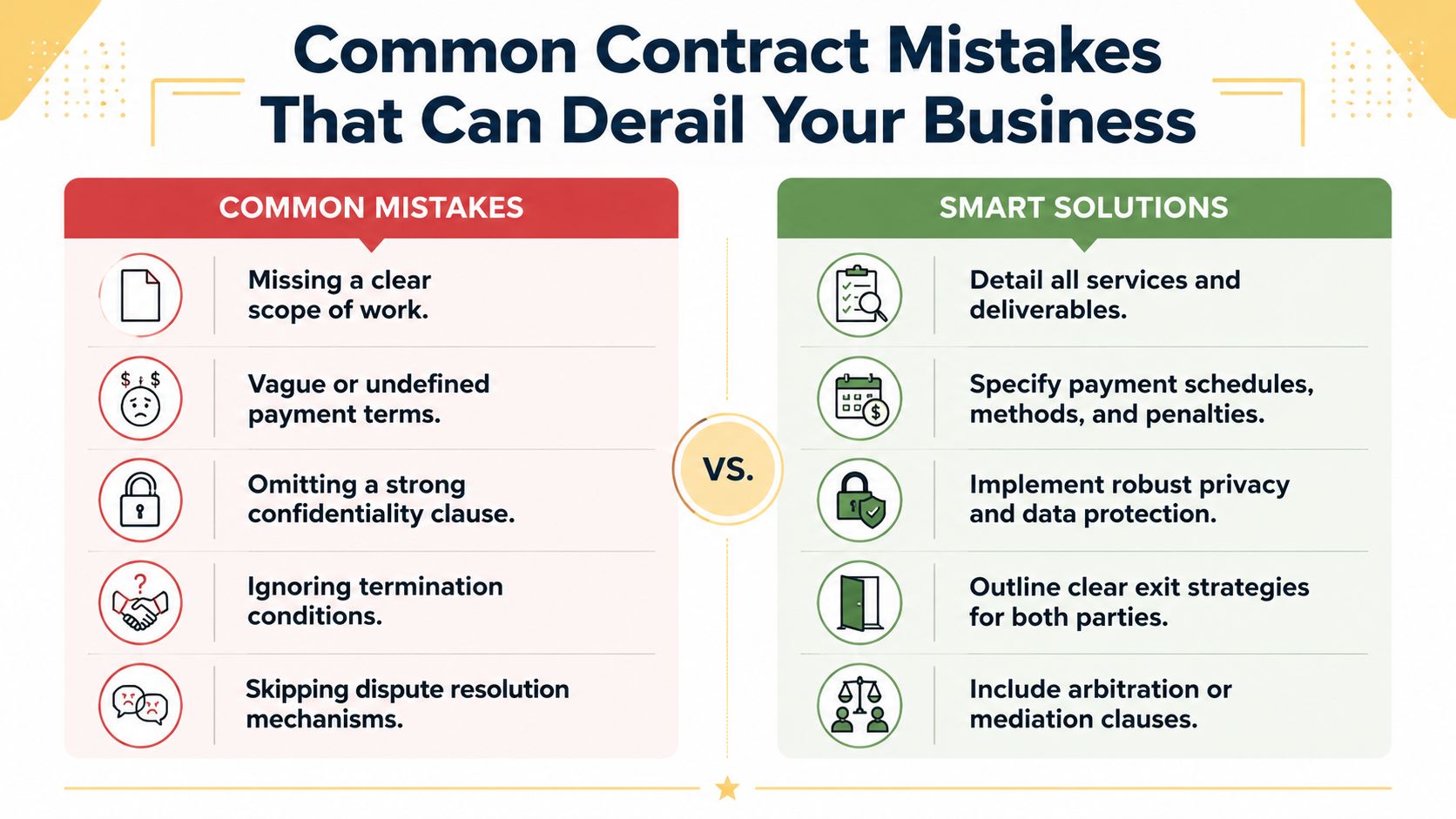
The clause coaches keep getting wrong
Many free templates use soft language like “coaching is for educational purposes only” and leave it there. That's not enough in higher-risk niches. If your work touches health, mindset, trauma-adjacent experiences, burnout, or emotionally charged decision-making, sloppy wording can invite the exact misunderstanding you're trying to avoid.
The issue isn't whether you see yourself as a therapist. The issue is whether a regulator, court, or unhappy client could argue that your services functioned like therapy, medical advice, or another regulated service.
If your disclaimer is vague, hidden, or copied from a template that doesn't fit your jurisdiction, you're borrowing confidence from words that may not protect you.
That's why this clause deserves human review. Not panic. Review.
Other expensive mistakes
The second trap is treating refunds casually. A clear no-refund policy is often one of the most important parts of the contract, especially when your offer is sold as a package. If a client leaves early, vague refund terms invite negotiation after the relationship is already strained.
The third trap is skipping client warranties about readiness for coaching. Verified guidance recommends requiring clients to confirm that they are mentally and emotionally fit to participate, are not currently undergoing therapy or medical treatment that conflicts with coaching, and will behave respectfully and provide accurate information, as outlined in this discussion of a life coaching contract template.
That language can feel uncomfortable to add. Add it anyway.
What smarter contracts do instead
A stronger agreement usually includes the following:
- A visible scope disclaimer: Put it where a client will read it. Don't hide it in dense boilerplate.
- A firm refund position: State what happens if the client leaves early, pauses, or stops engaging.
- Readiness language: Require the client to confirm that coaching is appropriate for them.
- Specific conduct expectations: Respectful behavior, honesty, and timely communication should be stated, not assumed.
- An exit path: If the relationship stops being a fit, the contract should show how it ends.
Here's the trade-off. The softer and fuzzier your contract feels at the start, the harder and more relationally costly the conversation becomes later. Coaches often avoid precision because they want to sound warm. In reality, precision is what preserves warmth when stress hits.
From Draft to Done Your Professional Onboarding Workflow
A contract that lives in your downloads folder isn't doing anything for you. The ultimate test is whether you can move a client from yes to signed agreement without awkwardness, delay, or admin sprawl.
The cleanest onboarding flows feel calm on the client side and repeatable on yours. You're not reinventing the process for every new engagement. You're guiding the client through the same professional sequence each time.
A simple flow that feels professional
A practical contract workflow usually looks like this:
Confirm fit on the call Clarify goals, scope, timeline, and whether coaching is the right service.
Send the proposal and agreement promptly
Don't let verbal momentum cool off while you “get around to paperwork.”Walk the client through key clauses
Highlight scope, payment, communication boundaries, cancellation, and termination. This keeps the contract relational, not transactional.Collect signature before the first session
Coaching shouldn't begin while terms are still fuzzy.Store the signed document where you can find it
Fast retrieval matters when you need to check what was agreed.
A useful benchmark here comes from the International Coaching Federation. According to ICF Competency 3, a coaching agreement should include at least eight core elements, including clear definitions of roles, confidentiality, fees, and termination policies, and the ICF provides a sample agreement that covers those baseline clauses.
How to present the contract without sounding defensive
The tone matters. Don't send the contract with a nervous apology like, “Sorry, I know this is formal.” That frames the agreement as an obstacle.
Try a steadier approach. “I'm sending over the agreement we'll use for our work together. It lays out scope, logistics, boundaries, and how we'll handle the practical side so we can focus on the coaching.”
That wording tells the truth. The contract exists to remove friction.
Onboarding habit: Review the key terms out loud at least once. Clients rarely object to clarity. They object to surprises.
If you're tightening your process overall, a practical client onboarding checklist template can help you make sure the contract, intake, scheduling, payments, and welcome communication all happen in the right order.
Managing renewals and amendments cleanly
The original agreement won't cover every future scenario. Clients extend packages, switch formats, pause work, or move from individual coaching into a team engagement. When that happens, don't rely on a casual email thread to modify key terms.
Use a short amendment or renewal document that references the original agreement and states what changed. Usually that means updated dates, session counts, fees, or support channels. The point isn't to create more paperwork. It's to preserve one clean source of truth.
A visual walkthrough helps if you want to see what a more polished client experience can look like in practice.
Good onboarding communicates something important before the first coaching session even starts. It tells the client they're in capable hands.
Your Next Step Toward a More Secure Coaching Practice
A contract isn't the opposite of trust. It's one of the clearest ways to create it.
When your agreement is well written, clients know where they stand. They know what they're buying, what support is included, how privacy works, what happens if something changes, and where coaching begins and ends. That doesn't make the relationship rigid. It makes it usable. People can relax when the edges are clear.
This is also one of the fastest ways to grow up as a practice owner. Not because a document makes you more talented, but because it forces precision. You define your offer more clearly. You communicate boundaries earlier. You stop relying on goodwill to carry structural ambiguity.
If you're newer, start with a proven template and customize it carefully. If you're established, review your current agreement with fresh eyes. Look for the places where your contract is still speaking in generalities while your work has become more specialized. That gap is where misunderstandings usually begin.
The strongest coaching contract templates don't just protect against worst-case scenarios. They support better coaching in ordinary, everyday moments. They help the client commit. They help you lead. They make the relationship easier to hold with confidence.
Your next move is simple. Put one solid agreement into active use. Refine the scope. Strengthen the boundaries. Make the wording sound like your real practice, not borrowed internet language. Then use it with every client, every time.
Coachful brings the practical side of coaching into one place, so contracts, onboarding, scheduling, payments, notes, and client progress don't live across scattered tools. If you want a cleaner, more professional client experience from first signature to final session, Coachful is worth a look.