
Stress Management Coaching: How It Works and Costs
Stress management coaching is practical, goal-focused support for people whose stress is real but manageable: a coach helps you find what is driving it, change the parts you can control, such as workload, boundaries, sleep, recovery time and difficult conversations, and build habits that hold up in a busy week. It is not treatment for an anxiety disorder, depression or trauma. If stress has turned into constant worry, panic or a low mood that will not lift, a clinician is the right first call.
Most people who search for stress management coaching already know the standard advice: sleep more, breathe, exercise, say no. The problem is doing it in a life that has not changed. That is where coaching earns its keep. This guide covers how to tell stress from anxiety and burnout, what a coach works on, what a few sessions look like, what the research found, what it costs and how to choose a coach.
Stress, anxiety, burnout or depression? Name it first
These overlap, and the right kind of help depends on which one you are dealing with.
| What it is | Who usually helps | |
|---|---|---|
| Stress | A response to an outside pressure, such as a deadline, a move or a sick parent, that tends to ease once the cause is resolved | You, your people, a coach |
| Anxiety | The body's reaction to stress that can continue even when there is no current threat | A coach for mild, situational worry; a clinician when it is persistent or disruptive |
| Burnout | A syndrome from chronic workplace stress that has not been managed: exhaustion, distance or cynicism about the job, and feeling less effective | A coach, your employer, sometimes a doctor to rule out other causes |
| Depression | A medical condition with persistent low mood or loss of interest, and changes in sleep, energy and thinking | A doctor or therapist first |
The stress and anxiety descriptions come from the National Institute of Mental Health's fact sheet "I'm So Stressed Out!". The burnout description follows the World Health Organization's ICD-11, which treats burnout as an occupational phenomenon rather than a medical condition (summarized on Wikipedia). If burnout is your main concern, our guide to burnout coaching goes deeper.
See a licensed professional when...
- Stress feels unmanageable, your symptoms are getting in the way of daily life, you are avoiding things you need to do, or your usual ways of coping are not working. Those are the signs NIMH gives for reaching out to a health care provider.
- You have panic attacks, constant worry you cannot switch off, or a low mood that will not lift.
- You are using alcohol, drugs or food to get through the day.
- Physical symptoms are new or worrying: chest pain, persistent headaches, stomach problems or sleep that has collapsed. See a doctor.
- You have thoughts of harming yourself. In the US, call or text 988 to reach the 988 Suicide and Crisis Lifeline, any time.
What a stress management coach works on
A coach starts with your actual life, not a generic list of tips. The work usually lands on a few levers:
- The load itself. What is on your plate, what can be dropped, delegated or renegotiated, and how to ask for that at work.
- Boundaries. Email after 7pm, the colleague who books meetings over lunch, the relative who calls during work.
- Recovery. Breaks you will actually take, an evening routine, a weekend that is not catch-up.
- Sleep and movement. Small, specific changes, tracked, rather than a full lifestyle overhaul.
- Thinking patterns. Noticing the "if I don't answer now, everything collapses" thought, and testing it.
- Decisions. Sometimes the stress is a decision you have been avoiding, such as a job, a move or a role at home.
Some stress coaches also teach brief relaxation or mindfulness practices. Our guide to mindfulness coaching covers what that research shows.
What four sessions of stress management coaching can look like
| Session | Focus | Between sessions |
|---|---|---|
| 1 | Map the stressors: what, when, how often, and which you control | Track energy and stress for a week |
| 2 | Pick one lever, such as evening email or the Monday meeting load | Try one change; note what happens |
| 3 | Rehearse the hard conversation: the boundary with your manager, the ask at home | Have the conversation |
| 4 | Review, keep what worked, plan for the next stressful stretch | Maintain two habits for a month |
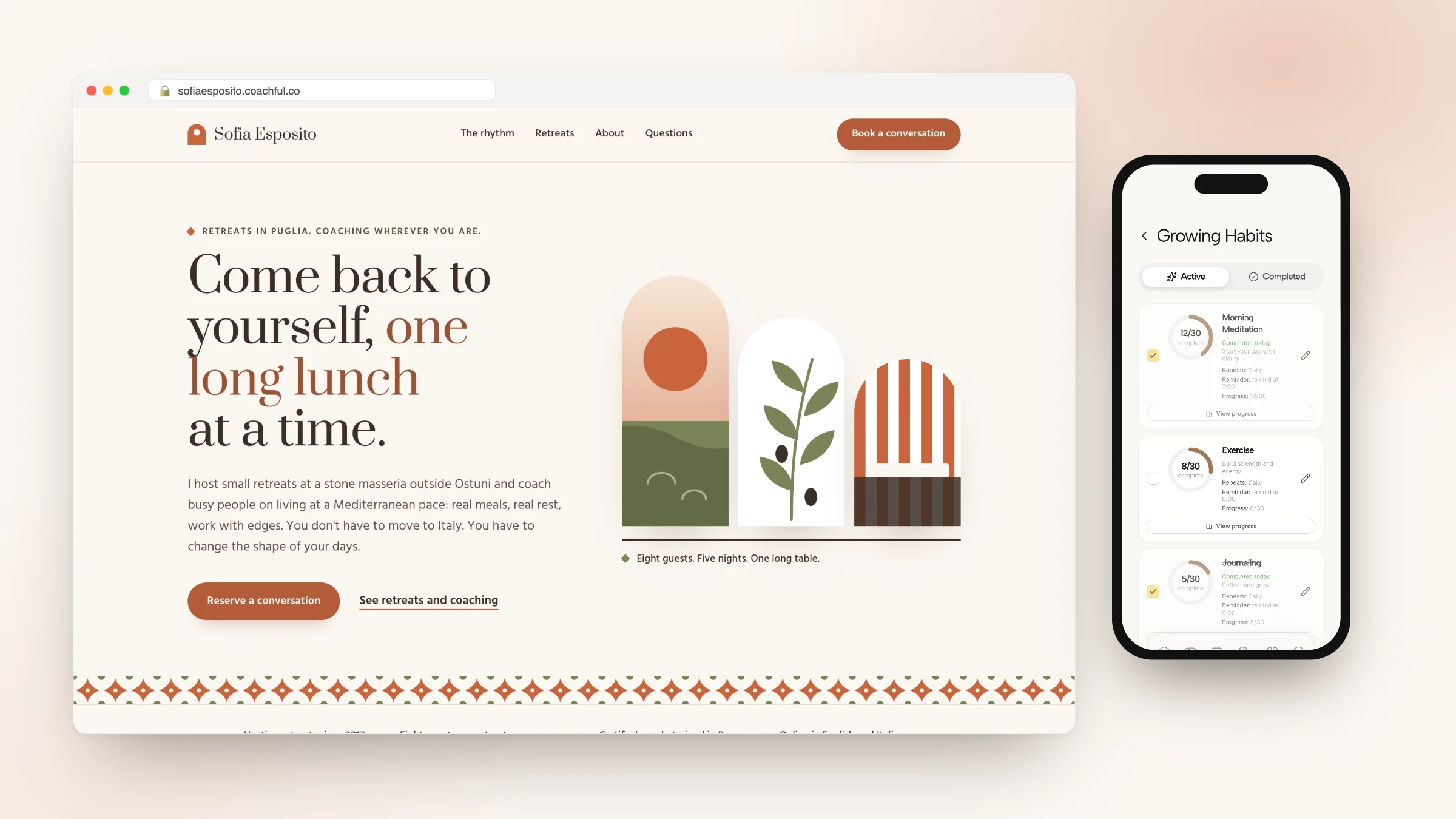
Real engagements are often longer, but the rhythm is the same: understand, change one thing, practice, review. Between sessions, small tracked habits keep the changes visible.

Daily check-ins help too. A morning question about the one thing that matters today and an evening one about how it went take a minute and show the pattern over weeks.

In Coachful's client app, a client's next session, the prep due and a short list of what to do next sit on one page, so the plan does not live only in the coach's head.

A dated goal makes progress measurable. "Leave work by 6pm four days a week for a month" is a test you can pass or fail.

What the research says
Stress is widespread. The American Psychological Association's 2025 Stress in America survey of more than 3,000 US adults found 69 percent felt they had needed more emotional support in the past year than they received, and 54 percent felt isolated at least some of the time (APA, Stress in America 2025). The evidence that coaching helps:
- A randomized study of coaching and stress. Grant, Curtayne and Burton (2009) randomly assigned 41 executives at a public health agency to coaching, which included 360-degree feedback, a half-day workshop and four coaching sessions over ten weeks, or to a control group. Compared with controls, the coached group improved goal attainment, resilience and workplace well-being and reported less depression and stress (Journal of Positive Psychology). The sample was small.
- Coaching improves well-being and coping on average. A meta-analysis by Theeboom, Beersma and van Vianen found significant positive effects on well-being, coping and other outcomes (Theeboom and colleagues). A 2023 meta-analysis found a medium positive effect of coaching overall (Frontiers in Psychology, 2023).
- Mindfulness has moderate evidence for anxiety and depression, less for stress itself. A review of 47 trials found moderate evidence that mindfulness meditation programs improve anxiety, depression and pain, and low evidence for stress (Goyal and colleagues, 2014).
Most coaching studies are workplace studies, often with self-reported outcomes. They support coaching for people under ordinary pressure who want to act on it. They do not support coaching as a substitute for treatment.
What stress management coaching costs
Stress management coaching is usually sold as health and wellness or life coaching. Coachful's 2026 Coaching Business Report, which compiles published research and practitioner reports for the second quarter of 2026, has these benchmarks:
| Format | Typical price | Category |
|---|---|---|
| One session | $75 to $200 | Health and wellness, and life coaching |
| Four-week reset | $400 to $800 | Health and wellness |
| Three months | $900 to $2,000 | Health and wellness, eight to ten sessions |
| Ongoing monthly | $300 to $700 a month | Health and wellness |
US dollars, Q2 2026. Hourly band from PayScale and practitioner reports; packages from practitioner reports. See coachingrates.com. Practitioner figures are estimates.
If work is the main source of the stress, ask whether your employer pays for coaching or runs an employee assistance program; the 2026 report notes that nearly six in ten coaching clients worldwide are sponsored by an employer. And if cost is the barrier, a chatbot can help you think things through, with limits we cover in can ChatGPT be my life coach.
How to choose a stress management coach
Credentials that mean something
- NBC-HWC. National Board Certified Health and Wellness Coaches complete an approved training program, log 50 coaching sessions and pass a board exam (NBHWC). Stress and lifestyle are core to that training.
- ICF credentials. The ACC, PCC and MCC show general coaching training and hundreds to thousands of logged hours (ICF credentialing).
- MBSR teacher training. If you want mindfulness-based stress reduction specifically, Brown University's Mindfulness Center offers a teacher certification pathway (Brown Mindfulness Center).
- A clinical license. Some stress coaches are also licensed therapists or nurses. Ask which role they are playing with you.
Questions to ask
- Who do you usually work with, and what kinds of stress?
- How do you tell when someone needs a therapist or doctor rather than coaching?
- What do sessions focus on: tools, habits, the situation itself, or all three?
- What happens between sessions?
- How will we know it is working?
Red flags
- Promises to cure anxiety, depression or burnout.
- Advice to stop medication or therapy.
- Only breathing exercises and affirmations, with no attention to the situation causing the stress.
- Selling supplements or devices as the solution.
- Pressure to buy a long package on the first call.

A clear coach's website tells you who they work with and how. This sample template, with a fictional burnout and recovery coach, names the clients (doctors, lawyers, founders and senior managers) and the approach in two lines.
Find a stress management coach on Coachful
Coachful's Find a Coach directory is public, and you can browse it without signing up. Search "stress", "burnout" or "resilience" to find coaches whose headline or bio mentions them, or start with the Health and Fitness, Mindset and Lifestyle categories. The Find My Coach quiz asks what you want to improve, where you are now, your preferred style, including a gentle, supportive option, and your monthly budget, then suggests coaches.
On each profile you will see the coach's background, credentials and method where they have added them, any programs and prices, and a calendar to book a discovery call or a form to send a message.

Are you a stress or wellness coach?
Read how to become a mental health coach for scope and training, and see what Coachful includes for health and wellness coaches: habits, check-ins, goals and notes in one client record. The team will build your website or program for you at no extra cost through the free white-glove service.
Frequently asked questions
What does a stress management coach do?
A stress management coach helps you identify what is driving your stress, change what you can control, such as workload, boundaries, sleep and recovery, and build habits that last. Sessions are usually weekly or every other week, with small changes tried and reviewed in between.
Is stress management coaching worth it?
For ordinary, situational stress, it can be. A randomized study found coaching reduced stress and depression and improved resilience in executives, and meta-analyses find coaching improves well-being and coping on average. For an anxiety disorder or depression, start with a clinician.
What is the difference between a stress coach and a therapist?
A therapist is licensed to diagnose and treat conditions such as anxiety disorders, depression and trauma. A stress coach works with people who are basically well on practical change in the present. If symptoms disrupt daily life or will not lift, see a therapist or doctor.
How much does a stress management coach cost?
Expect $75 to $200 a session, or $900 to $2,000 for a three-month program, based on health and wellness coaching figures in Coachful's 2026 Coaching Business Report. Some employers pay for coaching, so ask before you buy.
Can a coach help with burnout?
Often, yes. The World Health Organization describes burnout as the result of chronic workplace stress that has not been managed, which is the kind of problem coaching addresses: workload, boundaries, recovery and decisions about work. Get a medical check if exhaustion is severe or you also feel persistently low.
Is stress management coaching the same as mindfulness coaching?
Not quite. Mindfulness coaching centers on a meditation or awareness practice. Stress management coaching usually covers the situation as well: workload, boundaries, sleep and decisions. Many stress coaches teach a few brief mindfulness or relaxation techniques as one tool among several.
How many sessions of stress coaching do I need?
A focused block of four to six sessions is often enough to change a few habits and test them. People dealing with a long stretch of pressure, such as caregiving or a demanding job, often prefer two or three months of regular sessions.












